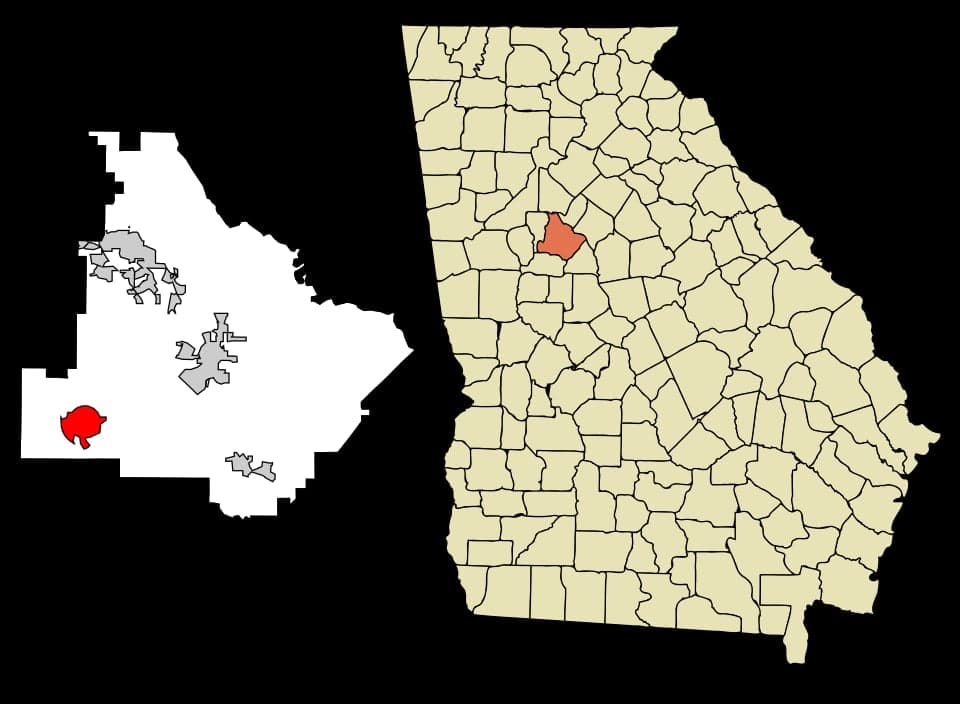
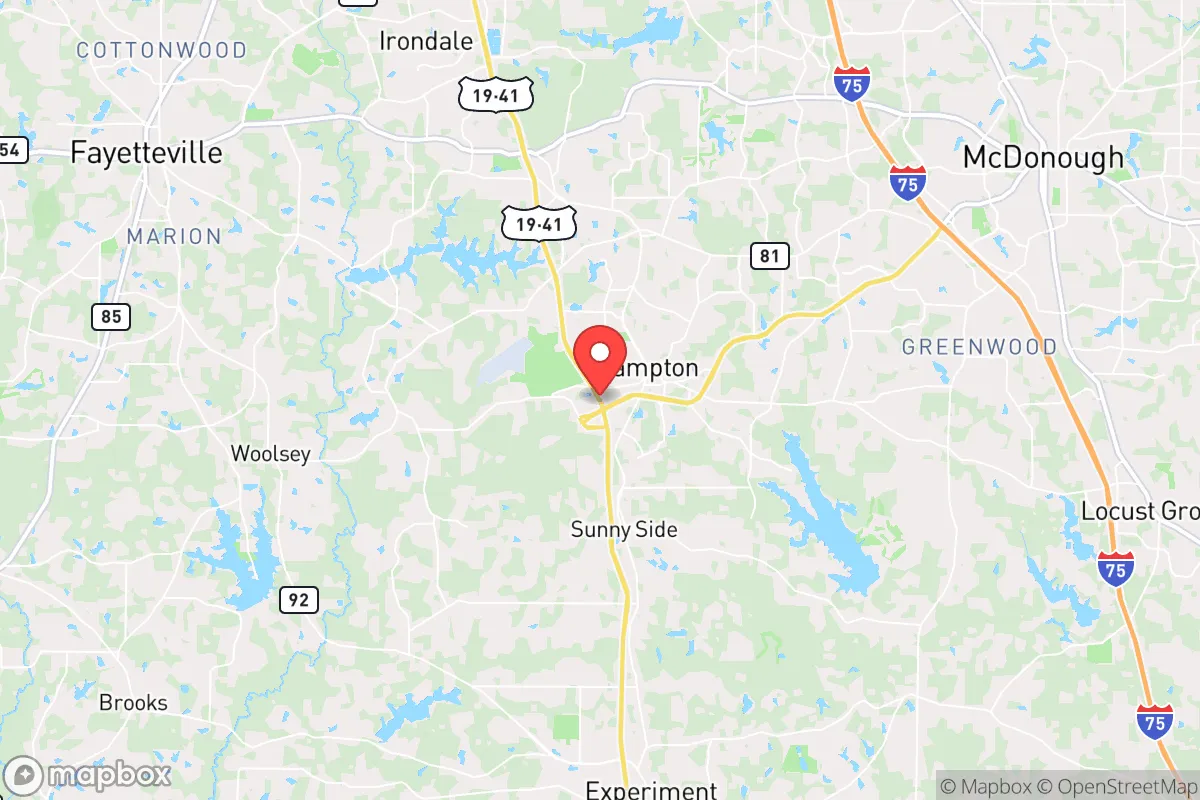
Photo: Wikipedia
Political ClimatePolitical Climate in Hampton, GA
District shown is the primary district for this city’s centroid. Cities may span multiple districts.
Local Political AnalysisPolitical Analysis of Hampton, GA
Hampton, Georgia, sits deep in the Republican column with a Cook Partisan Voting Index of R+15, making it one of the most reliably conservative communities in the Atlanta metro area. That number means the local electorate votes about 15 percentage points more Republican than the national average in presidential races, and it’s been that way for decades. But the political reality here isn’t static—Hampton is feeling the same suburban shift that’s reshaping much of Henry County, where Democratic gains in nearby Stockbridge and McDonough have slowly nudged the county from solid red to lean red over the past ten years. If you’ve lived here since the 1990s, you remember when every race was a foregone conclusion; now you see more yard signs for Democrats in the newer subdivisions, especially among families moving down from Clayton County or DeKalb.
How it compares
Compared to Georgia as a whole, Hampton is significantly more conservative. The state of Georgia has a Cook PVI of R+3 as of 2024, meaning it’s a competitive lean-Republican state where Democrats have made serious inroads in metro Atlanta and the Atlanta suburbs. Hampton’s R+15 is a full 12 points redder than the state average, putting it in the same political territory as rural south Georgia towns like Tifton or Douglas. The contrast is stark when you drive 15 minutes north to Stockbridge, which has a Cook PVI of D+2 and has elected a Democratic mayor and city council majority. Even closer, the city of McDonough—Henry County’s seat—sits at about R+6, still Republican but far less lopsided than Hampton. Locals will tell you the difference comes down to Hampton’s older housing stock and its identity as a small railroad town; newer subdivisions in the county’s northern end attract a more diverse, younger population that votes differently. In the 2024 presidential race, Henry County as a whole went for Trump by only 2 points, while Hampton precincts gave him a 20-point margin.
What this means for residents
For conservative residents, Hampton’s lean means local government stays reliably Republican—city council, school board, and county commission seats rarely see competitive Democratic challengers. Taxes remain low, zoning stays friendly to single-family development, and the local Republican Party chapter is active with monthly meetings and candidate support. For liberal residents, the reality is more nuanced. You won’t feel unsafe or unwelcome—Hampton is a polite Southern town—but you’ll be in a clear minority at public meetings and in local elections. Progressive candidates rarely run, and when they do, they typically get less than 40% of the vote. The practical effect is that policy debates here center on growth management, infrastructure, and public safety, not on the culture-war issues that dominate state-level politics. Both sides tend to agree on keeping the downtown historic district intact and supporting the Hampton Farmers Market; the friction comes when discussing how fast to approve new apartment complexes or whether to raise the millage rate for schools.
Culturally, Hampton holds onto its railroad and agricultural roots more tightly than its northern neighbors. The annual Hampton Olde Town Festival still draws crowds for a parade and craft booths, and the local high school football games are the social event of the week. Policy-wise, the city has resisted some of the progressive ordinances seen in Atlanta and Decatur—there’s no sanctuary city resolution, no local minimum wage hike, and the police department operates with a traditional community-policing model. But don’t mistake the red lean for hostility; the same people who vote Republican will help a neighbor haul brush or donate to a family in need. The trajectory, as I see it, is a slow drift toward purple as Henry County’s population grows more diverse and commuters from Atlanta push south for cheaper housing. In ten years, Hampton might be R+8 or R+10, but it’s unlikely to flip blue anytime soon. For now, it’s a place where the politics match the pace of life—steady, predictable, and deeply local.

State Political ClimatePolitical Climate in Georgia
State Political AnalysisPolitical Environment in the State
Georgia has transformed from a reliably red Southern stronghold into the nation's most competitive swing state, with a partisan lean that now flips between razor-thin margins in presidential elections — Biden won it by 0.2% in 2020 and Trump carried it by 1.2% in 2024. The dominant coalitions are a powerful suburban Atlanta suburban growth — especially in Gwinnett, Cobb, and Henry counties — combined with a deeply conservative rural base stretching from the north Georgia mountains around Dalton and Gainesville and the sprawling farm counties of the south like Valdosta and Thomasville. Over the past 15 years, the state has moved from a safe Republican lean to a true purple battleground, driven by explosive growth in the Atlanta metro, a rising Black electorate, and steady in-migration from other states.
Urban vs. rural divide
The political map of Georgia is a classic urban-rural split, but with a twist. Metro Atlanta — including the city itself, plus suburbs like Decatur, Sandy Springs, and the now-blue Gwinnett and Cobb counties — delivers a massive Democratic margin that often offsets the rest of the state. Outside the I-285 perimeter, the rest of the state leans heavily Republican. Savannah (Chatham County) is a blue island, while Columbus (Muscogee) and Augusta (Richmond) are blue-leaning but surrounded by deep red rural counties. The rural south — places like Albany, Tifton, and Thomasville — votes heavily Republican, as does the north Georgia mountains around Blue Ridge and Ellijay. The exurban ring of Atlanta — places like Cherokee County, Forsyth County, and Hall County (Gainesville) — is solidly red, but some of those areas are slowly shifting as Atlanta's growth pushes outward. The result is a state where every election comes down to turnout in Atlanta's suburbs and the rural counties, and the margins are razor-thin.
Georgia's policy environment
Georgia's policy environment is a mix of conservative governance with a business-friendly posture. The state has a flat income tax currently at 5.49%, with a scheduled drop to 4.99% by 2027, and no estate tax. Sales tax can reach up to 8% in some areas. Georgia is a right-to-work, and regulatory posture is generally light. Education policy has moved toward school choice: the Georgia Promise Scholarship Act (2024) creates a voucher program for students in low-performing schools. Healthcare: Georgia has not expanded Medicaid, though some limited waivers exist. Election laws tightened with SB 202 (2021) — requiring voter ID for absentee ballots, limiting drop boxes, and restricting third-party ballot collection. Gun laws are permissive: permitless carry (HB 218, 2022) allows carrying a concealed handgun without a license. Abortion is restricted: HB 481 (2019) banned abortion after a heartbeat (about 6 weeks), blocked in court, then reinstated after Dobbs. Property rights are conservative, with strong eminent domain protections.
Recent policy direction
Recent legislation points toward a continued conservative direction, but with some crosscurrents. HB 218 (2022) expanded gun rights, while SB 202 tightened voting access. HB 481 restricted abortion. The Georgia Promise Scholarship Act expanded school choice. Medical cannabis is limited (HB 324 allows low-THC oil for certain conditions). No recreational marijuana. Parental rights: HB 1178 (2023) requires parental consent for certain school activities. Speech and education: no explicit anti-CRT law, but local controversies over curriculum. Privacy and surveillance: limited data privacy laws. Property rights: strong property rights protections. Election integrity: voter ID for absentee, drop box restrictions, and a hand recount in 2020. The state has not passed any sanctuary city policies; in fact, HB 1105 (2024) requires local cooperation with ICE. The overall direction is a state that is moving right on most fronts, but the Atlanta metro's growth keeps the state competitive.
Civil unrest & political movements
Georgia has seen significant civil unrest and political movements in recent years. The 2020 George Floyd protests in Atlanta were large and widespread, especially in the city and surrounding suburbs. The "Stop Cop City" movement around the Atlanta public safety training center drew national attention and protests. Election integrity controversies: the 2020 hand recount, Fulton County's handling of the recount, and ongoing debates over voter access. Immigration politics: no sanctuary cities, but HB 1105 requires local cooperation with ICE. No secession rhetoric. Activist groups: Moms for Liberty is active in suburban counties like Cobb and Forsyth. Flashpoints: the 2020 Senate runoffs, the 2020 election audit, and the "Cop City" protests. A new resident would notice the political signs and bumper stickers in rural areas and the occasional protest in Atlanta.
Projection
Over the next 5-10 years, Georgia is likely to remain a competitive purple state, but with a slight rightward tilt due to rural growth and some suburban shifts. Demographic shifts: Atlanta's growth continues, Hispanic population increasing, Black population, suburban diversification. In-migration from other states, especially from blue states, may slightly moderate the rightward trend. Expect continued policy battles on abortion, voting, education, and gun rights. The state's trajectory is a state that will remain a battleground, with the outcome of every election decided by the Atlanta metro. A new resident moving in now should expect to find a state where the political climate is competitive, with conservative governance but liberal cities, and where the outcome of every election is uncertain.
For a relocator, the bottom-line is that Georgia offers low taxes, gun rights, school choice, and a business-friendly environment, but with growing Democratic influence in the Atlanta metro. For conservative residents, the state is a good fit, but they should be aware of the growing blue areas. For liberals, Atlanta provides a blue haven, but state policies are conservative. The practical takeaway: choose location carefully — the city or county matters more than the state. Georgia is a state that is a state of two states — one inside the perimeter and the rest of the state.
* Values derived from national, state, county, city and local statistics and may differ in a specific area. Last updated: 2026-10-14T23:40:55.000Z
Narrative content on this page is AI-generated and may contain mistakes. Verify any details that matter before acting on them.
ReloMaps may earn a commission from affiliate links at no extra cost to you.

