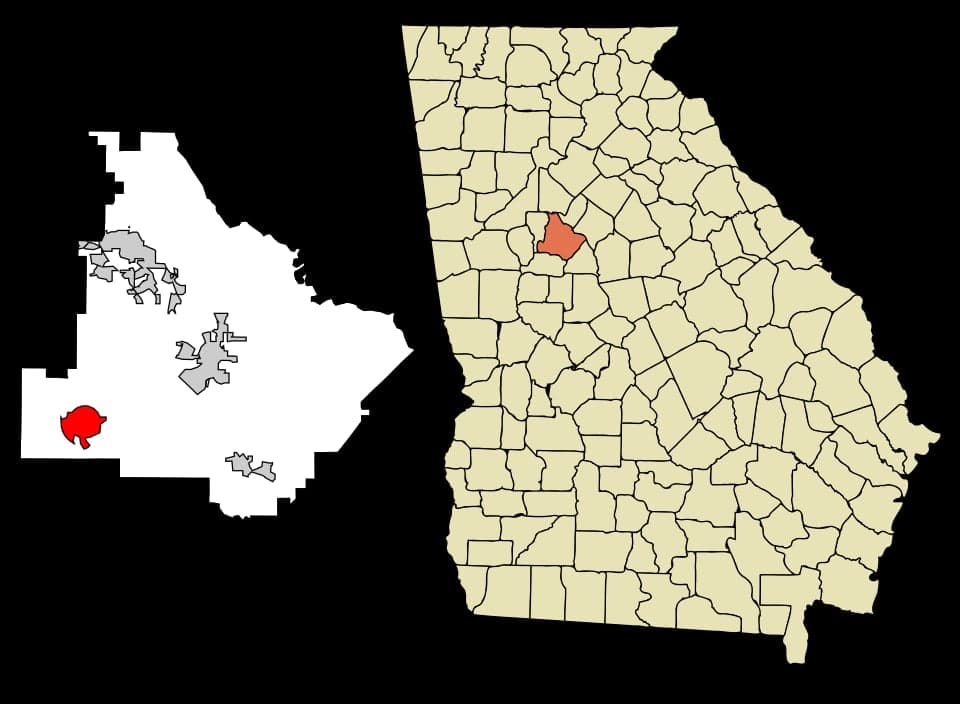
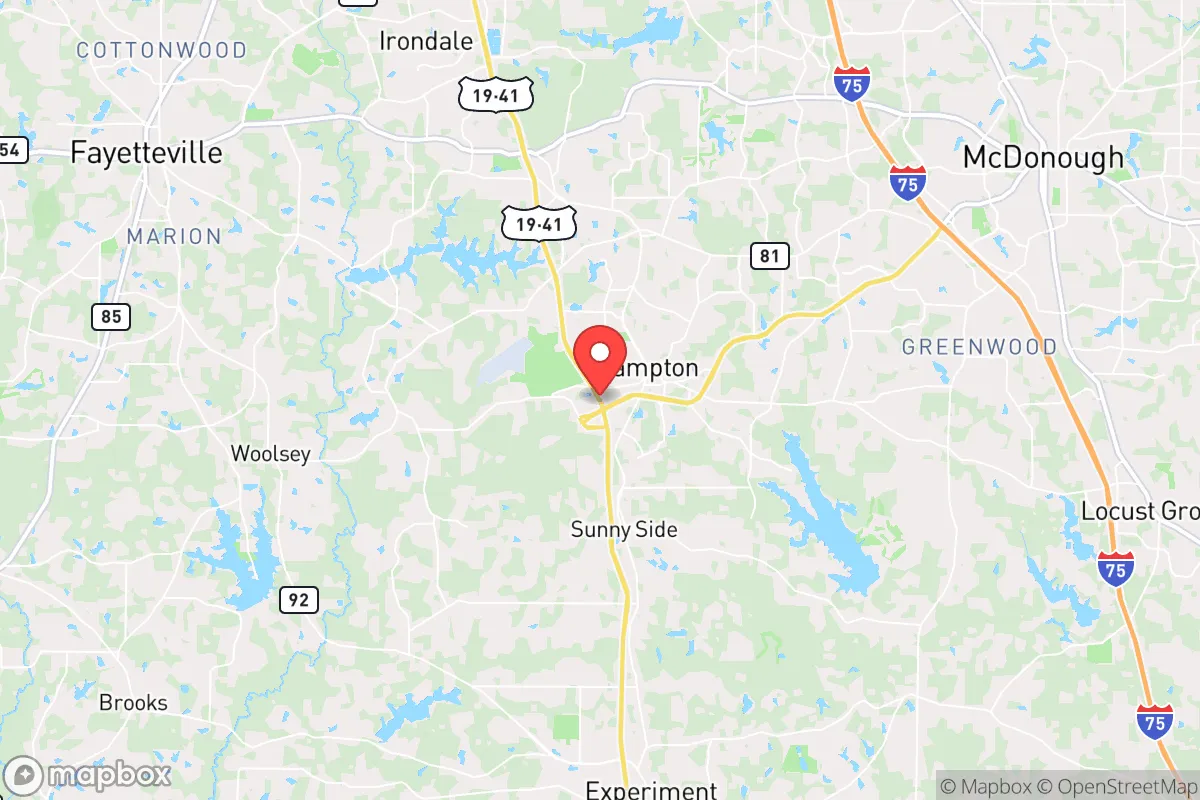
Photo: Wikipedia
Demographics of Hampton, GA
Affluence Level in Hampton, GA
A middle-class area roughly in line with national averages across income, home values, education, and employment.
People of Hampton, GA
Today, Hampton, Georgia, is a small city of 8,491 residents with a nearly even Black (45.0%) and White (44.4%) population, giving it a distinctive biracial character uncommon in metro Atlanta suburbs. The city remains predominantly native-born (97.8% U.S.-born) and family-oriented, with a moderate college attainment rate of 29.6% and a quiet, low-density feel that attracts those seeking affordable homes and slower pace within commuting distance of Atlanta. Hampton’s identity is rooted in its railroad past and Southern small-town traditions, now layered with newer subdivisions that house a mix of long-time local families and recent movers from the broader region.
How the city was settled and grew
Hampton was founded in the 1820s as a railroad stop on the Macon & Western line, later the Central of Georgia Railway. The original population consisted of railroad workers, merchants, and farmers drawn by the fertile clay soils and the rail connection that made Hampton a shipping point for cotton and timber. The historic Downtown Hampton district, centered on the old depot, was built by these early settlers—mostly white families of English and Scots-Irish descent who established churches, stores, and a small commercial core. By the late 1800s, a small African American community had formed in the Hampton Station area along the railroad tracks, where many worked as laborers, domestic servants, and sharecroppers on surrounding farms. The city incorporated in 1873, and through the early 20th century the population grew slowly, remaining overwhelmingly white and rural until after World War II.
Modern era (post-1965)
The 1965 Hart-Celler Act had minimal direct effect on Hampton—foreign-born residents still make up only 2.2% of the population. Instead, the city’s modern demographic transformation came from domestic migration. Beginning in the 1970s and accelerating through the 1990s, African American families moved from Atlanta and other parts of Henry County into Hampton, drawn by affordable land and new subdivisions. The Bear Creek Estates and Lake Dow Estates neighborhoods became primary destinations for these Black homebuyers, offering larger lots and newer homes than the older downtown. Meanwhile, white families continued to settle in the Hampton Village subdivision and in custom-built homes along the rural roads west of the city center. By 2000, Hampton’s Black population had risen to roughly 35%, and by the 2020 census it had reached 45%, while the white share fell to 44.4%. The Hispanic share (5.0%) and East/Southeast Asian share (2.1%) remain small, with Indian-subcontinent residents at 0.4%—most of these groups arrived after 2000, often settling in newer developments like The Preserve at Hampton, a master-planned community built in the 2010s. The city’s overall population more than doubled between 1990 and 2020, driven entirely by suburban expansion.
The future
Hampton’s population is likely to continue growing, though at a slower pace than the explosive 1990s and 2000s. The city’s racial composition is stabilizing: the Black and white shares are nearly equal, and neither group is projected to become a clear majority in the next decade. Hispanic and Asian populations are expected to increase modestly as metro Atlanta’s diversity spreads outward, but Hampton will remain overwhelmingly native-born and native-English-speaking. New subdivisions such as The Preserve at Hampton and planned developments near the I-75 corridor will absorb most new residents, while the historic downtown and older neighborhoods like Bear Creek Estates will see gradual turnover as original owners age. The cultural identity is evolving from a strictly Southern railroad town into a more generic suburban identity—still family-focused, church-oriented, and politically moderate—but less tied to a single ethnic or economic base. For someone moving in now, Hampton offers a stable, affordable, and demographically balanced community with clear neighborhood character, not a rapidly shifting one.
Hampton is becoming a settled, middle-class suburb where Black and white families coexist in roughly equal numbers, with little ethnic enclave formation. The next 10–20 years will likely see continued infill development, a slight uptick in Hispanic and Asian presence, and a gradual aging of the housing stock. For a relocating individual or family, Hampton offers a place where the population is neither diversifying rapidly nor stagnating—it is a settled, biracial Southern suburb with room for newcomers who will find a community that already reflects the region’s demographic future.

* Values derived from national, state, county, city and local statistics and may differ in a specific area. Last updated: 2026-10-14T23:40:55.000Z
Narrative content on this page is AI-generated and may contain mistakes. Verify any details that matter before acting on them.
ReloMaps may earn a commission from affiliate links at no extra cost to you.

