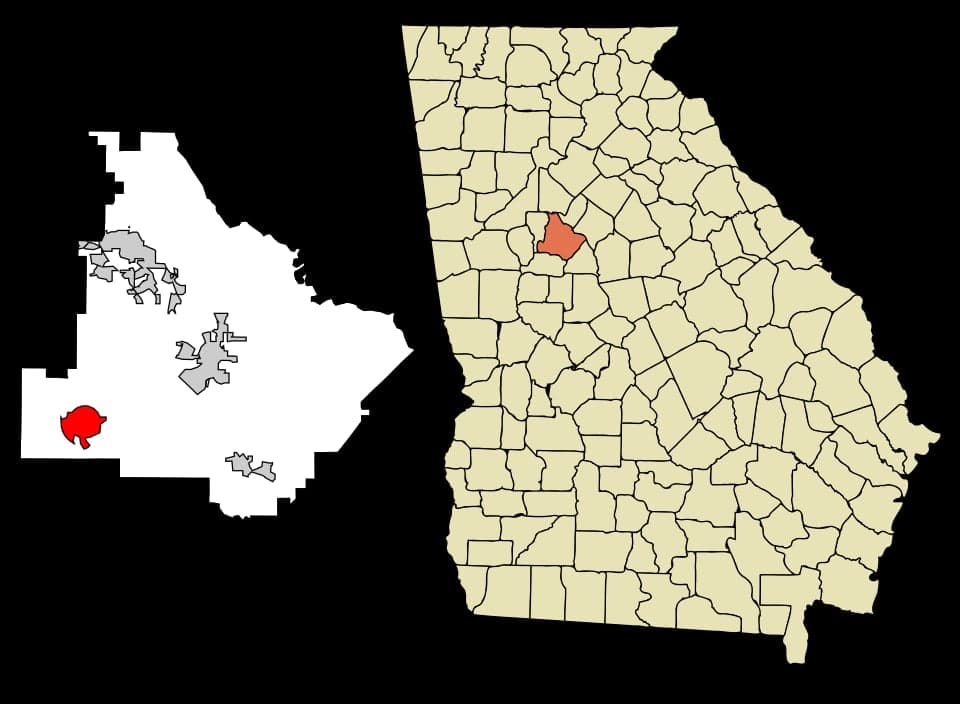
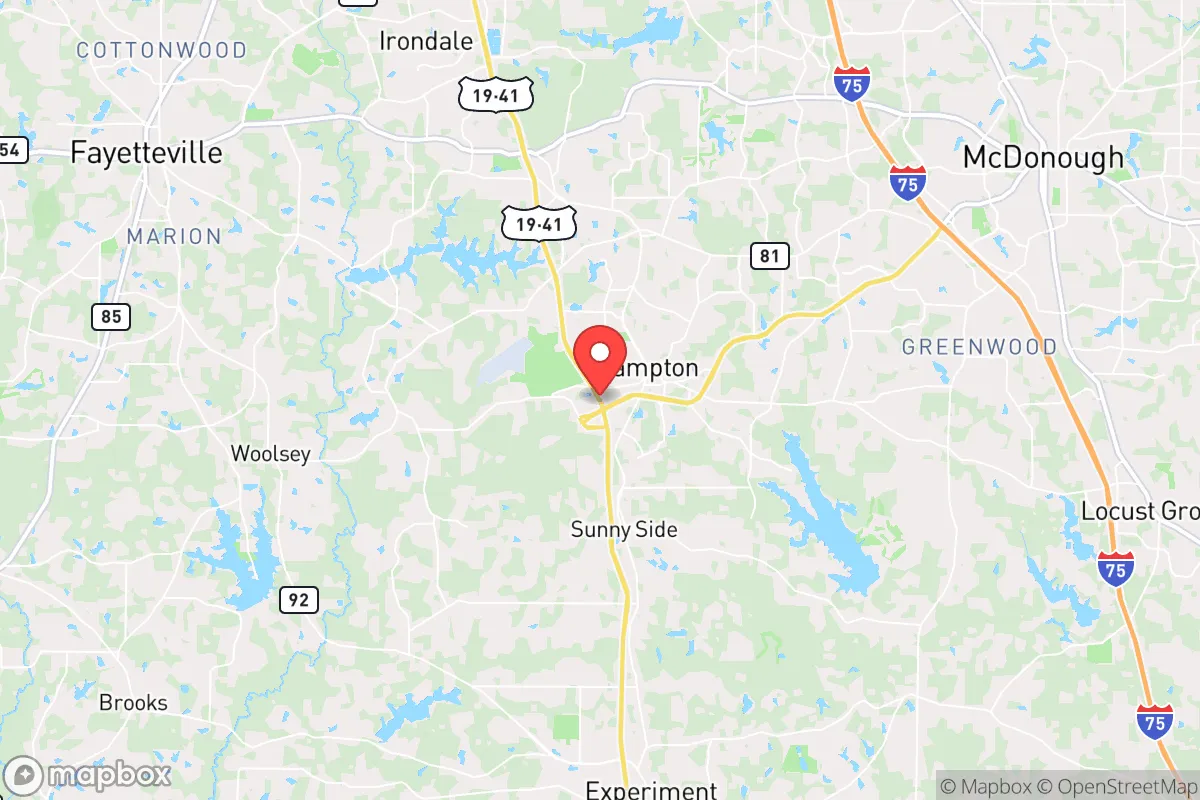
Photo: Wikipedia
Personal Sovereignty in Hampton, GA
Viable for self-reliance. Generally workable, though some barriers may limit total independence.
What does Personal Sovereignty tell us?
Personal Sovereignty measures your capacity for self-reliance and independence with minimal government friction. Higher scores mean fewer barriers between you and the way you want to live... but it assumes you have the space you need and good neighbors.
What does this tell us?
Personal Sovereignty measures your capacity for self-reliance and independence with minimal government friction. Higher scores mean fewer barriers between you and the way you want to live... but it assumes you have the space you need and good neighbors.
State Policy
Energy independence: Importer (12% of energy produced in-state)
Personal Liberty
Homesteading

Personal Liberty Analysis
Hampton, Georgia offers a notably high degree of personal sovereignty relative to metro Atlanta suburbs, driven by Georgia's preemptive state laws on firearms and zoning, a flat income tax structure, and a local culture that prizes self-reliance. While not a libertarian enclave, the city's small-town character and limited local government footprint create an environment where residents enjoy substantial autonomy in daily life, from property use to family decisions. For those prioritizing personal freedom, Hampton represents a deliberate middle ground—close enough to Atlanta for economic opportunity but far enough to avoid the regulatory density of larger municipalities.
Tax burden and regulatory posture in Hampton and Henry County
Georgia's state-level tax framework provides a baseline of fiscal sovereignty that Hampton residents benefit from directly. The state imposes a flat personal income tax rate of 5.49% as of 2026, with ongoing legislative pressure to reduce it further. Property taxes in Henry County are moderate, with a millage rate typically around 10.5 mills for the county portion, plus additional levies for the city of Hampton and the local school district. The combined effective property tax rate generally falls between 0.8% and 1.1% of assessed value, which is competitive with surrounding counties like Clayton (higher rates) and comparable to Fayette. Sales tax in Hampton is 8%, comprising the state's 4% base, a 1% county option, and a 3% special-purpose local-option sales tax (SPLOST) for infrastructure. There is no local city sales tax beyond the county level. Regulatory posture in Hampton is light-touch by design. The city does not impose its own business license fees beyond the county's standard requirements, and zoning is administered through Henry County's unified development code. Home-based businesses are permitted by right in most residential zones, with no special permitting for low-impact operations like consulting, online retail, or craft production. There are no rent control ordinances, no local minimum wage mandates above the state's $7.25, and no paid leave requirements. The county's approach to land use is permissive enough that residents can operate small-scale agricultural enterprises, including beekeeping and limited livestock, without conditional use permits in most cases. For a reader accustomed to the regulatory density of DeKalb or Fulton counties, Hampton's environment feels notably hands-off.
Self-defense and gun law specifics in Hampton and Georgia
Georgia is a constitutional carry state as of 2022, meaning Hampton residents may carry a handgun openly or concealed without a permit if they are legally eligible to possess a firearm. This applies within city limits, as Georgia's preemption statute (O.C.G.A. § 16-11-173) prohibits local governments from enacting their own firearm regulations. Hampton cannot and does not impose waiting periods, magazine capacity limits, or bans on specific firearm types. The city's municipal code contains no firearm-specific ordinances beyond state law. For those who wish to carry in other states, Georgia issues a Weapons Carry License (WCL) to residents through the Henry County Probate Court. The process requires fingerprints, a background check, and a fee of about $75, with licenses valid for five years. Georgia recognizes permits from all other states, and its own permit is honored in approximately 35 states through reciprocity. Stand-your-ground laws are fully in effect, with no duty to retreat in any place where a person is lawfully present. Castle doctrine protections extend to occupied vehicles and places of work. Use of deadly force is justified when a person reasonably believes it is necessary to prevent imminent death or great bodily harm to themselves or others, or to prevent a forcible felony. There are no firearm storage requirements in state law, and private firearm sales between individuals do not require a background check. For a reader prioritizing self-defense sovereignty, Hampton offers one of the most permissive legal environments in the southeastern United States, with no local ordinances adding friction to state law.
Self-reliance and homesteading viability in Hampton
Hampton's land use patterns make it one of the more viable locations in the Atlanta metro area for homesteading and self-reliance practices. Residential lots in the city's older neighborhoods and unincorporated areas of Henry County routinely range from 0.5 to 5 acres, with some rural subdivisions offering parcels of 10 acres or more. The Henry County zoning code permits keeping of chickens, rabbits, and other small livestock on residential lots of one acre or more without a special permit. Goats, sheep, and up to two horses are allowed on parcels of two acres or more, subject to setback requirements and coop/pasture standards. Beekeeping is permitted on lots of one-half acre or more, with no registration required beyond standard nuisance ordinances. Gardening and food production for personal consumption are unrestricted. Off-grid feasibility is moderate. Georgia does not require connection to municipal water or sewer if a private well and septic system are installed and permitted. Hampton's city limits include areas served by the Hampton Water System, but many properties in the surrounding county rely on private wells. Solar panel installation is permitted by right under the state's Solar Energy Equipment Easement Act, and Henry County has no specific restrictions on residential solar beyond standard building permit requirements. Rainwater collection is legal and encouraged under Georgia's Water Stewardship Act, with no permit required for systems under 10,000 gallons. Composting and wood-burning for heat are permitted, though outdoor burning is subject to state air quality restrictions during summer months. The primary limitation for full off-grid living is the county's requirement for a minimum of one acre for a private septic system, which effectively sets a floor on rural development density. For a family seeking to reduce dependence on supply chains and municipal services, Hampton's zoning and regulatory environment is accommodating without being permissive to the point of lawlessness.
Personal liberties in Hampton: parental rights, medical autonomy, speech, and property
Georgia's state-level legal framework provides strong protections for personal liberties that apply directly in Hampton. Parental rights are explicitly protected under Georgia law, with a statutory presumption that parents have the right to direct the upbringing, education, and healthcare of their minor children. The state's Parents' Bill of Rights (O.C.G.A. § 20-2-780) requires school districts to notify parents of any medical services provided to students and to obtain parental consent for most non-emergency care. Henry County Schools, which serves Hampton, maintains a policy of notifying parents of any changes in a student's services or monitoring related to mental, emotional, or physical health. Medical autonomy is supported by Georgia's lack of a state-level vaccine mandate for adults and its prohibition on local governments requiring proof of vaccination for access to public spaces. The state does not have a right-to-die law, but it does protect the right to refuse medical treatment. Speech and assembly are protected under the Georgia Constitution's free speech clause, which has been interpreted by state courts as providing protections at least as broad as the First Amendment. There are no local ordinances in Hampton restricting expressive activity beyond standard time, place, and manner regulations. Property rights are robust, with Georgia's eminent domain laws strictly limited to public use projects, and the state's right-to-farm act protecting agricultural operations from nuisance lawsuits if they have been in operation for at least one year. Hampton does not have a rental registry or inclusionary zoning ordinance, and there are no local rent control measures. For a reader concerned about government overreach in family and medical decisions, Hampton's legal environment is among the more protective in the Southeast, with state preemption consistently limiting local government's ability to infringe on personal choices.
Overall, Hampton, GA ranks as a high-sovereignty location within the Atlanta metropolitan area, comparable to other exurban communities like Locust Grove or McDonough, but with a slightly more permissive regulatory posture due to its smaller municipal footprint. The combination of constitutional carry, flat income tax, permissive homesteading zoning, and strong state-level protections for parental rights and property creates an environment where personal autonomy is the default rather than the exception. For a single individual or family seeking to maximize personal freedom while maintaining access to a major urban economy, Hampton represents a strategic choice that balances liberty with practicality.

* Values derived from national, state, county, city and local statistics and may differ in a specific area. Last updated: 2026-10-14T23:40:55.000Z
Narrative content on this page is AI-generated and may contain mistakes. Verify any details that matter before acting on them.
ReloMaps may earn a commission from affiliate links at no extra cost to you.

