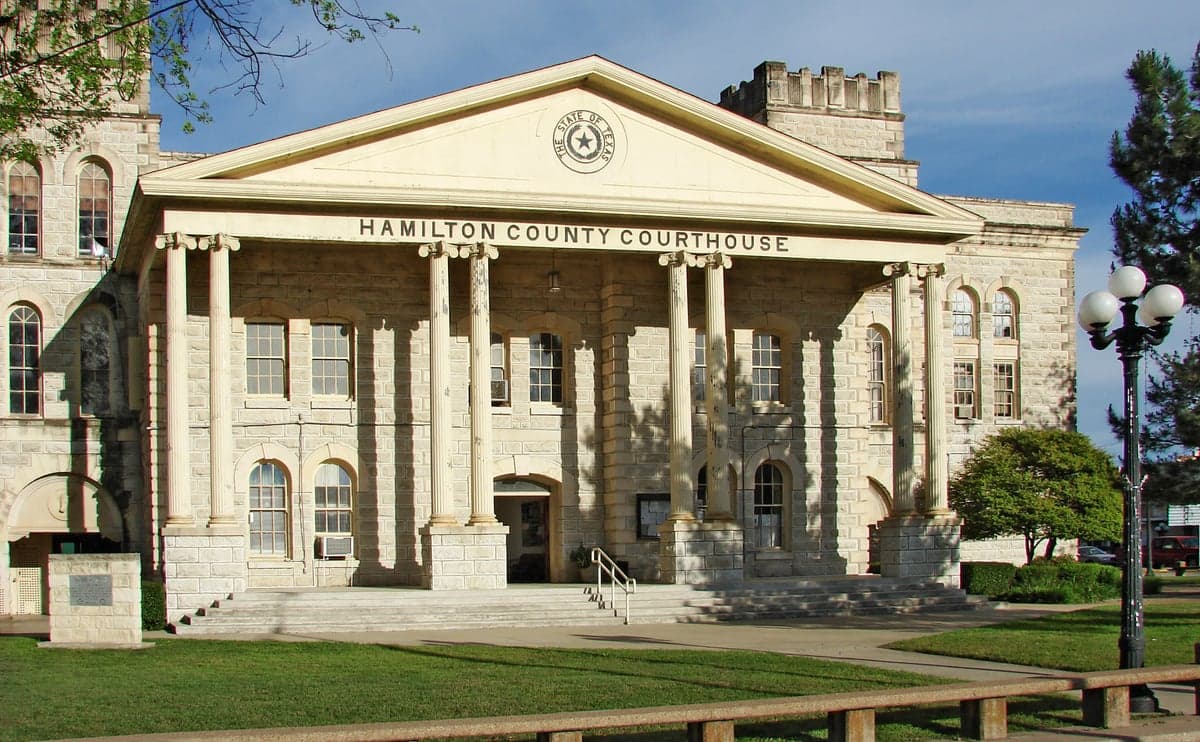
Photo: Wikipedia
Political ClimatePolitical Climate in Hamilton, TX
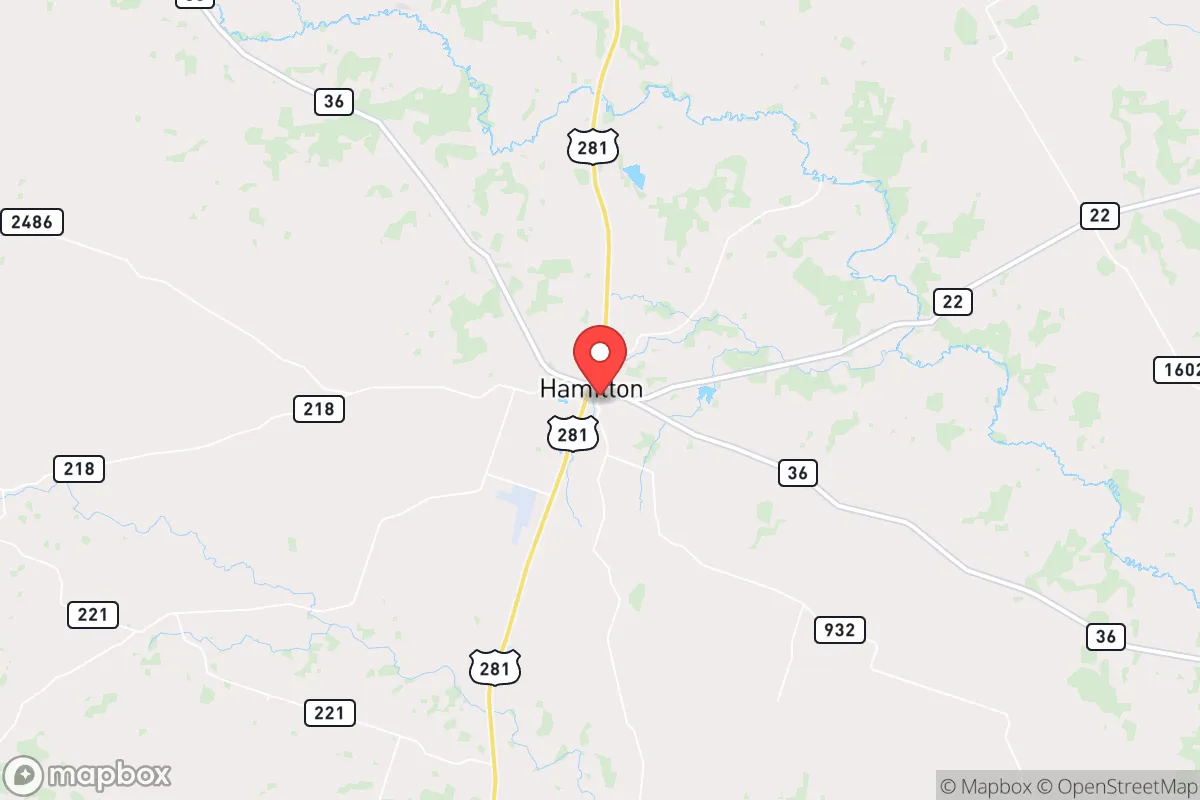
District shown is the primary district for this city’s centroid. Cities may span multiple districts.
Local Political AnalysisPolitical Analysis of Hamilton, TX
Hamilton sits in a solidly conservative corner of Texas, with a Cook Partisan Voting Index of R+11 that places it well to the right of the national average. This isn't a recent shift—the area has voted Republican in every presidential election since at least 2000, and local races rarely see competitive Democratic challengers. The trajectory here is one of deepening Republican dominance, driven by an aging population, a strong agricultural and oil-and-gas economic base, and a steady influx of retirees from bluer states who are drawn to the low taxes and slower pace. While the surrounding state of Texas as a whole has a Cook PVI that is unknown, Hamilton's R+11 rating puts it roughly in line with the more conservative rural counties that anchor the state's political right flank.
How it compares
Compared to Texas as a whole, Hamilton is noticeably more conservative. The state's major urban centers—Houston, Dallas, Austin, San Antonio—are far more politically mixed, with many precincts leaning Democratic or competitive. Hamilton, by contrast, shares its political DNA with nearby towns like Gatesville (R+18) and Goldthwaite (R+16), where Republican candidates routinely win by 20 points or more. Even Brownwood (R+14), the largest city in the region, is more conservative than Hamilton, though it has a small but visible progressive minority tied to Howard Payne University. The closest city that offers any real political contrast is Stephenville (R+9), home to Tarleton State University, where a younger, more transient population creates a slightly more moderate environment—but even there, Republicans hold every elected office. In practical terms, Hamilton's R+11 means that a Democratic candidate for statewide office would need to outperform the party's typical rural performance by a wide margin to be competitive here, which hasn't happened in decades.
What this means for residents
For conservative residents, Hamilton's political climate is a comfortable fit. Local government is reliably Republican, taxes are low, and the cultural values of the community—church attendance, gun ownership, small government—are reflected in policy decisions. The school board, county commission, and city council all lean conservative, so there's little friction between what residents want and what their elected officials deliver. For liberal residents, the reality is more challenging. They are a distinct minority, and while there is no open hostility, they often feel politically isolated. There are no Democratic Party offices in Hamilton County, and progressive candidates rarely appear on the ballot for local races. Socially, it can be difficult to find like-minded neighbors, and national political debates often feel distant or irrelevant to daily life. That said, most residents—regardless of party—agree on the basics: keeping taxes low, maintaining good roads, and supporting the local schools. Political disagreements tend to be about national issues, not local ones.
One cultural distinction worth noting is Hamilton's strong sense of self-reliance. Unlike some parts of Texas that have seen rapid growth and demographic change, Hamilton has remained remarkably stable. The population has hovered around 3,000 for decades, and the economy is still rooted in agriculture, oil, and small businesses. This stability reinforces the conservative political culture—people here vote the way they do because it reflects how they live. There's no real push for change, and no major political movement challenging the status quo. For anyone moving to Hamilton, the political climate is predictable: it's deeply Republican, it's not changing anytime soon, and it shapes everything from school funding to local ordinances. Whether that's a draw or a drawback depends entirely on your own politics.

State Political ClimatePolitical Climate in Texas
State Political AnalysisPolitical Environment in the State
Texas has been a solidly Republican state for the past three decades, but the margin has been shrinking. In 2024, Donald Trump won the state by roughly 9 points, down from 11 points in 2020 and 16 points in 2012. The dominant coalition remains a mix of rural conservatives, suburban moderates, and evangelical voters, but rapid in-migration and demographic shifts are slowly reshaping the map. The long-term trajectory points toward a competitive two-party state, though Republicans still control every statewide office and both legislative chambers.
Urban vs. rural divide
The political map of Texas is a story of three distinct zones. The big metros — Houston, Dallas-Fort Worth, San Antonio, and Austin — are increasingly Democratic, with Austin and El Paso being the most reliably blue. Harris County (Houston) and Dallas County have flipped decisively Democratic over the past decade. Meanwhile, the vast rural expanse, from the Panhandle down through West Texas and into East Texas, votes overwhelmingly Republican. The suburbs are the real battleground: places like Collin County (north of Dallas) and Fort Bend County (southwest of Houston) have shifted from solid red to purple, with Collin County voting for Trump by only 5 points in 2024 after giving him 15 points in 2016. The Rio Grande Valley, once reliably Democratic, has moved rightward, with counties like Starr and Hidalgo flipping to Trump in 2024 — a major realignment among Hispanic voters.
Policy environment
Texas has no state income tax, which is the single biggest policy draw for relocators. Property taxes are high to compensate — the average effective rate is around 1.6%, among the highest in the nation. The regulatory posture is light-touch: no state-level occupational licensing for many trades, minimal environmental review for development, and a right-to-work law that keeps union influence low. Education policy is dominated by the school choice debate: the 2023 legislative session saw a major push for education savings accounts (ESAs) that ultimately failed due to rural Republican opposition, but the issue is expected to return. Healthcare is a mixed bag: Texas has the highest uninsured rate in the country (around 17%), and the state has not expanded Medicaid under the ACA. Election laws were tightened in 2021 with SB 1, which added ID requirements for mail-in voting, limited drive-through and 24-hour voting, and gave partisan poll watchers more access. The state also banned abortion after roughly six weeks in 2021 (SB 8) and enacted a near-total ban in 2023 (trigger law).
Recent policy direction
The 2023 and 2025 legislative sessions have pushed Texas further in a conservative direction on several fronts. On gun and self-defense law, Texas became a permitless carry state in 2021 (HB 1927), allowing most adults to carry a handgun without a license. On parental and education rights, the state passed a law in 2023 banning "critical race theory" from K-12 classrooms (SB 3) and requiring schools to post all instructional materials online. The "bathroom bill" debate has quieted, but a 2023 law (SB 14) bans gender-affirming care for minors. On speech and privacy, a 2021 law (HB 20) restricts social media platforms from moderating content based on viewpoint — it's currently tied up in court. Property rights remain strong: no state-level rent control, and eminent domain for private development is rare. Taxation saw a major property tax cut in 2023 (SB 2), which compressed school tax rates and increased the homestead exemption. Voting and ballot access remains a flashpoint: the 2021 law (SB 1) is still in effect, and a 2023 bill (SB 1070) made it a crime for non-citizens to vote — already illegal — but added new penalties. The overall direction is toward more individual liberty on economic and gun issues, but tighter regulation on social and medical matters.
Civil unrest & political movements
Texas has seen significant protest activity, particularly around abortion and racial justice. The 2020 George Floyd protests in Houston and Austin were large and occasionally violent, leading to property damage and a lasting debate over police funding. The 2021 abortion ban (SB 8) sparked ongoing protests at the state capitol and outside clinics, though enforcement has largely shut down abortion access. Immigration politics are a constant flashpoint: Governor Abbott's Operation Lone Star, launched in 2021, has deployed state troopers and National Guard to the border, bused migrants to Democratic-led cities, and installed razor wire along the Rio Grande. This has created a visible state-federal conflict, with the Biden administration suing Texas over border enforcement. Secession rhetoric, often called "Texit," is a fringe movement — a 2023 poll found about 20% of Texans support it, but it has no serious legislative traction. Election integrity controversies persist: the 2020 and 2022 elections saw claims of fraud from some Republican activists, though no widespread fraud was found. A 2023 law (SB 2) created a new election audit unit, but it has not produced major findings.
Projection
Over the next 5-10 years, Texas is likely to become more politically competitive. The state is growing by about 1,000 people per day, and many newcomers come from blue states like California and New York, bringing more Democratic-leaning voters. The suburbs around Dallas, Houston, and San Antonio will continue to shift left, while rural areas will remain deeply red. The Rio Grande Valley trend toward Republicans may continue, but it's unclear if that's a permanent realignment or a reaction to specific issues. The state's Republican majority in the legislature is safe for now, but the margin could narrow to single digits in the next decade. A relocator moving in now should expect a state that remains conservative on fiscal and gun issues, but where social policy — especially on abortion and education — will be a constant battleground. The political climate will feel increasingly polarized, with the big cities and rural areas growing further apart.
For a new resident, the bottom line is this: Texas offers low taxes, light regulation, and strong property rights, but you'll also find high property taxes, limited public transit, and a healthcare system that leaves many uninsured. If you're conservative, you'll feel at home in most of the state outside the major cities. If you're liberal, you'll find like-minded communities in Austin, Houston, and Dallas, but you'll be living under a state government that opposes many of your priorities. The political divide is real and visible, but daily life is generally peaceful — the culture wars play out in the legislature and on cable news, not on your street.
* Values derived from national, state, county, city and local statistics and may differ in a specific area. Last updated: 2026-10-27T12:34:14.000Z
Narrative content on this page is AI-generated and may contain mistakes. Verify any details that matter before acting on them.
ReloMaps may earn a commission from affiliate links at no extra cost to you.

