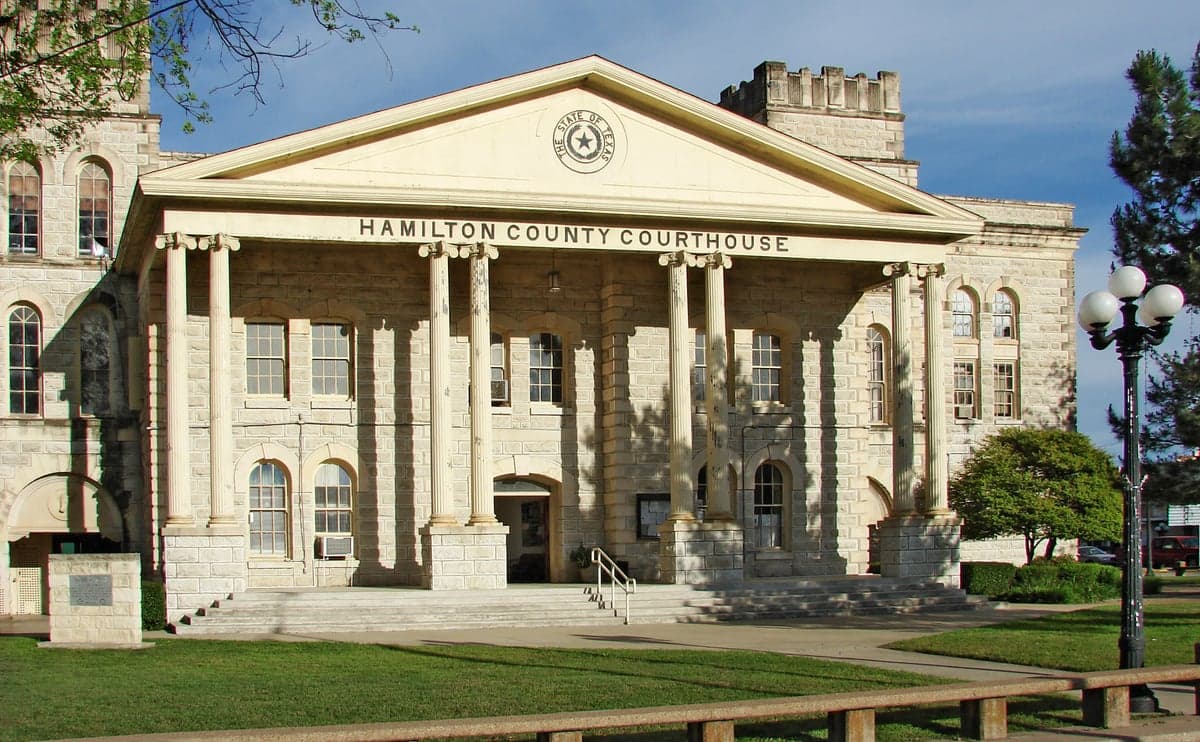
Photo: Wikipedia
Personal Sovereignty in Hamilton, TX
Strong independent fundamentals that actively favor personal liberty and low regulation.
What does Personal Sovereignty tell us?
Personal Sovereignty measures your capacity for self-reliance and independence with minimal government friction. Higher scores mean fewer barriers between you and the way you want to live... but it assumes you have the space you need and good neighbors.
What does this tell us?
Personal Sovereignty measures your capacity for self-reliance and independence with minimal government friction. Higher scores mean fewer barriers between you and the way you want to live... but it assumes you have the space you need and good neighbors.
State Policy
Energy independence: Net exporter (220% of energy produced in-state)
Personal Liberty
Homesteading

Personal Liberty Analysis
Hamilton, Texas, offers a personal sovereignty environment that is among the most permissive in the state, reflecting a deep-rooted culture of self-reliance and minimal government interference. Located in Hamilton County, this rural community of roughly 3,000 residents operates under Texas’s broad preemption laws, which limit local ordinances on everything from firearms to property use. For individuals and families who prioritize autonomy—whether in daily decision-making, economic activity, or personal defense—Hamilton provides a legal and social framework that consistently favors individual choice over collective regulation. The area’s low population density and agricultural heritage further reinforce a hands-off governance style, making it a practical option for those seeking to maximize personal freedom without the friction of urban or suburban oversight.
Tax burden and regulatory posture: How Hamilton compares to urban Texas
Hamilton’s tax burden is moderate by Texas standards, but its regulatory posture is notably light-touch. The state imposes no personal income tax, and Hamilton County’s property tax rate hovers around 1.2% to 1.4% of assessed value, which is competitive with rural counties but slightly higher than some neighboring areas due to school district funding needs. Sales tax in Hamilton is 8.25% (state plus local), standard for Texas. What sets Hamilton apart is the absence of many regulatory layers common in larger cities: there are no local rental registration fees, no business license requirements for most home-based enterprises, and no zoning overlays that restrict agricultural or light commercial use on residential lots. The city’s zoning code is minimal, focusing primarily on lot setbacks and basic safety, rather than aesthetic or use-based restrictions. This means a homeowner can operate a small welding shop, keep livestock, or run a daycare from their property without navigating a thicket of permits. For a reader comparing Hamilton to, say, Austin or Dallas, the regulatory difference is stark—Hamilton’s approach is closer to “if it’s not illegal, it’s allowed,” while larger cities often require explicit permission for many activities.
Self-defense and gun law specifics: Constitutional carry and castle doctrine in practice
Hamilton sits squarely within Texas’s robust self-defense legal framework, which is among the most protective of individual rights in the nation. Texas is a constitutional carry state (permitless carry) for handguns, effective since 2021, meaning any adult who can legally possess a firearm may carry it openly or concealed without a license. Hamilton County has no local ordinances restricting this right—no “gun-free zones” beyond those mandated by state law (e.g., schools, polling places). The state’s castle doctrine applies fully here: a person has no duty to retreat before using deadly force in their home, vehicle, or workplace if they reasonably believe it’s necessary to prevent imminent harm. Additionally, Texas’s stand your ground law extends this principle to any place where a person is lawfully present. For practical purposes, a Hamilton resident can keep a loaded firearm in their vehicle without a license, store weapons in their home without safe-storage mandates, and use force in self-defense without fear of prosecution if the threat is credible. The local sheriff’s office, which serves a county of about 8,500 people, is known for a pro-Second Amendment stance, and permit applications (for out-of-state reciprocity, for example) are processed efficiently. There are no waiting periods for firearm purchases beyond the federal background check, and private sales between individuals remain unregulated at the state level.
Self-reliance and homesteading viability: Lot sizes, zoning, and off-grid feasibility
Hamilton’s rural character makes it highly viable for homesteading and off-grid living, with few regulatory barriers. Residential lots within the city limits typically range from 0.25 to 1 acre, while unincorporated county land offers parcels from 1 to 100+ acres at prices often below $5,000 per acre. The city’s zoning code does not prohibit keeping chickens, goats, or even a single cow on a standard residential lot, though larger livestock may require a minimum lot size of 2 acres. There are no noise ordinances that would restrict generators or power tools during daytime hours, and no aesthetic covenants (like HOA rules) unless a buyer specifically chooses a subdivision with them. Off-grid feasibility is high: Texas law does not require connection to municipal water or sewer if a property has a permitted well and septic system, and solar panels are allowed without special permits. Rainwater collection is actively encouraged by state law (Texas offers a tax exemption for rainwater harvesting equipment). The county has no building codes for agricultural structures (barns, sheds) under 600 square feet, and even residential construction follows the state’s relatively lenient International Residential Code, with no local amendments adding cost. For a family wanting to grow food, raise animals, and minimize utility dependence, Hamilton presents a low-friction environment—the main practical constraints are well depth (the area is in the Edwards Plateau, so wells often need to go 200-400 feet) and occasional drought restrictions on outdoor water use, which are enforced by the local groundwater district but rarely affect rainwater users.
Personal liberties: Parental rights, medical autonomy, speech, and property
Hamilton’s personal liberties environment aligns closely with Texas’s conservative legal framework, which prioritizes parental authority, medical choice, and property rights. Parental rights are strongly protected: Texas law gives parents broad control over their children’s education (including homeschooling without state oversight of curriculum), medical decisions (including vaccine exemptions for school attendance), and religious upbringing. Hamilton Independent School District, which serves about 1,100 students, has a conservative school board that has resisted state-level mandates on curriculum content and library materials, deferring to parental input. Medical autonomy is similarly broad: Texas has no state-level vaccine mandate for adults, no mask mandates, and no restrictions on alternative or complementary medicine (though licensed practitioners are regulated). The nearest hospital is in Hamilton (Hamilton General Hospital), but for specialized care, residents drive 45 minutes to Stephenville or an hour to Waco. Speech and assembly are protected under the First Amendment, and Hamilton has no local ordinances restricting political signage, leafleting, or public gatherings—the town square is a common venue for political rallies and church events. Property rights are reinforced by Texas’s strong eminent domain protections (requiring public use and just compensation) and the absence of rent control or landlord licensing. A property owner can fence their land, post “no trespassing” signs, and enforce trespassing laws without needing to prove intent. The only notable limitation is the county’s floodplain regulations, which restrict building in designated 100-year flood zones—a practical safety measure rather than a liberty restriction.
Overall, Hamilton offers a personal sovereignty profile that is among the most permissive in Texas, particularly for those who value self-reliance and minimal government involvement. Compared to urban areas like Dallas or Houston, where zoning, noise, and business regulations are dense, Hamilton’s regulatory environment is light enough that most daily decisions—from carrying a firearm to building a chicken coop to homeschooling—require no permission from local authorities. The trade-offs are typical of rural life: fewer services, longer drives to specialty healthcare, and a slower pace of economic opportunity. For a single individual or family who prioritizes autonomy over convenience, Hamilton represents a practical, legally grounded option where the default answer to most questions is “yes, you can.”

* Values derived from national, state, county, city and local statistics and may differ in a specific area. Last updated: 2026-10-27T12:34:14.000Z
Narrative content on this page is AI-generated and may contain mistakes. Verify any details that matter before acting on them.
ReloMaps may earn a commission from affiliate links at no extra cost to you.

