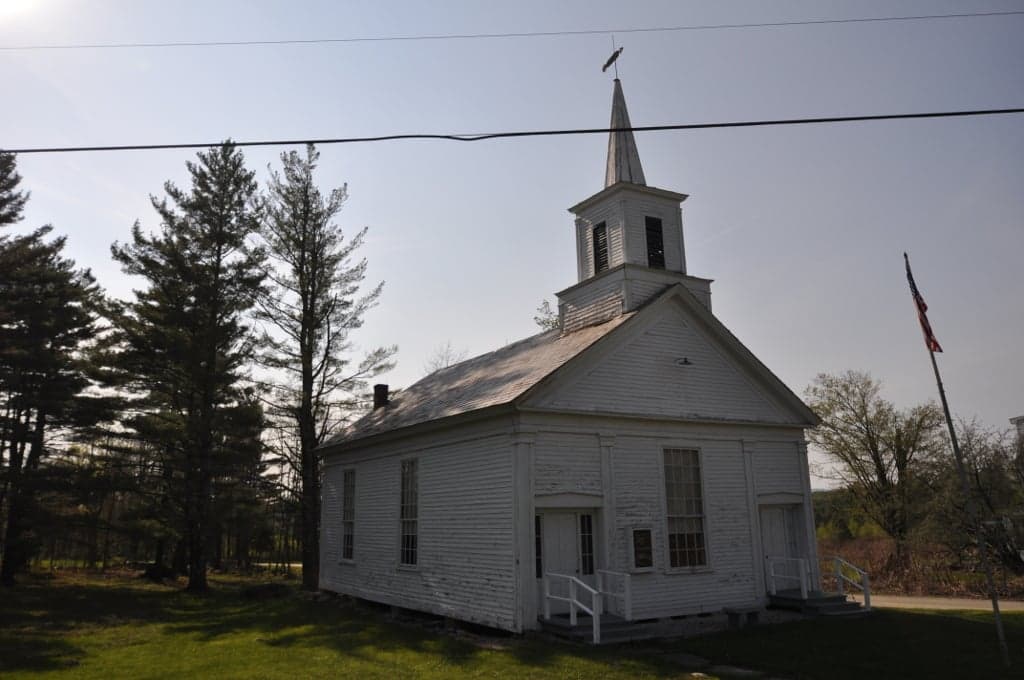
Photo: Wikipedia
Personal Sovereignty in Halifax, VT
Moderate friction. Expect trade-offs in some aspect of personal liberty and independence.
What does Personal Sovereignty tell us?
Personal Sovereignty measures your capacity for self-reliance and independence with minimal government friction. Higher scores mean fewer barriers between you and the way you want to live... but it assumes you have the space you need and good neighbors.
What does this tell us?
Personal Sovereignty measures your capacity for self-reliance and independence with minimal government friction. Higher scores mean fewer barriers between you and the way you want to live... but it assumes you have the space you need and good neighbors.
State Policy
Energy independence: Importer (15% of energy produced in-state)
Personal Liberty
Homesteading

Personal Liberty Analysis
Halifax, Vermont, offers a distinctive personal sovereignty environment that balances the state’s progressive regulatory framework with a deeply rural, hands-off local culture. As a small town in Windham County with fewer than 800 residents, Halifax provides a setting where day-to-day autonomy is high—neighbors largely mind their own business, and local government footprint is minimal—but where state-level policies impose notable constraints on taxes, self-defense, and property use. For a relocation reader prioritizing personal freedom, the key trade-off is between Vermont’s light-touch social culture and its relatively heavy state-level regulatory and tax structure, which differs sharply from neighboring New Hampshire or more libertarian-leaning states.
Tax burden and regulatory posture in Halifax and Vermont
Vermont’s overall tax burden ranks among the highest in the nation, and Halifax residents feel this directly. The state levies a progressive income tax with rates from 3.35% to 8.75% (2025), and the statewide property tax—funding education—averages roughly $1.60 per $100 of assessed value, though Halifax’s specific rate can vary. Combined with a 6% sales tax (no local add-ons), the effective tax load is significant for a rural town. However, Halifax’s low property values partially offset this: median home values hover around $200,000, so annual property tax bills often fall between $3,000 and $4,000—manageable compared to wealthier parts of the state. Regulatory posture at the state level is heavy on environmental and land-use rules. Act 250, Vermont’s landmark development review law, applies to any subdivision of 10 or more lots or construction above 2,500 square feet, meaning even modest rural projects can trigger state-level permitting. Local zoning in Halifax is minimal—the town has no formal planning department—but state wetland, shoreland, and forest management regulations still apply. For a reader accustomed to low-regulation states like Texas or Florida, Vermont’s permitting overhead will feel intrusive; for someone from Massachusetts or New York, it may feel familiar but still burdensome. The net effect: Halifax offers low local interference but high state-level friction for anyone building, expanding, or running a business.
Self-defense and gun law specifics in Vermont
Vermont has historically been one of the most gun-friendly states in the Northeast, but recent legislation has tightened restrictions. As of 2025, Vermont is a “constitutional carry” state—no permit is required to carry a concealed handgun for residents 21 or older. However, the state now mandates universal background checks for all firearm sales, including private transfers, and bans “large-capacity” magazines (over 10 rounds for long guns, 15 for handguns). Red flag laws (extreme risk protection orders) allow law enforcement to seize firearms based on a court order without a criminal conviction. There is no state-level firearm registry, and no waiting period for purchases. In Halifax, local law enforcement presence is minimal—the town relies on the Vermont State Police for coverage—so practical self-defense autonomy is high. Residents can carry openly or concealed without state interference, and there are no local ordinances restricting firearms. However, the magazine capacity ban and universal background checks are real constraints for enthusiasts. Stand-your-ground laws do not exist in Vermont; the state follows a “duty to retreat” standard outside the home, though the home is considered a castle (no duty to retreat before using deadly force against an intruder). For a reader prioritizing self-defense sovereignty, Halifax offers a solid baseline—constitutional carry and minimal local enforcement—but falls short of the permissive environments found in states like New Hampshire (no magazine ban, no universal background checks) or Alaska.
Self-reliance and homesteading viability in Halifax
Halifax’s rural character makes it a strong candidate for homesteading and off-grid living. The town is heavily forested, with large parcels of undeveloped land; typical lot sizes for residential properties range from 2 to 10 acres, and larger tracts (20–100+ acres) are available at relatively low per-acre costs—often $3,000–$8,000 per acre as of 2025. Zoning is minimal: the town has no subdivision regulations beyond state Act 250 thresholds, and there are no local restrictions on keeping livestock, chickens, or bees. Off-grid feasibility is high but not unrestricted. Vermont requires that all dwellings have a potable water supply and a wastewater system (septic or approved alternative), and the state’s building code applies to new construction—though enforcement in rural Halifax is lax. Solar panels, rainwater collection, and composting toilets are legal, but grid-tied electrical connections are not mandatory. The state’s net metering policy allows homeowners to sell excess solar power back to the grid, which supports energy independence. However, Vermont’s property tax structure does not favor homesteaders: the state offers a “current use” tax program for forest and agricultural land, which can reduce tax bills significantly (often by 50–70%) if the land is actively managed. For a family seeking to live off-grid with minimal state interference, Halifax is viable but requires navigating Act 250 for any substantial construction and complying with state health regulations for water and waste. The trade-off is that local neighbors and town officials are generally supportive of self-reliant lifestyles, and enforcement is complaint-driven rather than proactive.
Personal liberties in Halifax: parental rights, medical autonomy, speech, and property
Vermont’s legal framework generally supports personal liberties in several key areas, though with notable exceptions. Parental rights are strong: Vermont has no mandatory vaccination laws for school attendance (philosophical exemptions are allowed), and parents can homeschool without state approval—though they must submit an annual enrollment notice and provide a “narrative of progress.” The state does not require standardized testing for homeschoolers. Medical autonomy is mixed. Vermont was an early adopter of telehealth and has a robust right-to-try law for terminally ill patients, but it also mandates health insurance coverage for abortion and gender-affirming care, which may conflict with some readers’ values. There is no state-level religious exemption for medical procedures beyond what federal law provides. Free speech is protected under both the U.S. and Vermont constitutions, and the state has no specific laws restricting political speech or expression. However, Vermont’s campaign finance laws are among the strictest in the nation, with contribution limits and disclosure requirements that some readers may view as burdensome. Property rights are the most contested area. Vermont’s Act 250 and state wetland regulations give the government broad authority to restrict land use, and the state’s “right to farm” law protects agricultural operations from nuisance lawsuits but does not prevent neighbors from challenging new farming activities. Eminent domain is rarely used in rural Halifax, but the state’s environmental regulations effectively limit what owners can do with their land—especially near waterways or on steep slopes. For a reader who values maximum property autonomy, Halifax’s local culture is permissive, but state-level rules create real friction.
Overall, Halifax offers a personal sovereignty profile that is strong on social autonomy and weak on tax and regulatory freedom compared to the most libertarian-friendly states. The town’s rural isolation, minimal local government, and supportive community for self-reliance make it a viable choice for homesteaders and those seeking to live with minimal neighborly interference. However, Vermont’s high tax burden, Act 250 permitting, magazine capacity ban, and environmental regulations mean that Halifax is not a low-regulation haven. For a reader comparing it to places like Coos County, New Hampshire (no income or sales tax, constitutional carry with no magazine ban, minimal land-use rules) or rural Texas (no state income tax, castle doctrine, weak zoning), Halifax will feel moderately constrained. For someone leaving a high-regulation state like California or New York, it will feel liberating. The key takeaway: Halifax provides a high degree of day-to-day personal freedom in a beautiful, quiet setting, but the state-level overhead is real and should be factored into any relocation decision.

* Values derived from national, state, county, city and local statistics and may differ in a specific area. Last updated: 2026-10-17T00:28:32.000Z
Narrative content on this page is AI-generated and may contain mistakes. Verify any details that matter before acting on them.
ReloMaps may earn a commission from affiliate links at no extra cost to you.

