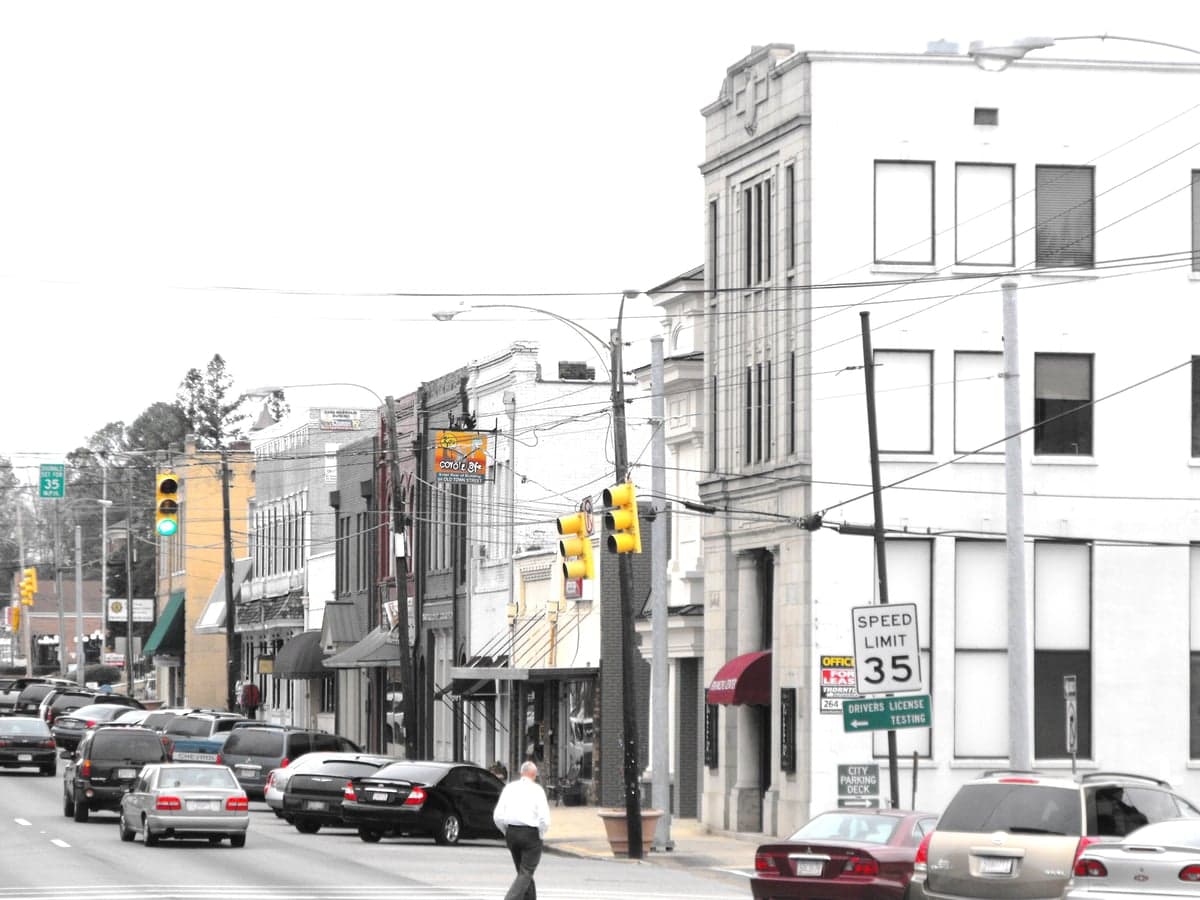
Photo: Wikipedia
Political ClimatePolitical Climate in Guntersville, AL
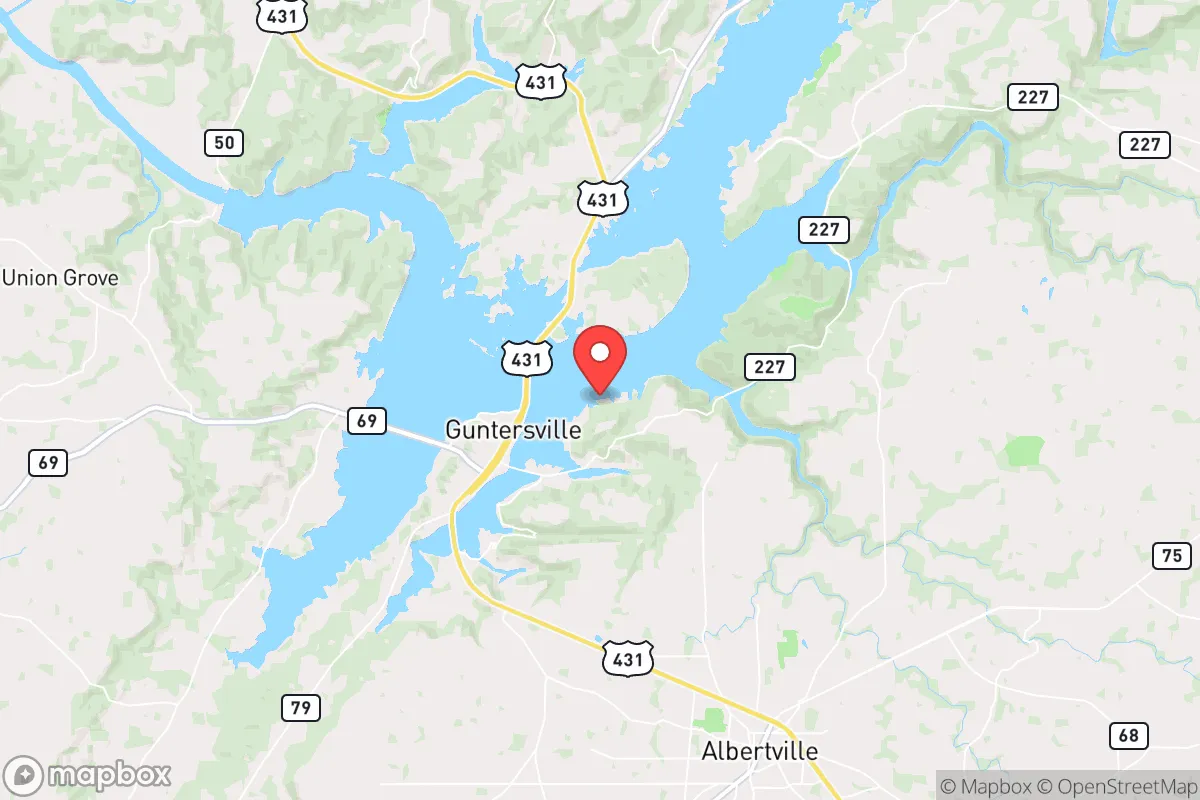
District shown is the primary district for this city’s centroid. Cities may span multiple districts.
Local Political AnalysisPolitical Analysis of Guntersville, AL
Guntersville is about as reliably Republican as any place in Alabama, with a Cook Partisan Voting Index of R+33 that puts it deep in deep-red territory. That number means the area votes roughly 33 points more Republican than the national average, and in practice, you’ll see GOP candidates routinely win by 70-80% margins in local elections. The trajectory here has been stable for decades—there’s no sign of a shift toward the center, and if anything, the surrounding Marshall County has only gotten redder since the 2010s as new retirees and remote workers from more purple states move in, drawn by the lake and low taxes.
How it compares
Alabama as a whole is also solidly Republican, but Guntersville’s R+33 is notably more conservative than the state’s overall lean, which sits around R+15 to R+20 depending on the election cycle. For context, Huntsville, about 40 miles north, is R+20 and has a growing moderate-liberal bloc thanks to its tech and aerospace workforce; Birmingham and Montgomery are Democratic-leaning. Guntersville, by contrast, lacks that kind of urban counterweight. The closest town with a noticeably different political flavor is Albertville, about 15 miles west, which has a larger Hispanic population and tends to vote slightly less Republican—though still overwhelmingly red. Scottsboro, 30 miles east, is similar to Guntersville in its deep-red profile. What sets Guntersville apart is the intensity of its conservatism: it’s not just a Republican town, it’s a place where local GOP primaries are often the only competitive elections, and where Democratic candidates rarely even bother to campaign.
What this means for residents
For conservative residents, the political climate is a comfortable fit. Local government, school board, and law enforcement are all reliably Republican, and policies like low property taxes (Marshall County’s millage rate is among the lowest in the state) and minimal zoning reflect that. Gun rights are broadly supported, and you’ll see open carry in everyday life. For liberal residents, the reality is more isolating. There’s no active Democratic Party presence in the county, and progressive viewpoints are rarely represented in local media or public meetings. That said, the area is not hostile—people are generally polite and neighborly regardless of politics—but it can feel like you’re swimming against the current. National issues like abortion or immigration are discussed in overwhelmingly conservative terms, and local candidates who stray from that line rarely get traction.
Culturally, Guntersville’s politics are tied to its identity as a lake town with a strong outdoor recreation economy. There’s a libertarian streak here—people want to be left alone to fish, hunt, and run their businesses without interference. That’s a distinction from, say, the more religiously conservative parts of Alabama like Cullman or the Wiregrass. You’ll find fewer church-based political endorsements and more emphasis on property rights and Second Amendment issues. The city council has occasionally clashed with the county commission over development regulations, but those fights are usually about local control, not ideology. Looking ahead, as the lake continues to attract out-of-state buyers, there might be a slow drift toward more moderate positions on environmental issues—lake water quality and shoreline development are already hot topics—but don’t expect any change in the partisan lean anytime soon.

State Political ClimatePolitical Climate in Alabama
State Political AnalysisPolitical Environment in the State
Alabama is one of the most reliably Republican states in the country, with a deep-red lean that has only solidified over the past two decades. The state hasn’t voted for a Democratic presidential candidate since 1976, and in 2024, Donald Trump carried it by over 30 points. The dominant coalition is a mix of rural white conservatives, evangelical Christians, and a growing number of suburban voters in places like Auburn and Madison who have shifted rightward since the early 2000s. The Democratic base is almost entirely concentrated in the Black Belt counties—like Montgomery, Selma, and Greene County—and in the urban core of Birmingham, but these areas have lost relative population share, making the statewide trend even more Republican over the last 10-20 years.
Urban vs. rural divide
The political map of Alabama is a study in stark contrasts. The major metros—Birmingham, Montgomery, and Mobile—are Democratic-leaning islands in a sea of red. Birmingham’s Jefferson County is the state’s most populous and votes reliably blue, driven by a large Black population and a growing liberal white professional class in neighborhoods like Homewood and Mountain Brook (though the latter is still conservative-leaning). Montgomery, the capital, is majority-Black and votes Democratic, but its surrounding suburbs like Prattville and Wetumpka are deeply red. The rural areas—especially the northern counties like DeKalb and Marshall, and the Wiregrass region around Dothan—are among the most conservative in the nation. The Huntsville metro is a fascinating exception: it’s a rapidly growing, high-education area driven by aerospace and defense jobs, and while it leans Republican, it’s more moderate and libertarian-leaning than the rest of the state, with a noticeable independent streak. The divide isn’t just about geography; it’s about race, education, and economic base, with the Black Belt’s rural poverty voting blue and the white, wealthier suburbs and small towns voting red.
Policy environment
Alabama’s policy environment is a textbook example of a low-tax, low-regulation, socially conservative state. There is no state income tax on retirement income, and the state’s combined state and local sales tax rate averages around 9.2%, one of the highest in the nation, which hits lower-income residents hardest. Property taxes are among the lowest in the country, thanks to a 1978 constitutional amendment that caps assessment increases. The state has a right-to-work law, no minimum wage above the federal floor, and a regulatory climate that the American Legislative Exchange Council consistently ranks as business-friendly. On education, Alabama has a school choice program—the Alabama Accountability Act—that provides tax credits for private school tuition, and in 2024, the state expanded its charter school law. Healthcare policy is limited: Alabama did not expand Medicaid under the Affordable Care Act, leaving roughly 200,000 residents in the coverage gap. Election laws are strict: voter ID is required, and in 2024, the state passed a law banning curbside voting and limiting absentee ballot drop boxes. The state’s constitution still contains language banning interracial marriage (unenforceable since the 1967 Loving decision), but efforts to remove it have repeatedly failed in the legislature.
Recent policy direction
The last few years have seen Alabama push aggressively into culturally conservative territory. In 2023, the legislature passed a near-total abortion ban with no exceptions for rape or incest, which was blocked by courts but remains the stated policy goal. On gun rights, Alabama is a constitutional carry state (permitless carry for handguns since 2022) and has a “Stand Your Ground” law with no duty to retreat. Parental rights in education were strengthened with the 2022 “Don’t Say Gay” style law (the Alabama Parental Rights Act), which restricts classroom discussion of sexual orientation and gender identity in K-5. On speech and privacy, the state passed a law in 2024 banning TikTok on government devices and requiring social media platforms to verify the ages of users under 18. Medical and bodily autonomy is heavily restricted: gender-affirming care for minors was banned in 2022, and the state has a 48-hour waiting period for abortions even when legally available. Property rights are strong, with no state-level rent control and a robust homestead exemption. On voting, the 2024 election law tightened absentee ballot rules and banned the use of private money for election administration. The overall direction is toward more cultural conservatism, less regulation, and a firm resistance to federal mandates on everything from environmental rules to healthcare.
Civil unrest & political movements
Alabama has a history of civil rights activism that remains a living memory, but modern political movements are more fragmented. The Black Lives Matter protests in 2020 were significant in Birmingham and Montgomery, with large, mostly peaceful demonstrations and some clashes with police. On the right, the “Stop the Steal” movement had a strong presence, with rallies at the state capitol in 2020 and 2021, and the Alabama Republican Party passed a resolution in 2021 calling for an audit of the 2020 election results. Immigration politics are less visible than in border states, but there’s a vocal anti-sanctuary movement: in 2024, the legislature passed a law requiring local law enforcement to cooperate with ICE and banning sanctuary policies. There’s no serious secessionist movement, but “nullification” rhetoric occasionally surfaces in debates over federal gun laws or environmental regulations. Election integrity remains a flashpoint: the 2022 secretary of state race was dominated by claims of voter fraud, and the state has purged voter rolls aggressively. A new resident would notice the Confederate monument debates—Birmingham removed its monument in 2020, while Montgomery still has a prominent one—and the ongoing tension over how the state’s history is taught in schools.
Projection
Over the next 5-10 years, Alabama is likely to become even more Republican, but with a growing libertarian and moderate wing in the Huntsville and Auburn areas. In-migration is modest but concentrated in these high-growth metros, which are attracting tech and defense workers from blue states who tend to be fiscally conservative but socially moderate. The Black Belt’s population is declining, which will further reduce the Democratic base. The state’s political trajectory will likely see continued fights over education funding, with the school choice movement gaining ground, and over healthcare, as the Medicaid expansion debate resurfaces every few years. The biggest wild card is the federal courts: Alabama’s abortion ban and voting laws are likely to face ongoing legal challenges, and a future Democratic administration could force changes. But for the foreseeable future, expect the state to remain a solid red stronghold, with policy moving further right on cultural issues while maintaining its low-tax, low-regulation economic posture.
For a new resident, the bottom line is straightforward: if you’re conservative, you’ll find a state that aligns with your values on taxes, guns, and social issues, with a government that’s responsive to your concerns. If you’re liberal, you’ll be in a clear minority, especially outside of Birmingham and the Black Belt, and you’ll face a policy environment that’s actively hostile to many of your priorities. The practical takeaway is that Alabama is a place where your vote matters less in statewide races but where local politics—especially in cities and counties—can still shape your daily life. The state’s trajectory is stable and predictable, so what you see now is largely what you’ll get for the next decade.
* Values derived from national, state, county, city and local statistics and may differ in a specific area. Last updated: 2026-09-16T22:27:58.000Z
Narrative content on this page is AI-generated and may contain mistakes. Verify any details that matter before acting on them.
ReloMaps may earn a commission from affiliate links at no extra cost to you.

