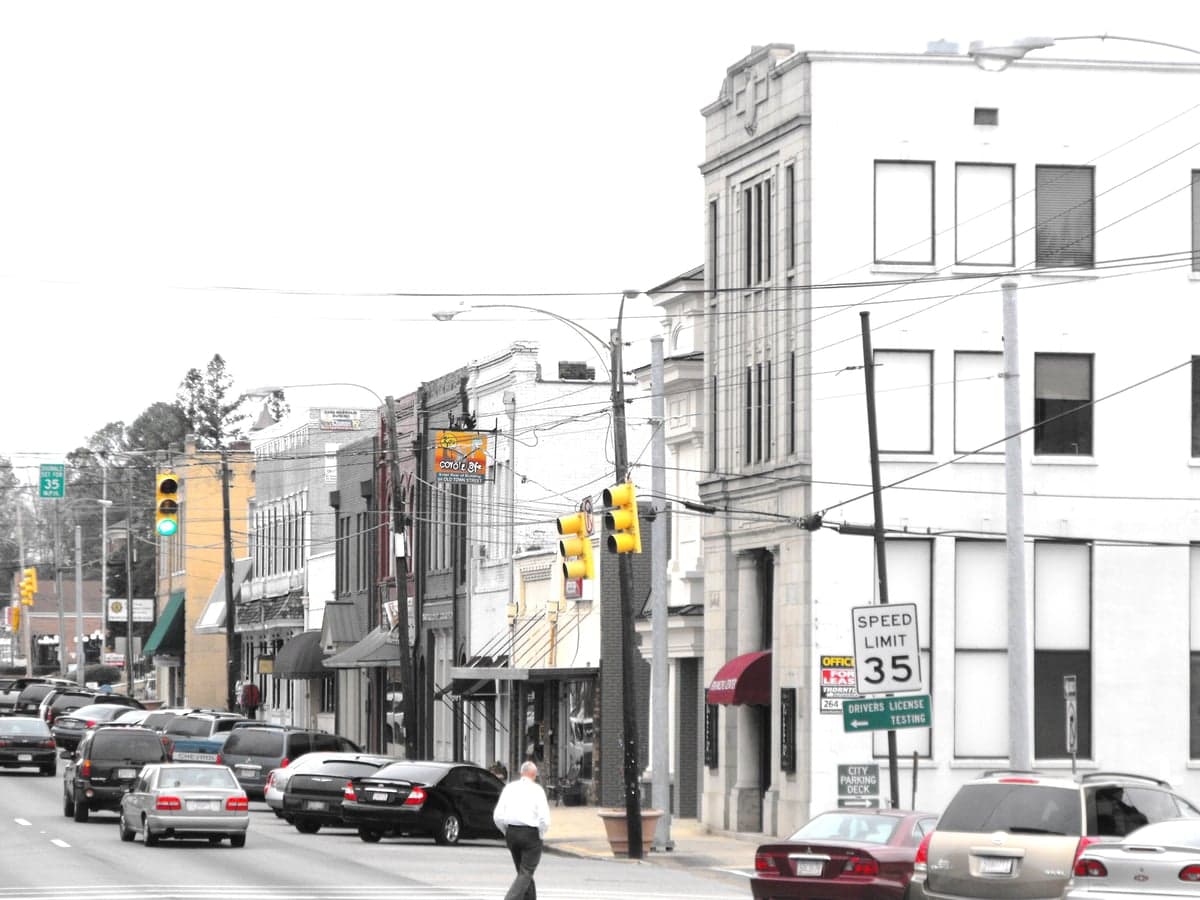
Photo: Wikipedia
Personal Sovereignty in Guntersville, AL
Viable for self-reliance. Generally workable, though some barriers may limit total independence.
What does Personal Sovereignty tell us?
Personal Sovereignty measures your capacity for self-reliance and independence with minimal government friction. Higher scores mean fewer barriers between you and the way you want to live... but it assumes you have the space you need and good neighbors.
What does this tell us?
Personal Sovereignty measures your capacity for self-reliance and independence with minimal government friction. Higher scores mean fewer barriers between you and the way you want to live... but it assumes you have the space you need and good neighbors.
State Policy
Energy independence: Importer (45% of energy produced in-state)
Personal Liberty
Homesteading

Personal Liberty Analysis
Guntersville, Alabama, offers a notably high degree of personal sovereignty, rooted in Alabama’s strong constitutional protections for individual rights and a consistently low-tax, low-regulation state posture. For a relocation-minded individual or family prioritizing autonomy, the area provides a legal and practical environment where self-reliance is the baseline expectation, not an exception. The combination of permissive gun laws, minimal zoning in unincorporated areas, and a state government that explicitly limits its own reach creates a setting where residents are largely free to direct their own lives without heavy-handed interference.
Tax burden and regulatory posture in Guntersville and Alabama
Alabama’s tax structure is among the lightest in the nation, and Guntersville residents benefit directly. The state levies a flat 2% to 5% personal income tax, with a standard deduction that shelters most middle-class earners from the top bracket. Property taxes are exceptionally low: the effective rate in Marshall County typically runs 0.33% to 0.45% of assessed value, meaning a $300,000 home carries an annual tax bill of roughly $1,000 to $1,350. There is no state-level tax on groceries, though local sales tax in Guntersville city limits totals about 9.5% (state plus local). The regulatory environment is correspondingly light. Alabama is a right-to-work state with no state-level occupational licensing for many trades, and the state government has actively preempted local ordinances on matters like short-term rentals, plastic bag bans, and minimum wage increases. For a business owner or independent contractor, this means fewer compliance hurdles and lower overhead. The state’s regulatory flexibility is especially evident in land use: outside Guntersville’s city limits, Marshall County imposes minimal zoning, allowing property owners broad discretion in how they use their land.
Self-defense and gun law specifics in Guntersville
Alabama is a constitutional carry state, meaning no permit is required to carry a concealed handgun for anyone legally allowed to possess a firearm. Guntersville residents can carry openly or concealed without a license, though a permit remains available for reciprocity with other states. The state’s Stand Your Ground law, codified in Alabama Code § 13A-3-23, removes any duty to retreat before using deadly force in any place where a person has a legal right to be. Castle Doctrine protections extend to vehicles and occupied structures, with a legal presumption that a forcible entry creates reasonable fear of imminent death or great bodily harm. There are no state-level restrictions on magazine capacity, no assault weapon bans, and no firearm registration requirements. Background checks are required only for purchases from licensed dealers; private sales between individuals are unregulated. For a reader prioritizing self-defense autonomy, Guntersville sits in one of the most permissive legal environments in the country. The local sheriff’s office in Marshall County is known for issuing permits quickly (for those who still want one for reciprocity), and the culture strongly supports individual firearm ownership as a normal part of daily life.
Self-reliance and homesteading viability: lot sizes, zoning, and off-grid feasibility
Guntersville’s location on Lake Guntersville, combined with surrounding rural Marshall County, makes it a strong candidate for homesteading and off-grid living. In unincorporated areas of the county, minimum lot sizes are typically 1 to 5 acres depending on the specific subdivision or area, but many parcels of 10 to 40 acres are available within a 15-minute drive of downtown. Zoning in the county is minimal: there are no county-wide building codes for agricultural structures, no restrictions on keeping chickens, goats, or livestock on parcels over one acre, and no prohibition on alternative energy systems. Solar panels and small wind turbines are permitted without special permits, and the county does not require connection to municipal water or sewer on rural parcels—wells and septic systems are standard. Off-grid feasibility is high: the area receives ample sunlight for solar, and the Tennessee Valley Authority (TVA) provides reliable grid backup if needed. Rainwater collection is legal and common for irrigation. The city of Guntersville itself has more conventional zoning (R-1 residential, commercial districts), but even within city limits, residents can keep backyard chickens on lots of half an acre or more. For a family wanting to grow food, raise animals, and reduce reliance on external systems, the regulatory barriers are low and the practical infrastructure (feed stores, farm supply co-ops, local extension office) is well-established.
Personal liberties: parental rights, medical autonomy, speech, and property
Alabama law provides strong protections for parental rights. The state’s Parents’ Bill of Rights (Alabama Code § 16-1-51) affirms that parents have the fundamental right to direct the upbringing, education, and healthcare of their minor children. This includes the right to opt children out of any school curriculum or activity the parent finds objectionable, and to access all educational and medical records. Medical autonomy is similarly broad: Alabama does not require parental consent for routine medical care, but it does require parental consent for most non-emergency procedures on minors, and the state has no vaccine mandate for school attendance (only a requirement to submit an exemption form). For adults, the state does not mandate health insurance coverage for specific treatments, and alternative medicine practitioners (naturopaths, herbalists) operate with minimal regulation. Free speech is protected under the Alabama Constitution, which explicitly guarantees the right to speak, write, and publish freely. There are no state-level hate speech laws that restrict expression, and the state has preempted local governments from enacting their own speech restrictions. Property rights are robust: Alabama is a “pure” fee simple state, meaning there are no state-level restrictions on what a property owner can do with their land unless a local ordinance specifically applies. Eminent domain is limited to public use projects, and the state has strong protections against regulatory takings. For a reader who values the ability to live, speak, and raise a family without government overreach, Guntersville’s legal framework is among the most accommodating in the Southeast.
Overall, Guntersville offers a level of personal sovereignty that is rare even by Southern standards. The combination of constitutional carry, minimal property tax, permissive land-use rules, and strong protections for parental and property rights creates an environment where individuals and families can exercise genuine autonomy over their daily lives. Compared to states with more centralized regulatory systems—such as California, New York, or even neighboring Tennessee in some respects—Guntersville’s legal and cultural posture is distinctly hands-off. For a relocation reader whose primary concern is maximizing personal freedom while maintaining access to a small-town community and natural amenities, this area represents a strong, data-backed choice.

* Values derived from national, state, county, city and local statistics and may differ in a specific area. Last updated: 2026-09-16T22:27:58.000Z
Narrative content on this page is AI-generated and may contain mistakes. Verify any details that matter before acting on them.
ReloMaps may earn a commission from affiliate links at no extra cost to you.

