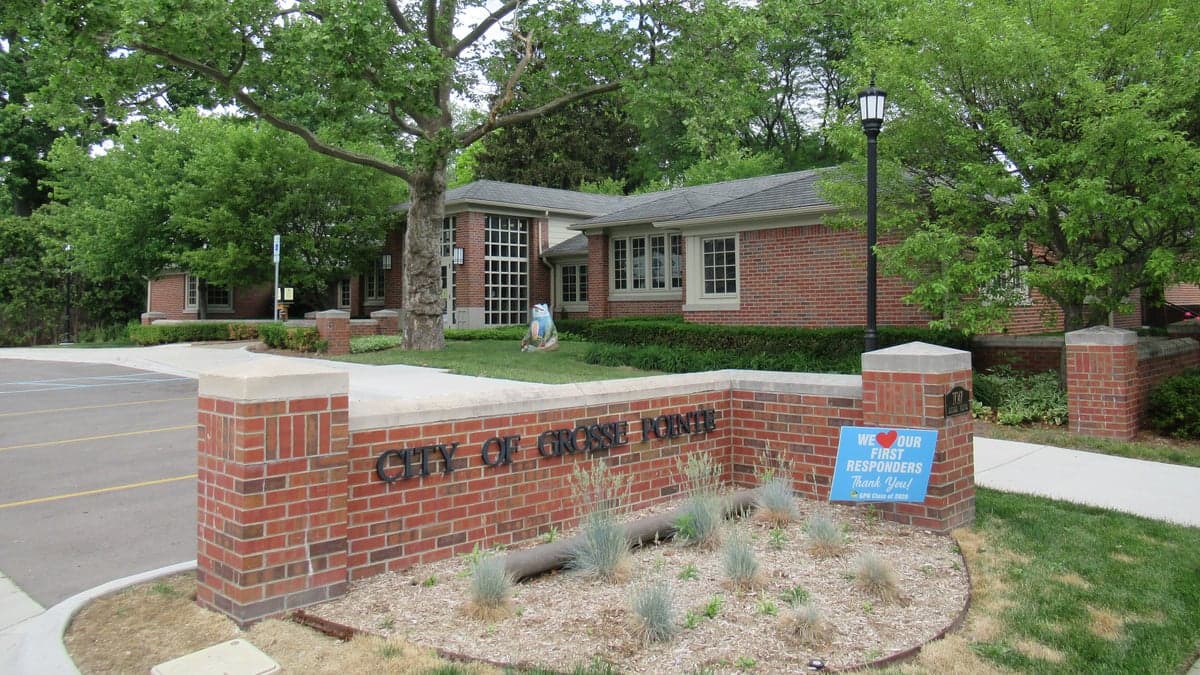
Photo: Wikipedia
Personal Sovereignty in Grosse Pointe, MI
Strong independent fundamentals that actively favor personal liberty and low regulation.
What does Personal Sovereignty tell us?
Personal Sovereignty measures your capacity for self-reliance and independence with minimal government friction. Higher scores mean fewer barriers between you and the way you want to live... but it assumes you have the space you need and good neighbors.
What does this tell us?
Personal Sovereignty measures your capacity for self-reliance and independence with minimal government friction. Higher scores mean fewer barriers between you and the way you want to live... but it assumes you have the space you need and good neighbors.
State Policy
Energy independence: Importer (22% of energy produced in-state)
Personal Liberty
Homesteading

Personal Liberty Analysis
Grosse Pointe, Michigan, presents a nuanced environment for personal sovereignty, where the dense, established character of these lakeshore suburbs creates a trade-off between certain freedoms and the benefits of a highly organized community. While Michigan’s state-level legal framework provides a baseline of individual rights, the local regulatory posture in the Grosse Pointes is decidedly more interventionist than in rural or exurban parts of the state. For a relocation-minded individual or family prioritizing autonomy, the key question is whether the area’s strong property values, excellent services, and low crime justify the tighter leash on certain personal choices, from home modifications to self-defense options.
Tax burden and regulatory posture in the Grosse Pointes
The tax burden in the Grosse Pointes is substantial, a direct consequence of the high-quality municipal services and schools that define the area. Property taxes are the primary driver, with combined millage rates (city, county, school district, and library) typically falling between 30 and 35 mills, translating to roughly $10,000 to $12,000 annually on a $350,000 home. This is significantly above the Michigan average of around 25 mills. The regulatory posture is equally hands-on. The five individual Grosse Pointe cities—Grosse Pointe, Grosse Pointe Farms, Grosse Pointe Park, Grosse Pointe Shores, and Grosse Pointe Woods—each maintain their own zoning codes, building departments, and historic district commissions. These bodies exert tight control over exterior modifications, from fence heights and paint colors to tree removal and driveway materials. A homeowner cannot simply replace a window or add a deck without a permit and often a review by a design board. This level of regulation ensures a uniform, high-end aesthetic and protects property values, but it directly limits a property owner’s ability to alter their home without bureaucratic approval. There is no county-level income tax, and Michigan’s state income tax is a flat 4.25%, but the local property tax and regulatory overhead are the primary costs of personal sovereignty in this area.
Self-defense and gun law specifics in Wayne County
Michigan is a shall-issue state for concealed pistol licenses (CPL), meaning the county sheriff must issue a license if the applicant meets statutory requirements, including a background check and completion of a safety course. Wayne County, where all Grosse Pointe communities are located, processes these applications in a generally compliant but sometimes slow manner, with wait times for initial applications occasionally stretching to several months. The state preempts local firearm ordinances, so Grosse Pointe cities cannot enact their own bans on open carry or concealed carry beyond state law. However, local police departments are known to be proactive, and the dense, suburban environment means that discharging a firearm within city limits is strictly prohibited except at a licensed range. For self-defense within the home, Michigan law provides a strong Castle Doctrine and Stand Your Ground statute, with no duty to retreat in any place where an individual is lawfully present. This is a significant protection for residents. Magazine capacity and the types of firearms (including modern sporting rifles) are not restricted by state law, though federal restrictions on NFA items (suppressors, short-barreled rifles) apply. For a gun owner, the legal framework is solid, but the practical reality is that the Grosse Pointes are not a place where one can freely shoot on private property, and the local culture is one of lawful, discreet ownership rather than overt display.
Self-reliance and homesteading viability: lot sizes and off-grid feasibility
Homesteading and off-grid living are not viable in the Grosse Pointes. The typical lot size in the core cities (Grosse Pointe, Grosse Pointe Park, Grosse Pointe Farms) is a quarter-acre or less, with many homes on lots of 6,000 to 10,000 square feet. Grosse Pointe Woods and Grosse Pointe Shores offer slightly larger lots, occasionally reaching half an acre, but still far below what is needed for meaningful self-sufficiency. Zoning codes explicitly prohibit agricultural uses, including keeping chickens, goats, or bees in most residential districts. Front-yard vegetable gardens are often restricted or require special approval. Rainwater collection is not explicitly banned but is effectively impractical due to lot size and homeowners association (HOA) or city covenants. Solar panel installation is permitted but subject to strict aesthetic review by historic commissions and zoning boards, often requiring them to be placed on rear roof slopes only, which can dramatically reduce efficiency. The entire area is served by municipal water, sewer, natural gas, and high-speed internet, making disconnection from the grid a non-starter. For a reader seeking self-reliance through land, livestock, or energy independence, the Grosse Pointes are the wrong choice. This environment is for those who define sovereignty through financial security, property value appreciation, and access to urban amenities, not through physical self-sufficiency.
Personal liberties: parental rights, medical autonomy, speech, and property
Michigan law provides a baseline of personal liberties that apply in the Grosse Pointes. Parental rights are generally strong, with state law affirming parents’ authority to direct the upbringing, education, and healthcare of their minor children. School choice exists through inter-district transfer options and a robust charter school network in the region, though the Grosse Pointe Public School System is a major draw and most families opt in. Medical autonomy is a mixed picture. Michigan has no state-level vaccine mandate for adults, but school immunization requirements are standard, with a philosophical exemption available for parents. The state’s COVID-era emergency powers were a flashpoint, but those have since lapsed. Regarding speech, the First Amendment applies fully, and the Grosse Pointes have no local ordinances restricting political signage or public expression beyond standard time, place, and manner restrictions. Property rights, however, are the most constrained liberty in this area. As noted, the combination of city zoning, historic district commissions, and HOA covenants (in some neighborhoods) creates a thicket of approvals for any exterior change. A homeowner cannot paint their house a non-approved color, install a fence over four feet, or build a shed without a permit and often a public hearing. This is the price of living in a highly curated, high-value community. For a reader who values the ability to do what they want with their own property without asking permission, this will feel restrictive. For someone who values predictable aesthetics and neighborly standards, it is a feature, not a bug.
Overall, personal sovereignty in the Grosse Pointes is best understood as a trade-off: you cede significant control over your property and daily choices in exchange for a safe, well-managed, and high-amenity environment. The tax burden is heavy, the regulatory touch is light-years from laissez-faire, and self-reliance in the homesteading sense is impossible. However, the state-level protections for self-defense, parental rights, and speech are solid. Compared to a rural Michigan county like Alpena or Montcalm, where you can own 40 acres, build a cabin without a permit, and shoot on your own land, the Grosse Pointes offer far less personal autonomy. Compared to a similarly affluent inner-ring suburb like Oak Park, Illinois, or Shaker Heights, Ohio, the tax burden is lower and the gun laws are more permissive. For the conservative-leaning reader who prioritizes financial sovereignty, low crime, and excellent schools over the ability to modify their home at will, the Grosse Pointes can work. For the reader who wants maximum personal independence with minimal government or HOA interference, this area will feel like a velvet cage.

* Values derived from national, state, county, city and local statistics and may differ in a specific area. Last updated: 2026-11-14T16:59:05.000Z
Narrative content on this page is AI-generated and may contain mistakes. Verify any details that matter before acting on them.
ReloMaps may earn a commission from affiliate links at no extra cost to you.

