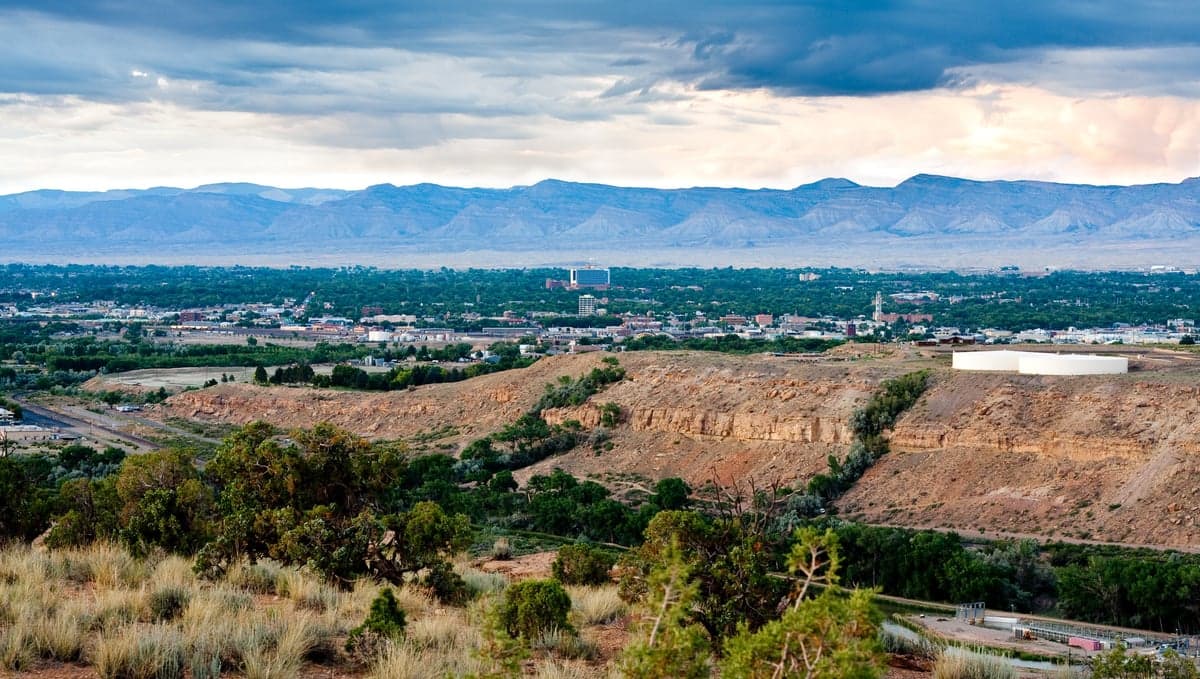
Photo: Wikipedia
Political ClimatePolitical Climate in Grand Junction, CO
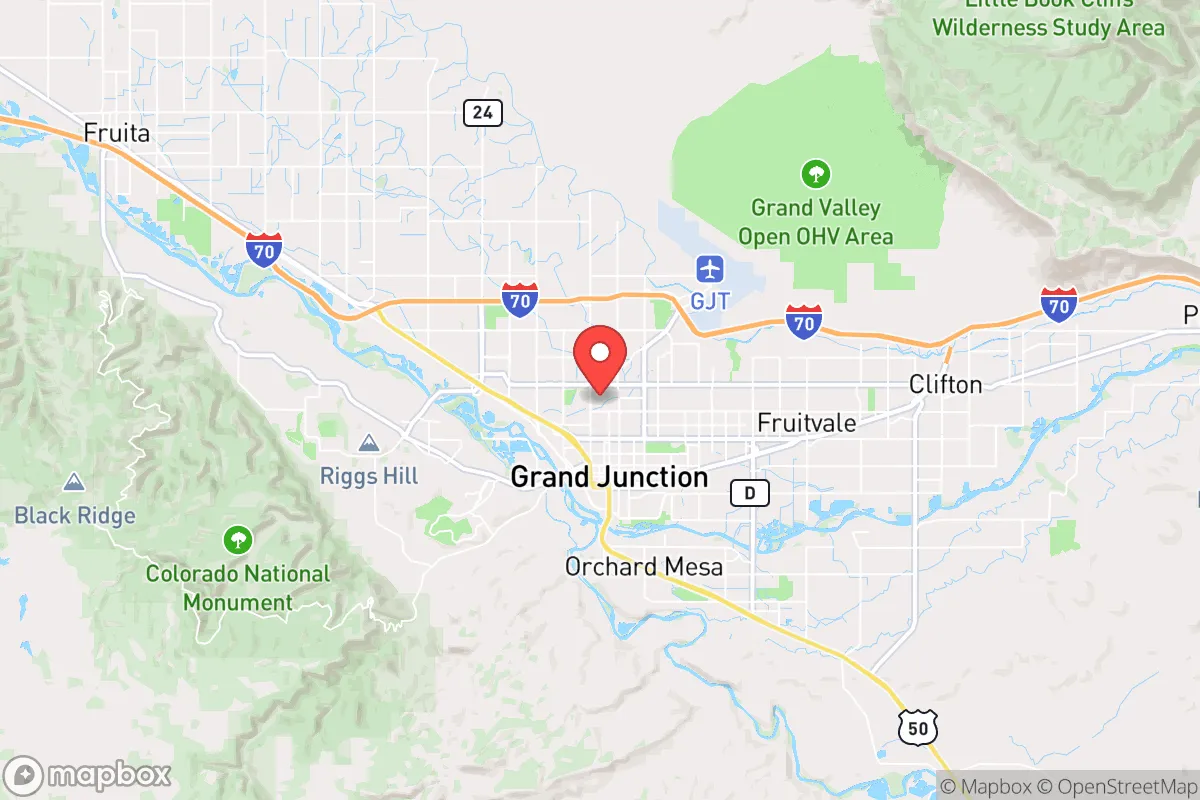
District shown is the primary district for this city’s centroid. Cities may span multiple districts.
Local Political AnalysisPolitical Analysis of Grand Junction, CO
Grand Junction has long been a reliably conservative stronghold in western Colorado, and while the area still leans right with a Cook PVI of R+5, you can feel the political winds shifting in ways that would have been unthinkable even a decade ago. The city itself has a solid Republican base, but the influx of out-of-state transplants—many from deep-blue states like California and Oregon—has started to nudge the local Overton window leftward. That said, the surrounding Mesa County remains deeply red, and most local elections still go to candidates who prioritize limited government, Second Amendment rights, and local control over land use. The real tension isn't between Republicans and Democrats so much as it is between traditional Western libertarian conservatism and a newer, more progressive strain that's creeping into city council races and school board meetings.
How it compares
If you drive 40 miles east to Palisade or 20 miles north to Fruita, you'll find communities that are even more conservative than Grand Junction itself—places where the "Don't Tread on Me" ethos is still the default setting. But head south toward Delta or Montrose, and you'll see a similar pattern: rural towns that vote overwhelmingly red, but with a growing progressive minority that's becoming more vocal. The real contrast is with Boulder or Denver, which are about as far left as you can get in Colorado. Grand Junction feels like a different planet compared to those places—more independent, more skeptical of federal mandates, and far less tolerant of government overreach into personal freedoms. The local paper, the Daily Sentinel, still runs plenty of op-eds defending property rights and school choice, but you'll also see more pieces pushing climate action and diversity initiatives than you did five years ago. That's the canary in the coal mine for a lot of longtime residents.
What this means for residents
For folks who value personal liberty and want to keep government out of their lives, the near-term outlook in Grand Junction is still pretty good—but you have to stay engaged. The city council recently debated a rental inspection ordinance that many saw as an overreach into private property rights, and while it didn't pass, it came closer than it would have in 2015. School board meetings have gotten heated over curriculum transparency and parental rights, with some parents worried that progressive ideology is being pushed on kids without their consent. On the plus side, Mesa County still has a sheriff who publicly refuses to enforce any state gun laws he considers unconstitutional, and the county commission is solidly conservative on land-use issues. The long-term trajectory, though, depends on who moves here next. If the growth continues to bring in people who want to turn Grand Junction into a mini-Boulder, you can expect more battles over zoning, taxes, and the role of local government.
Culturally, Grand Junction still feels like a place where a handshake matters more than a government mandate. The annual Country Jam festival, the thriving outdoor recreation scene, and the strong agricultural roots all reinforce a live-and-let-live attitude. But there's a growing tension between that Western independence and the push for more regulation—whether it's plastic bag bans, energy efficiency mandates, or "equity" training for city employees. The local economy is still driven by natural resources, healthcare, and small business, and most people here would rather solve problems at the kitchen table than through a city ordinance. If you're considering a move, just know that Grand Junction is still a place where you can own your land, carry your firearm, and raise your kids without a lot of bureaucratic interference—but you'll need to keep an eye on the ballot box to make sure it stays that way.

State Political ClimatePolitical Climate in Colorado
State Political AnalysisPolitical Environment in the State
Colorado has undergone a dramatic political transformation over the past two decades, shifting from a classic purple swing state to a solidly blue stronghold at the state level, though with deep internal fractures. The Democratic Party now controls every statewide office, both U.S. Senate seats, and both chambers of the state legislature, a dominance that was unthinkable in the early 2000s when the state was reliably Republican in presidential elections. This shift has been driven by massive in-migration from coastal states, particularly to the Denver-Boulder corridor, which has overwhelmed the state’s historically conservative rural and suburban base. For a conservative considering relocation, the state’s trajectory is a cautionary tale of how fast a place can change when policy and population trends align.
Urban vs. rural divide
The political map of Colorado is a story of two completely separate states. The Front Range urban corridor—Denver, Boulder, Aurora, and the suburbs of Jefferson and Arapahoe counties—is overwhelmingly Democratic and drives statewide election results. Denver County itself routinely votes 80%+ Democratic, while Boulder County is even further left. In contrast, the Eastern Plains, the Western Slope, and the San Luis Valley are deeply Republican. El Paso County (Colorado Springs) remains a conservative stronghold, but its influence is diluted by the massive population growth in the Denver metro. The real flashpoint is the suburban ring: counties like Adams, Broomfield, and Larimer (home to Fort Collins) have flipped from purple to blue in the last decade, driven by younger, college-educated transplants. Rural counties like Moffat, Rio Blanco, and Kiowa vote 75-80% Republican, but they simply don’t have the population to counterbalance the urban machine. The 2020 election saw Denver, Boulder, and Jefferson counties alone deliver a margin larger than the entire state’s Republican vote.
Policy environment
Colorado’s policy environment is a mixed bag that leans heavily progressive, with some notable exceptions. The state income tax is a flat 4.4%, which is relatively low, but the state has a history of passing tax increases through ballot initiatives—like Proposition CC (2019) which allowed the state to keep revenue that would otherwise be refunded under the Taxpayer’s Bill of Rights (TABOR). TABOR itself is under constant assault from the left, with repeated attempts to weaken or repeal it. On regulation, Colorado is one of the most aggressive states in the nation on environmental policy, with a 2024 law (SB24-229) that effectively bans new natural gas hookups in most new buildings, a direct attack on energy freedom. Education policy is dominated by teachers’ unions, and the state has a universal school choice program, but it’s being eroded by progressive school board takeovers in blue counties. Healthcare is heavily regulated, with a state-run reinsurance program that has stabilized premiums but at the cost of provider choice. Election laws are among the most liberal in the country: universal mail-in voting, same-day registration, and no voter ID requirement for mail ballots—a system that conservatives view as ripe for fraud, despite official denials.
Trajectory & freedom
The trajectory of personal freedom in Colorado is clearly downward, especially for conservatives. The most glaring example is the 2013 gun control package (HB13-1224 and HB13-1229) that imposed universal background checks and magazine capacity limits, passed in the wake of the Aurora theater shooting. Since then, the state has added a “red flag” law (HB19-1177) allowing for temporary firearm seizure without due process, and in 2024 passed a law (SB24-131) that bans the sale of many semi-automatic firearms entirely—a direct infringement on Second Amendment rights. On parental rights, the state has moved in the opposite direction of places like Florida: a 2023 law (HB23-1221) codified protections for transgender students, overriding parental notification requirements in some districts. Medical autonomy took a hit with the 2020 passage of Proposition 115, which banned late-term abortions, but that was a rare win for conservatives. Property rights are under pressure from a 2024 law (SB24-212) that allows local governments to impose rent control, a policy that historically destroys housing markets. The state’s energy policies, including the 2019 law (SB19-181) that gave local governments veto power over oil and gas drilling, have effectively ended new development in many areas, costing jobs and tax revenue.
Civil unrest & political movements
Colorado has been a flashpoint for political activism on both sides. The 2020 George Floyd protests in Denver turned violent, with property damage and clashes with police that lasted weeks. The left-wing activist group “Antifa” has a visible presence in Denver and Boulder, and there have been multiple arrests for vandalism and assault at political rallies. On the right, the “Colorado Springs” area has a strong conservative activist base, and the “Weld County” region (Greeley) has seen organized opposition to oil and gas restrictions. Immigration politics are a major fault line: Denver has a “sanctuary city” policy, and the state has a law (HB19-1124) that limits cooperation between local law enforcement and federal immigration authorities. This has led to a surge in illegal immigration-related crime in the metro area, with the Denver Police Department reporting a 40% increase in gang activity linked to the Venezuelan gang Tren de Aragua. Election integrity remains a hot-button issue: the 2020 election saw widespread use of ballot drop boxes and mail-in voting, and while no major fraud was proven, the system’s lack of transparency has left many conservatives deeply skeptical. The “Colorado Project” and other grassroots groups continue to push for voter ID laws and signature verification reforms, but they face an uphill battle in the Democratic-controlled legislature.
Projection
Looking ahead 5-10 years, the trend lines are clear: Colorado will continue to move left, driven by demographic shifts and in-migration from California, New York, and Illinois. The 2024 election saw the state vote for Kamala Harris by a 13-point margin, and the state legislature is likely to pass even more progressive policies, including a potential repeal of TABOR, a state-level public option for healthcare, and further gun restrictions. The rural-urban divide will only widen, with rural counties losing population and political influence. However, there are some countervailing forces: the high cost of living in the Front Range is pushing some families to more affordable areas like Pueblo and the Western Slope, which could shift those areas slightly right. The 2026 gubernatorial race will be a key test—if a moderate Democrat wins, the pace of change might slow, but if a progressive like Governor Jared Polis’s successor is more left-wing, expect accelerated government overreach. For a conservative moving in now, the realistic expectation is that within a decade, Colorado will look more like Oregon or Washington than the purple state it was in 2010.
For a conservative considering a move to Colorado, the bottom line is this: you are moving into a state where your vote will be increasingly irrelevant at the state level, and where your personal freedoms—especially your Second Amendment rights, your property rights, and your ability to opt out of progressive social policies—are under active assault. The natural beauty and outdoor lifestyle are undeniable, but they come at the cost of living in a state that is rapidly adopting the worst policies of the West Coast. If you are willing to fight for your values at the local level and can afford the high cost of living, places like Colorado Springs, El Paso County, or the Western Slope towns of Grand Junction and Montrose offer a conservative-friendly enclave. But if you want a state where your vote actually matters and your freedoms are respected, you might want to look at Wyoming or Texas instead.
* Values derived from national, state, county, city and local statistics and may differ in a specific area. Last updated: 2026-04-25T04:41:08.000Z
Narrative content on this page is AI-generated and may contain mistakes. Verify any details that matter before acting on them.
ReloMaps may earn a commission from affiliate links at no extra cost to you.

