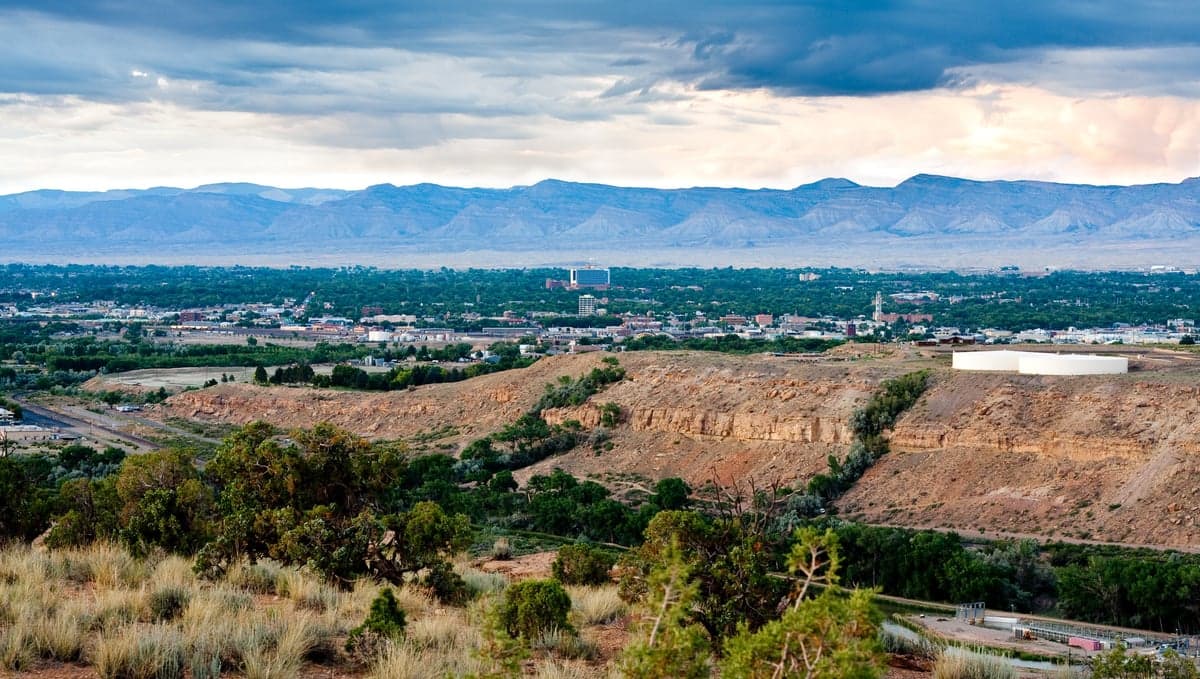
Photo: Wikipedia
Personal Sovereignty in Grand Junction, CO
Viable for self-reliance. Generally workable, though some barriers may limit total independence.
What does Personal Sovereignty tell us?
Personal Sovereignty measures your capacity for self-reliance and independence with minimal government friction. Higher scores mean fewer barriers between you and the way you want to live... but it assumes you have the space you need and good neighbors.
What does this tell us?
Personal Sovereignty measures your capacity for self-reliance and independence with minimal government friction. Higher scores mean fewer barriers between you and the way you want to live... but it assumes you have the space you need and good neighbors.
State Policy
Energy independence: Net exporter (110% of energy produced in-state)
Personal Liberty
Homesteading

Personal Liberty Analysis
Grand Junction offers a notably high degree of personal sovereignty compared to many Front Range or coastal alternatives, largely because Mesa County operates with a deliberate hands-off approach that aligns with a survivalist and prepper mindset. The area’s political culture, rooted in Western individualism, treats government overreach as a threat to be resisted rather than a service to be expanded. For single individuals and parents seeking to minimize state intrusion into daily life—whether that means keeping more of your earnings, defending your home without bureaucratic hurdles, or raising your family according to your own values—this region presents a strategic advantage. The key is understanding where that autonomy is strongest and where the state-level framework still imposes limits.
Tax burden and regulatory posture: how much the state and county leave in your hands
Colorado’s flat income tax rate of 4.4% is moderate, but the real story for Grand Junction is the absence of local income taxes and the county’s resistance to adopting state-level regulatory creep. Mesa County has no county sales tax beyond the state’s 2.9% base, though the city of Grand Junction adds 3.75%, bringing the combined rate to roughly 8.15%—still lower than many urban Colorado jurisdictions. Property taxes are a standout advantage: the effective rate in Mesa County hovers around 0.55% of assessed value, roughly half the national average. For a $400,000 home, that’s about $2,200 annually, compared to $4,000+ in Denver or Boulder. The regulatory posture is equally favorable. Mesa County commissioners have repeatedly pushed back against state mandates on land use, building codes, and environmental restrictions. The county’s planning department is known for processing permits quickly, and there is no countywide rental inspection program or burdensome business licensing regime. For a prepper or homesteader, this means fewer hoops to jump through when building a shop, installing solar panels, or storing water—activities that trigger endless red tape in more regulated counties.
Self-defense and gun law specifics: what you can carry, store, and use without permission
Colorado is a shall-issue state for concealed carry permits, meaning Mesa County issues them to any qualified applicant without subjective discretion. The process is straightforward: a background check, proof of training, and a fee. Grand Junction’s sheriff’s office processes permits in about 30 days, and there are no local ordinances restricting magazine capacity or banning specific firearm types—state preemption prevents that. Open carry is legal without a permit throughout Mesa County, including within Grand Junction city limits, though private businesses can post signage to restrict it. Stand-your-ground laws apply statewide, meaning there is no duty to retreat before using deadly force in self-defense. For parents, this extends to defending your home or vehicle. The state’s “Make My Day” law provides strong civil and criminal immunity for using force against an intruder in your dwelling. However, note that Colorado does have a red-flag law (Extreme Risk Protection Orders) that allows law enforcement or family members to petition a court to temporarily remove firearms. Mesa County commissioners have passed a resolution declaring the county a “Second Amendment Sanctuary,” and local law enforcement has signaled reluctance to enforce the red-flag law aggressively, but the statute remains on the books. For the survivalist, the practical reality is that Grand Junction offers one of the most permissive gun environments in the state, with minimal local interference.
Self-reliance and homesteading viability: lot sizes, zoning, and off-grid feasibility
Grand Junction’s zoning code is a major asset for anyone serious about self-reliance. Within the city, standard residential lots range from 6,000 to 10,000 square feet, but the real opportunity lies in the unincorporated county, where minimum lot sizes for agricultural zoning start at 5 acres and many parcels are 10 to 40 acres. These areas are zoned for livestock, gardens, and accessory structures without special permits. The county allows “rural homestead” designations that permit year-round occupancy on wells and septic systems, bypassing city water and sewer hookups. Off-grid feasibility is high: solar panels are common, and net metering is available through the local utility, Grand Valley Power. Rainwater collection is legal without a permit, and the county does not restrict the number of water storage tanks. Chickens, goats, and even a single cow are allowed on parcels as small as 2.5 acres in agricultural zones. The only notable limitation is that building codes still require a foundation and roof for habitable structures—no shipping-container shacks or unpermitted yurts for permanent residence—but the county’s enforcement is complaint-driven, not proactive. For a family looking to produce a significant portion of their own food and energy, Grand Junction’s regulatory environment is among the most accommodating in the state.
Personal liberties: parental rights, medical autonomy, speech, and property
Parental rights in Mesa County are robust. The school district, Mesa County Valley School District 51, has a conservative board that has resisted state-level mandates on curriculum transparency and health education. Parents can opt their children out of any sex education or health survey without pushback, and the district maintains a policy of notifying parents before any mental health screening. Homeschooling is straightforward: file a notice of intent with the district, provide 172 days of instruction annually, and submit a standardized test or evaluation every other year. There is no requirement to follow state curriculum or use certified teachers. Medical autonomy is more mixed. Colorado has legalized recreational marijuana and assisted suicide, but Mesa County voters have consistently rejected local marijuana sales—there are no dispensaries in the county, which aligns with a conservative preference for avoiding normalization of drug culture. Vaccine mandates for school attendance exist at the state level, but Mesa County has one of the highest exemption rates in Colorado, and many healthcare providers are willing to work with families on alternative schedules. Speech and assembly rights are fully protected; the county has not enacted any local ordinances restricting political signs, public gatherings, or protest. Property rights are strongly defended: Mesa County has no inclusionary zoning, no rent control, and no local historic preservation overlay that could restrict what you do with your land. Eminent domain is used sparingly and almost never for private development.
Overall, Grand Junction delivers a level of personal sovereignty that is rare in modern Colorado. While the state government in Denver continues to push progressive policies on firearms, education, and land use, Mesa County’s local leadership and cultural inertia act as a buffer. For the survivalist or prepper, the calculus is clear: you get the economic and geographic advantages of a Western Colorado hub—access to public lands, lower cost of living, and a growing community of like-minded individuals—without the heavy hand of Front Range governance. Compared to rural counties in the Pacific Northwest or Northeast, Grand Junction offers stronger property rights, lower taxes, and a more permissive regulatory environment. It is not a libertarian utopia—state laws on red flags and vaccines still apply—but it is one of the best bets in the Intermountain West for a family or individual who values being left alone to live, defend, and provide for themselves on their own terms.

* Values derived from national, state, county, city and local statistics and may differ in a specific area. Last updated: 2026-04-25T04:41:08.000Z
Narrative content on this page is AI-generated and may contain mistakes. Verify any details that matter before acting on them.
ReloMaps may earn a commission from affiliate links at no extra cost to you.

