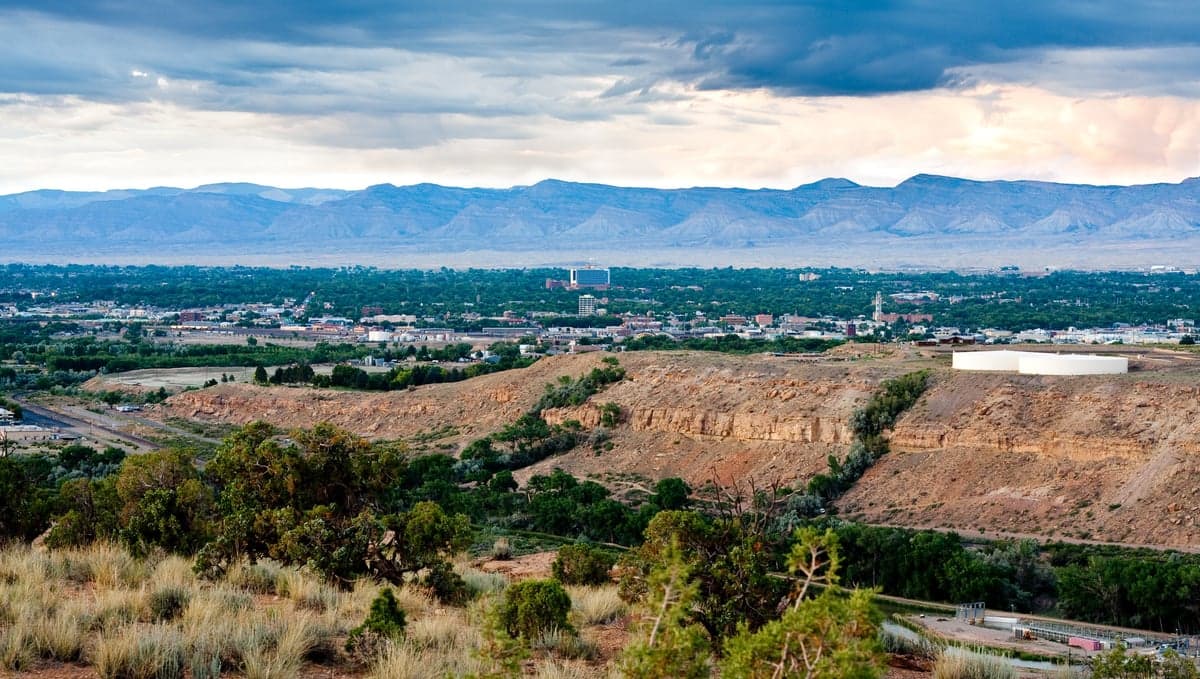
Photo: Wikipedia
Demographics of Grand Junction, CO
Affluence Level in Grand Junction, CO
A middle-class area roughly in line with national averages across income, home values, education, and employment.
People of Grand Junction, CO
Grand Junction, Colorado, is home to 67,027 residents who form a predominantly white (77.0%) and politically conservative community with a growing Hispanic minority (16.6%). The city’s population is notably less diverse than the national average, with a foreign-born share of just 2.2% and small East/Southeast Asian (0.8%), Black (0.7%), and Indian-subcontinent (0.2%) communities. Its identity is rooted in a Western ranching and energy heritage, reflected in a lower college attainment rate (36.1%) than many Front Range cities, and a population that values self-reliance, outdoor recreation, and a slower pace of life.
How the city was settled and grew
Grand Junction was founded in 1881 as a railroad town on the Denver & Rio Grande Western line, with the first wave of settlers drawn by the promise of irrigated farmland along the Colorado and Gunnison rivers. The original population was overwhelmingly Anglo-American homesteaders, many from the Midwest and Great Plains, who established orchards and vineyards that gave the area the nickname "Palisade peach country." The historic Lincoln Park neighborhood, centered around the park of the same name, was the original residential core for these early families, with its modest Victorian homes and proximity to downtown businesses. A second wave arrived during the uranium boom of the 1940s and 1950s, when the federal government established the Climax Uranium Mill and the Colorado Plateau’s mining industry drew workers from rural Colorado and neighboring states. These workers settled in the Orchard Mesa area, a working-class neighborhood south of the Colorado River that remains a hub for tradespeople and energy-sector employees. The city’s population grew steadily through the mid-20th century, reaching roughly 20,000 by 1960, but remained overwhelmingly white and native-born, with little immigration from outside the United States.
Modern era (post-1965)
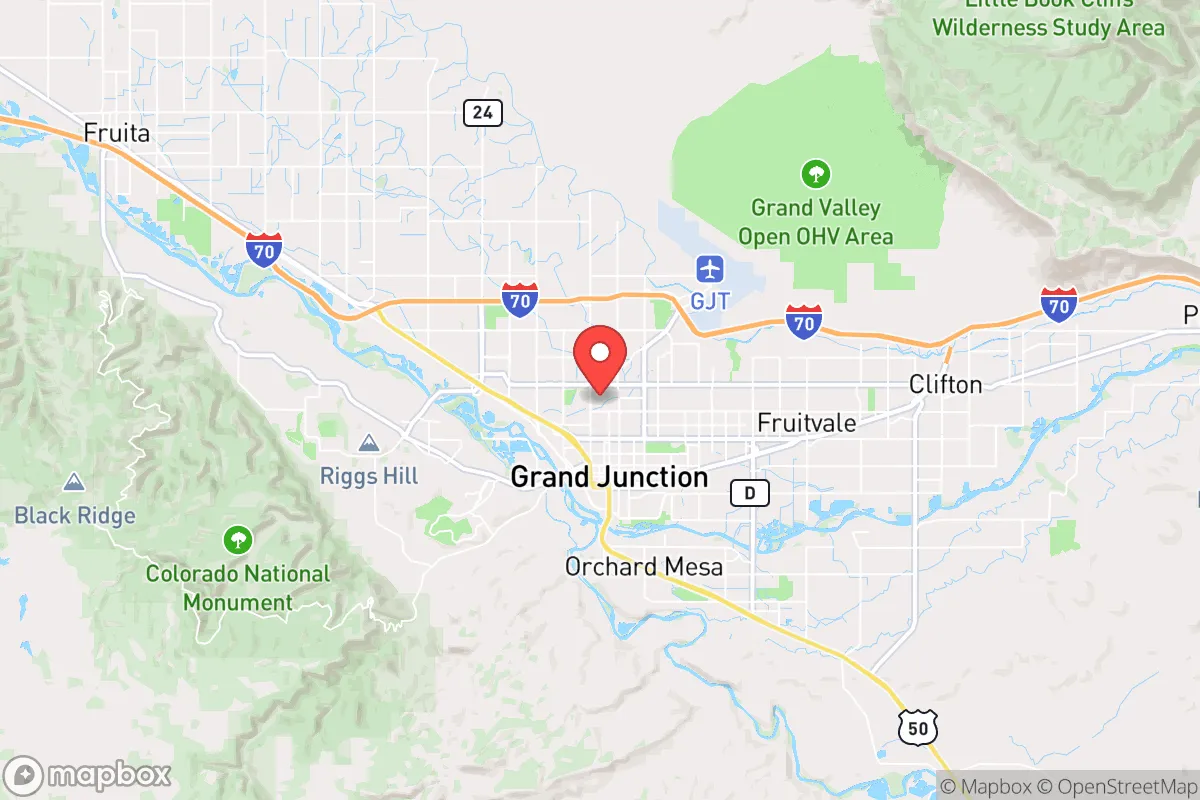
After the 1965 Hart-Cellar Act, Grand Junction saw virtually no increase in foreign-born immigration, unlike many Western cities. The city’s small Hispanic population (16.6% today) is largely composed of multigenerational families with roots in northern New Mexico and southern Colorado, not recent immigrants. These families historically concentrated in the Clifton area, an unincorporated community east of Grand Junction that has become a predominantly Hispanic working-class enclave, and in the Redlands neighborhood, a more established area where Hispanic families have lived for generations alongside Anglo neighbors. The post-1965 period was instead defined by domestic in-migration: retirees and outdoor enthusiasts from California and the Front Range, drawn by lower housing costs and the Colorado National Monument. This wave settled in newer subdivisions like Redlands Mesa and Mesa View, which feature larger lots and mountain views. The city’s Black population remains tiny (0.7%), concentrated in no single neighborhood, while the East/Southeast Asian community (0.8%) is scattered, with a small cluster of Vietnamese-origin families in the Downtown area near the St. Mary’s Medical Center, where some work in healthcare. The Indian-subcontinent population (0.2%) is almost entirely professionals employed at Colorado Mesa University or the region’s hospitals, living in newer developments near the university campus.
The future
Grand Junction’s population is slowly diversifying, but the pace is glacial compared to the Front Range. The Hispanic share is projected to rise to roughly 20-22% by 2040, driven by higher birth rates among established families rather than new immigration. The white non-Hispanic share will decline proportionally but remain above 70%. The city is not tribalizing into distinct ethnic enclaves; instead, Hispanic families are gradually moving into previously all-white neighborhoods like Redlands and Orchard Mesa, while the small Asian and Indian communities remain too tiny to form concentrated clusters. The foreign-born share may tick up to 3-4% as healthcare and tech employers recruit internationally, but Grand Junction lacks the job base and cultural infrastructure to attract large immigrant flows. The bigger demographic story is domestic: an aging population of retirees and a slow outflow of young adults to Denver and the Front Range for better job opportunities. The city’s conservative character and low cost of living will continue to attract politically like-minded migrants from California and the Pacific Northwest, reinforcing its white, native-born majority.
For a conservative-leaning mover, Grand Junction offers a stable, culturally homogeneous community with a strong Western identity and minimal demographic upheaval. The population is slowly becoming more Hispanic, but through assimilation and generational change, not through rapid immigration. The city’s future is one of gradual, organic evolution rather than the rapid diversification seen in Denver or Colorado Springs. It remains a place where the people who live there are likely to have deep local roots, and where newcomers who share those values will find a welcoming, low-drama environment.

* Values derived from national, state, county, city and local statistics and may differ in a specific area. Last updated: 2026-04-25T04:41:08.000Z
Narrative content on this page is AI-generated and may contain mistakes. Verify any details that matter before acting on them.
ReloMaps may earn a commission from affiliate links at no extra cost to you.

