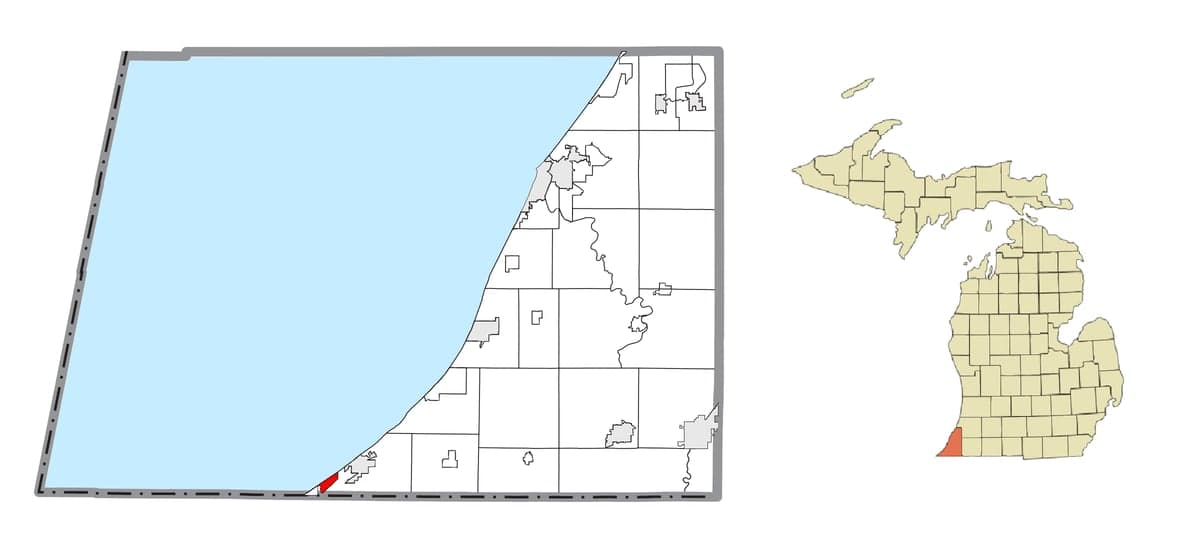
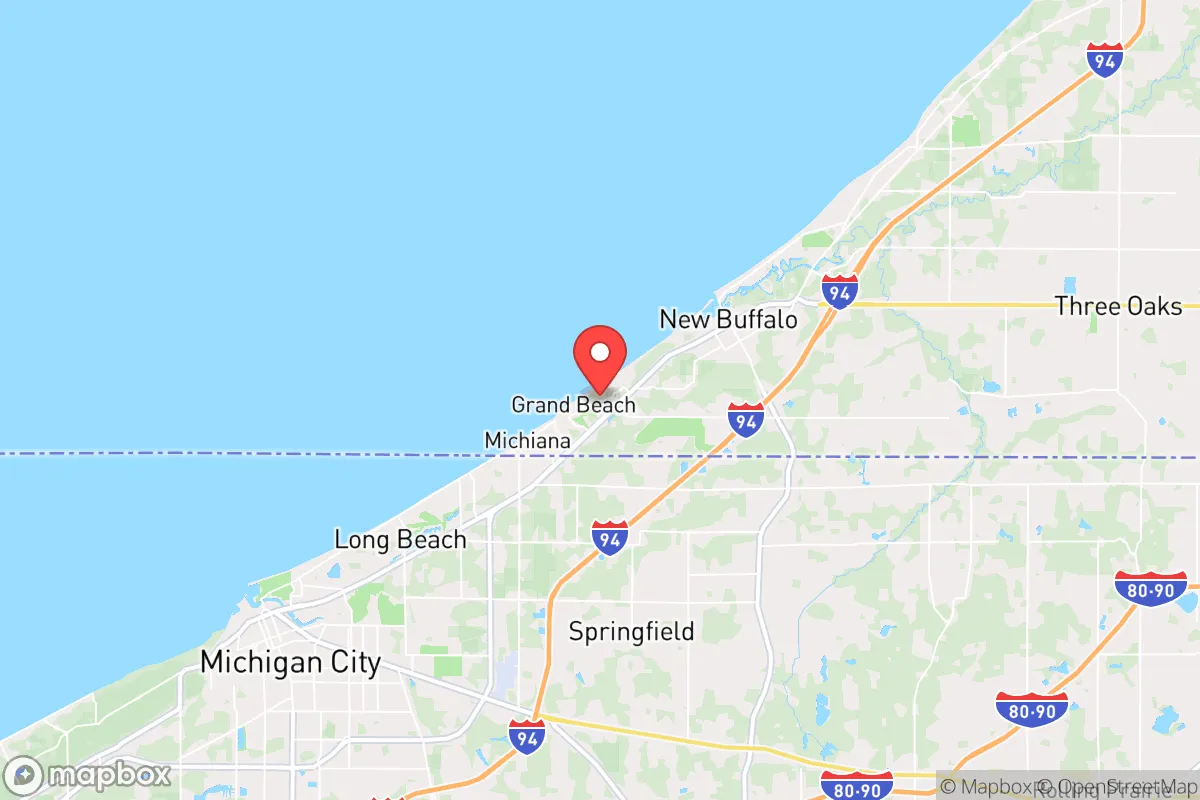
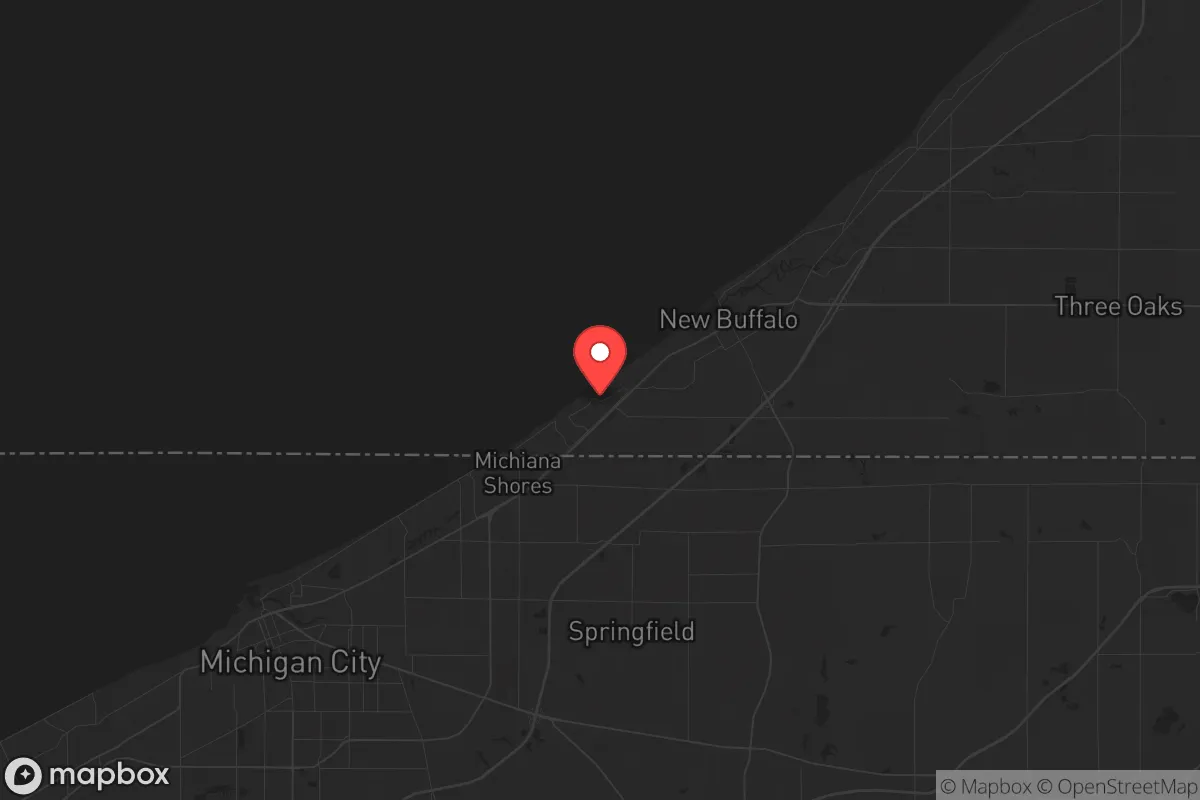
Photo: Wikipedia
Political ClimatePolitical Climate in Grand Beach, MI
District shown is the primary district for this city’s centroid. Cities may span multiple districts.
Local Political AnalysisPolitical Analysis of Grand Beach, MI
Grand Beach sits in a reliably Republican corner of Michigan, with a Cook PVI of R+13 — meaning the area votes about 13 points more Republican than the national average. That’s a stark contrast with the state of Michigan as a whole, which sits at EVEN on the Cook index, a perfect toss-up that flipped from Trump in 2016 to Biden in 2020 and back to Trump in 2024. For a small lakefront village of roughly 300 year-round residents, the politics here are as steady as the shoreline, but the surrounding region tells a more layered story.
How it compares
Grand Beach’s R+13 lean puts it in the same political family as nearby Berrien County’s more rural and agricultural townships, but it’s a world apart from the urban centers that drive Michigan’s statewide EVEN rating. Drive 15 minutes north to Benton Harbor or St. Joseph, and you’ll find a different political reality — Benton Harbor is heavily Democratic, with precincts routinely going 80%+ for Democratic candidates, while St. Joseph is more of a purple-leaning-blue enclave. Head east toward Niles or south into Indiana’s LaPorte County, and you’re back in deep-red territory. The contrast is sharpest when you look at the 2024 presidential results: Berrien County overall went for Trump by a narrow margin, but Grand Beach and its neighboring lakefront communities like Michiana and Union Pier voted more decisively Republican, driven by a mix of retirees, second-home owners, and long-time local families who prioritize low taxes and property rights.
What this means for residents
For conservative residents, living in Grand Beach means your vote carries weight in local races — the township board, county commission, and sheriff’s races are all competitive but lean right, and you’re unlikely to feel politically isolated at the grocery store or the marina. For liberal residents, the reality is more nuanced: you’ll be in the minority locally, but you’re only a short drive from St. Joseph or Benton Harbor, where progressive candidates and causes have a real foothold. Statewide, your vote still matters enormously — Michigan’s EVEN rating means every county, including Berrien, gets serious attention from both parties during presidential cycles. In practice, that means you’ll see campaign signs from both sides on Red Arrow Highway, but the local zoning board meetings and school board elections will skew conservative. The practical effect of the R+13 lean is visible in policy: property taxes are relatively low, there’s little appetite for new development regulations, and the township tends to favor minimal government intervention in everything from beach access to short-term rental rules.
What the future looks like
Looking ahead, Grand Beach’s political character is likely to hold steady, but the edges are softening. The influx of remote workers and Chicago transplants since 2020 has brought a small but noticeable wave of more moderate or independent voters, particularly among younger families who bought lakefront properties during the pandemic. That said, the core demographic — retirees and seasonal residents from Illinois and Indiana — remains firmly Republican, and the R+13 rating isn’t expected to shift dramatically in the next few cycles. The bigger political story is at the state level: Michigan’s EVEN rating means the state will remain a battleground, and Berrien County’s swing status within that battleground means Grand Beach residents on both sides can expect their votes to be courted, not taken for granted. Culturally, the village remains a place where politics is less about national cable news and more about local issues — beach erosion, septic systems, and the cost of a new roof in a lakeside climate. That’s the real political reality here: the national lean matters, but daily life is governed by the lake, the weather, and the neighbors.

State Political ClimatePolitical Climate in Michigan
State Political AnalysisPolitical Environment in the State
Michigan is the truest swing state in the Midwest, carrying a Cook PVI of EVEN after a wild decade that saw it back Donald Trump in 2016, flip hard to Joe Biden in 2020, and then re-elect a Democratic governor while splitting its legislative chambers in 2022. The state is a perfect 50/50 coin flip nationally, but that even split hides a deeply fractured geography: the urban cores of Detroit, Grand Rapids, and Lansing pull left, while the vast rural expanse of the Upper Peninsula and northern Lower Peninsula pulls hard right. For a relocator, this means your experience of Michigan politics depends almost entirely on which of the state’s 83 counties you call home.
Urban vs. rural divide
The political map of Michigan is a tale of three distinct regions. The southeast corner, anchored by Detroit and its sprawling suburbs in Wayne, Oakland, and Macomb counties, is the Democratic engine room — Wayne County alone delivered roughly 68% of its vote to Biden in 2020, and Oakland County, once a Republican bastion, has shifted blue over the past two cycles. The mid-state corridor around Lansing and Ann Arbor (Washtenaw County) is solidly Democratic, with the University of Michigan and state government driving a progressive tilt. Out west, Grand Rapids (Kent County) has flipped from reliably red to a genuine battleground — it went for Biden in 2020 and has become the state’s second Democratic anchor, driven by a growing professional class and a moderate Republican base that has soured on the national party.
Everything else is a sea of red. The Upper Peninsula, stretching from Sault Ste. Marie to Ironwood, votes Republican by 20-30 points in most races, despite its union-heavy history — cultural and rural issues now outweigh economic ones there. The northern Lower Peninsula, including Traverse City’s surrounding counties, is similarly conservative outside the city limits themselves. The 2022 midterms told the story: while Governor Gretchen Whitmer won re-election statewide by 11 points, she lost 70 of Michigan’s 83 counties, winning almost entirely on the strength of Wayne, Oakland, Macomb, Kent, Washtenaw, and Ingham. That’s the reality — Michigan is a state where a handful of dense metros decide everything, and the rural majority has almost no statewide representation.
Policy environment
Michigan’s policy environment is a study in contradictions. The state has a flat income tax of 4.25%, which is moderate by national standards, and a 6% sales tax. Property taxes are relatively high, with an average effective rate around 1.3%, though the 1994 Proposal A caps annual increases on primary residences at the rate of inflation or 5%, whichever is lower — a major protection for long-term homeowners. The regulatory posture leans Democratic under Whitmer, with strict environmental rules on PFAS and water quality, but the state remains a right-to-work state in name — the 2012 law was repealed in 2023, meaning union membership is again mandatory in unionized workplaces. Education policy is a mixed bag: Michigan has charter schools and school choice, but the state’s K-12 system ranks near the bottom nationally in NAEP scores, and Detroit’s schools remain in perpetual crisis. Healthcare is solidly blue-leaning, with Medicaid expansion under the Affordable Care Act and a state-run insurance marketplace that has kept uninsured rates below 6%.
Recent policy direction
The 2023-2024 legislative session was a Democratic trifecta — the first in 40 years — and it moved fast. The most consequential change was the repeal of the 1931 abortion ban, codified after voters passed Proposal 3 in 2022, which enshrined abortion rights in the state constitution. The same session repealed right-to-work, expanded the state’s Earned Income Tax Credit, and passed a package of gun safety laws including universal background checks, safe storage requirements, and a red flag law — all signed by Whitmer in 2023. On the other side, Michigan remains a shall-issue state for concealed carry permits, and open carry is legal without a permit. The state has no income tax on pensions or Social Security, which makes it attractive for retirees. Election law is a flashpoint: Proposal 2 in 2022 added nine days of early voting, drop boxes, and automatic voter registration, while Republicans have pushed for stricter ID requirements — a fight that continues in the courts. Property rights are generally strong, with no statewide zoning mandates, but local governments in the urban cores have imposed rent control and inclusionary zoning measures that conservatives view as overreach.
Civil unrest & political movements
Michigan has been a national flashpoint for political movements on both sides. The 2020 Whitmer kidnapping plot, in which FBI agents foiled a plan by militia members to abduct the governor, put the state’s armed right-wing movement under a national spotlight — the convictions and acquittals that followed remain a live controversy. The 2020 election itself was a battleground for election integrity claims, with Republican lawmakers holding hearings on alleged irregularities in Wayne County, though no evidence of widespread fraud was ever substantiated. On the left, the 2023 pro-Palestinian protests at the University of Michigan and Wayne State were among the largest in the country, and the state’s large Arab-American community in Dearborn — which is over 50% Arab-American — has become a pivotal voting bloc, with many expressing anger at both parties over foreign policy. The state also has a significant sanctuary-adjacent posture: Detroit, Ann Arbor, and Kalamazoo have declared themselves welcoming cities, limiting cooperation with ICE, while rural counties have passed resolutions declaring themselves Second Amendment sanctuaries. The net effect is a state where political violence and civil disobedience are not abstract concepts — they’re recent, visible history.
Projection
Over the next 5-10 years, Michigan is likely to remain a toss-up, but the demographic currents are shifting. The state’s population is aging and slowly declining overall, but the urban cores are growing — Detroit added residents for the first time in decades in the 2020 census, and Grand Rapids is one of the fastest-growing metros in the Midwest. In-migration is coming disproportionately from Illinois and California, which tends to pull the state left, but the exurban and rural areas are also growing, driven by remote workers seeking cheaper land. The 2024 election will be a stress test: if Trump wins Michigan again, it will confirm that the 2020 Biden victory was a coalition of convenience, not a realignment. If a Democrat wins, it will suggest the urban shift is durable. The most likely outcome is continued gridlock — a Democratic governor with a Republican legislature, or vice versa — which means policy will swing wildly every two years. A relocator should expect that the laws they move under may not be the laws in place five years later.
For a new resident, the bottom line is this: Michigan is a state where your political experience is hyper-local. If you’re conservative, you’ll find welcoming communities in the Upper Peninsula, the northern Lower Peninsula, and the exurbs of Grand Rapids and Detroit — but you’ll be voting in a state where your vote is effectively canceled by the urban cores. If you’re liberal, you’ll find a comfortable home in Ann Arbor, Detroit, or Grand Rapids, but you’ll be living in a state where the rural majority resents your influence. The taxes are moderate, the property rights are solid, and the gun laws are permissive, but the policy environment is volatile. Come for the lakes and the low cost of living — just know that the political weather changes as fast as the Michigan seasons.
* Values derived from national, state, county, city and local statistics and may differ in a specific area. Last updated: 2026-11-01T01:03:04.000Z
Narrative content on this page is AI-generated and may contain mistakes. Verify any details that matter before acting on them.
ReloMaps may earn a commission from affiliate links at no extra cost to you.

