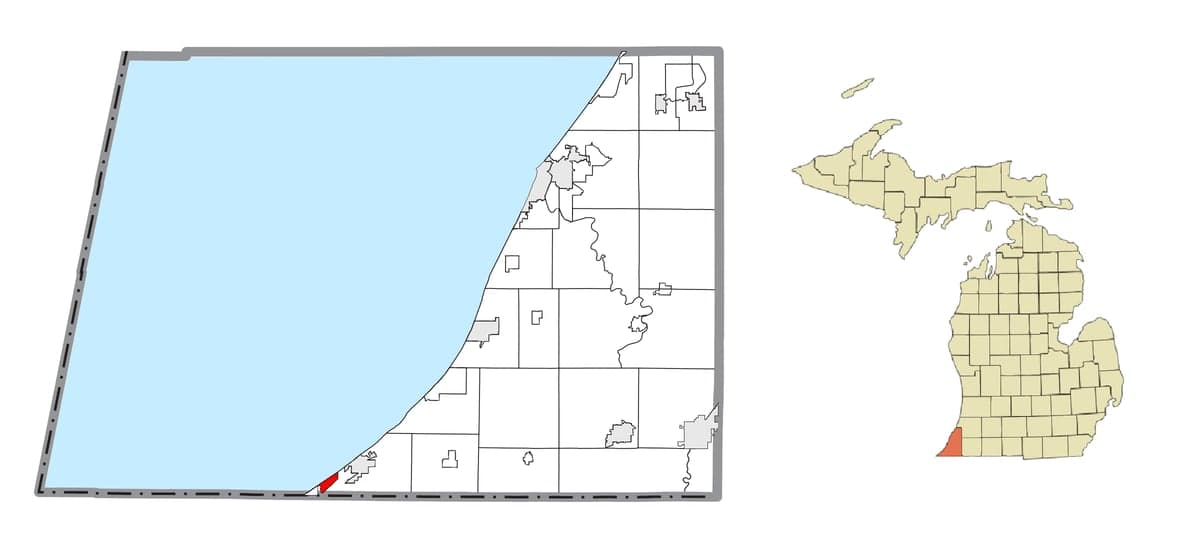
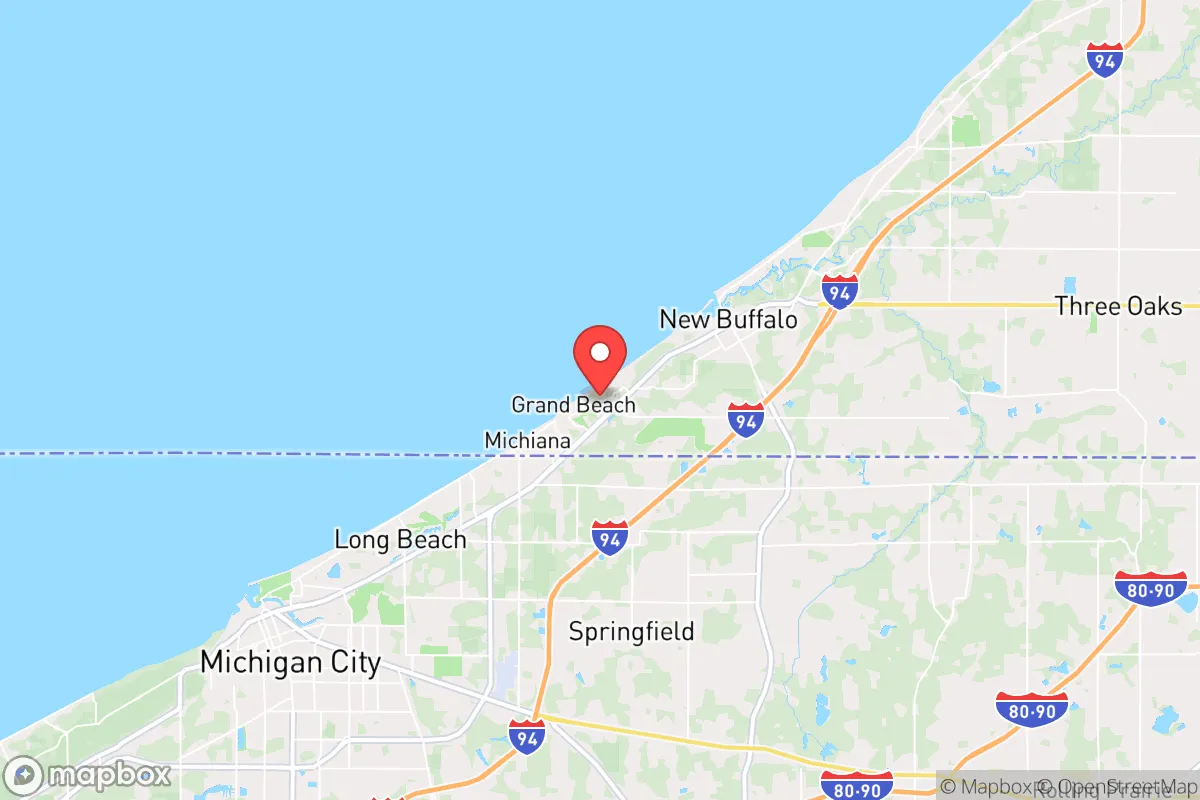
Photo: Wikipedia
Personal Sovereignty in Grand Beach, MI
Strong independent fundamentals that actively favor personal liberty and low regulation.
What does Personal Sovereignty tell us?
Personal Sovereignty measures your capacity for self-reliance and independence with minimal government friction. Higher scores mean fewer barriers between you and the way you want to live... but it assumes you have the space you need and good neighbors.
What does this tell us?
Personal Sovereignty measures your capacity for self-reliance and independence with minimal government friction. Higher scores mean fewer barriers between you and the way you want to live... but it assumes you have the space you need and good neighbors.
State Policy
Energy independence: Importer (22% of energy produced in-state)
Personal Liberty
Homesteading

Personal Liberty Analysis
Grand Beach, Michigan, offers a notably light-touch environment for personal sovereignty compared to most of the Midwest, anchored by Michigan's constitutional right to keep and bear arms, a flat income tax, and a rural Berrien County setting where local government interference in daily life is minimal. For individuals and families weighing relocation, the autonomy calculus here is favorable: the state preempts most local firearm ordinances, property taxes are the primary revenue mechanism, and the surrounding countryside still permits substantial self-reliant living. The trade-offs are real — winters are long, and the state's regulatory footprint on certain activities (like water access and short-term rentals) is heavier than in, say, Indiana or Tennessee — but the overall posture is one of live-and-let-live rather than paternalistic oversight.
How the tax burden and regulatory climate compare to neighboring states
Michigan's tax structure is moderate but predictable, which matters more to sovereignty-minded residents than raw rates. The state levies a flat 4.25% individual income tax — no progressive brackets, no local income taxes in Grand Beach or anywhere in Berrien County. That flatness means your marginal rate equals your effective rate, and there are no surprise city-level payroll taxes eating into take-home pay. Property taxes are the real cost center: the statewide average effective rate hovers around 1.3% of assessed value, and Grand Beach's lakefront premium properties can push that higher, though Michigan's Proposal A caps annual assessment increases at 5% or the rate of inflation, whichever is lower, so long-term owners see their taxable base lag far behind market value.
Regulatory posture is where Michigan diverges from its neighbors. The state is not a free-for-all — environmental regulations under the Michigan Department of Environment, Great Lakes, and Energy (EGLE) are stringent, particularly for shoreline property, septic systems, and wetland disturbance. Grand Beach sits directly on Lake Michigan, so any dock, seawall, or beach modification triggers state permitting. However, for ordinary residential life — running a home business, building a shed, raising chickens — Berrien County's zoning is permissive, and there is no county-wide building code enforcement for most rural parcels. Compared to Illinois across the lake, where Cook County's regulatory web is dense, Grand Beach feels positively libertarian. Compared to Texas or Florida, it feels moderately administered. The key advantage: no state-level capital gains tax on the sale of a primary residence beyond federal rules, and no inheritance or estate tax at the state level.
Self-defense rights and Michigan's gun law landscape in 2026
Michigan is a "shall-issue" state for concealed pistol licenses (CPLs), meaning the county sheriff — here, Berrien County — must issue a permit if you meet statutory criteria: 21 years old, completed a state-approved training course, and no disqualifying criminal history. There is no discretionary denial, no character reference requirement, and no "good cause" showing. As of 2024, Michigan also became a permitless carry state for adults 21 and over who can legally possess a firearm, so carrying concealed without a license is lawful in most places. The CPL still matters for reciprocity — Michigan honors permits from roughly 40 other states, and its own CPL is recognized widely — and for avoiding the training requirement if you travel.
Use-of-force law in Michigan follows the classic Castle Doctrine. There is no duty to retreat in your own home, and the "stand your ground" statute extends that to any place you are lawfully present. Civil immunity applies if the force was justified. One notable divergence from more permissive states: Michigan bans the open carry of firearms in "pistol-free zones" like schools, churches, and sports arenas, and a CPL does not override those restrictions. Magazine capacity is not limited by state law, and there is no state-level assault weapons ban, though local municipalities are prohibited from enacting their own — state preemption is absolute, so Grand Beach's village council cannot pass its own gun control ordinances. For a sovereignty-focused reader, this is a clean, predictable legal environment: the rules are set at the state level, they are stable, and they skew toward individual rights.
Self-reliance and homesteading viability: lot sizes, zoning, and off-grid feasibility
Grand Beach itself is a compact lakefront village — most lots are a quarter-acre or less, platted in the early 20th century as a summer resort community. That means true homesteading — livestock, substantial gardens, solar arrays — is not practical within the village limits. The zoning ordinance restricts agricultural uses, and the covenant-heavy neighborhood association has aesthetic standards. However, the surrounding Berrien County countryside changes the picture dramatically. Drive 10 minutes inland to Chikaming Township or New Buffalo Township, and you will find 2- to 10-acre parcels available for $50,000 to $150,000, zoned agricultural-residential, where chickens, goats, and a 40-foot shipping-container workshop are entirely legal without permits.
Off-grid feasibility is genuinely viable here, with caveats. Michigan's net-metering rules allow solar panels to offset your consumption, and the state's Right to Farm Act protects agricultural activities from nuisance lawsuits, which is a powerful shield for anyone raising animals or composting at scale. However, Michigan requires a licensed well driller and a permitted septic system for any habitable dwelling — there is no legal path to a "no-running-water" cabin. Winter is the real constraint: Lake Michigan's snowbelt effect can dump 80+ inches annually, so passive solar and wood heat are practical only with a serious backup plan. The regulatory sweet spot: Berrien County does not require building permits for structures under 200 square feet, so a detached workshop, greenhouse, or chicken coop can be built without any government interaction. For a family wanting to grow food, keep animals, and reduce utility dependence, the inland parcels offer a genuine path; the lakefront village does not.
Personal liberties: parental rights, medical autonomy, speech, and property
Michigan's posture on parental rights is mixed but trending conservative. The state has no mandatory vaccination law for schoolchildren — parents can claim a philosophical exemption, and the process is a simple form, not a court hearing. Homeschooling is lightly regulated: no notice requirement, no curriculum approval, and no standardized testing mandate. Parents can teach their own children with full autonomy, and the Home School Legal Defense Association rates Michigan as a "low-regulation" state. Medical autonomy is more constrained: Michigan has a broad informed consent law for abortion (24-hour waiting period, ultrasound requirement), but it also expanded Medicaid under the ACA, and vaccine mandates for healthcare workers were enacted during the pandemic and remain in place for hospital staff. For a family seeking to opt out of mainstream medical protocols, Michigan is more permissive than New York but less than Texas.
Free speech protections are robust — Michigan has no hate speech law that criminalizes expression, and the state constitution's free speech clause has been interpreted more expansively than the federal First Amendment in some cases. Property rights are where Michigan shines: the state's "adverse possession" statute requires 15 years of open, notorious use, and there is no statewide rent control (preempted by statute), no forced inclusionary zoning, and no county-wide short-term rental ban — though Grand Beach's village ordinance restricts rentals to 30+ days. The most sovereignty-relevant property feature: Michigan is a "lien state" for mechanics' liens, meaning contractors must file within 90 days, protecting homeowners from surprise claims. And unlike some coastal states, there is no state-level "right to repair" restriction that prevents you from fixing your own appliances, vehicles, or electronics.
Overall, Grand Beach offers a sovereignty profile that is stronger than the national median but weaker than the Mountain West or Deep South. The tax burden is moderate, the gun laws are firmly pro-individual, and the rural hinterland permits genuine self-reliance. The constraints are environmental (shoreline permitting, winter climate) and municipal (village covenants), not ideological. For a single person or family that wants to live largely unbothered — carry a firearm, homeschool children, grow food, and keep the government at arm's length — this corner of southwest Michigan delivers a better autonomy-to-cost ratio than almost anywhere in the Great Lakes region, with the caveat that you must accept Michigan's colder, wetter reality and its moderately progressive state-level social programs. If those trade-offs are acceptable, Grand Beach and its inland neighbors represent a quiet, durable bastion of personal freedom.

* Values derived from national, state, county, city and local statistics and may differ in a specific area. Last updated: 2026-11-01T01:03:04.000Z
Narrative content on this page is AI-generated and may contain mistakes. Verify any details that matter before acting on them.
ReloMaps may earn a commission from affiliate links at no extra cost to you.

