Demographics of Gordon, WI
Affluence Level in Gordon, WI
A below-average socioeconomic profile. Incomes, home values, and educational attainment trail the U.S., with higher poverty and unemployment.
People of Gordon, WI
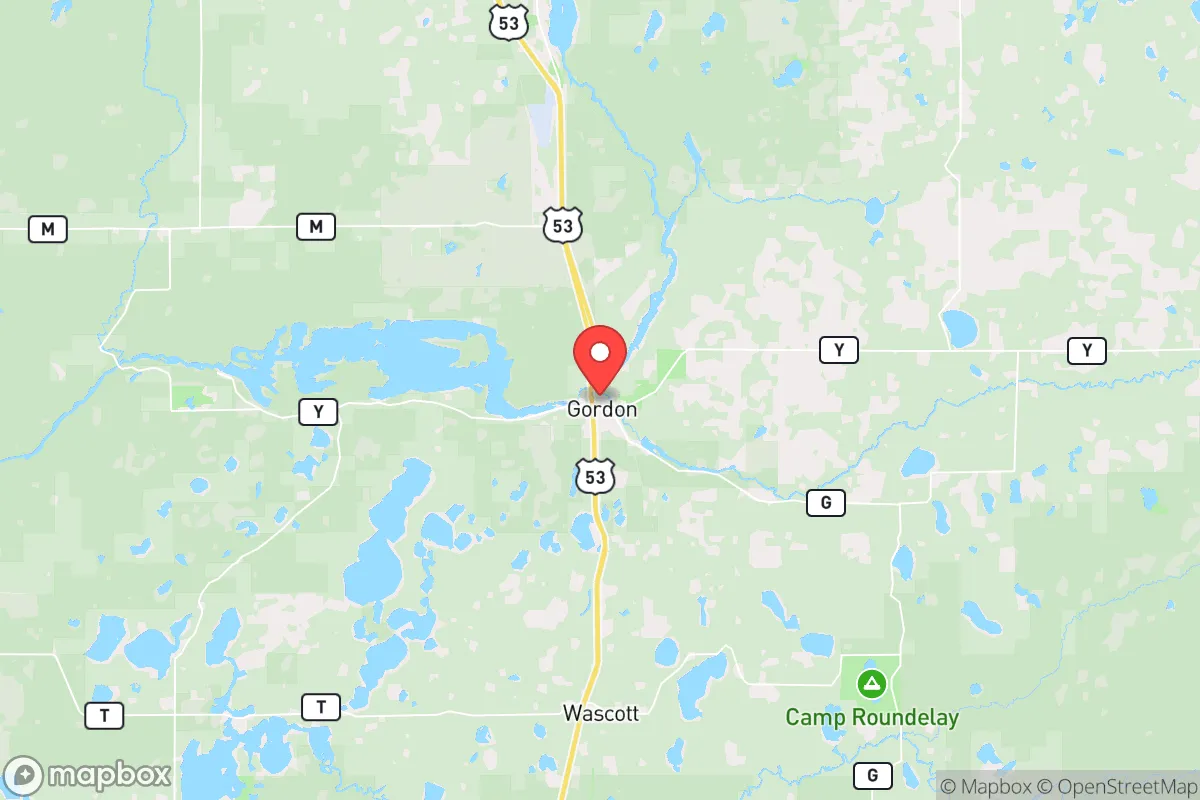
Gordon, Wisconsin, is a community of 114 residents where 94.7% of the population is White and the foreign-born share is 0.0%, making it one of the most ethnically homogeneous places in Douglas County. The town's identity is rooted in its Northwoods setting along the St. Croix River and its history as a railroad and logging settlement that never grew beyond village scale. With only 13.9% of adults holding a college degree, the population skews toward working-class retirees, outdoor recreationists, and families seeking affordable rural property near the Twin Cities metro.
How the city was settled and grew
Gordon was never a planned city; it grew organically as a 19th-century logging camp and railroad stop. The Wisconsin Central Railroad pushed through the area in the 1870s, and the first permanent settlers were Scandinavian and German immigrant loggers who cleared the white pine forests. The original homesteads clustered around the rail depot in what is now the Gordon Business District, a stretch of Highway 53 that still anchors the town's few commercial buildings. As the timber played out by 1900, the population shifted to subsistence farming and seasonal work, and the town's growth stalled permanently. The historic Riverside Flats neighborhood, along the St. Croix River south of the depot, was built by these first-generation Finnish and Swedish families who took up small dairy plots after the logging camps closed.
The second wave came in the 1920s and 1930s with the construction of U.S. Highway 53, which turned Gordon into a summer resort destination for Duluth and Superior families. This era produced the Lakehead Cottages district, a string of seasonal cabins on the flowage that were built by middle-class professionals from the Iron Range. These were never year-round homes, and their descendants largely sold out by the 1980s. The third and final significant wave arrived in the 1960s and 1970s as retired farmers from southern Wisconsin and Minnesota moved north for cheaper land, settling in the Northwoods Acres subdivision, a rural residential area of 5- to 10-acre parcels east of the highway that remains the town's most populated neighborhood today.
Modern era (post-1965)
Since the 1965 Hart-Celler Act, Gordon has seen essentially zero immigration-driven demographic change; the foreign-born population remains at 0.0%, and the White share has held above 94% for decades. The post-1965 story is one of domestic in-migration, not international. The most notable shift has been the growth of Pine Ridge Estates, a 1990s-era subdivision of manufactured homes and modular houses that attracted younger families priced out of Duluth's housing market. This neighborhood is the most economically diverse part of Gordon, with a mix of remote workers, tradespeople, and retirees, though it remains overwhelmingly White. The St. Croix Bluffs area, a newer development of custom-built homes on the river bluffs, has drawn a small number of affluent second-home owners from the Twin Cities since 2010, but they are seasonal residents who do not meaningfully alter the year-round demographic profile.
The college-educated share of 13.9% reflects this pattern: Gordon has no four-year university within 30 miles, and most residents with degrees commute to Superior or Duluth for white-collar work. The town's population has been slowly declining since the 1990s, losing roughly 10-15% of its residents each decade as younger people leave for urban job markets and the remaining population ages in place.
The future
Gordon's demographic trajectory points toward continued homogeneity and gradual shrinkage. The 0.0% foreign-born share and 0.0% Hispanic, Black, and Asian populations are unlikely to change materially in the next decade, as the town offers no major employment base to attract international migrants. The more realistic scenario is that Gordon becomes slightly older and slightly smaller, with the Northwoods Acres and Pine Ridge Estates neighborhoods absorbing most of the new residents as retirees from the Twin Cities metro continue to buy lakefront and rural parcels. The St. Croix Bluffs seasonal community may expand modestly, but these second-home owners will not become permanent census residents.
The cultural identity of Gordon is likely to remain tied to outdoor recreation—fishing, snowmobiling, and hunting—rather than to any demographic transformation. The town's school-age population is small enough that the local district already shares resources with nearby Solon Springs, and that consolidation pressure will continue if the under-18 cohort keeps shrinking.
For someone moving to Gordon now, the bottom line is this: you are joining a small, stable, overwhelmingly White community where the population is aging and slowly declining. The practical advantages are low property taxes, proximity to the St. Croix River and the Brule River State Forest, and a quiet rural lifestyle within an hour of Duluth's amenities. The trade-off is limited economic opportunity, a thin social infrastructure, and a demographic future that looks very much like the present—just smaller and older.

* Values derived from national, state, county, city and local statistics and may differ in a specific area. Last updated: 2026-09-01T03:04:44.000Z
Narrative content on this page is AI-generated and may contain mistakes. Verify any details that matter before acting on them.
ReloMaps may earn a commission from affiliate links at no extra cost to you.

