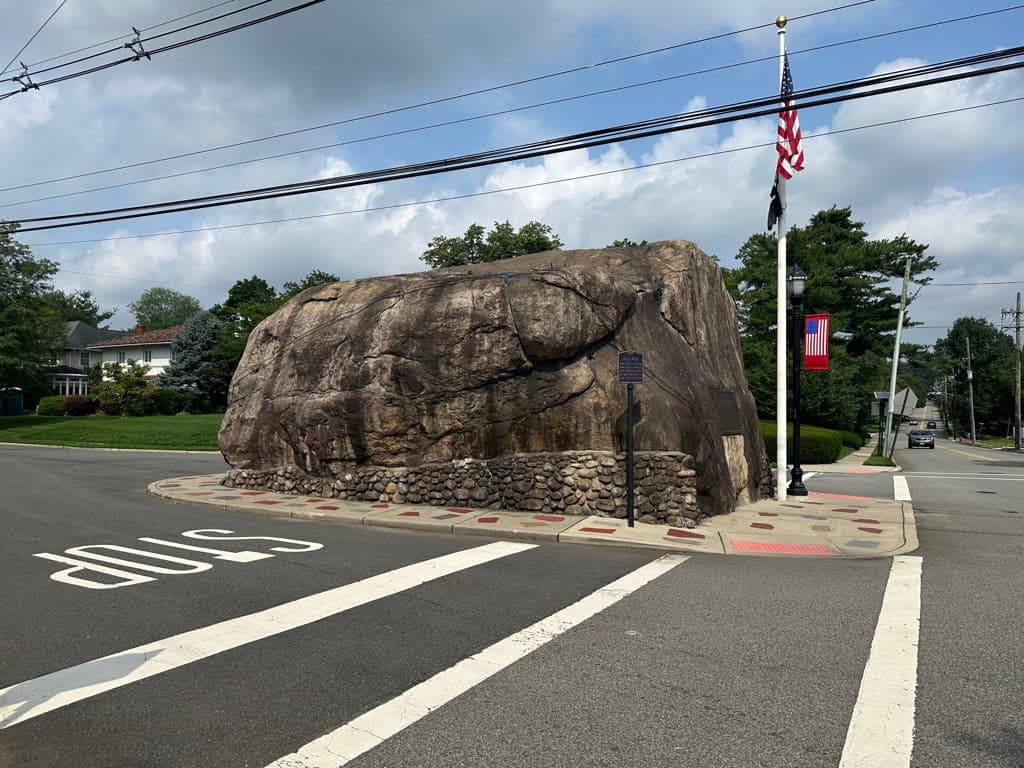
Photo: Wikipedia
Demographics of Glen Rock, NJ
Affluence Level in Glen Rock, NJ
A wealthy area with high-earning, well-educated households. Incomes, home values, and educational attainment meaningfully outpace national averages.
People of Glen Rock, NJ
The people of Glen Rock, New Jersey, today form a highly educated, predominantly white-collar community of 12,082 residents, marked by a 75.5% white population and a significant 75.4% college attainment rate. The borough is characterized by its quiet, family-oriented density—a classic Bergen County commuter suburb where single-family homes on tree-lined streets dominate the landscape. Its distinctive identity is shaped by a long-standing, stable population base, now gradually diversifying with growing East/Southeast Asian (9.5%) and Indian-subcontinent (4.8%) communities, while remaining less ethnically varied than many neighboring towns.
How the city was settled and grew
Glen Rock’s human history is almost entirely a story of the 20th century. Unlike older Hudson River towns, the area remained sparsely populated farmland until the arrival of the railroad. The Erie Railroad’s Bergen County Line reached the area in the 1840s, but it was the construction of the Glen Rock station in the 1870s that triggered the first real wave of settlement. The borough was formally incorporated in 1894, carved from portions of Ridgewood and Saddle River Township. Its early population was overwhelmingly native-born white Protestants of German, Dutch, and English descent, drawn by the promise of a rural retreat with a quick commute to New York City. These early families built the first homes in the Glen Rock Historic District, centered around Rock Road and Doremus Avenue, where Victorian and Colonial Revival houses still stand. The second major wave came in the 1920s and 1930s, as the automobile made suburban living more accessible. Developers subdivided former farms into the grid of streets that now define neighborhoods like South Glen Rock, south of Maple Avenue, and North Glen Rock, north of the railroad tracks. This era brought a mix of middle-class Irish and Italian Catholic families, who built the borough’s first Catholic church, St. Catharine’s, in 1929. The post-World War II baby boom cemented Glen Rock’s identity as a family suburb. The Fairlawn Avenue and Harristown Road corridors filled with Cape Cods and split-levels, housing returning GIs and their growing families. By 1960, the population had swelled to over 8,000, and the borough was overwhelmingly white, with a tiny fraction of non-white residents.
Modern era (post-1965)
The post-1965 immigration reforms had a delayed and modest effect on Glen Rock compared to other North Jersey suburbs. The borough’s high property values and lack of large apartment complexes limited the influx of new immigrant groups. The first noticeable shift came in the 1980s and 1990s, when East/Southeast Asian families—primarily of Chinese and Korean heritage—began moving into the Bradley Park neighborhood, drawn by the top-rated Glen Rock public schools. This trend accelerated in the 2000s, with Indian-subcontinent families also settling in the same area, particularly along the streets near the high school. Today, East/Southeast Asian residents make up 9.5% of the population, and Indian-subcontinent residents account for 4.8%, together forming the largest non-white demographic. The Hispanic population (4.8%) and Black population (1.3%) remain small, concentrated in no single neighborhood but scattered across the borough. The foreign-born share is just 6.4%, well below the New Jersey average of roughly 23%, underscoring Glen Rock’s character as a stable, second- and third-generation suburb rather than a first-stop immigrant gateway. The borough’s racial composition has shifted only gradually: the white share dropped from roughly 90% in 1990 to 75.5% today, with the Asian and Indian populations absorbing most of that change.
The future
Glen Rock’s population is slowly becoming more diverse, but the pace is likely to remain gradual. The borough’s limited housing stock—mostly single-family homes with few new developments—constrains rapid demographic change. The Rock Road commercial corridor has seen some redevelopment, including a new mixed-use project, but large-scale multifamily construction is rare. The school district, a primary draw for families, is already seeing a rising share of Asian and Indian students, a trend that will continue as these families age into the housing market. The white population is expected to continue its slow decline, but Glen Rock is unlikely to become a majority-minority suburb within the next 20 years. The borough’s cultural identity remains rooted in its traditional family-oriented, high-achieving school environment, with a growing but still secondary influence from its East/Southeast Asian and Indian communities. New residents are most likely to be professionals—doctors, lawyers, finance executives—who value the short commute to Manhattan and the strong public schools.
For someone moving in now, Glen Rock offers a stable, low-crime, high-amenity suburb that is gradually diversifying without losing its core character. The population is not heading toward a dramatic transformation, but toward a slow, steady broadening of its ethnic and cultural base—a place where the old and new are blending quietly, block by block.

* Values derived from national, state, county, city and local statistics and may differ in a specific area. Last updated: 2026-11-09T06:00:12.000Z
Narrative content on this page is AI-generated and may contain mistakes. Verify any details that matter before acting on them.
ReloMaps may earn a commission from affiliate links at no extra cost to you.

