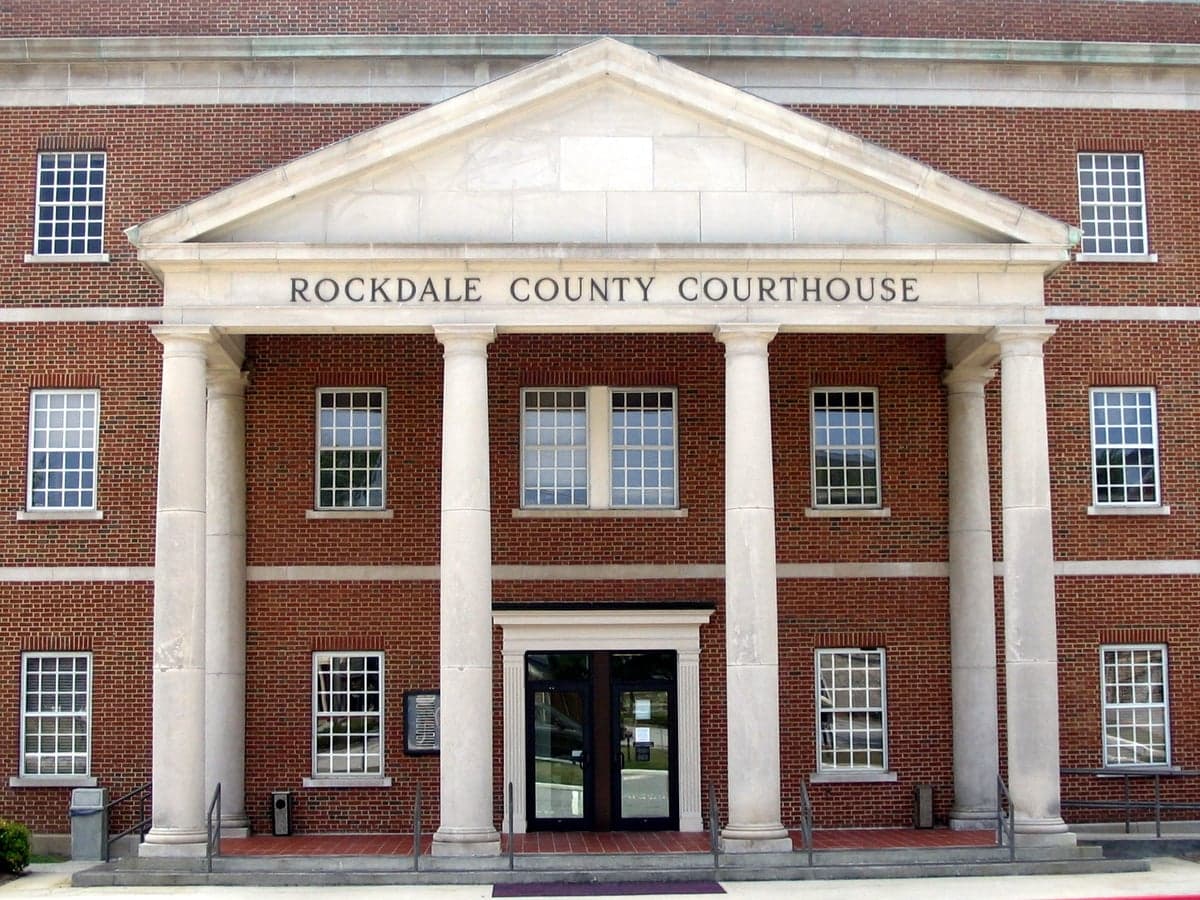
Photo: Wikipedia
Political ClimatePolitical Climate in Rockdale County
Showing county-level results — no local-only data available.
Lean and PVI are calculated from this county’s 2020 and 2024 presidential results, Cook-style.
Political rankings in Georgia
- Most Conservative Cities in Georgia
- Most Liberal Cities in Georgia
- Best Liberal-Leaning Towns in the South
- Best Liberal-Leaning Towns in the Deep South
- Safest Liberal-Leaning Towns in the South
- Safest Conservative-Leaning Towns in the South
- Safest Conservative-Leaning Towns on the East Coast
- Affordable Small Towns for Conservatives
- Most Conservative Counties in Georgia
- Most Liberal Counties in Georgia
Local Political AnalysisPolitical Analysis of Rockdale County
Rockdale County, Georgia, is a solidly Democratic stronghold with a Cook Partisan Voting Index of D+21, making it one of the most reliably blue counties in the metro Atlanta area. This isn't a recent flip—it's been trending this way for over a decade, driven by rapid suburbanization, an influx of younger and more diverse residents from Atlanta proper, and a growing professional class. While the county as a whole leans heavily Democratic, the political reality on the ground is more nuanced, with distinct pockets of conservatism in its more rural and exurban fringes.
How it compares
Compared to the rest of Georgia—which is a classic swing state that voted for Joe Biden in 2020 by a razor-thin margin and then flipped back to Donald Trump in 2024 by about 2 points—Rockdale County is an outlier. The county's D+21 rating means it's roughly 21 points more Democratic than the national average, while the state of Georgia as a whole is essentially a toss-up. In practical terms, this means that in a close statewide race, Rockdale's votes are a critical part of the Democratic coalition, often offsetting deep-red rural counties in south and north Georgia. Within the county itself, the city of Conyers (the county seat) and the unincorporated areas around it are the most reliably blue, with precincts like those near the Rockdale Medical Center and the downtown Conyers area routinely delivering 70-75% of the vote to Democratic candidates. In contrast, the more rural and newer subdivisions near the county's eastern edge—think areas around the town of Milstead and the unincorporated community of Magnet—tend to lean more conservative, sometimes voting 55-60% Republican in local races. The swing precincts are generally found in the central and western parts of the county, where newer subdivisions mix with older, more established neighborhoods.
What this means for residents
For liberal residents, Rockdale County is a comfortable place to live politically. Local government, including the Board of Commissioners and the school board, is reliably Democratic, which means policies around affordable housing, public transit expansion (like the proposed MARTA extension to Conyers), and environmental regulations tend to align with progressive priorities. Conservative residents, however, aren't marginalized—they just have to work a bit harder to be heard. The county's Republican Party is active, and there are still plenty of conservative-leaning churches and civic groups, especially in the eastern part of the county. In practice, this means that while the county's official stance is blue, there's a live-and-let-live culture. You'll see Trump signs in some yards and Biden signs in others, and people generally get along. The real tension isn't between neighbors—it's between the county's Democratic leadership and the state's Republican-controlled legislature, which has occasionally preempted local ordinances on issues like housing density and short-term rentals.
Culturally, Rockdale County stands apart from much of Georgia because of its high degree of racial and economic diversity. The county is roughly 50% Black, 30% white, and 15% Hispanic, and this diversity is reflected in local politics—the county commission and school board are majority-minority, and issues like equity in education and economic development are front and center. Unlike more monolithic suburbs, Rockdale has a mix of old farming families, new immigrants, and Atlanta commuters, which creates a political climate that's less about ideology and more about practical problem-solving. One notable policy distinction: Rockdale County was an early adopter of inclusionary zoning policies to encourage affordable housing, a move that's been controversial among some long-time residents but has helped maintain a relatively balanced housing market. For anyone moving here, the key takeaway is that Rockdale is a blue county in a purple state—meaning your vote matters locally, but statewide elections are always a toss-up.

State Political ClimatePolitical Climate in Georgia
State Political AnalysisPolitical Environment in the State
Georgia has transformed from a reliably Republican stronghold into the nation’s most competitive swing state, with a partisan lean that now sits at roughly R+3 to D+1 depending on the cycle. The state’s dominant coalition is a tense standoff between a rapidly diversifying, metro-Atlanta Democratic bloc and a deeply entrenched, rural and exurban Republican base. Over the past 20 years, Georgia has shifted from a safe red state (Bush won it by 17 points in 2004) to a state that delivered the presidency to Joe Biden in 2020 by fewer than 12,000 votes and elected two Democratic senators in 2021. The 2024 presidential race saw Donald Trump carry the state by roughly 2 points, confirming that Georgia is now a true battleground where no outcome is a given.
Urban vs. rural divide
The political map of Georgia is a story of two Georgias. The Atlanta metro area — including Fulton, DeKalb, Cobb, Gwinnett, and Clayton counties — now accounts for roughly 60% of the state’s population and drives the Democratic surge. Gwinnett County flipped from red to blue between 2016 and 2020, while Cobb County, once a GOP stronghold, has voted Democratic in the last three presidential cycles. Outside the metro, the state is overwhelmingly Republican. Rural south Georgia counties like Brooks, Colquitt, and Tift routinely vote 70-80% Republican. The exurban ring — places like Forsyth County (north of Atlanta) and Cherokee County — remain deeply red, with Forsyth voting +40 points for Trump in 2024. The “blue wall” of Georgia is essentially the I-285 perimeter plus the urban cores of Savannah, Augusta, and Columbus. Macon and Athens lean Democratic but are surrounded by conservative rural areas. The political reality for a relocator is simple: where you live in Georgia determines your political experience more than in almost any other state.
Policy environment
Georgia’s policy environment is a patchwork of conservative state-level laws tempered by local control in blue metros. The state has a flat income tax rate of 5.49% (set to drop to 4.99% by 2027), no estate tax, and a relatively low property tax burden compared to the national average. It is a right-to-work state with a regulatory posture friendly to business — Georgia consistently ranks in the top 5 for business climate. On education, the state has a robust school choice program (the Georgia Promise Scholarship Act, passed in 2024, provides $6,500 per student for private school or homeschooling expenses), but public school funding remains a flashpoint, with metro Atlanta districts often supplementing state funds through local property taxes. Healthcare policy is a mixed bag: Georgia did not expand Medicaid under the ACA, leaving roughly 300,000 residents in the coverage gap, but the state has a limited “Pathways to Coverage” program with work requirements. Election laws have been a national focus: the 2021 Election Integrity Act (SB 202) added voter ID requirements for absentee ballots, limited drop boxes, and restricted third-party ballot collection. Gun laws are permissive — Georgia is a constitutional carry state (no permit needed to carry a concealed firearm in public) and has a “stand your ground” law. The state also has a six-week abortion ban (HB 481, the “Heartbeat Bill”) that took effect in 2022 after the Dobbs decision, with no exceptions for rape or incest.
Recent policy direction
The last five years have seen Georgia’s Republican-controlled legislature push a distinctly conservative agenda, while Democratic governors (none since 2003) have been absent. Key recent legislation includes the aforementioned six-week abortion ban (HB 481), which has made Georgia a destination for anti-abortion activists and a restricted state for those seeking care. On gun rights, the state passed constitutional carry in 2022 (SB 319), allowing permitless carry for anyone 21 or older. On parental rights, the “Parents’ Bill of Rights” (SB 449, 2022) requires schools to notify parents of any changes to a student’s mental, emotional, or physical health — effectively a “don’t say gay” law that has sparked lawsuits. On election integrity, SB 202 (2021) shortened the runoff election window from nine weeks to four, which some argue suppresses turnout. On property rights, Georgia has strong eminent domain protections and no statewide rent control. On privacy and surveillance, the state has no comprehensive data privacy law, though a 2023 law (HB 133) restricts the use of facial recognition by law enforcement without a warrant. On taxes, the legislature passed a $1 billion income tax cut in 2022, accelerating the flat tax reduction. The overall direction is conservative on social issues, business-friendly on economics, and increasingly restrictive on voting access.
Civil unrest & political movements
Georgia has been a flashpoint for political movements on both sides. The 2020 election aftermath saw massive protests in Atlanta over the killing of George Floyd, with the city becoming a hub for the Black Lives Matter movement. The 2021 election law (SB 202) sparked boycotts from Major League Baseball (which moved the 2021 All-Star Game from Atlanta to Denver) and corporate backlash. On the right, the “Stop the Steal” movement had a strong presence in Georgia, with Trump allies challenging the 2020 results in Fulton County. The state has seen a rise in organized conservative activist groups, particularly around school board meetings and library content challenges (the “Moms for Liberty” chapter in Cobb County is one of the most active in the nation). Immigration politics are less heated than in border states, but the 2024 “Georgia Criminal Alien Act” (SB 110) requires local law enforcement to cooperate with ICE detainers. There are no sanctuary cities in Georgia — in fact, a 2009 state law prohibits them. Election integrity remains a live issue: the 2024 presidential race saw Trump win Georgia by 2 points, but Democrats immediately challenged the state’s new hand-count rule for ballots (passed by the State Election Board in 2024), which was later blocked by a judge. Fulton County remains the epicenter of election controversy, with ongoing investigations into the 2020 election interference case against Trump and his allies.
Projection
Over the next 5-10 years, Georgia is likely to remain a competitive swing state, but the trajectory favors Democrats at the presidential level while Republicans hold state-level power. The Atlanta metro is growing fast — Gwinnett County alone added 100,000 residents between 2020 and 2024, many of them young, diverse, and left-leaning. The exurban counties (Forsyth, Cherokee, Paulding) are also growing but remain deeply red. The wild card is the “blue shift” in the suburbs of Savannah, Augusta, and Columbus, which are slowly trending Democratic. However, the state legislature is gerrymandered to protect Republican majorities, and the 2024 redistricting maps (drawn by the GOP) are likely to keep the state House and Senate under Republican control through 2030. The demographic trend is clear: Georgia is becoming more diverse, more urban, and more Democratic at the top of the ticket. But the state’s political culture — shaped by rural conservatism, strong gun rights, and low taxes — will keep it from flipping fully blue. A relocator moving in now should expect a state where presidential elections are decided by 1-3 points, but where state policy remains conservative on social issues and business-friendly on economics.
For a new resident, the bottom line is this: Georgia offers a low-tax, business-friendly environment with strong gun rights and a conservative social policy framework, but you’ll live in a political battleground where your vote actually matters. If you’re conservative, you’ll find a welcoming state government and deep red rural areas, but you’ll need to navigate blue metro counties where local policies may differ. If you’re liberal, you’ll find a vibrant, diverse urban core in Atlanta, but you’ll live under a state government that restricts abortion, limits voting access, and promotes school choice. The practical takeaway: choose your county carefully — your experience in Forsyth County will be radically different from living in DeKalb County, even though both are in the same state. Georgia is no longer a place where you can assume the politics of your neighbors; it’s a state where you need to know the local landscape.
* Values derived from national, state, county, city and local statistics and may differ in a specific area. Last updated: 2026-10-23T21:54:58.000Z
Narrative content on this page is AI-generated and may contain mistakes. Verify any details that matter before acting on them.
ReloMaps may earn a commission from affiliate links at no extra cost to you.

