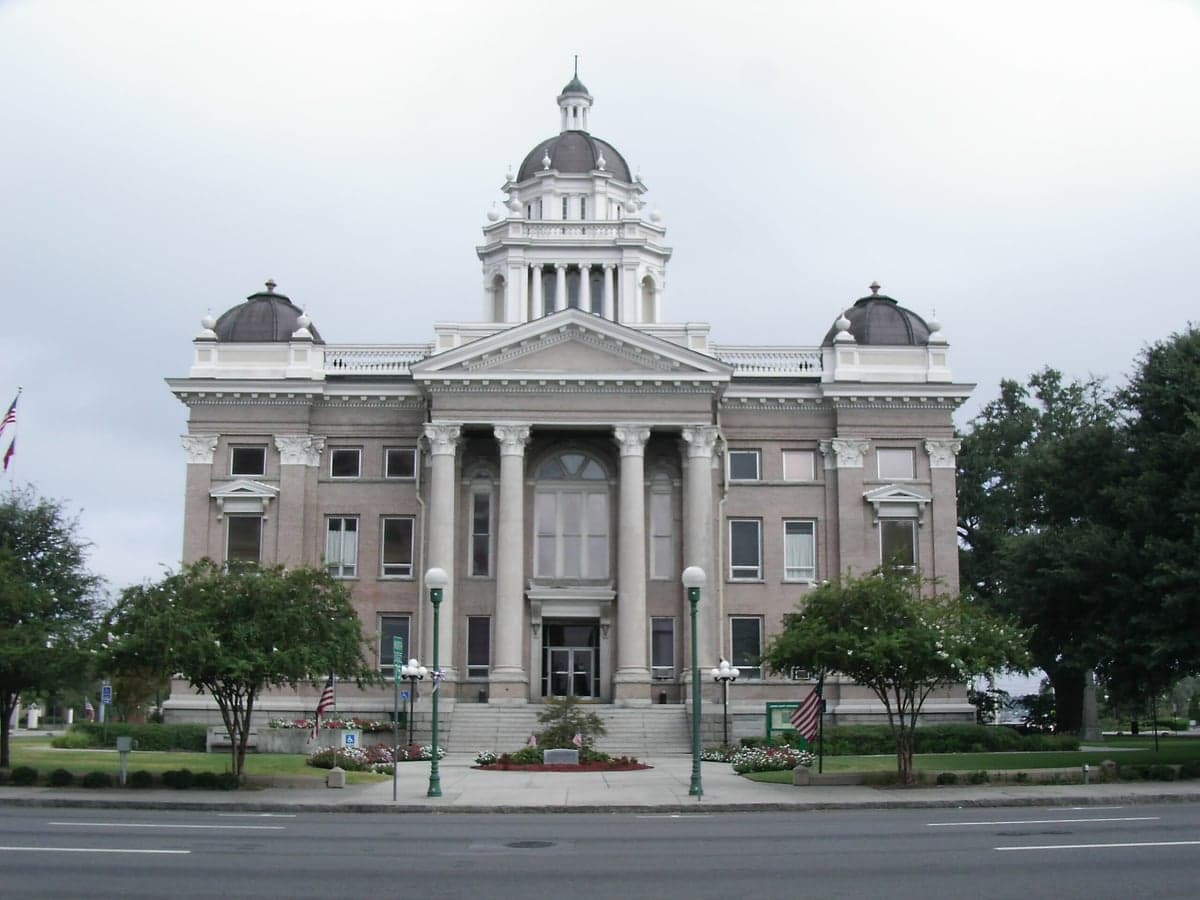
Photo: Wikipedia
Political ClimatePolitical Climate in Lowndes County
Showing district-level results — no local-only data available.
Local Political AnalysisPolitical Analysis of Lowndes County
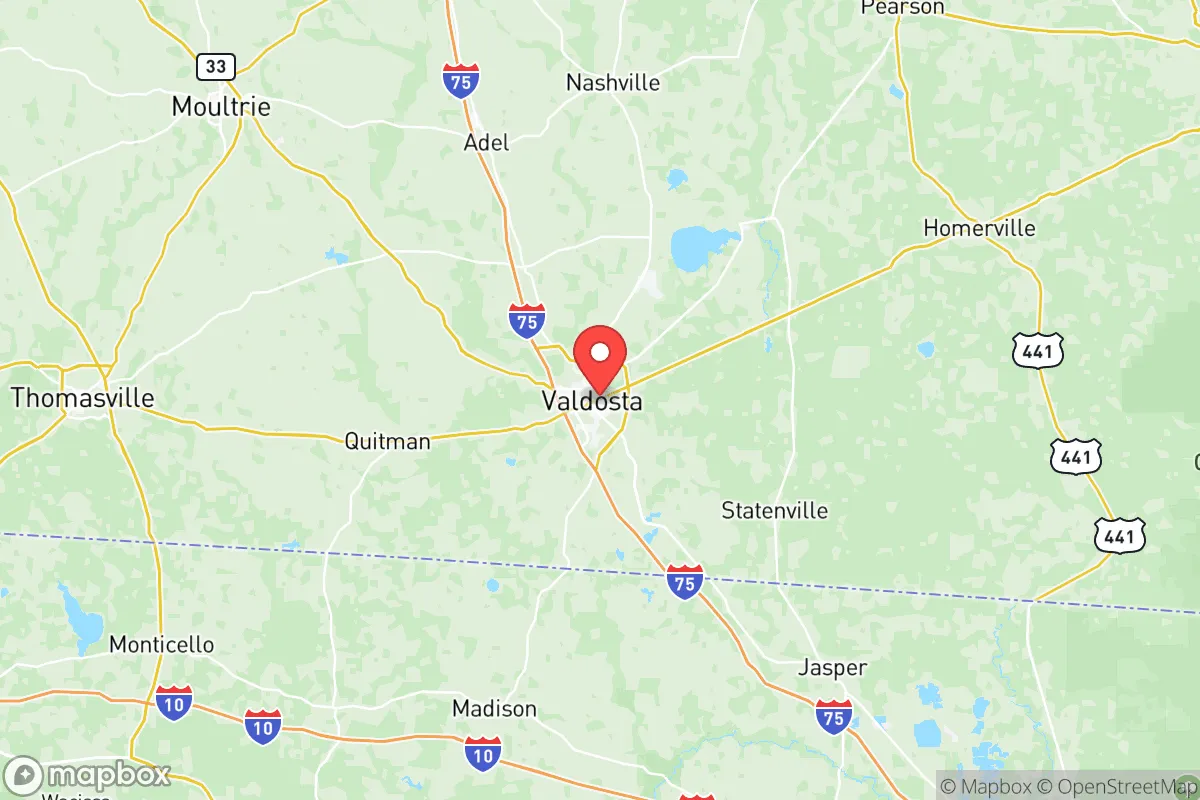
Lowndes County, Georgia, is a reliably conservative stronghold, carrying a Cook Partisan Voting Index of R+15, meaning it votes about 15 points more Republican than the national average. This isn't a recent shift; the county has voted for the GOP presidential candidate in every election since 2000, with margins typically hovering in the high teens to low twenties. The political center of gravity is Valdosta, the county seat and largest city, but even there, the Democratic vote is largely concentrated in a few historically Black neighborhoods and around the campus of Valdosta State University. The surrounding rural areas and smaller towns like Hahira, Lake Park, and Remerton are deeply red, creating a clear urban-rural split that defines the county's politics.
How it compares
Comparing Lowndes County to the state of Georgia as a whole is a study in contrasts. While Georgia has become a fiercely competitive swing state—flipping blue for Biden in 2020 and seeing razor-thin margins in subsequent Senate races—Lowndes County has remained a Republican bulwark. In 2020, Donald Trump carried Lowndes with 58.2% of the vote, while Joe Biden won the state by a hair. This means a Lowndes County Republican lives in a political environment far more conservative than the state's overall mood, while a Lowndes County Democrat is part of a clear minority, even as their party gains ground statewide. The county's R+15 PVI is a full 15-20 points more Republican than the state's current lean, which is essentially neutral. The trajectory is also telling: while metro Atlanta's suburbs have shifted left, Lowndes has held steady, with the GOP vote share barely budging over the past decade.
What this means for residents
For conservative residents, this means their vote carries outsized weight in local and county-level races, where the Republican primary is often the de facto general election. Policy at the county commission and school board level tends to reflect conservative priorities on taxes, development, and education. For liberal residents, the reality is more about finding community within the minority. The Democratic Party is active in Valdosta, particularly around the university and in the city's older wards, but winning a countywide office is an uphill battle. The practical effect is that local government tends to move slowly on progressive initiatives, and debates often center on fiscal conservatism and traditional values. However, the presence of Valdosta State University injects a steady stream of younger, more diverse voters, which keeps the county from becoming a monolith and ensures that political conversations are not entirely one-sided.
Culturally, Lowndes County is a place where church, family, and agriculture are central, and this is reflected in its politics. The county is part of the "Wiregrass" region, with a strong military presence from Moody Air Force Base, which leans conservative. There is a palpable sense of local pride and self-reliance. One notable policy distinction is the county's approach to growth: it has been more resistant to the kind of rapid, unchecked development seen in Georgia's metro areas, favoring slower, managed expansion. This is a point of pride for many long-time residents who value the area's small-town feel. For anyone moving here, understanding this political and cultural landscape is key: it's a place where relationships and local reputation matter, and where the pace of change is deliberate, regardless of which party is in power.

State Political ClimatePolitical Climate in Georgia
State Political AnalysisPolitical Environment in the State
Georgia has transformed from a reliably Republican stronghold into the nation’s most competitive battleground state, a shift driven by the explosive growth of metro Atlanta and the mobilization of a diverse, multi-racial coalition. The state’s current partisan lean is a razor-thin toss-up—Joe Biden won it by just 0.23% in 2020, and the 2024 presidential race was decided by a similarly narrow margin—but the underlying trajectory is unmistakably Democratic-leaning at the presidential level. However, the state legislature and statewide offices remain under solid Republican control, creating a unique tension where a purple presidential vote coexists with red state policy. Over the last 20 years, the old “Solid South” Republican dominance has eroded as suburban voters, particularly in the Atlanta metro, have shifted left, while rural and exurban areas have hardened their conservative identity.
Urban vs. rural divide
The political map of Georgia is a story of two Georgias. The Atlanta metro—encompassing Fulton, DeKalb, Cobb, Gwinnett, and Clayton counties—drives the state’s Democratic surge. Fulton and DeKalb are deep blue, delivering margins of 70%+ for Democrats, while the once-reliably red suburbs of Cobb and Gwinnett have flipped decisively; Gwinnett went from voting Republican by 12 points in 2012 to voting Democratic by 18 points in 2020. Outside the metro, the state is overwhelmingly red. Rural south Georgia, including cities like Valdosta, Albany, and Waycross, votes Republican by 30-40 point margins, as do the exurban and small-town counties north of Atlanta, such as Pickens and Gilmer. The only other significant blue island is the Augusta area (Richmond County) and the Savannah metro (Chatham County), both of which are Democratic-leaning but surrounded by deep red rural territory. The political divide is not just geographic but demographic: the urban core and inner suburbs are younger, more diverse, and more college-educated, while rural and exurban Georgia is older, whiter, and more culturally conservative.
Policy environment
Georgia’s state-level policy environment is firmly conservative, reflecting the Republican supermajorities in the General Assembly. The state has a flat income tax rate of 5.49%, which is scheduled to drop to 4.99% by 2029 under a 2022 law, and a relatively low property tax burden compared to the national average. It is a right-to-work state with a business-friendly regulatory posture that has attracted major corporate relocations, including the massive Hyundai Metaplant near Savannah. On education, Georgia has a robust school choice landscape, including a new Promise Scholarship program (SB 233, 2024) that provides state-funded education savings accounts for students in low-performing schools. The state also has a constitutional carry law (HB 218, 2022) that allows permitless carry of firearms for anyone 21 or older legally able to possess a gun. On healthcare, Georgia did not expand Medicaid under the Affordable Care Act, leaving roughly 300,000 low-income adults in a coverage gap. The state’s election laws have been a flashpoint: the 2021 Election Integrity Act (SB 202) added voter ID requirements for absentee ballots, limited drop box availability, and restricted third-party ballot collection, while also expanding early voting hours in most counties.
Recent policy direction
The last five years have seen Georgia’s legislature move decisively on a range of liberty-related issues that relocators weigh carefully. On gun and self-defense law, the 2022 permitless carry law was a major expansion, and the state also maintains a strong Stand Your Ground statute. On parental and education rights, the 2024 Promise Scholarship program and a 2022 law banning the teaching of “divisive concepts” (HB 1084) reflect a push for school choice and curriculum transparency. On speech and privacy, Georgia has a relatively weak shield law for journalists and no comprehensive state-level data privacy law, though a 2023 law (SB 36) restricted the use of social media by minors without parental consent. On medical and bodily autonomy, Georgia’s 2019 Living Infants Fairness and Equality Act (HB 481) bans abortion after a fetal heartbeat is detected, typically around six weeks, with limited exceptions; this law was blocked by courts for a time but reinstated in 2022 after the Dobbs decision. On property rights, Georgia is a strong property rights state with no statewide rent control and relatively low eminent domain risk. On taxation, the flat tax reduction is a clear pro-growth signal. On voting and ballot access, SB 202 tightened rules, but Georgia also has automatic voter registration through the DMV and no-excuse absentee voting (though with a photo ID requirement). The overall direction is a conservative tilt on social and cultural issues, combined with a business-friendly, low-tax economic posture.
Civil unrest & political movements
Georgia has been a focal point for political activism on both sides. The 2020 election cycle saw massive voter mobilization efforts, particularly from Stacey Abrams’ Fair Fight organization, which registered hundreds of thousands of new voters and made Georgia a national Democratic target. The 2021 Senate runoff elections in Atlanta drew unprecedented national attention and spending. On the right, the “Stop the Steal” movement had a significant presence, with protests at the Georgia Capitol in 2020 and 2021, and ongoing election integrity activism that has influenced the passage of SB 202. Immigration politics are less visible than in border states, but Georgia has a 2011 law (HB 87) that allows local law enforcement to check immigration status under certain circumstances, and there have been periodic protests over ICE detention centers, particularly in Lumpkin (Stewart County). There is no serious secessionist or nullification movement in Georgia, though some rural counties have passed symbolic “Second Amendment sanctuary” resolutions. The most visible flashpoint for a new resident would be the political signage and bumper stickers in different parts of the state—you will see far more Trump flags and conservative messaging in rural and exurban areas, while the Atlanta metro and college towns like Athens (home to UGA) display more progressive and Democratic messaging.
Projection
Over the next 5-10 years, Georgia is likely to remain a competitive battleground, but the demographic and migration trends favor a slow, steady shift toward the Democratic column at the presidential level. The Atlanta metro continues to grow rapidly, drawing in domestic migrants from other states and international immigrants, both of whom tend to lean Democratic. The suburbs of Gwinnett, Cobb, and Henry counties are becoming more diverse and more Democratic with each election cycle. However, the state legislature is heavily gerrymandered, and Republican control of the General Assembly is likely to persist even as the statewide vote tightens, because the rural and exurban districts are drawn to maximize Republican seats. The wild card is the in-migration of conservative-leaning retirees and remote workers from high-tax states like California and New York, who are moving to exurban counties like Forsyth and Cherokee north of Atlanta; these areas are already deep red and could become even more so. A new resident moving to Georgia today should expect to live in a state where the presidential vote is a toss-up, the governor’s office and legislature remain Republican for the foreseeable future, and the cultural and policy environment is conservative but with a growing progressive counterweight in the metro areas.
For a new resident, the bottom line is that Georgia offers a genuinely mixed political environment. If you are a conservative, you will find a state government that largely reflects your values on taxes, guns, education, and abortion, and you will feel at home in the vast majority of the state’s geography. If you are a liberal, you will find a vibrant and growing political community in Atlanta, Savannah, and Athens, and your vote will matter more here than in almost any other state—but you will also live under a state government that is actively working against many of your policy preferences. The practical takeaway is that Georgia rewards political engagement: your vote carries weight, your activism can shift outcomes, and the state’s trajectory is still being written. It is not a place where you can take the political climate for granted, regardless of which side you are on.
* Values derived from national, state, county, city and local statistics and may differ in a specific area. Last updated: 2026-06-16T21:22:44.000Z
Narrative content on this page is AI-generated and may contain mistakes. Verify any details that matter before acting on them.
ReloMaps may earn a commission from affiliate links at no extra cost to you.

