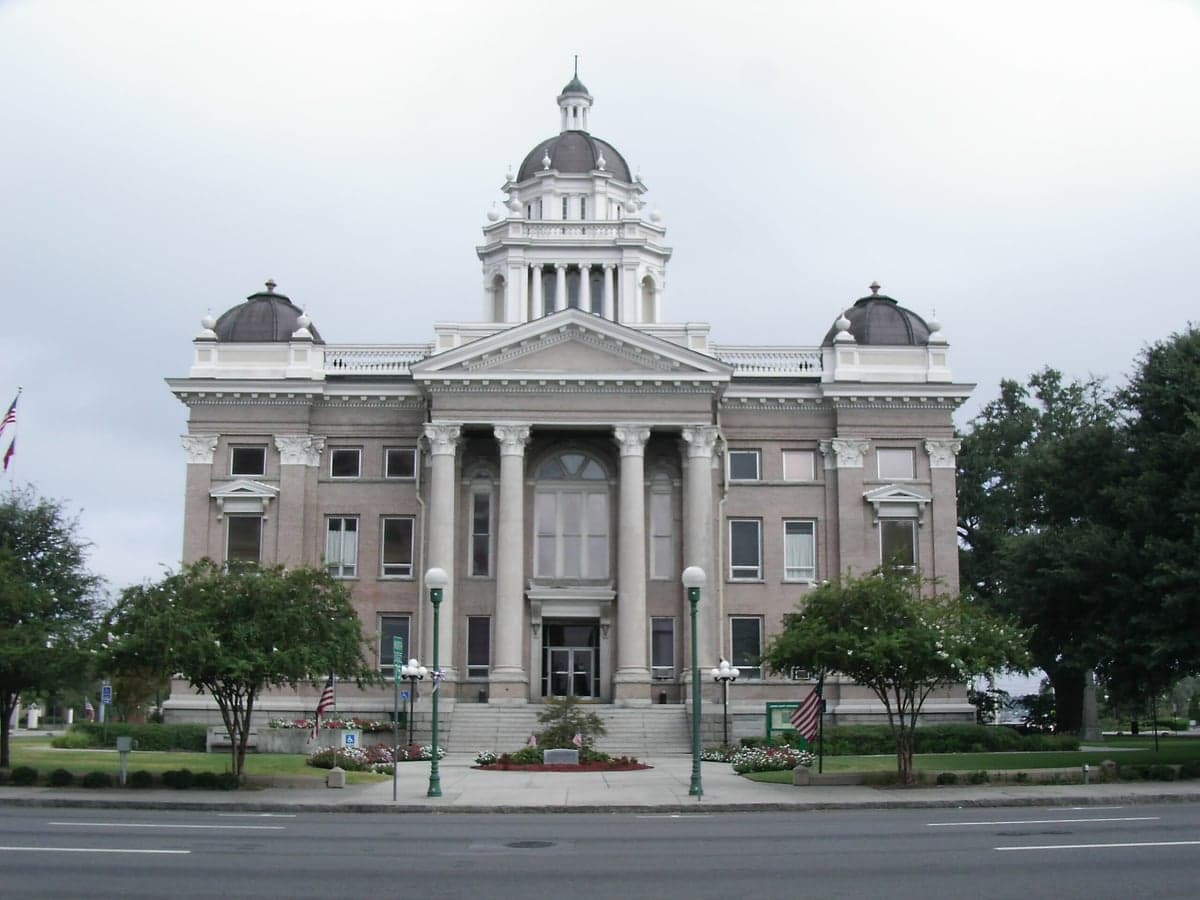
Photo: Wikipedia
Demographics of Lowndes County
Affluence Level in Lowndes County
A below-average socioeconomic profile. Incomes, home values, and educational attainment trail the U.S., with higher poverty and unemployment.
People of Lowndes County
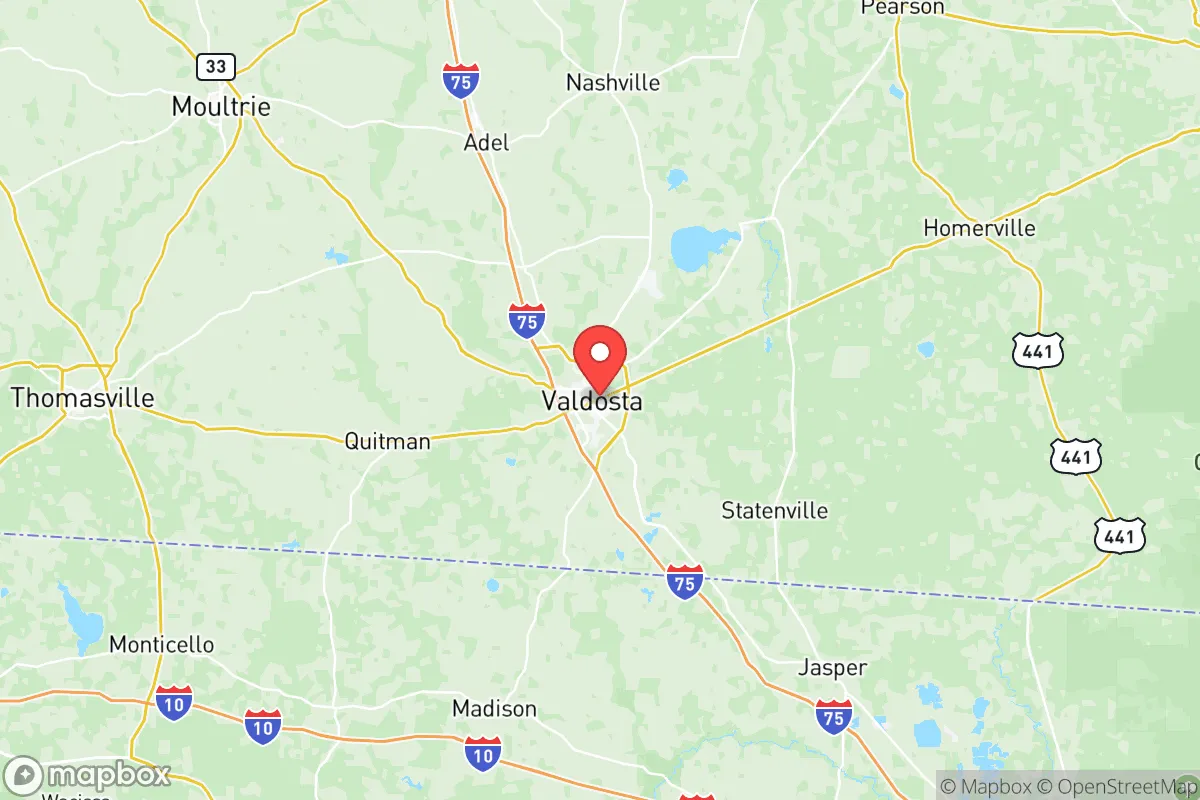
The people of Lowndes County, Georgia, today number roughly 119,055, forming a community defined by a near-even split between White (51.0%) and Black (37.0%) populations, with a small but growing Hispanic presence (6.9%) and very low foreign-born share (1.8%). The county’s identity is rooted in its role as the home of Valdosta State University and Moody Air Force Base, which together anchor a relatively young, family-oriented population with a 27.1% college-educated rate. Culturally, the area blends Deep South agricultural heritage with a modern military and education-driven economy, creating a conservative-leaning but steadily diversifying social fabric. The population is concentrated in the city of Valdosta, with smaller clusters in Lake Park, Hahira, and Remerton.
Settlement & growth (pre-1960)
Before European settlement, the region that became Lowndes County was part of the ancestral homeland of the Creek (Muscogee) people, who lived in scattered villages along the Withlacoochee and Alapaha Rivers. The area remained under Creek control through the Spanish and British colonial periods, with no permanent European settlements established until after the Creek ceded the land in the 1814 Treaty of Fort Jackson and subsequent removals in the 1820s and 1830s. Lowndes County was formally created in 1825, named after U.S. Representative William Lowndes, and the first wave of settlers were primarily Scots-Irish and English yeoman farmers migrating from the Carolinas and Virginia, drawn by cheap land opened through the Georgia land lottery system.
These early settlers established small farms and plantations, founding the county seat of Franklinville in 1828 (now a ghost town) before the seat moved to Troupville in 1837. The population grew slowly through the antebellum period, with enslaved Black people making up a significant portion — by 1860, roughly 45% of the county's residents were enslaved, working cotton and timber operations. After the Civil War and Emancipation, freedmen and their descendants formed the foundation of the county's Black population, concentrating in Valdosta and in rural communities like Dasher and Hahira, where they worked as sharecroppers, tenant farmers, and later as laborers in the naval stores (turpentine) industry.
The arrival of the railroad in the 1860s transformed the county. The Atlantic and Gulf Railroad reached Valdosta in 1860, and the town quickly eclipsed Troupville as the commercial hub. A second wave of domestic migration followed in the late 19th and early 20th centuries, as poor White farmers from the Georgia Piedmont and the Carolinas moved into the area to work in the expanding timber, turpentine, and cotton industries. This period also saw the establishment of Moody Field (later Moody Air Force Base) in 1941, which brought a steady stream of military personnel and their families from across the United States, a demographic influence that continues today. By 1960, the county's population had reached roughly 49,000, with a Black population share near 40% and a White population share near 60%, reflecting the enduring legacy of the plantation and post-Reconstruction eras.
Modern era (post-1965)
The post-1965 period in Lowndes County has been defined less by international immigration — the foreign-born share remains very low at 1.8% — and more by domestic migration and suburbanization. The 1965 Hart-Cellar Act had minimal direct impact here compared to major gateway cities; instead, the county's demographic shifts have been driven by the expansion of Moody Air Force Base, the growth of Valdosta State University (enrolling over 11,000 students), and the broader Sun Belt migration of Americans from the Rust Belt and Northeast. These trends have gradually increased the county's population from 55,000 in 1970 to over 119,000 today.
The most notable modern demographic change has been the growth of the Hispanic population, which rose from negligible levels in 1990 to 6.9% today. This community is primarily composed of Mexican and Central American immigrants and their U.S.-born children, drawn by work in agriculture (particularly the region's tobacco, pecan, and vegetable farms), construction, and the service industry. Hispanic residents are concentrated in Valdosta, especially in the southeastern parts of the city, and in Lake Park, where agricultural labor demand is highest. The Asian population remains small at 1.2% East/Southeast Asian and 0.5% Indian subcontinent, largely tied to professional roles at the university and the medical center. The Indian community, though tiny, is growing slowly through medical and tech professionals recruited to South Georgia Medical Center and Valdosta State.
Suburbanization has reshaped settlement patterns since the 1990s. While Valdosta remains the dominant population center, new subdivisions have spread into unincorporated areas and small towns like Hahira (which has seen significant residential growth), Remerton (a college-oriented enclave), and Lake Park. The Black population, historically concentrated in Valdosta's older neighborhoods and rural communities, has suburbanized as well, with middle-class Black families moving into newer developments on the city's north and west sides. The White population, while still a majority at 51.0%, has seen its share decline from roughly 60% in 1990 as the county has diversified, though much of this shift is due to Hispanic growth rather than White out-migration.
The future
Lowndes County is projected to continue growing at a moderate pace, likely reaching 130,000–140,000 by 2040, driven by the steady expansion of Moody Air Force Base (which employs over 5,000 military and civilian personnel) and Valdosta State University's enrollment growth. The Hispanic share is expected to rise to 10–12% over the next two decades, as younger Hispanic families have higher birth rates and continued in-migration for agricultural and construction work. The Black population share is likely to remain stable near 37%, while the White share will continue a gradual decline toward 45–48% as the county becomes more diverse.
The foreign-born share, currently very low at 1.8%, may rise modestly to 3–4% as the health care and education sectors recruit internationally, but Lowndes County will remain far less immigrant-diverse than metro Atlanta or coastal Georgia. New residential development is concentrating in Hahira and along the I-75 corridor south of Valdosta, where land is cheaper and schools are perceived as strong. The county's cultural identity is evolving from a historically biracial Black-White Southern community into a triracial (White, Black, Hispanic) one, though the pace of change is slow enough that the area retains a distinctly traditional, conservative character. For someone moving in now, Lowndes County offers a stable, family-oriented environment with a growing economy, a diversifying but still predominantly native-born population, and a social atmosphere that remains rooted in its Deep South heritage.
Lowndes County is becoming a slowly diversifying, moderately growing Sun Belt community where military and university anchors provide economic stability, and where the population is gradually shifting from a biracial to a triracial makeup without the rapid demographic churn seen in larger Georgia metros. For a family or individual seeking a conservative-leaning, affordable, and family-focused Southern environment with a modest but real trajectory of change, the county represents a stable choice with a clear sense of its own history.

* Values derived from national, state, county, city and local statistics and may differ in a specific area. Last updated: 2026-06-16T21:22:44.000Z
Narrative content on this page is AI-generated and may contain mistakes. Verify any details that matter before acting on them.
ReloMaps may earn a commission from affiliate links at no extra cost to you.

