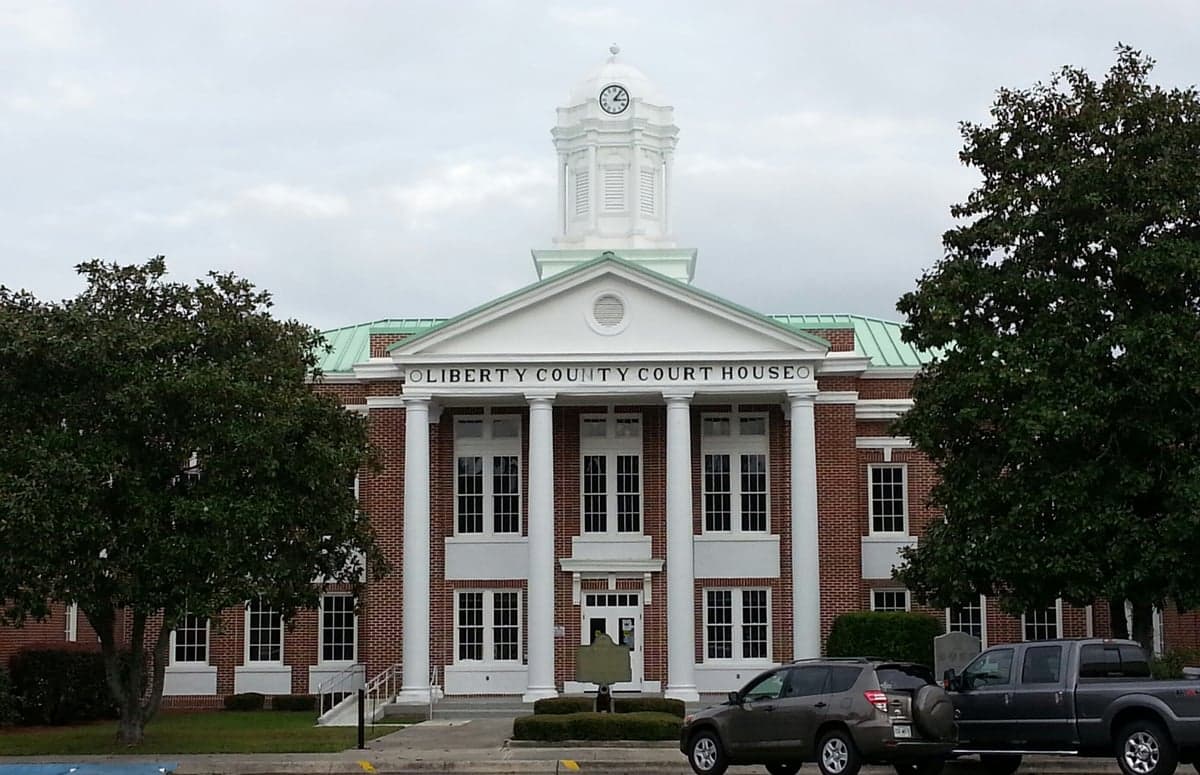
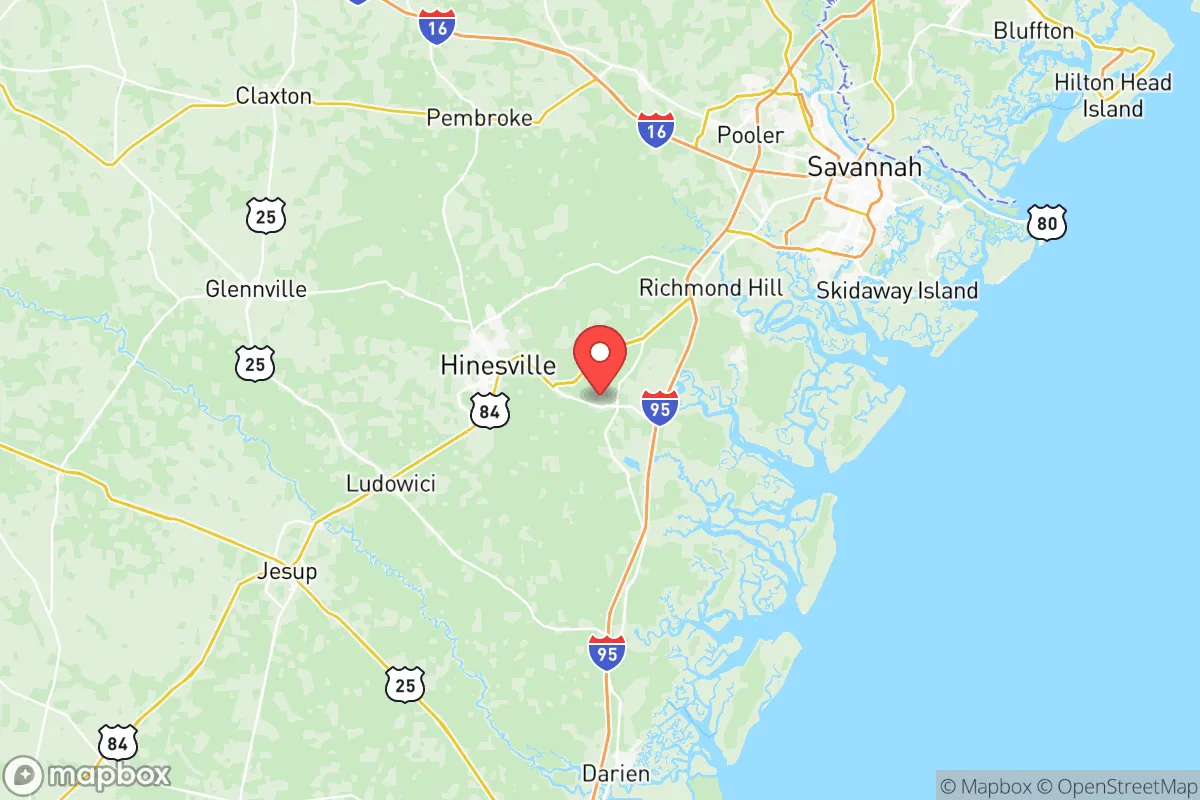
Photo: Wikipedia
Political ClimatePolitical Climate in Liberty County
Showing district-level results — no local-only data available.
Local Political AnalysisPolitical Analysis of Liberty County
Liberty County, Georgia, leans reliably Republican with a Cook PVI of R+8, but its political character is more nuanced than that number suggests, shaped by a strong military presence and a growing, diversifying population around Hinesville. The county has voted for the GOP presidential candidate in every election since 2000, though margins have tightened slightly in recent cycles as the area’s demographics shift. Locals will tell you that while the county seat of Hinesville and the sprawling Fort Stewart Army base anchor the conservative vote, the smaller towns and coastal-adjacent communities tell a different story.
How it compares
Compared to the rest of Georgia, Liberty County is notably more conservative than the state as a whole, which has become a competitive battleground in recent years. While Georgia’s overall Cook PVI is not publicly assigned, the state flipped blue for Biden in 2020 and has trended leftward in metro Atlanta and its suburbs. Liberty County, by contrast, has held steady at R+8, reflecting a political culture that is more aligned with rural and exurban Georgia than with the state’s fast-growing urban centers. Within the county itself, the political map is not uniform. Hinesville and the areas immediately around Fort Stewart tend to vote Republican, driven by active-duty military families and veterans who lean conservative on national security and fiscal issues. However, the coastal communities of Midway, Sunbury, and Riceboro show a more mixed pattern, with some precincts swinging toward Democrats in recent local elections, particularly in precincts with higher African American populations. The swing precincts are often found in the unincorporated areas along Highway 84, where the vote can shift by 5-10 points depending on the candidate and turnout.
What this means for residents
For conservative residents, Liberty County offers a comfortable political environment where Republican candidates typically win local offices—from county commission to school board—without much drama. The local GOP is active and well-organized, and conservative values are reflected in policy decisions, such as relatively low property taxes and a pro-business regulatory climate. For liberal residents, the political reality is more of a mixed bag. While they are a clear minority, they are not isolated; the presence of Fort Stewart brings a transient population that includes younger, more diverse service members and their families, which can create pockets of progressive sentiment, especially around issues like military family support and public education funding. Local elections in Hinesville and Midway often see competitive races, and Democratic candidates can win city council or school board seats in districts with higher voter turnout. The county’s political trajectory is likely to remain R+8 for the near future, but the growing population in the Hinesville-Fort Stewart corridor could gradually shift the balance if younger, more diverse residents continue to move in.
Culturally, Liberty County stands apart from much of Georgia due to its deep ties to the military. Fort Stewart is the county’s largest employer, and its presence shapes everything from the local economy to the social calendar. This military influence creates a political culture that is patriotic and family-oriented, but also pragmatic—residents tend to prioritize issues like infrastructure, schools, and healthcare over the culture-war battles that dominate state politics. The county’s coastal location also gives it a distinct identity, with a slower pace of life and a strong connection to the salt marshes and rivers that define the landscape. Policy-wise, Liberty County is more likely to focus on supporting military families and maintaining low taxes than on controversial social legislation, making it a place where both conservatives and liberals can find common ground on practical matters, even if they disagree on national politics.

State Political ClimatePolitical Climate in Georgia
State Political AnalysisPolitical Environment in the State
Georgia has transformed from a reliably Republican stronghold into the nation’s most competitive swing state over the past two decades, with a partisan lean that now sits at roughly R+3 in a neutral national environment. The state’s 16 electoral votes flipped for Joe Biden in 2020 by just 11,779 votes, and both Senate seats went Democratic in the 2021 runoffs, a seismic shift from the 2012 cycle when Mitt Romney carried Georgia by nearly 8 points. The driving force is a rapidly diversifying electorate, explosive growth in the Atlanta metro, and a suburban exodus from the GOP that has turned once-reliable red counties into battlegrounds. For a relocator, this means you’re moving into a state where your vote genuinely matters, but where the political culture is still deeply conservative outside of the urban core.
Urban vs. rural divide
The political map of Georgia is a tale of two Georgias. The Atlanta metro — specifically Fulton, DeKalb, Cobb, Gwinnett, and Clayton counties — now delivers roughly 60% of the state’s Democratic vote. Gwinnett County flipped from red to blue between 2016 and 2020, driven by Asian American and Hispanic growth in suburbs like Duluth and Lawrenceville. Cobb County, once the home of Newt Gingrich’s congressional base, went for Biden by 14 points. Meanwhile, rural and exurban Georgia remains deeply Republican. Murray County in the northwest gave Trump 84% of the vote in 2020, and Bacon County in southeast Georgia hit 87%. The divide isn’t just urban vs. rural — it’s also generational. Younger voters in college towns like Athens (Clarke County) and Statesboro (Bulloch County) push those counties blue, while retirees in the coastal Glynn County (Brunswick) and the mountains of Fannin County (Blue Ridge) lean heavily red. The result is a state where the governor’s mansion and legislature are still Republican, but the margin is razor-thin and shrinking.
Policy environment
Georgia’s policy environment is a study in contrasts. The state has a flat income tax rate of 5.39%, which is scheduled to drop to 4.99% by 2029 under legislation passed in 2022. Property taxes are relatively low, with a median effective rate of 0.87% of home value, though they vary widely by county — Fulton County levies higher millage rates than Forsyth County. The regulatory posture is business-friendly: Georgia is a right-to-work state with a 5.75% corporate income tax, and it consistently ranks in the top five for business climate. Education policy is a flashpoint: the state has a robust school choice program (the Georgia Promise Scholarship Act, passed in 2024) that provides $6,500 per student for private school or homeschooling expenses, but public school funding remains a perennial issue, with teacher pay raises often tied to legislative battles. Healthcare is a major gap: Georgia is one of ten states that has not expanded Medicaid under the Affordable Care Act, leaving roughly 300,000 low-income adults in a coverage gap. Election laws have been hotly contested: the 2021 SB 202 added voter ID requirements for absentee ballots, limited drop boxes, and restricted weekend early voting hours, though it also expanded early voting days overall. For a conservative relocator, the tax and school choice environment is a clear draw; for a liberal relocator, the healthcare and voting access landscape is a frustration.
Recent policy direction
The last five years have seen Georgia’s legislature move decisively on several fronts. On gun and self-defense law, Georgia is a constitutional carry state since 2022 (SB 319), meaning no permit is needed to carry a concealed firearm. Stand-your-ground law has been on the books since 2006. On parental and education rights, the 2024 HB 1104 (the “Parents’ Bill of Rights”) codifies parental access to curriculum and medical records, and the 2022 HB 1084 restricts the teaching of “divisive concepts” related to race in public schools. On speech and privacy, Georgia has no broad shield law for journalists, and the state’s 2018 HB 757 (the “Heartbeat Bill”) bans abortion after six weeks, with no exceptions for rape or incest — a law that took effect in 2022 after the Dobbs decision. On medical and bodily autonomy, the six-week ban is the most restrictive in the Southeast, and the state also has a 2023 law (SB 140) that restricts gender-affirming care for minors, banning puberty blockers and hormone therapy. On property rights, Georgia is a strong “fee simple” state with limited eminent domain abuse, but the 2023 HB 514 tightened rules on squatter rights. On taxation, the 2022 HB 1437 accelerated the income tax rate cut, and the state has no estate or inheritance tax. On voting and ballot access, SB 202 remains the most significant change, but the state also passed SB 189 in 2023 to ban private funding of election administration (the “Zuckerbucks” ban). The overall direction is a conservative legislative agenda that has accelerated since the 2020 election, but it’s worth noting that the governor’s veto pen has occasionally moderated bills — Kemp vetoed a 2023 “divisive concepts” expansion that would have applied to private employers.
Civil unrest & political movements
Georgia has been a focal point for political activism on both sides. The 2020 election cycle saw massive protests in Atlanta after the killing of George Floyd, with the Atlanta Police Department facing scrutiny and the state legislature responding with a 2022 law (HB 479) that enhanced penalties for rioting and blocking highways. The “Stop Cop City” movement — opposition to the Atlanta Public Safety Training Center — has been the most sustained protest campaign since 2021, with activists citing environmental and police militarization concerns, and the state responding with a 2023 law (SB 44) that expanded the definition of domestic terrorism to cover certain protest activities. On the right, the Georgia Republican Party has seen internal battles between establishment and Trump-aligned factions, with the 2022 primary for governor seeing Kemp defeat Trump-endorsed David Perdue by 50 points. Immigration politics are less visible than in border states, but HB 1105 (2024) requires local law enforcement to cooperate with ICE detainers, and Gwinnett County has been a flashpoint over sanctuary policies — though no Georgia county has formally declared itself a sanctuary. Election integrity remains a live issue: the 2020 audit and hand recount affirmed Biden’s win, but the state’s 2021 election law changes have kept the issue in the news. For a new resident, the most visible sign of political tension is the sheer number of campaign signs and yard flags in suburban neighborhoods — this is a state where politics is a dinner-table topic.
Projection
Over the next 5-10 years, Georgia is likely to become more competitive, not less. The Atlanta metro is adding roughly 100,000 new residents annually, and the in-migration is disproportionately young, diverse, and college-educated — all demographics that lean Democratic. The I-85 corridor from Atlanta to Greenville, SC, is seeing explosive growth in exurbs like Braselton and Jefferson, which are trending purple. Meanwhile, rural Georgia is depopulating: 60 of Georgia’s 159 counties lost population between 2020 and 2024. The state’s 2026 gubernatorial election will be a bellwether — if a Democrat can win the governor’s mansion, it would signal a permanent shift. However, the state legislature is gerrymandered to protect Republican majorities, and the 2023 redistricting maps (drawn after the 2020 census) are likely to keep the House and Senate in GOP hands through 2030. For a relocator, this means you’re moving into a state where the political trajectory is toward a purple equilibrium — neither party will have a lock on power, and policy will swing with each election cycle. The practical effect is that Georgia will remain a low-tax, business-friendly state with conservative social policies, but the margin for those policies to change is narrowing.
For a new resident, the bottom line is this: Georgia offers a low-tax, business-friendly environment with strong school choice and gun rights, but the political climate is increasingly polarized and competitive. If you’re conservative, you’ll find a legislature that reflects your values, but you’ll also live in a state where your vote is contested. If you’re liberal, you’ll find a growing coalition that can win statewide elections, but you’ll face a legislature that restricts abortion access and voting rights. The practical takeaway is that Georgia is not a place where you can ignore politics — it’s a state where every election feels like a national referendum, and where your neighbors are as likely to have a “Defend the Police” sign as a “Black Lives Matter” one. If you want a stable, predictable political environment, Georgia is not that. If you want to live in a state where your vote actually matters and where the culture is shifting in real time, you’ll find it here.
* Values derived from national, state, county, city and local statistics and may differ in a specific area. Last updated: 2026-07-17T10:32:41.000Z
Narrative content on this page is AI-generated and may contain mistakes. Verify any details that matter before acting on them.
ReloMaps may earn a commission from affiliate links at no extra cost to you.

