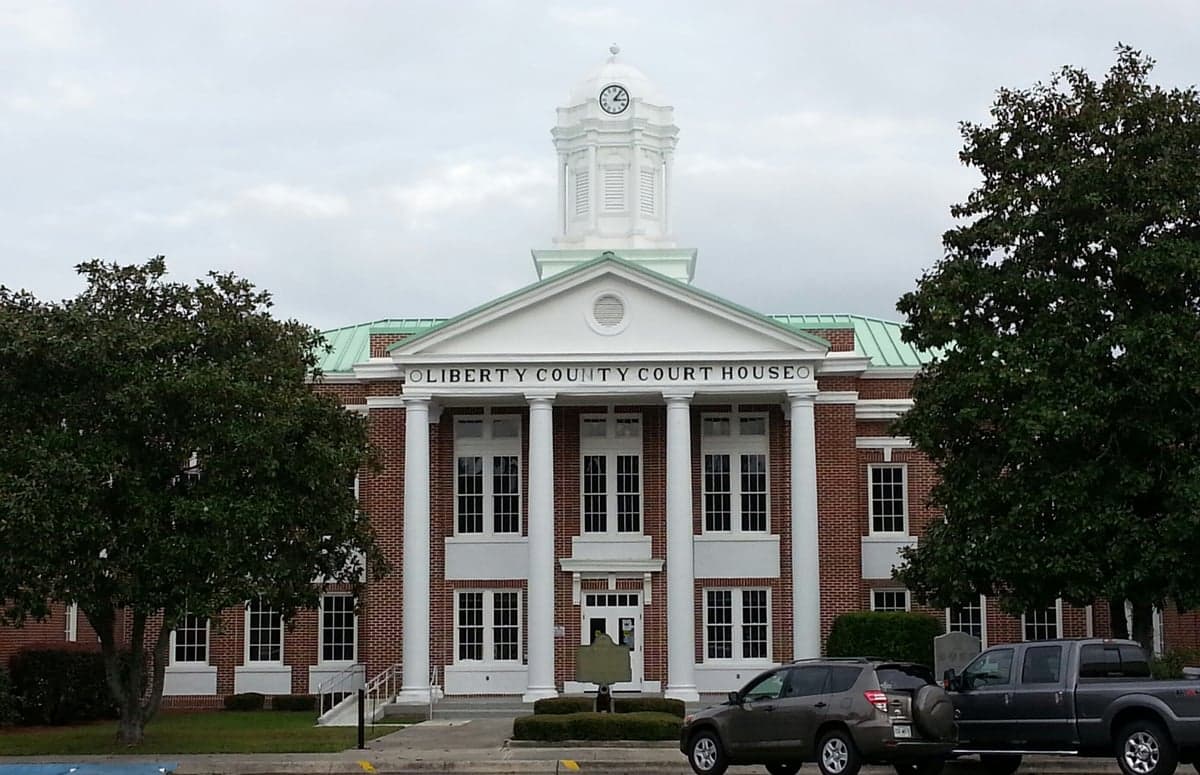
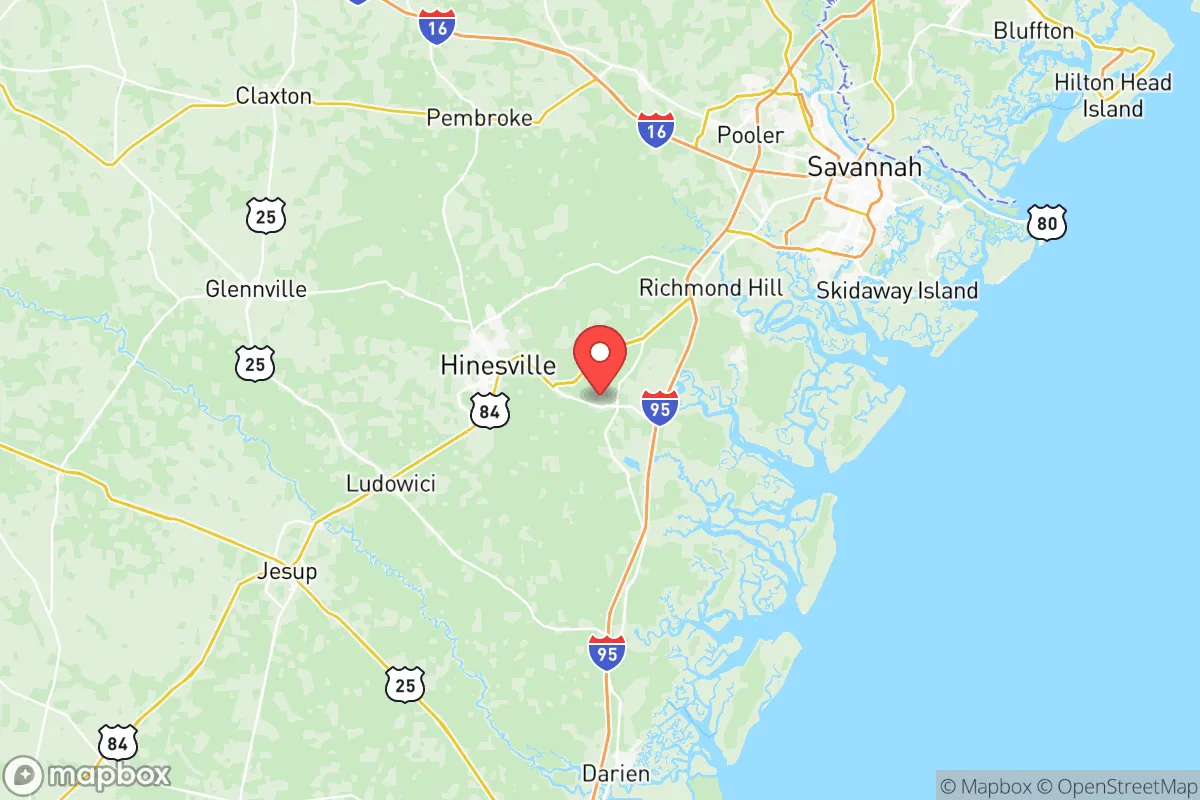
Photo: Wikipedia
Demographics of Liberty County
Affluence Level in Liberty County
A below-average socioeconomic profile. Incomes, home values, and educational attainment trail the U.S., with higher poverty and unemployment.
People of Liberty County
The people of Liberty County, Georgia today form a predominantly Black (41.4%) and White (37.4%) community, with a growing Hispanic population (12.4%) and a small but present East/Southeast Asian (1.1%) and Indian (0.7%) presence. With a population of 66,826 and a foreign-born share of just 3.1%, the county remains less diverse than the national average but more diverse than many neighboring rural counties. The county's identity is shaped by its deep military ties to Fort Stewart, its historic Gullah-Geechee heritage along the coast, and a slow but steady suburbanization from Hinesville outward.
Settlement & growth (pre-1960)
Before European contact, the area now known as Liberty County was inhabited by the Guale people, a Muskogean-speaking tribe. Spanish missionaries established the Mission Santa Catalina de Guale on St. Catherines Island (now part of Liberty County) in the late 16th century, though the mission system collapsed by the 1680s due to disease and slave raids. The region then fell under the influence of the Creek Confederacy until British colonization.
Liberty County was created in 1777 from St. Andrew, St. James, and St. John parishes, named for the patriotic fervor of the American Revolution. The first wave of permanent settlers were English and Scots-Irish planters who received land grants along the coast and the lower reaches of the North Newport River. These families established large rice and indigo plantations, relying on enslaved African labor. By 1790, enslaved people already made up a majority of the county's population, a pattern that would persist through the Civil War.
After the Civil War, newly freed African Americans concentrated in several communities. Riceboro, Midway, and Sunbury became centers of the Gullah-Geechee population, a distinct cultural group descended from enslaved West Africans who maintained their language, foodways, and crafts. The Dorchester Academy in Midway, founded by the American Missionary Association in 1870, became a key site for Black education and later a civil rights organizing hub. Meanwhile, White planters who lost their enslaved labor force shifted to timber and turpentine production, industries that employed both Black and White workers but kept the county's racial hierarchy intact.
The 20th century brought two transformative changes. First, the establishment of Fort Stewart in 1940 (expanded during World War II) brought a permanent military presence to the county's western edge. The base drew soldiers and civilian workers from across the country, diversifying the population beyond the historic planter-and-freedman dynamic. Second, the Great Migration saw thousands of Black residents leave Liberty County for northern cities like Philadelphia and New York between 1940 and 1970, reducing the county's Black population share from roughly 60% in 1940 to 48% by 1970. The county's population actually declined during the 1950s and 1960s as agriculture mechanized and timber jobs faded.
Modern era (post-1965)
The 1965 Hart-Cellar Act had a limited direct impact on Liberty County, as the foreign-born share remains low at 3.1%. However, the post-1965 military realignments reshaped the county profoundly. Hinesville, the county seat, grew from a town of 4,700 in 1970 to over 34,000 today, driven almost entirely by Fort Stewart's expansion. The base became the home of the 3rd Infantry Division in 1996, bringing thousands of soldiers and their families from every state and dozens of countries. This military influx created a population that is younger, more transient, and more racially diverse than the surrounding rural counties.
Domestic migration from the Rust Belt and other parts of the South accelerated after 2000. Retirees and military veterans drawn by the low cost of living and proximity to Savannah settled in Fleming and Gumbranch, while younger families seeking affordable housing pushed into subdivisions around Walthourville and Allenhurst. The Hispanic population grew from under 2% in 1990 to 12.4% today, driven largely by construction and service jobs tied to the base and the broader Savannah metro area. These Hispanic residents are predominantly Mexican and Central American, with many working in landscaping, hospitality, and the poultry processing plants in neighboring counties.
The Black population, now 41.4%, is a mix of multigenerational Gullah-Geechee families in the coastal communities and newer arrivals from other parts of Georgia and the South drawn by military jobs. The White population, 37.4%, is disproportionately concentrated in the military and civilian defense sectors. The East/Southeast Asian population (1.1%) and Indian population (0.7%) are small but visible, primarily military families and medical professionals at the Liberty Regional Medical Center. Fort Stewart itself functions as a kind of enclave, with its own schools, housing, and retail, creating a parallel community that is more diverse and more educated than the county at large.
The future
Liberty County is becoming slightly more diverse, but the pace is slow. The Hispanic share is projected to reach 15-17% by 2040, driven by natural increase and continued migration for construction and service jobs. The Black and White shares will likely converge toward parity, as both groups see modest growth. The foreign-born share may rise to 5-6% as military families from overseas continue to settle locally after service. The county's college-educated share (19.9%) is below the state average of 33%, but the presence of Fort Stewart and the Savannah Technical College campus in Hinesville may slowly raise that figure.
The biggest demographic wildcard is the future of Fort Stewart. Any major base realignment or reduction in the 3rd Infantry Division's footprint would sharply reverse population growth, particularly in Hinesville and the surrounding subdivisions. Conversely, continued military investment could push the county toward 80,000 residents by 2040. The coastal communities of Riceboro and Sunbury are likely to see increased development pressure from Savannah's expanding exurbs, potentially bringing more White and Hispanic residents into historically Black areas.
Culturally, the county is becoming less distinct. The Gullah-Geechee language and traditions, once strong in the coastal settlements, are fading as younger generations move to Savannah or Atlanta. The military presence creates a more national, less Southern culture in Hinesville, while the rural areas remain more traditional. The county's political leanings are mixed: Liberty County voted for Donald Trump in 2024 by a narrow margin, reflecting its military-heavy, working-class character, but the Black population keeps it competitive for Democrats.
For someone moving in now, Liberty County offers a low-cost, military-anchored community with a genuine but fading coastal heritage. The population is stable, moderately diverse, and heavily dependent on a single employer. The county is not a boomtown, but it is not in decline either. The people who thrive here are those who value affordability, proximity to Savannah, and a community where the military and the old Gullah-Geechee families coexist, each shaping the county in their own way.

* Values derived from national, state, county, city and local statistics and may differ in a specific area. Last updated: 2026-07-17T10:32:41.000Z
Narrative content on this page is AI-generated and may contain mistakes. Verify any details that matter before acting on them.
ReloMaps may earn a commission from affiliate links at no extra cost to you.

