Photo: Wikipedia
Political ClimatePolitical Climate in Barrow County
Showing district-level results — no local-only data available.
Local Political AnalysisPolitical Analysis of Barrow County
Barrow County has been a reliably Republican stronghold for decades, and that hasn't changed. The Cook Partisan Voting Index (PVI) of R+11 means the county votes about 11 points more Republican than the national average, making it one of the more conservative corners of the Atlanta metro area. But if you've been around here long enough, you'll notice the old guard is slowly giving way to a new wave of residents, and that's starting to shift things under the surface.
How it compares
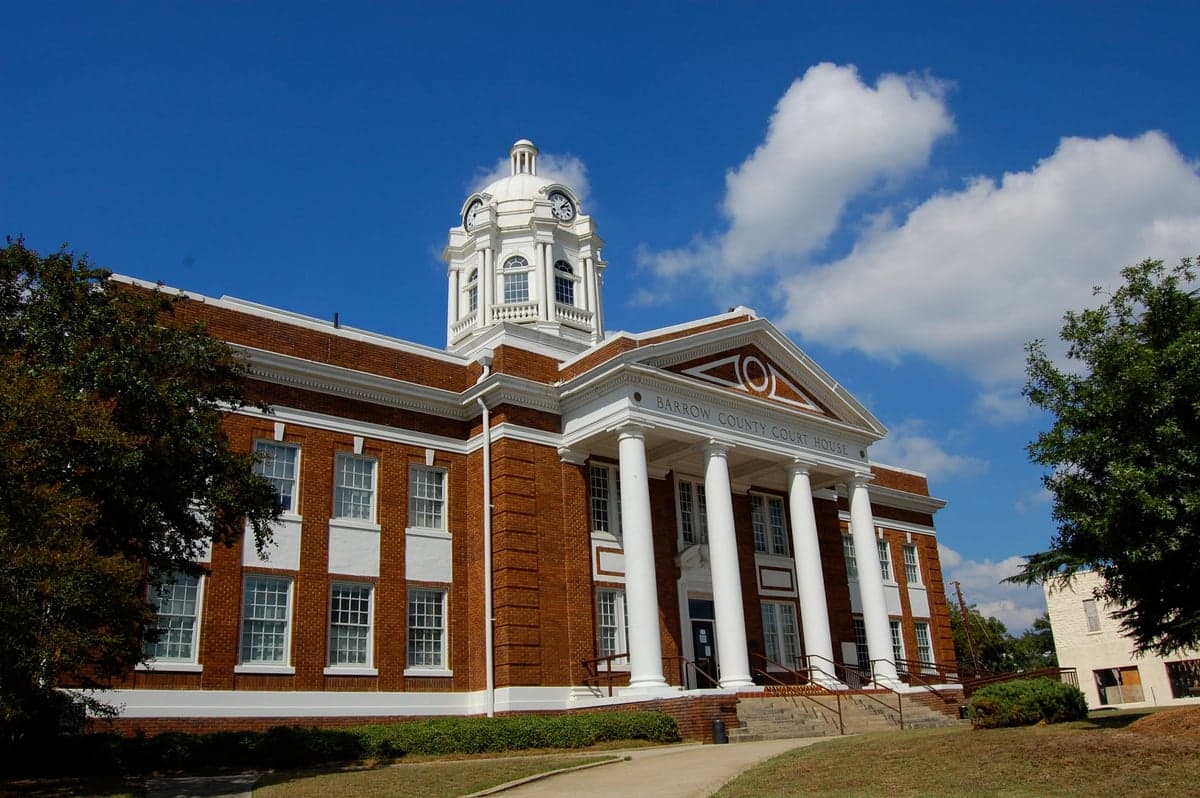
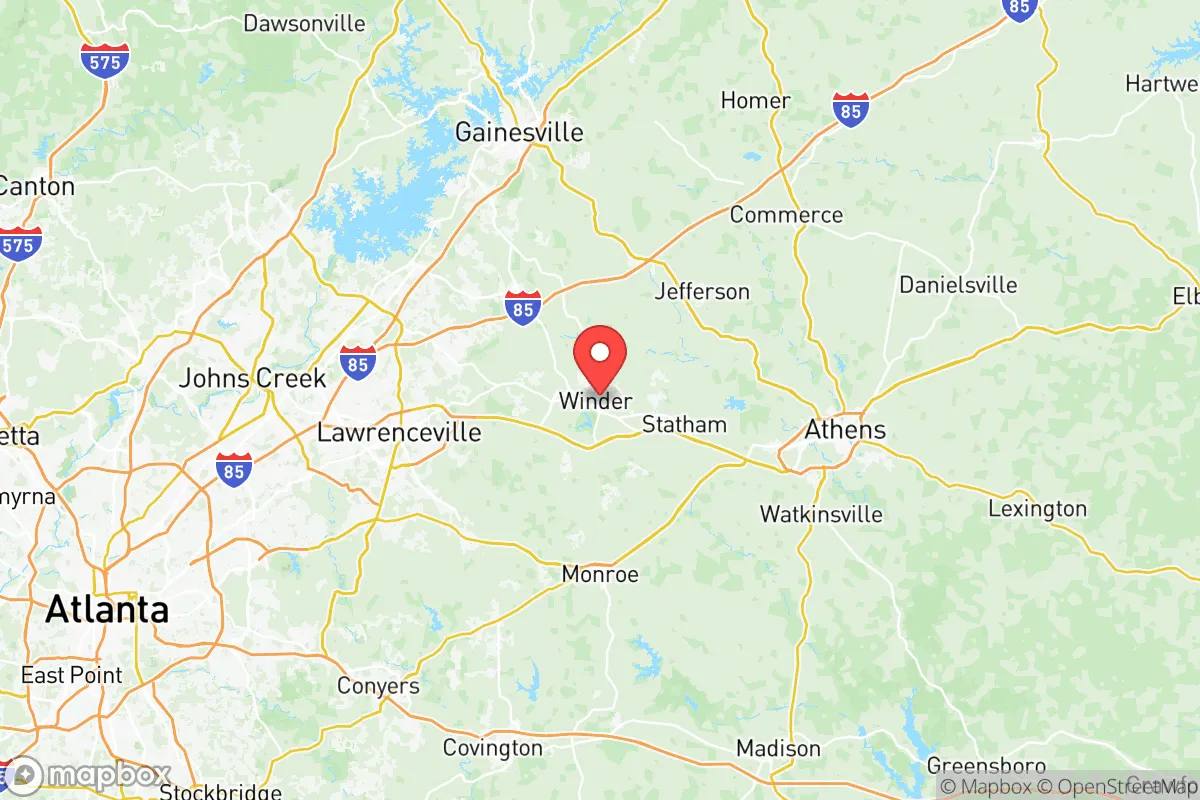
Compared to Georgia as a whole, Barrow County is noticeably more conservative. The state itself has been trending purple in recent cycles — narrowly flipping blue for Biden in 2020 and then swinging back to Trump in 2024 — but Barrow County has stayed solidly red. In the 2024 presidential race, Donald Trump carried the county by roughly 30 points, a margin far wider than his statewide win. That gap tells you everything: Barrow is not a bellwether; it's a Republican anchor. Within the county, though, there's real variation. Winder, the county seat, tends to be the most conservative precinct, with deep roots in the old farming and manufacturing community. Auburn and Statham lean red but are a bit more moderate, often swinging closer to the county average. Braselton, which straddles the line with Gwinnett County, is the most interesting — it's the only part of Barrow where you'll find precincts that occasionally vote within single digits of a Democrat, thanks to an influx of commuters and younger families from the east side of Atlanta. Bethlehem and Carl are still deeply conservative, with turnout driven by local churches and gun clubs.
What this means for residents
For conservative residents, Barrow County is a comfortable place to live politically. Local government, from the Board of Commissioners to the school board, is dominated by Republicans. Tax policy is generally low and business-friendly, and the county has resisted some of the more progressive zoning and housing mandates seen in metro Atlanta. For liberal residents, it can feel isolating. There's no real Democratic infrastructure here — no party headquarters, no regular activist meetups. But it's not hostile. Most people keep politics to themselves, and the growing diversity of the county (especially in Braselton and along the Highway 316 corridor) means you'll find plenty of neighbors who share your views, even if they're not loud about it. The real tension isn't between left and right — it's between the old-timers who want to keep Barrow rural and the newcomers who want more development, better schools, and faster internet.
Culturally, Barrow County still feels like a place where the Fourth of July parade in Winder matters more than any national election. The county has a strong gun culture, with several indoor and outdoor ranges, and the local schools still lead students in the Pledge of Allegiance daily. But the policy landscape is shifting. The county recently approved a new mixed-use development near the Chateau Elan winery in Braselton, signaling a slow embrace of the suburban growth that's already swallowed Gwinnett. If you're moving here, the key thing to know is that Barrow is still red, but it's not static — and the next decade will likely see it become a little more purple, especially as Atlanta's sprawl pushes further east.

State Political ClimatePolitical Climate in Georgia
State Political AnalysisPolitical Environment in the State
Georgia has transformed from a reliably Republican stronghold into the nation’s most competitive swing state over the past two decades, with a partisan lean that now sits essentially dead even. The state voted for Joe Biden in 2020 by a razor-thin 0.2% margin, then re-elected both Democratic Senator Raphael Warnock and Republican Governor Brian Kemp in 2022—a split ticket that perfectly captures its current political schizophrenia. The long arc has been driven by explosive growth in the Atlanta metro, particularly in diverse suburban counties like Gwinnett, Cobb, and Henry that flipped from red to blue between 2012 and 2020, while rural and exurban areas have hardened their Republican margins.
Urban vs. rural divide
The political map of Georgia is essentially a battle between the Atlanta metropolitan area and the rest of the state. The core of Democratic strength is the city of Atlanta itself, along with the inner-ring suburbs of DeKalb and Fulton counties, which routinely deliver 75-85% Democratic margins. The real story, however, is the suburban ring: Gwinnett County, once a Republican bastion, now votes Democratic by about 15 points, while Cobb County has shifted from +13 Republican in 2012 to +2 Democratic in 2020. Farther out, exurban counties like Forsyth and Cherokee remain deeply Republican, but their growth is slower than the diversifying inner suburbs. Outside the Atlanta orbit, the state’s other urban centers—Savannah, Augusta, Columbus, and Macon—each have Democratic-leaning cores surrounded by conservative rural territory. The rural southwest, stretching from Albany to Valdosta, is heavily Democratic in terms of Black voter registration but often votes Republican in practice due to lower turnout. The northern mountains and the coastal areas outside Savannah are the most consistently Republican regions, with counties like Union and Towns routinely delivering 75%+ Republican margins.
Policy environment
Georgia’s policy environment is a study in contrasts, reflecting its divided government. The state has a flat income tax rate of 5.49% (set to decline to 4.99% by 2029), a relatively low corporate tax rate, and a homestead exemption that keeps property taxes moderate for homeowners. There is no state-level rent control, and zoning is largely controlled by local governments, leading to a patchwork of regulations. On education, Georgia has a robust school choice program—the Georgia Promise Scholarship Act, passed in 2024, provides $6,500 vouchers for students in low-performing schools—alongside charter school options and a state-funded pre-K program. Healthcare policy is notably conservative: Georgia did not expand Medicaid under the Affordable Care Act, leaving roughly 300,000 residents in the coverage gap, though a limited waiver program (Georgia Pathways) was launched in 2023 with work requirements. Election laws have been a flashpoint: the 2021 Election Integrity Act (SB 202) added voter ID requirements for absentee ballots, limited drop boxes, and restricted third-party ballot collection, while also expanding early voting hours in most counties. Gun laws are among the most permissive in the country: permitless carry was enacted in 2022 (HB 218), and there is no state-level red flag law, no waiting period, and no universal background check requirement beyond federal law.
Recent policy direction
The last three years have seen Georgia’s Republican-controlled legislature and governor push a distinctly conservative agenda, though tempered by the reality of a competitive state. On gun rights, the 2022 permitless carry law (HB 218) was the headline, but the state also passed a law in 2023 allowing firearms in places of worship unless explicitly prohibited. On education and parental rights, the 2022 “Parents’ Bill of Rights” (HB 1178) requires schools to notify parents of any changes to a student’s services or monitoring related to mental, emotional, or physical health, and the 2023 “Protect Students First Act” (SB 88) restricts classroom instruction on gender identity and sexual orientation through third grade. Property rights saw a win for homeowners with the 2023 “Squatter Reform Act” (HB 1017), which made it easier to remove unauthorized occupants. On the medical and bodily autonomy front, Georgia’s 2019 “Heartbeat Bill” (HB 481) bans abortion after roughly six weeks, with exceptions for rape, incest, and medical emergencies; the law was blocked by courts until 2022 and remains in effect. Privacy and surveillance are mixed: Georgia has no comprehensive data privacy law, but the 2023 “Georgia Data Protection Act” (SB 132) created a limited framework for consumer data rights. Voting access remains a battleground: SB 202’s restrictions have been upheld in court, but turnout in 2022 and 2024 remained high, suggesting the law’s practical impact may be overstated.
Civil unrest & political movements
Georgia has been a focal point for political activism on both sides. The 2020 election aftermath saw massive “Stop the Steal” protests at the state capitol, and the 2021 Senate runoff elections drew national attention and record turnout. The Atlanta area has seen periodic protests over police reform, particularly after the 2020 killing of Rayshard Brooks, and the “Cop City” controversy—a proposed police training facility in DeKalb County—sparked sustained protests and legal battles, with activists labeling it a “militarization” of law enforcement. Immigration politics are heated but localized: Georgia has no sanctuary city policies, and the 2011 HB 87 law (modeled on Arizona’s SB 1070) allows police to check immigration status during lawful stops, though enforcement varies widely. The state’s election integrity debate remains active, with Republican officials continuing to push for hand-counting of ballots (a proposal that failed in 2024) and Democratic groups challenging voter roll purges. A new resident would notice the political polarization most acutely in the Atlanta suburbs, where yard signs and bumper stickers are common, and in the stark contrast between urban and rural news coverage.
Projection
Over the next 5-10 years, Georgia is likely to remain a toss-up state, with a slight trend toward competitiveness rather than a clear blue or red shift. The key demographic driver is the continued growth of the Atlanta suburbs, particularly Gwinnett, Cobb, and Henry counties, which are becoming more diverse and more Democratic-leaning. However, the exurban and rural areas are also growing, and they are becoming more Republican. The net effect is a state that will probably stay within 2-3 points of the national popular vote in presidential elections. The wild card is migration: Georgia is attracting both conservative retirees from Florida and the Northeast and liberal professionals from California and New York, creating a demographic tug-of-war. State-level policy will likely remain conservative on fiscal and gun issues, with incremental changes on education and healthcare, but the possibility of a Democratic trifecta (governor + legislature) is real if suburban trends continue for another two election cycles. A resident moving in now should expect a state where their vote truly matters, where policy can swing sharply with each election, and where the political conversation is dominated by Atlanta’s growth and its cultural ripple effects.
For a new resident, the bottom line is that Georgia offers a genuinely competitive political environment where your vote carries weight, but also where policy can change dramatically depending on which party controls the governor’s mansion and legislature. Conservative residents will find a friendly tax and regulatory climate, strong gun rights, and school choice options, but should expect ongoing battles over election laws and social issues. Liberal residents will find a growing base of support in the Atlanta suburbs and urban centers, but will face a conservative state government that shows no signs of moderating on abortion, gun rights, or labor policy. The practical takeaway: Georgia is not a place where you can ignore politics—it’s a state where every election feels like a national bellwether, and where your neighborhood’s political character can change within a single census cycle.
* Values derived from national, state, county, city and local statistics and may differ in a specific area. Last updated: 2026-06-15T12:04:55.000Z
Narrative content on this page is AI-generated and may contain mistakes. Verify any details that matter before acting on them.
ReloMaps may earn a commission from affiliate links at no extra cost to you.

