
Photo: Wikipedia
Personal Sovereignty in Barrow County
Viable for self-reliance. Generally workable, though some barriers may limit total independence.
What does Personal Sovereignty tell us?
Personal Sovereignty measures your capacity for self-reliance and independence with minimal government friction. Higher scores mean fewer barriers between you and the way you want to live... but it assumes you have the space you need and good neighbors.
What does this tell us?
Personal Sovereignty measures your capacity for self-reliance and independence with minimal government friction. Higher scores mean fewer barriers between you and the way you want to live... but it assumes you have the space you need and good neighbors.
State Policy
Energy independence: Importer (12% of energy produced in-state)
Personal Liberty
Homesteading

Personal Liberty Analysis
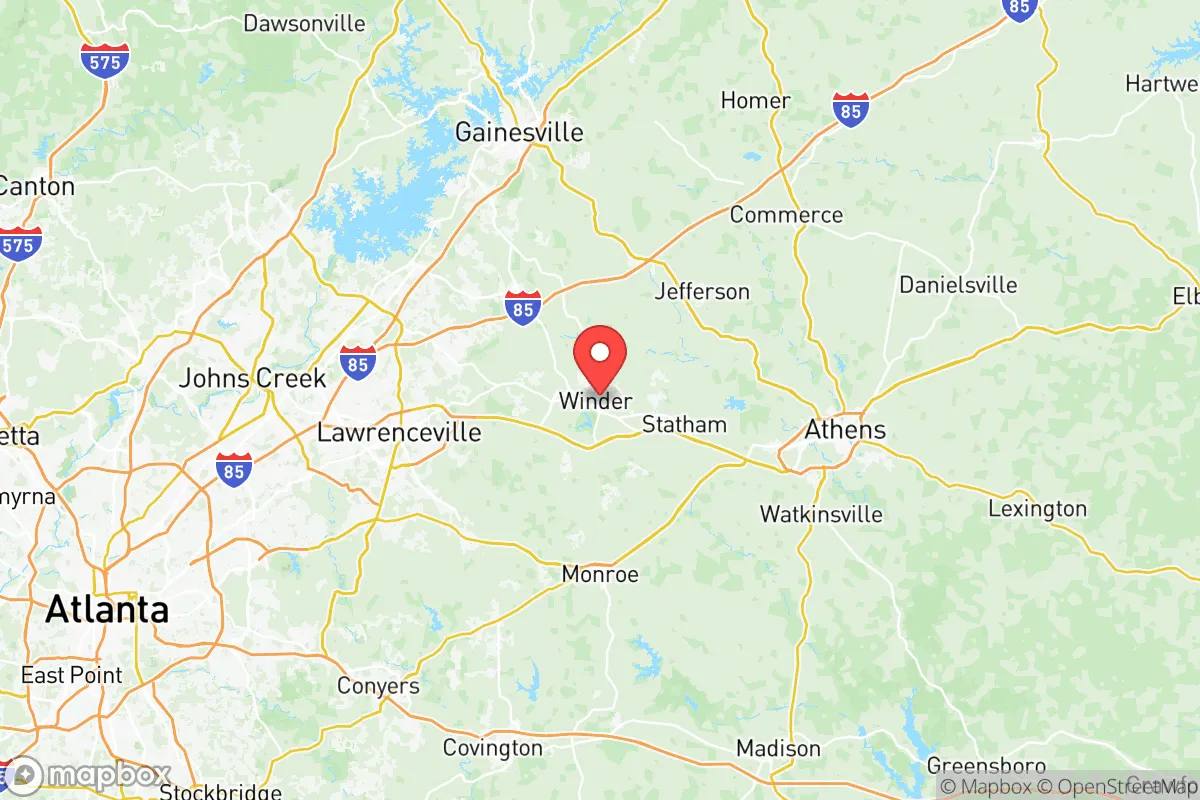
Barrow County, Georgia, offers a notably high degree of personal sovereignty, grounded in Georgia’s generally light-touch regulatory environment and strong protections for individual rights. Located in the rapidly growing Atlanta exurbs, the county balances rural independence with suburban convenience, making it a compelling option for those prioritizing autonomy. The county’s unincorporated areas, particularly around Winder and Statham, provide a markedly different experience from the more restrictive environments found closer to Atlanta, with lower taxes, fewer zoning hurdles, and a culture that values self-reliance.
Tax burden and regulatory posture in Barrow County
Georgia’s state-level tax structure is favorable for personal sovereignty, with a flat income tax rate of 5.49% and no state-level estate or inheritance taxes. Barrow County itself maintains a relatively low property tax millage rate—around 12.5 mills for the unincorporated area—which is competitive with neighboring counties like Gwinnett (higher) and Jackson (similar). The county’s regulatory posture is generally permissive, especially outside the city limits of Winder and Auburn. Building permits for detached structures, sheds, and fences are processed with minimal delay, and the county does not impose a separate stormwater utility fee, a common hidden cost in more regulated jurisdictions. Business licensing is straightforward, with no county-level occupational tax for most home-based enterprises. The lack of a county-wide tree preservation ordinance or strict impervious surface limits in unincorporated areas further reduces regulatory friction for property owners. However, the cities of Winder and Statham have their own zoning codes that are more restrictive on accessory dwelling units and home occupations, so those seeking maximum flexibility should prioritize unincorporated parcels.
Self-defense and gun law specifics in Barrow County
Georgia is a “constitutional carry” state, meaning no permit is required to carry a handgun openly or concealed for anyone legally allowed to possess a firearm. Barrow County’s culture strongly supports this right, with multiple gun shops and indoor ranges in Winder and Bethlehem. The county sheriff’s office is known for issuing weapons carry licenses (WCLs) efficiently, though the permit is now optional. Stand-your-ground laws are fully in effect, with no duty to retreat in any place where a person is lawfully present. Barrow County’s courts have a reputation for applying these laws broadly, with local prosecutors rarely pursuing charges in clear self-defense cases. The county also has no local ordinances restricting magazine capacity, firearm types, or storage requirements, leaving those decisions entirely to the individual. For those concerned about home defense, the county’s response times in rural areas near Carl can exceed 20 minutes, making personal firearms a practical necessity rather than a lifestyle choice.
Self-reliance and homesteading viability: lot sizes, zoning, and off-grid feasibility
Barrow County is one of the more homestead-friendly areas in the Atlanta metro region, particularly in its eastern and southern reaches. Minimum lot sizes in unincorporated areas are typically 1 acre for single-family homes, but agricultural zoning allows parcels as small as 5 acres for livestock and crop production. The county’s zoning code explicitly permits backyard chickens, beekeeping, and small-scale farming without a special permit, a significant advantage over more restrictive suburbs. Off-grid living is feasible but requires navigating Georgia’s state-level building codes. The county does not mandate connection to municipal water or sewer in unincorporated areas; private wells and septic systems are standard. Solar panels are permitted without a separate county permit, though they must comply with the state’s electrical code. Rainwater collection is legal and encouraged, with no volume restrictions. The areas around Statham and Carl are particularly suited for homesteading, with larger tracts of land, lower property prices, and a rural character that supports self-reliant lifestyles. In contrast, subdivisions near Auburn and Winder often have HOA covenants that restrict livestock, outbuildings, and off-grid systems, so buyers should verify deed restrictions before purchasing.
Personal liberties: parental rights, medical autonomy, speech, and property
Georgia law provides strong protections for parental rights, including a statutory presumption that parents have the right to direct their children’s education, healthcare, and religious upbringing. Barrow County’s school board has been active in this area, adopting policies that require parental notification for any health services provided at school and maintaining a curriculum transparency portal. Homeschooling is straightforward, with no required approval from the school district—only a simple declaration of intent. Medical autonomy is supported by Georgia’s broad scope of practice for naturopathic doctors and the absence of a state vaccine mandate for adults. The county has no local health ordinances that override state-level medical freedom protections. Property rights are robust, with Georgia’s “right to farm” act shielding agricultural operations from nuisance lawsuits, a critical protection for homesteaders. The county’s planning department generally interprets zoning codes in favor of the property owner, and variance requests are routinely approved for reasonable uses. Free speech is protected under Georgia’s constitution, which explicitly guarantees the right to speak, write, and publish on any subject, and Barrow County has no local noise or signage ordinances that would restrict political or religious expression on private property.
Overall, Barrow County ranks among the more sovereignty-friendly jurisdictions in Georgia’s exurban ring. Its combination of low taxes, permissive gun laws, homestead-friendly zoning, and strong protections for parental and property rights creates an environment where individuals and families can exercise a high degree of personal autonomy. While the cities of Winder and Auburn introduce some regulatory friction, the unincorporated areas—especially around Statham, Carl, and Bethlehem—offer a level of self-reliance that is increasingly rare in the Atlanta region. For those weighing personal freedom against proximity to urban jobs and services, Barrow County represents a practical middle ground where independence is not just tolerated but actively supported by local governance and culture.

* Values derived from national, state, county, city and local statistics and may differ in a specific area. Last updated: 2026-06-15T12:04:55.000Z
Narrative content on this page is AI-generated and may contain mistakes. Verify any details that matter before acting on them.
ReloMaps may earn a commission from affiliate links at no extra cost to you.

