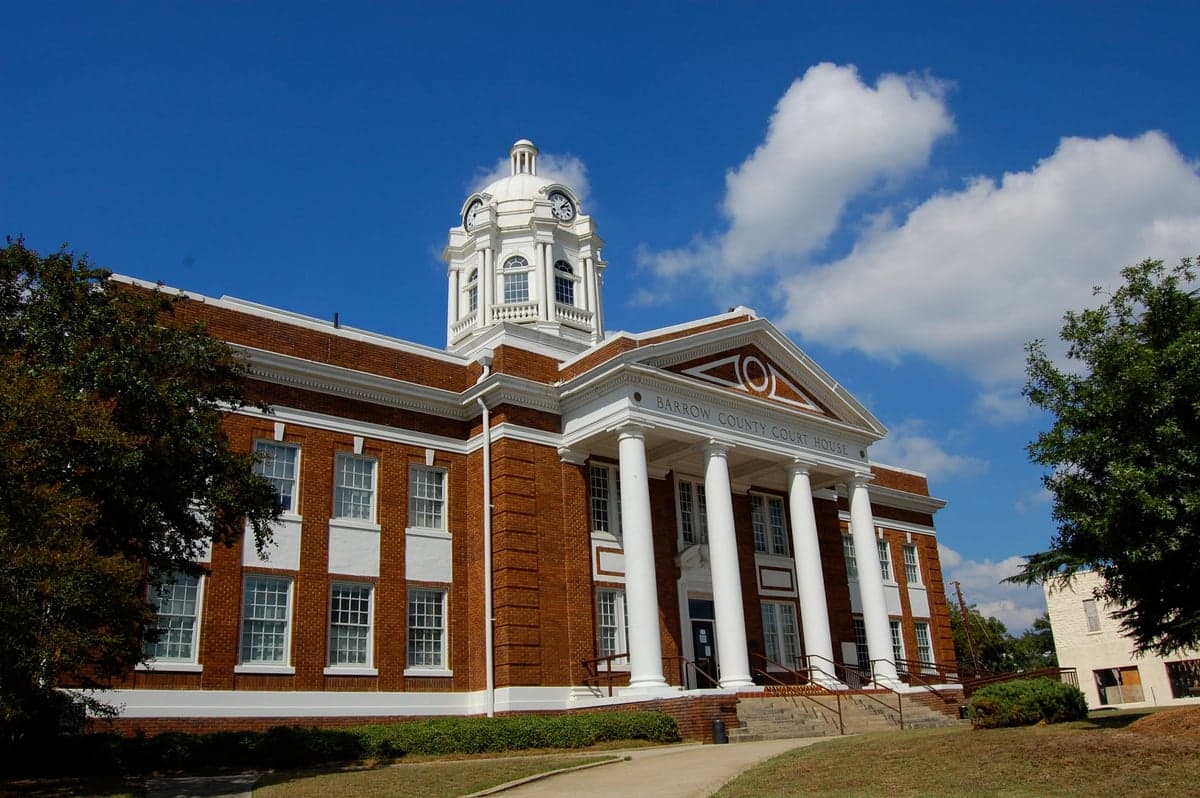
Photo: Wikipedia
Demographics of Barrow County
Affluence Level in Barrow County
A middle-class area roughly in line with national averages across income, home values, education, and employment.
People of Barrow County
Barrow County, Georgia, is home to 86,982 residents, a population that has more than doubled since 2000, driven largely by suburban spillover from the Atlanta metro area. The county’s character is defined by a predominantly white (65.0%) and increasingly Hispanic (14.2%) and Black (13.1%) population, with a modest foreign-born share of 4.8% and a college attainment rate of 21.0%. This is a working-to-middle-class exurban community where newcomers are drawn by lower housing costs and a slower pace than nearby Gwinnett or Hall counties, yet the area retains a distinct small-town identity rooted in its agricultural and railroad past.
Settlement & growth (pre-1960)
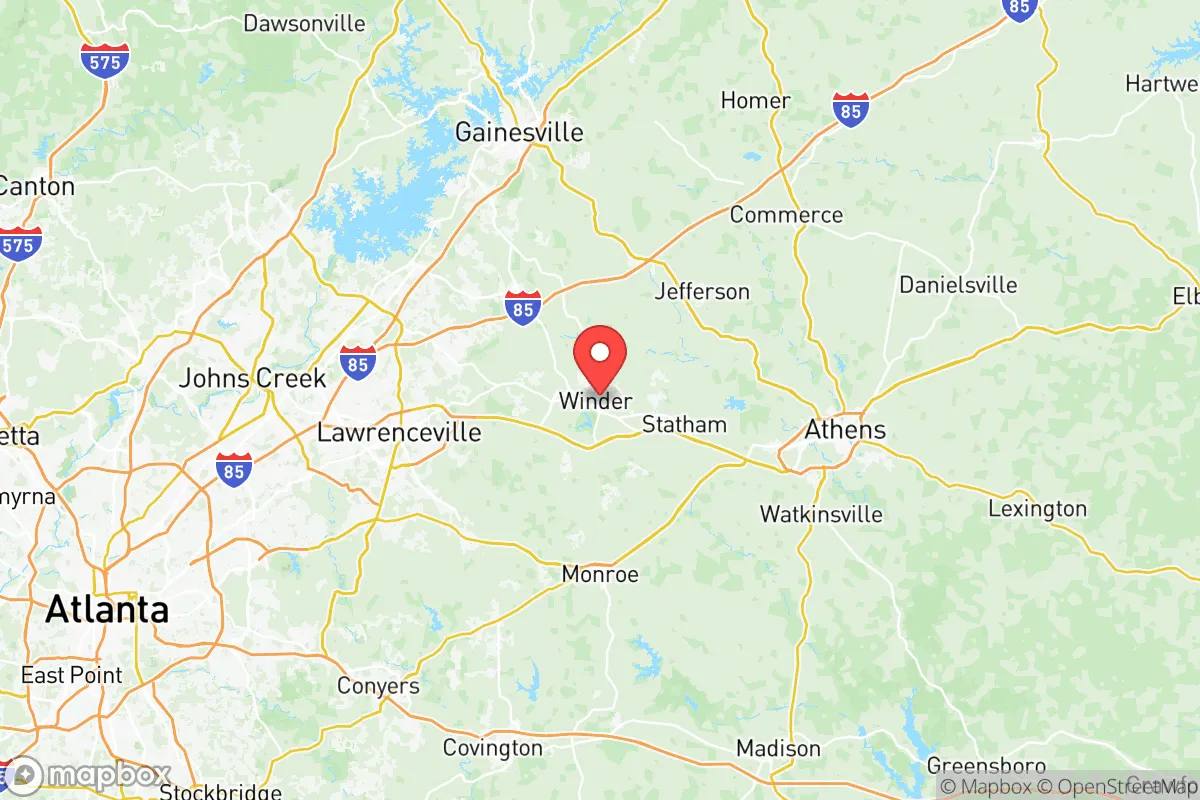
Before European settlement, the area now known as Barrow County was part of the vast hunting grounds of the Cherokee and Creek nations. The Cherokee ceded the land in the 1817 Treaty of the Cherokee Agency, and white settlers—primarily of Scots-Irish and English descent—began arriving in the 1820s and 1830s. These early pioneers were drawn by the fertile Piedmont soil and the promise of cotton farming, establishing small farming communities that would later become the towns of Winder, Auburn, and Statham. Winder, the county seat, was founded in 1893 as a railroad depot on the Gainesville Midland line, and its growth was tied to the cotton trade and later to textile mills that employed local farmers and their families.
The county itself was created in 1914 from parts of Gwinnett, Jackson, and Walton counties, named after Confederate Secretary of State John C. Barrow. Through the early 20th century, the population remained overwhelmingly white and native-born, with a small Black community concentrated in rural pockets and in the southern part of the county near Bethlehem. The Great Depression and the boll weevil devastated cotton farming, leading many residents to leave for industrial jobs in Atlanta or the textile mills of Gainesville. By 1960, Barrow County’s population stood at just 13,115—a slow-growing, largely homogeneous farming community with little immigration and a deeply rooted Southern Protestant culture.
Modern era (post-1965)
The 1965 Hart-Cellar Act had little immediate effect on Barrow County, which remained overwhelmingly white and native-born through the 1980s. The real demographic transformation began in the 1990s and accelerated after 2000, driven by two forces: domestic migration from the Rust Belt and the suburban expansion of Atlanta’s Hispanic and Black populations. The construction of Highway 316 and the widening of State Route 11 made Winder and Braselton (which straddles Barrow, Gwinnett, Jackson, and Hall counties) commutable to Atlanta, and developers began building subdivisions on former farmland.
Hispanic residents, primarily of Mexican and Central American origin, began arriving in the 1990s to work in construction, landscaping, and poultry processing plants in nearby Gainesville. They concentrated in Winder and in the unincorporated areas around Carl and Bethlehem, where affordable rental housing was available. By 2020, the Hispanic share had grown to 14.2%, making them the largest minority group. The Black population, which had been a small but steady presence since the county’s founding, grew more rapidly after 2000 as African American families moved from Atlanta and DeKalb County seeking larger lots and lower crime rates. Today, Black residents make up 13.1% of the population, with notable concentrations in Winder and the southern part of the county near Statham.
East and Southeast Asian communities (3.8% of the population) are a more recent addition, arriving primarily in the 2010s as professionals and small business owners drawn to the area’s lower cost of living and proximity to Asian-owned businesses in Gwinnett County. Many live in the newer subdivisions around Auburn and Braselton, where larger homes and good schools are available. The Indian subcontinent population remains tiny at 0.3%, with no distinct enclave. The foreign-born share overall is just 4.8%, well below the national average, indicating that most of the county’s diversity comes from domestic migration rather than immigration.
The future
Barrow County is projected to continue growing at a rapid pace, with the Atlanta Regional Commission estimating a population of over 100,000 by 2030. The county is becoming more diverse, but the pace of change is slower than in core metro counties like Gwinnett or Cobb. The white share is declining gradually as Hispanic and Black populations grow, but Barrow remains a majority-white, English-dominant community. New residential developments are concentrated along the Highway 316 corridor and around Winder and Auburn, where large master-planned communities are attracting families from Gwinnett and Hall counties who are priced out of those markets.
The cultural identity of Barrow County is evolving from a rural farming community to a suburban bedroom county, but it retains a conservative, family-oriented character. The school system is a major draw, and the county’s relatively low property taxes compared to neighboring Gwinnett are a selling point. The next decade will likely see continued infill development, more retail and service-sector jobs, and a slow but steady increase in diversity, particularly among Hispanic and East/Southeast Asian residents. The Indian and Arab populations are expected to remain very small.
For someone moving in now, Barrow County offers a middle ground between rural Georgia and the Atlanta metro: a place where housing is still affordable, schools are improving, and the population is growing but not yet crowded. The county is becoming more diverse but remains culturally conservative and family-focused, with a strong sense of local identity centered on Winder and its historic downtown. The key question for newcomers is whether the area can manage its growth without losing the small-town feel that draws people here in the first place.

* Values derived from national, state, county, city and local statistics and may differ in a specific area. Last updated: 2026-06-15T12:04:55.000Z
Narrative content on this page is AI-generated and may contain mistakes. Verify any details that matter before acting on them.
ReloMaps may earn a commission from affiliate links at no extra cost to you.

