
Photo: Wikipedia
Political ClimatePolitical Climate in Garden City, GA
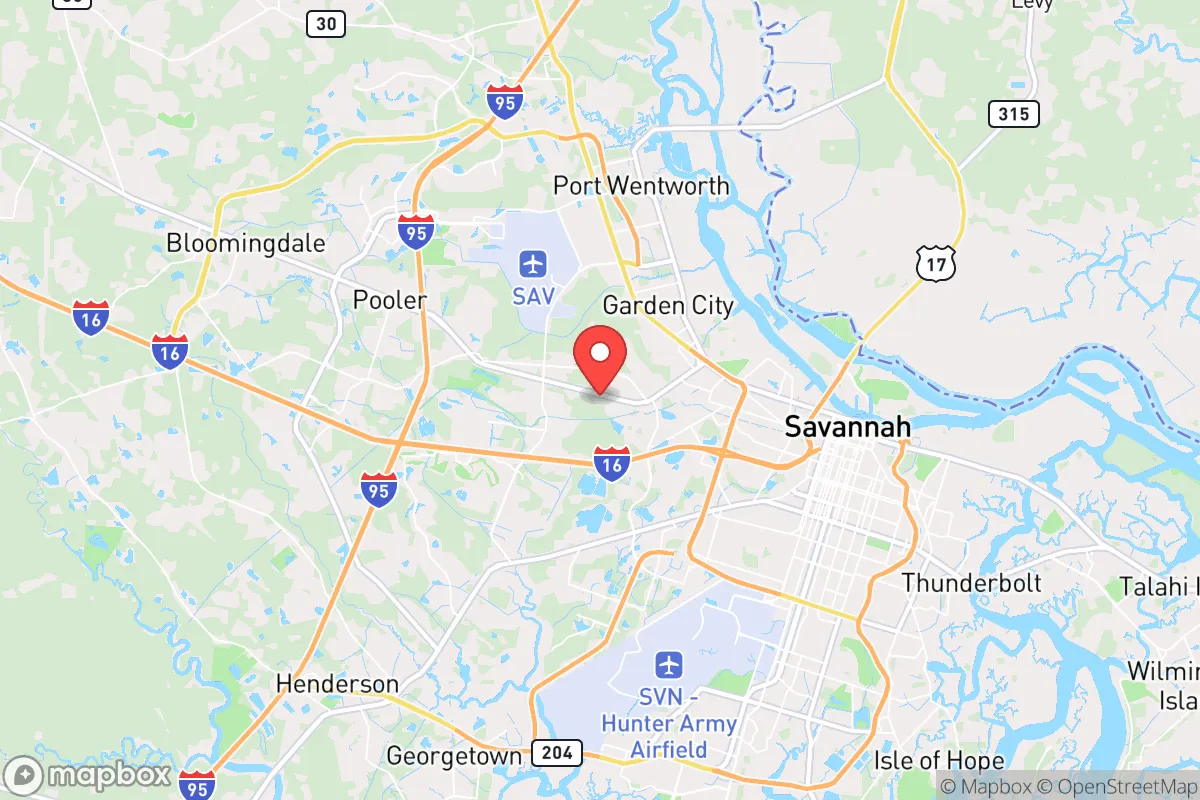
District shown is the primary district for this city’s centroid. Cities may span multiple districts.
Local Political AnalysisPolitical Analysis of Garden City, GA
Garden City, Georgia, leans solidly Republican, with a Cook Partisan Voting Index (PVI) of R+8, meaning it votes about eight points more conservative than the national average. This isn't a new development—the area has been reliably red for decades, driven by a mix of working-class voters, military-affiliated families from nearby Hunter Army Airfield, and a strong local culture of fiscal conservatism. Over the last few election cycles, the Republican tilt has held steady, though you'll see pockets of blue in the more diverse, younger neighborhoods closer to Savannah proper. The trajectory here is one of slow, incremental change: the GOP base remains dominant, but the growing population of transplants and younger residents is gradually nudging the margins, making local races slightly more competitive than they were ten years ago.
How it compares
Compared to the rest of Georgia, Garden City is noticeably more conservative than the state as a whole, which has become a competitive battleground in recent years. While Georgia's statewide Cook PVI isn't publicly calculated in the same way, the state has flipped blue in presidential elections (2020) and has two Democratic U.S. Senators, reflecting its urban and suburban shifts. Garden City, by contrast, sits in Chatham County, which overall leans Democratic due to Savannah's influence, but the city itself is a conservative outlier within that county. Drive ten minutes east into downtown Savannah, and you'll find a very different political vibe—progressive, diverse, and heavily Democratic. Head west toward Pooler or south toward Richmond Hill, and you'll hit suburbs that are also Republican-leaning, but often with a more moderate, business-friendly flavor than Garden City's blue-collar conservatism. The contrast is stark: Garden City feels like a small-town Republican stronghold tucked inside a purple county, while the broader state is a toss-up between urban blue and rural red.
What this means for residents
For conservative residents, the R+8 lean means their values are well-represented in local government—city council and county commission races typically go to Republicans, and policy tends to favor low taxes, limited regulation, and a pro-business environment. You'll find that issues like gun rights, school choice, and law-and-order policing get serious traction here. For liberal residents, the political reality is more about finding your niche: you're likely in the minority, but not isolated. Savannah's progressive scene is a short drive away, and there are active Democratic groups in Chatham County that organize locally. In practice, this means a conservative can feel at home in most civic spaces, while a liberal might need to seek out like-minded neighbors or engage in state-level politics to feel heard. The area's political climate is stable but not hostile—most folks are neighborly regardless of party, and the real divides tend to be more about economic class than culture wars.
Culturally, Garden City stands apart from both Savannah and the rest of Georgia in its no-nonsense, working-class identity. You won't find the art galleries or college-town activism of Athens, nor the sprawling suburban sprawl of metro Atlanta. Instead, the city's politics are shaped by its industrial base—the port, the paper mill, and logistics jobs—which fosters a practical, "what works" mentality. Policy debates here often center on infrastructure, truck traffic, and property taxes rather than hot-button social issues. This pragmatic streak means that even in a deeply red area, there's room for compromise on local matters like road improvements or public safety funding. Looking ahead, the long-term trajectory will depend on how much the area grows: if development continues to bring in new residents from more diverse backgrounds, the R+8 lean could soften, but for now, Garden City remains a reliably conservative anchor in a changing Georgia.

State Political ClimatePolitical Climate in Georgia
State Political AnalysisPolitical Environment in the State
Georgia has transformed from a reliably Republican stronghold into the nation’s premier swing state over the past two decades, with Joe Biden’s 2020 win by just 0.2% and the 2024 presidential race again decided by razor-thin margins. The state’s political landscape is now defined by a coalition of fast-growing, diverse metro Atlanta suburbs pulling left, while the rest of the state—from the rural southwest to the mountain counties in the north—holds firm as deeply conservative territory. This tug-of-war has made Georgia the most closely watched political battleground in the country, with both parties pouring resources into a state that was once an afterthought in presidential elections.
Urban vs. rural divide
The political map of Georgia is essentially a story of Atlanta versus everywhere else. Metro Atlanta’s core counties—Fulton, DeKalb, Clayton—are among the most reliably Democratic in the South, delivering margins of 70-85% for Democratic candidates. But the real story is the suburban ring: Cobb, Gwinnett, and Henry counties, which voted Republican by double digits as recently as 2012, have flipped decisively blue. Cobb County, once the home of Newt Gingrich’s congressional district, went for Biden by 14 points in 2020. Meanwhile, the exurban and rural counties tell a different tale. Forsyth County, just north of Atlanta, has become a Republican stronghold with margins exceeding 40 points, while deep south Georgia counties like Brooks and Early routinely vote 70%+ Republican. The state’s second-largest metro, Augusta, leans Republican but with a significant Democratic base in Richmond County, while Savannah’s Chatham County has trended blue. Columbus and Macon are purple-to-blue cities surrounded by deep red rural areas. The I-75 corridor south of Atlanta, through places like Warner Robins and Valdosta, remains reliably conservative, anchored by military communities and agricultural interests.
Policy environment
Georgia’s policy environment reflects its divided politics. The state has a flat income tax rate of 5.39%, with a scheduled reduction to 4.99% by 2029 under legislation passed in 2022. Property taxes are locally set and generally moderate, with a homestead exemption that caps annual assessment increases at 3% for primary residences. The state is a right-to-work state with a business-friendly regulatory climate, ranking consistently in the top 10 for business climate by Site Selection magazine. Education policy is a flashpoint: Georgia has a robust system of charter schools and a school choice program that includes tax-credit scholarships, but the state’s public schools rank near the middle nationally. The state expanded Medicaid eligibility under the Affordable Care Act in 2023 through a limited waiver program, but has not adopted full expansion. Election laws have been a national focus since 2021’s SB 202, which added voter ID requirements for absentee ballots, limited drop box locations, and restricted third-party ballot collection. Gun laws are permissive: Georgia is a constitutional carry state as of 2022, with no permit required for concealed carry, and has strong Stand Your Ground protections. The state has a six-week abortion ban (HB 481) that took effect in 2022, with limited exceptions for rape, incest, and medical emergencies.
Recent policy direction
The last five years have seen Georgia move decisively in a conservative direction on several fronts, even as the state’s electorate has grown more competitive. The 2022 constitutional carry law (SB 319) eliminated the requirement for a weapons carry license, making Georgia one of 25 states with permitless carry. The 2024 election integrity law (SB 202) shortened the runoff election window from nine weeks to four, a change that critics argue suppresses turnout but supporters say reduces voter fatigue. On education, the 2023 Georgia Promise Scholarship Act created a $6,500 per-student voucher for students in low-performing schools, while the state has also banned the teaching of divisive concepts in schools and restricted classroom discussion of gender identity. Property rights were strengthened by the 2023 law limiting local governments’ ability to regulate short-term rentals like Airbnb. On medical freedom, Georgia passed a law in 2023 prohibiting COVID-19 vaccine mandates by state and local governments, and the state has maintained a strong parental rights framework in education. The state has not expanded Medicaid fully, but the 2023 Pathways to Coverage program extended limited benefits to low-income adults. Privacy and surveillance laws remain relatively undeveloped compared to states like California, with no comprehensive data privacy law on the books.
Civil unrest & political movements
Georgia has been a focal point for political activism on both sides. The 2020 election aftermath saw massive protests in Atlanta, including the “Stop the Steal” rally at the state capitol and counter-protests from voting rights groups. The 2021 passage of SB 202 drew national attention, with Major League Baseball moving the 2021 All-Star Game from Atlanta in protest. Immigration politics have been relatively quiet compared to border states, but Georgia passed a strict immigration enforcement law (HB 87) in 2011 that was partially struck down by courts. The state has no sanctuary city policies, and local law enforcement generally cooperates with federal immigration authorities. Election integrity remains a live issue: the 2024 presidential election saw multiple recounts and legal challenges in Georgia, though none changed the outcome. The state has seen organized efforts from both the Democratic Party’s “Stacey Abrams” voter registration machine and conservative groups like the Georgia Republican Assembly. Visible flashpoints include the ongoing controversy over the Atlanta Public Safety Training Center (“Cop City”), which has drawn protests from environmental and racial justice activists. A new resident would notice the prevalence of political yard signs and bumper stickers, especially in the competitive suburban counties, and the regular presence of campaign volunteers at grocery stores and transit stations during election season.
Projection
Over the next 5-10 years, Georgia is likely to remain a competitive swing state, but the demographic trends favor a slow leftward drift. The Atlanta metro area continues to attract domestic and international migrants, particularly from California and New York, and the state’s growing Asian American and Hispanic populations are trending Democratic. However, the exurban and rural areas are also growing, and the state’s Republican base remains deeply entrenched. The wild card is the continued suburbanization of counties like Cherokee, Paulding, and Forsyth, which are seeing Democratic inroads even as they remain Republican-leaning. The state’s electoral college votes (16) will remain a top target for both parties. A new resident moving in now should expect to live in a state where every election is a nail-biter, where the political conversation is constant, and where the policy environment will continue to seesaw between conservative governance and Democratic resistance depending on which party controls the governor’s mansion and legislature. The state’s economic growth—led by film production, data centers, and logistics—will continue to attract new residents from both red and blue states, ensuring that Georgia’s political identity remains in flux.
For a new resident, the bottom line is that Georgia offers a conservative policy environment—low taxes, gun rights, school choice—within a state that is politically competitive and culturally diverse. Conservatives will find a state that largely reflects their values on taxes, guns, and education, but they’ll need to accept that their vote is contested. Liberals will find a state where their vote matters more than almost anywhere else in the country, but they’ll have to live under conservative governance on abortion, guns, and election laws. The practical takeaway: Georgia is not a safe bet for either side, and that’s exactly what makes it interesting. If you want a state where your vote is guaranteed to be in the majority, look elsewhere. If you want to live where politics is real and consequential, Georgia delivers.
* Values derived from national, state, county, city and local statistics and may differ in a specific area. Last updated: 2026-08-08T13:25:41.000Z
Narrative content on this page is AI-generated and may contain mistakes. Verify any details that matter before acting on them.
ReloMaps may earn a commission from affiliate links at no extra cost to you.

