
Photo: Wikipedia
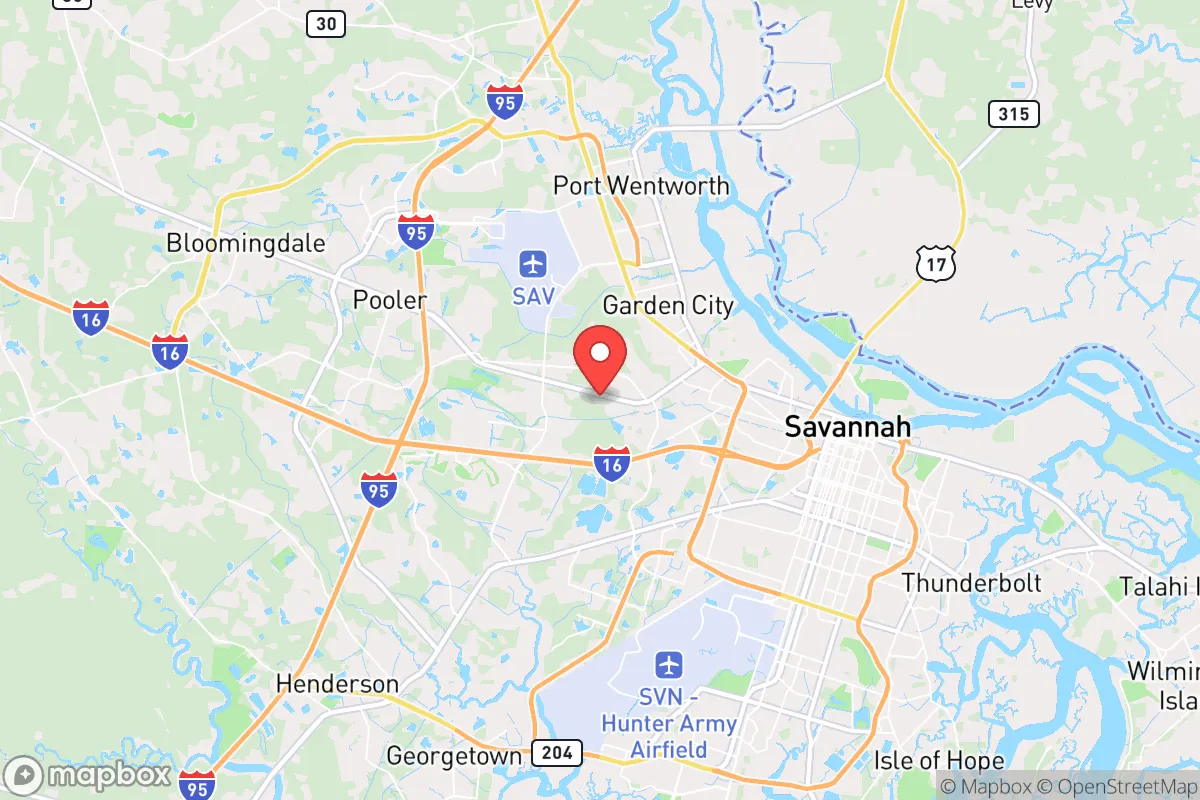
Personal Sovereignty in Garden City, GA
Viable for self-reliance. Generally workable, though some barriers may limit total independence.
What does Personal Sovereignty tell us?
Personal Sovereignty measures your capacity for self-reliance and independence with minimal government friction. Higher scores mean fewer barriers between you and the way you want to live... but it assumes you have the space you need and good neighbors.
What does this tell us?
Personal Sovereignty measures your capacity for self-reliance and independence with minimal government friction. Higher scores mean fewer barriers between you and the way you want to live... but it assumes you have the space you need and good neighbors.
State Policy
Energy independence: Importer (12% of energy produced in-state)
Personal Liberty
Homesteading

Personal Liberty Analysis
Garden City, Georgia, offers a notably high degree of personal sovereignty, shaped by Georgia’s broader legal framework as a state that generally favors limited government intervention in daily life. For individuals and families who prioritize autonomy—whether in financial decisions, self-defense, or lifestyle choices—the regulatory environment here is light-touch compared to many coastal and Midwestern jurisdictions. The city’s position within Chatham County and proximity to Savannah means some local ordinances exist, but the state preempts many areas of law, leaving residents with a wide berth for personal decision-making. This analysis breaks down the specific dimensions of sovereignty that matter most to relocation-minded readers.
Tax burden and regulatory posture in Garden City and Chatham County
Georgia is a right-to-work state with a flat income tax rate of 5.49% as of 2026, and Garden City residents pay no city-level income tax. The property tax environment is moderate: Chatham County’s millage rate hovers around 30 mills for the unincorporated area, but Garden City’s combined rate (city plus county plus school) typically lands between 35 and 40 mills, depending on the specific district. For a $250,000 home, that translates to roughly $3,500 to $4,000 annually—higher than rural Georgia but competitive with metro Savannah. Georgia’s homestead exemption provides a $2,000 baseline reduction in assessed value for county taxes, and additional exemptions exist for seniors and disabled veterans. Sales tax in Garden City is 8%, which includes the county’s special-purpose local-option sales tax (SPLOST) for infrastructure. On the regulatory side, Georgia has no state-level rent control, no universal paid family leave mandate, and no state minimum wage above the federal $7.25—meaning employers and employees negotiate terms directly. Occupational licensing is less burdensome than in states like California or New York, though certain trades (electricians, plumbers, contractors) still require state certification. Garden City itself does not impose business license fees that are punitive; a general contractor’s license runs about $150 annually. The overall posture is one of low friction: zoning is handled at the city level, but there is no county-wide growth management plan that restricts development density or property use beyond basic safety codes.
Self-defense and gun law specifics in Garden City, Georgia
Georgia is a constitutional carry state as of 2022, meaning Garden City residents may carry a handgun openly or concealed without a permit. No background check is required for private firearm sales between individuals, though federal law still applies to licensed dealers. The state preempts all local firearm ordinances, so Garden City cannot enact its own bans on magazine capacity, assault weapons, or carry in parks—what state law allows, the city cannot restrict. Stand-your-ground law is fully in effect: there is no duty to retreat before using deadly force if a person reasonably believes it is necessary to prevent death or great bodily harm. Castle doctrine extends to vehicles and occupied structures. For those who want a permit for reciprocity when traveling, Georgia issues a Weapons Carry License (WCL) with a $74.25 fee, valid for five years, requiring a background check but no training course. Gun ranges and firearm retailers are plentiful in the Savannah area, with several within a 15-minute drive of Garden City. The legal environment is among the most permissive in the Southeast, comparable to Texas or Florida, and significantly more protective of individual gun rights than states like New York, California, or Illinois.
Self-reliance and homesteading viability: lot sizes, zoning, and off-grid feasibility
Garden City is a suburban-industrial community, not a rural homesteading zone, but opportunities for self-reliance exist within its zoning framework. Minimum lot sizes in residential zones (R-1 and R-2) are typically 7,500 to 10,000 square feet, which allows for substantial vegetable gardens, small orchards, and backyard poultry. Chickens are permitted in most residential districts, though roosters may be restricted due to noise ordinances. Larger parcels—half-acre to acre lots—are available in the western parts of the city near I-95 and along Dean Forest Road, where older homes sit on more land. Zoning code does not prohibit rainwater collection, and Georgia law explicitly allows it for outdoor use without a permit. Off-grid solar is legally feasible: Georgia has no state-level net metering mandate, but Savannah Electric (a subsidiary of Southern Company) offers interconnection for grid-tied systems. Going fully off-grid (no utility connection) is technically possible but requires meeting building code for septic and well water, which the county health department regulates. Composting toilets are allowed under state alternative sewage system rules. The biggest constraint is that Garden City is fully within the Savannah city water and sewer service area, so disconnecting from municipal water may trigger a lien or require a variance. For serious homesteaders, the more viable option is to look 15–20 minutes west into unincorporated Chatham County or Effingham County, where acreage is cheaper and zoning is looser. Still, within city limits, a family can keep bees, raise meat rabbits, and grow a significant portion of their own produce without running afoul of local code.
Personal liberties: parental rights, medical autonomy, speech, and property
Georgia law provides strong protections for parental rights in education and healthcare. Parents have the legal right to opt their children out of any school curriculum or activity they find objectionable, without needing to provide a reason. Homeschooling is straightforward: parents file a declaration of intent with the Georgia Department of Education, teach 180 days per year, and cover basic subjects—no standardized testing requirement, no portfolio review, and no teacher certification needed. Medical autonomy is less clear-cut: Georgia has not expanded Medicaid, and the state does not mandate COVID-19 or HPV vaccines for school attendance (though certain childhood vaccines are required with a broad religious exemption available). There is no state-level right-to-try law for terminally ill patients beyond the federal version, but Georgia does allow direct primary care (DPC) arrangements, where patients pay a monthly fee for unlimited primary care visits, bypassing insurance. Free speech protections are robust: Georgia has no hate speech law that criminalizes expression, and the state’s public meeting and records laws are moderately strong, though not as transparent as some Western states. Property rights are well-protected: eminent domain is limited to public use (roads, schools, utilities) and cannot be used for private economic development under Georgia’s 2006 constitutional amendment. Short-term rentals (Airbnb, VRBO) are permitted in Garden City without a special permit, though the city requires a business license and charges a 6% hotel/motel excise tax. There is no county-wide noise ordinance that restricts amplified speech or political signage on private property, though standard nuisance laws apply.
Overall, Garden City offers a sovereignty profile that is above average for the U.S. South and significantly higher than the national median. The combination of constitutional carry, low taxes, minimal business regulation, and strong parental rights places it in the top tier of Georgia municipalities for personal freedom. Compared to nearby Savannah, Garden City is notably less restrictive on firearms and property use, and compared to Atlanta suburbs, it has lower taxes and less zoning complexity. For a single individual or family who values autonomy over government-provided services, this area represents a practical balance: close enough to a major port city for employment and healthcare, but with a regulatory environment that leaves most decisions in the hands of the resident. The main trade-off is that the light-touch approach means fewer public amenities and less consumer protection—so self-reliance is not just permitted, but implicitly expected.

* Values derived from national, state, county, city and local statistics and may differ in a specific area. Last updated: 2026-08-08T13:25:41.000Z
Narrative content on this page is AI-generated and may contain mistakes. Verify any details that matter before acting on them.
ReloMaps may earn a commission from affiliate links at no extra cost to you.

