
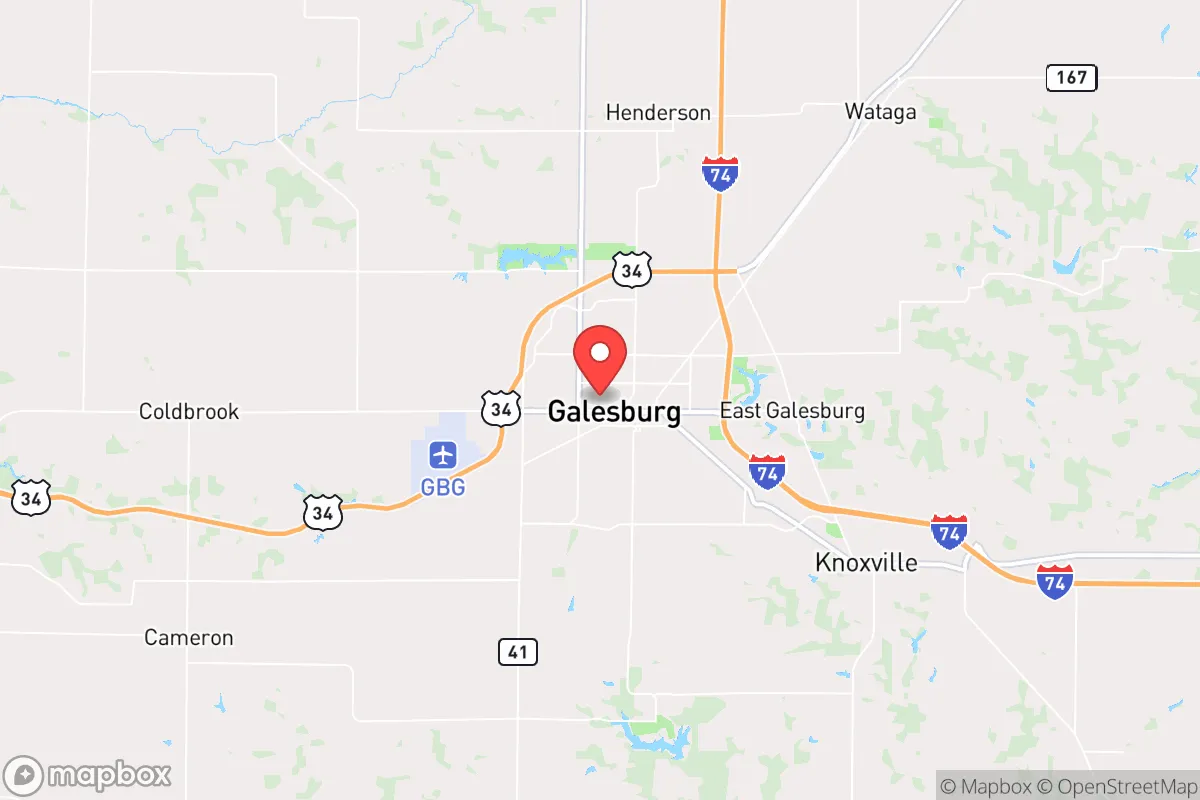
Photo: Wikipedia
Political ClimatePolitical Climate in Galesburg, IL
District shown is the primary district for this city’s centroid. Cities may span multiple districts.
Inherited from parent county — no local data available.
* Lean and PVI are calculated from Galesburg, IL’s own 2020 presidential results (precinct returns summed to the city), with 2024 estimated from the surrounding county’s 2020–2024 shift, Cook-style. Sources: state election offices; VEST 2020 precinct results (CC BY 4.0).
Political rankings in Illinois
- Most Conservative Cities in Illinois
- Most Liberal Cities in Illinois
- Best Liberal-Leaning Towns in the Midwest
- Safest Liberal-Leaning Towns in the Midwest
- Safest Conservative-Leaning Towns in the Midwest
- Affordable Small Towns for Conservatives
- Most Affordable Liberal-Leaning Small Towns in the U.S.
- Safest Conservative-Leaning Cities in the U.S.
- Most Conservative Counties in Illinois
- Most Liberal Counties in Illinois
Local Political AnalysisPolitical Analysis of Galesburg, IL
Galesburg sits in a political pocket that’s become noticeably more conservative than the rest of Illinois, with a Cook PVI of R+5 that puts it a full 12 points to the right of the state’s D+7 rating. This isn’t a recent flip—it’s a slow, steady shift that’s been building for over a decade, driven by the same working-class disillusionment that’s reshaped much of rural and small-town Illinois. Walk into a coffee shop on Main Street and you’ll hear as much talk about property taxes and union politics as you will about national races, but the local lean is unmistakably redder than it was in the 1990s or early 2000s.
How it compares
Illinois as a whole is a deep-blue state, powered by Chicago and its collar counties, but Galesburg is a world apart. Drive 45 minutes east to Peoria, and you’ll find a similar R+5 tilt, but head 90 minutes south to Springfield—the state capital—and the politics get more purple, with a D+3 lean that reflects a mix of government workers and rural voters. The real contrast is with the Chicago metro area, where Cook County itself is D+30 or more. In Galesburg, you’re closer politically to places like Macomb (R+8) or Monmouth (R+6) than to anything in the northeastern part of the state. The 2020 presidential race here saw Trump win Knox County by about 4 points, while Illinois went for Biden by 17. That gap has widened since 2016, when the county was essentially a toss-up. Locals will tell you the shift tracks with the decline of manufacturing—Maytag closed its Galesburg plant in 2004, and the ripple effects are still felt in every local election.
What this means for residents
For conservative residents, Galesburg feels like a comfortable place to live politically—you’re not constantly outnumbered, and local offices like the county board and sheriff’s department tend to lean right. But you’re still living under state laws passed in Springfield, which means higher income taxes and stricter gun regulations than you’d see in, say, Iowa (just 30 minutes west). For liberal residents, the reality is more mixed. You’ll find like-minded people at Knox College or in the downtown arts scene, but you’re a clear minority in countywide elections. The practical effect is that local policy debates—like zoning for a new warehouse or funding for the library—tend to be less ideological than in Chicago, but national issues can still get heated at town hall meetings. The area’s trajectory suggests it will stay R+5 to R+7 for the near future, as younger residents move to larger cities and the remaining population ages into more conservative voting patterns.
Culturally, Galesburg’s political lean shows up in subtle ways. The local paper, The Register-Mail, covers both sides fairly, but the letters to the editor skew conservative. The annual Railroad Days festival is more about community than politics, and the biggest local controversies usually involve school funding or road repairs, not culture wars. That said, the contrast with Illinois as a whole is hard to ignore—Galesburg is a place where a “Blue Lives Matter” flag flies alongside the American flag on some porches, while just a few blocks away, a Knox College professor might have a Harris-Walz sign in their window. It’s a town that’s learned to live with its political split, even as the state’s overall direction pulls it further apart from Chicago. If you’re moving here, expect to hear both sides at the grocery store—and expect to get along anyway.

State Political ClimatePolitical Climate in Illinois
State Political AnalysisPolitical Environment in the State
Illinois is a solidly Democratic state with a Cook PVI of D+7, meaning it votes about seven points more Democratic than the national average in presidential elections. The state has been trending blue for decades, driven overwhelmingly by the Chicago metropolitan area, while downstate regions have moved sharply in the opposite direction. For a conservative-leaning relocator, the reality is a state where state-level politics are dominated by Democrats, but where local control and political diversity still exist in many counties and suburbs.
Urban vs. rural divide
The political map of Illinois is a study in extremes. Cook County, home to Chicago, casts roughly 40% of the state’s total vote and delivers margins of 60-70% for Democratic candidates. The surrounding collar counties — DuPage, Lake, Kane, Will, and McHenry — have been trending blue over the past two decades, with once-Republican strongholds like Naperville and Arlington Heights now reliably Democratic in statewide races. Meanwhile, downstate Illinois is deeply red. Counties like Effingham, Williamson, and Jefferson routinely vote 70-80% Republican. The divide is so stark that the 2020 presidential election saw Joe Biden win Illinois by 17 points, while Donald Trump carried 93 of the state’s 102 counties. The geographic split is not just urban vs. rural; it’s also suburban vs. exurban. Places like St. Charles and Geneva in the Fox Valley remain competitive, while Joliet and Aurora have shifted left as their populations diversified.
Policy environment
Illinois has a progressive tax structure — a flat income tax rate of 4.95% — but property taxes are among the highest in the nation, averaging about 2.1% of home value statewide. The state’s regulatory posture is generally business-friendly in Chicago but burdensome downstate, with strict environmental rules and a high minimum wage ($15/hour as of 2025). Education policy is dominated by Chicago Public Schools, which receives a disproportionate share of state funding, though downstate districts often complain of underfunding. Illinois has some of the most expansive election laws in the country, including automatic voter registration, no-excuse mail-in voting, and same-day registration. The state also has a strong union presence, particularly in public-sector unions like the Illinois Federation of Teachers and AFSCME, which wield significant influence in Springfield.
Recent policy direction
Over the past five years, Illinois has moved decisively left on several fronts. In 2021, the state passed the Illinois Reproductive Health Act, codifying abortion rights into state law and removing most restrictions. The same year, the Firearm Owners Identification (FOID) Card Act was strengthened, and in 2023, the state banned the sale of assault weapons and high-capacity magazines under the Protect Illinois Communities Act. On education, the state eliminated cash bail in 2023 via the SAFE-T Act, though the law was later amended after widespread criticism. Parental rights in education have been a flashpoint, with the state passing a law in 2022 requiring schools to adopt policies supporting LGBTQ+ students, including allowing students to use bathrooms and locker rooms matching their gender identity. On property rights, Illinois has not enacted broad rent control, but Chicago has its own tenant-friendly ordinances. The state’s tax burden remains high, with no serious movement toward a graduated income tax after voters rejected a 2020 ballot measure. Voting access has expanded, with the state now offering permanent vote-by-mail status.
Civil unrest & political movements
Illinois has seen significant political activism on both sides. Chicago was a major epicenter of the 2020 George Floyd protests, with widespread property damage and looting in the Loop and along the Magnificent Mile. The city also saw a surge in homicides in 2020-2021, which became a major political issue. On the right, downstate counties have seen growing “secession” movements, with several counties passing symbolic resolutions to join Indiana or form a new state. These efforts are largely rhetorical but reflect deep frustration with Chicago-dominated state government. Immigration politics are also contentious: Illinois is a sanctuary state, with the TRUST Act limiting local law enforcement cooperation with federal immigration authorities. This has led to tensions in suburbs like Elgin and Waukegan, where immigrant populations have grown rapidly. Election integrity has been a recurring issue, with Republican activists alleging irregularities in Chicago’s vote-counting process, though no major fraud has been proven. The state’s Democratic supermajority has also drawn heavily gerrymandered congressional and legislative maps, which have been upheld in court.
Projection
Over the next 5-10 years, Illinois is likely to remain a solidly Democratic state, but the margins may narrow slightly as downstate population loss continues and collar counties moderate further. Chicago’s population has been declining since 2020, losing about 80,000 residents, while the suburbs are growing. This could shift the balance of power within the state, with suburban Democrats gaining influence over Chicago-centric policies. The state’s fiscal situation remains precarious — Illinois has the worst-funded pension system in the country, with a $140 billion unfunded liability — which will likely force tax increases or service cuts regardless of who is in power. For a conservative relocator, the political environment will not change dramatically; the state will remain a Democratic stronghold with high taxes and progressive policies. However, local control in red counties and exurbs will persist, and the state’s strong economy in sectors like agriculture, manufacturing, and logistics will continue to attract residents who prioritize jobs over politics.
For a new resident, the bottom line is that Illinois offers a stark choice: live in a blue metro area with high taxes and progressive policies, or in a red downstate county with lower costs but fewer services. The state’s political climate is not for everyone, but it is stable and predictable. If you value low taxes and conservative governance, you will find it in places like Effingham or Quincy, but you will have little influence over state-level decisions. If you prioritize urban amenities and are comfortable with a Democratic majority, Chicago and its suburbs remain vibrant, if expensive, places to live. Either way, Illinois is a state where your local experience will be shaped more by your county than by Springfield.
* Values derived from national, state, county, city and local statistics and may differ in a specific area. Last updated: 2026-11-21T09:01:41.000Z
Narrative content on this page is AI-generated and may contain mistakes. Verify any details that matter before acting on them.
ReloMaps may earn a commission from affiliate links at no extra cost to you.

