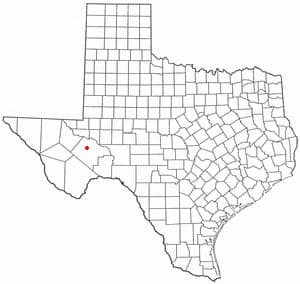
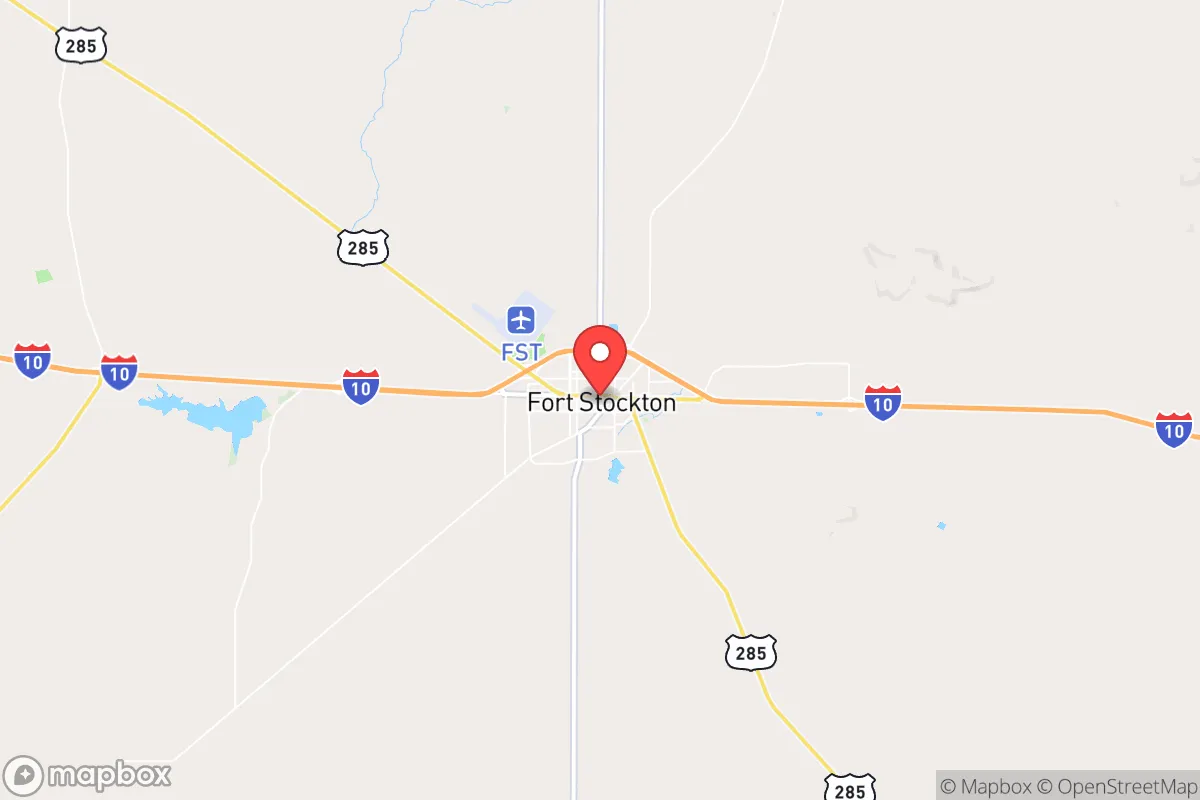
Photo: Wikipedia
Political ClimatePolitical Climate in Fort Stockton, TX
District shown is the primary district for this city’s centroid. Cities may span multiple districts.
Inherited from parent county — no local data available.
* Lean and PVI are calculated from the surrounding county’s 2020 and 2024 presidential results, Cook-style — a finer measure here than its congressional district (TX-23).
Political rankings in Texas
- Most Conservative Cities in Texas
- Most Liberal Cities in Texas
- Best Liberal-Leaning Towns in the South
- Safest Liberal-Leaning Towns in the South
- Safest Conservative-Leaning Towns in the South
- Affordable Small Towns for Conservatives
- Most Affordable Liberal-Leaning Small Towns in the U.S.
- Safest Conservative-Leaning Cities in the U.S.
- Most Conservative Counties in Texas
- Most Liberal Counties in Texas
Local Political AnalysisPolitical Analysis of Fort Stockton, TX
Fort Stockton leans reliably Republican, with a Cook PVI of R+7 that places it about seven points more conservative than the national average. In practice, that means local elections here are rarely competitive for Democrats—the last time a Democrat carried Pecos County in a presidential race was 1976, and the county voted for Donald Trump by a margin of roughly 40 points in 2024. The trajectory has been steadily rightward over the past two decades, mirroring the broader shift across rural West Texas, though Fort Stockton’s oil-and-gas economy and strong ranching heritage have kept it solidly red even when neighboring towns like Alpine (home to Sul Ross State University) or Marfa (an arts hub) lean more purple or even blue in local races.
How it compares
Compared to Texas as a whole, Fort Stockton is noticeably more conservative. While the state’s Cook PVI isn’t publicly calculated at the state level, Texas overall has a partisan lean of roughly R+5 to R+6 in federal elections—meaning Fort Stockton is about one to two points redder than the state average. But the real difference is cultural: in Fort Stockton, conservative values aren’t just a voting pattern; they’re woven into daily life. Gun rights, low taxes, and energy development are near-universal priorities, whereas in fast-growing parts of Texas like the Dallas-Fort Worth suburbs or the Austin metro, you’ll find a much wider ideological spread. Even within the Permian Basin, Fort Stockton is more conservative than Odessa (R+10) but less so than Midland (R+12), and it’s a world apart from liberal-leaning El Paso, about 200 miles west.
What this means for residents
For conservative residents, Fort Stockton feels like a place where their values are the default. Local government, school board meetings, and civic groups tend to reflect a pro-business, pro-oil, and pro-Second Amendment consensus. There’s little friction over issues like zoning or environmental regulations—most folks agree that economic growth from the oil patch comes first. For liberal residents, the reality is more isolating. You’ll find few openly progressive voices, and local Democratic Party activity is minimal. That said, the town is small enough (around 8,500 people) that most disagreements stay civil—people know each other, and political arguments rarely get heated at the grocery store. The biggest practical impact is on policy: property taxes are low, there’s no city income tax, and the local government prioritizes infrastructure for energy companies over, say, public transit or affordable housing initiatives.
One cultural distinction worth noting: Fort Stockton’s politics are deeply tied to the oil-and-gas industry, which means the local mood swings with the price of crude. When oil is booming, the town feels optimistic and the conservative majority is even more entrenched. When busts hit, there’s more grumbling about government assistance or diversification, but the political lean doesn’t shift—people just get quieter about it. Compared to Texas’s urban centers, where you see constant political activism and protest, Fort Stockton is a place where politics is more about who you know at the coffee shop than about signs in yards. It’s a conservative town, but a neighborly one—and that’s unlikely to change anytime soon.

State Political ClimatePolitical Climate in Texas
State Political AnalysisPolitical Environment in the State
Texas has been a reliably Republican state for the past three decades, but the margin has been shrinking. In 2024, Donald Trump carried the state by about 9 points, down from 11 points in 2020 and 16 points in 2012. The dominant coalition is still a mix of rural and suburban conservatives, but explosive growth in the urban crescent from Dallas-Fort Worth down through Austin to San Antonio and Houston is steadily shifting the ground. The state’s political reality is now a tug-of-war between a deeply entrenched conservative legislature and a rapidly diversifying, increasingly Democratic-leaning population in its major metros.
Urban vs. rural divide
The political map of Texas is a study in contrasts. The vast rural west, panhandle, and east Texas — places like Lubbock, Midland, and Tyler — vote Republican by 30 to 50 points. These areas anchor the GOP’s legislative supermajorities. Meanwhile, the state’s four biggest metros tell a more complex story. Houston’s Harris County, once a bellwether, has voted Democratic by double digits since 2018. Dallas County and Travis County (Austin) are deep blue, with Austin’s core voting over 80% Democratic. Bexar County (San Antonio) is reliably blue but by narrower margins. The real battleground is the suburban ring — places like Collin County (north of Dallas) and Fort Bend County (southwest of Houston). Collin County, once a GOP stronghold, voted for Trump by only 8 points in 2024, down from 22 points in 2016. Fort Bend, one of the most diverse counties in the nation, flipped to Biden in 2020 and stayed blue in 2024. The urban-rural split is so sharp that a Democrat can win statewide by piling up huge margins in Houston, Dallas, Austin, and San Antonio, but the rural vote still gives Republicans a comfortable edge — for now.
Policy environment
Texas’s policy environment is defined by a low-tax, low-regulation posture that appeals strongly to conservative relocators. There is no state income tax, and property taxes are high — averaging about 1.6% of home value — but the state caps appraisal increases for homeowners. The regulatory climate is business-friendly, with no state-level minimum wage above the federal $7.25 and weak union protections. Education policy is a flashpoint: the state uses a school voucher-like program (the Texas Education Savings Account, passed in 2023) that lets families use public funds for private school tuition, but it’s limited to certain students. Healthcare is a mixed bag: Texas has the highest uninsured rate in the nation (around 17%), and the state has not expanded Medicaid under the ACA. Election laws have tightened: the 2021 Senate Bill 1 restricted mail-in voting, added ID requirements, and banned 24-hour and drive-through voting. Abortion is effectively banned after about six weeks under the 2021 “Heartbeat Act” (SB 8) and a near-total trigger ban that took effect in 2022. Gun laws are permissive: permitless carry was enacted in 2021, and there is no waiting period or universal background check for private sales.
Recent policy direction
The last five years have seen a sharp rightward shift in state policy, driven by a GOP supermajority in the legislature. On gun and self-defense law, the 2021 permitless carry law (HB 1927) allows most adults to carry a handgun without a license or training. On parental and education rights, the 2023 “Parental Bill of Rights” (HB 900) requires schools to get parental consent for library materials and bans “sexually explicit” content — a law that has led to book removals in districts from Keller to Katy. On speech and privacy, the 2023 law (HB 20) targeting “viewpoint-based” content moderation by large social media platforms is being challenged in court. On medical and bodily autonomy, the near-total abortion ban has no exceptions for rape or incest, and the state has also restricted gender-affirming care for minors (SB 14, 2023). On property rights, Texas has strong homestead protections against creditors, but eminent domain use by private pipeline companies remains controversial. On taxation, the 2023 property tax cut (SB 2) sent $12.7 billion to homeowners and businesses, but critics note it didn’t lower the overall tax burden for renters. On voting and ballot access, the 2021 law added a new ID requirement for mail ballots and banned unsolicited mail-in ballot applications. The overall direction is clear: the state is doubling down on conservative social policy and limited government, even as its population becomes more diverse and urban.
Civil unrest & political movements
Texas has seen significant political activism from both sides. The 2020 Black Lives Matter protests in Austin and Houston were among the largest in the country, with Austin’s protests lasting weeks and leading to a city council vote to defund the police (later partially reversed). On the right, the “Texas Nationalist Movement” — a group advocating for secession — has gained some visibility but no serious political traction. Immigration politics are a constant flashpoint: Governor Greg Abbott’s “Operation Lone Star” has bused over 100,000 migrants to Democratic-led cities like New York and Chicago since 2022, and the state has sued the Biden administration over border policies. The 2024 election saw controversies over voter roll purges, with the state removing over 1 million names since 2021, though officials say it’s routine maintenance. A new resident would notice the heavy presence of law enforcement at the border, especially in El Paso and the Rio Grande Valley, and the occasional protest at the state capitol in Austin. The political temperature is high, but actual civil unrest is rare outside of organized demonstrations.
Projection
Over the next 5-10 years, Texas is likely to become more competitive at the statewide level, but not necessarily blue. The key demographic driver is in-migration: about 1,000 people move to Texas every day, many from California and other blue states. These newcomers tend to be younger, more diverse, and more moderate — they often support low taxes and business-friendly policies but are less aligned with the state’s social conservatism. The suburbs of Dallas-Fort Worth and Houston are the battlegrounds: if Collin County and Fort Bend County continue trending left, a Democrat could win statewide by 2032. However, the GOP’s legislative supermajority is protected by gerrymandered maps that won’t be redrawn until 2031. The policy direction will likely remain conservative for the next few years, but the margin for error is shrinking. A new resident moving in now should expect a state that is politically divided but still governed by a conservative majority — and one that will become more contested with every new housing development.
For a new resident, the bottom line is this: Texas offers a low-tax, business-friendly environment with strong gun rights and conservative social policies, but the political landscape is shifting. If you’re a conservative, you’ll find a state that largely aligns with your values, especially outside the major cities. If you’re a liberal, you’ll find strong communities in Austin, Houston, Dallas, and San Antonio, but you’ll be living under a state government that opposes most of your priorities. The practical takeaway is that Texas is not a monolith — your experience will depend heavily on which city or suburb you choose, and the state’s politics will continue to evolve as its population grows and diversifies.
* Values derived from national, state, county, city and local statistics and may differ in a specific area. Last updated: 2026-11-08T15:23:32.000Z
Narrative content on this page is AI-generated and may contain mistakes. Verify any details that matter before acting on them.
ReloMaps may earn a commission from affiliate links at no extra cost to you.

