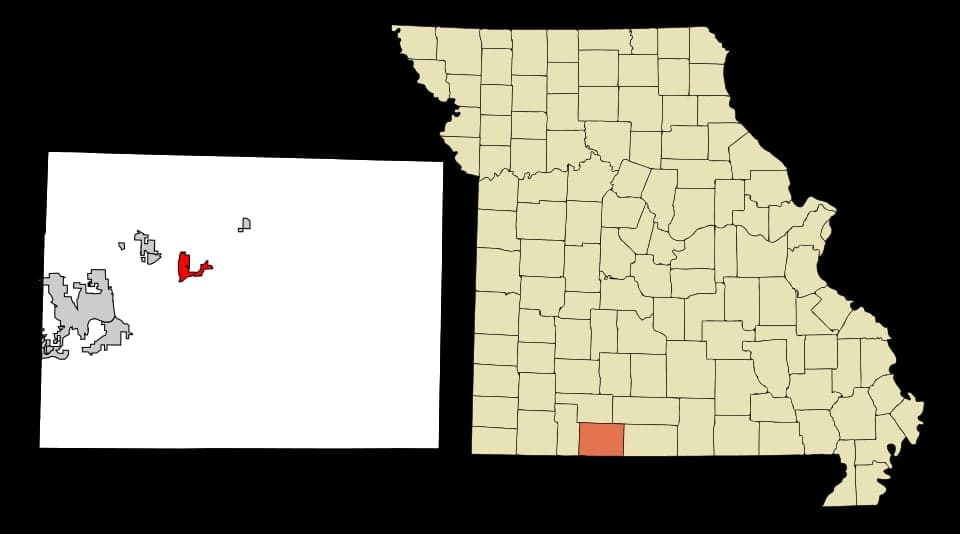
Photo: Wikipedia
Strategic Assessment of Forsyth, MO
Workable tactical position. Some exposure to population density or targets, but generally defensible in a crisis.
What does the Strategic Assessment tell us?
Our Strategic Assessment grades tactical survivability of an area. Major population centers, military targets, fallout zones, natural disasters, and border exposure all drive risk — lower exposure means a more defensible position in a crisis.
This is heavily inspired by Joel Skousen's Strategic Relocation book. Highly recommended you checkout the book ($)What does this tell us?
Our Strategic Assessment grades tactical survivability of an area. Major population centers, military targets, fallout zones, natural disasters, and border exposure all drive risk — lower exposure means a more defensible position in a crisis.
This is heavily inspired by Joel Skousen's Strategic Relocation book. Highly recommended you checkout the book ($)Strategic Pillars

Key Distances
Regional Safe Places
Below is our recommended "safe zones" in Missouri and the surrounding area based on our strategic heuristics. For most people, it's unrealistic to live in a “safe zone” full-time due to work, family or other personal reasons. They tend to be more rural. However, many of these areas are perfect for second homes and retreat properties that double as a vacation home or even a short-term rental.


Important Note: For informational purposes only. This does not mean nothing bad ever happens in the green zones. Please use common sense. This is based on public data and modeled with AI. We tried to take a conservative approach but mistakes happen. We update this regularly as new information becomes available.
Solar Generator Recommendations
Backup power matters more here than in safer locations. We've picked three solar generators across budgets and capacity tiers — start with the budget unit if you only need a few essentials, or step up if you want to run a fridge and HVAC for days at a time.

Jackery Portable Power Station Explorer 300
Budget OptionPower on the Go: Weighing only 11 lbs, it's convenient to set up and store with book-sized foldable solar panels

BLUETTI Portable Power Station AC180
Designed for both indoor and outdoor scenarios, AC180 is highly capable as it has a robost capacity and continuous output power.

EF ECOFLOW DELTA Pro Ultra Power Station
Upgraded PickEcoFlow DELTA Pro Ultra is a whole-home energy system designed to grow with your family. Integrated with the Smart Home Panel 2, it scales to meet your evolving energy needs — keeping your home powered, intelligent, and secure through every stage of life.
We earn a commission, at no additional cost to you.
Strategic Assessment Analysis
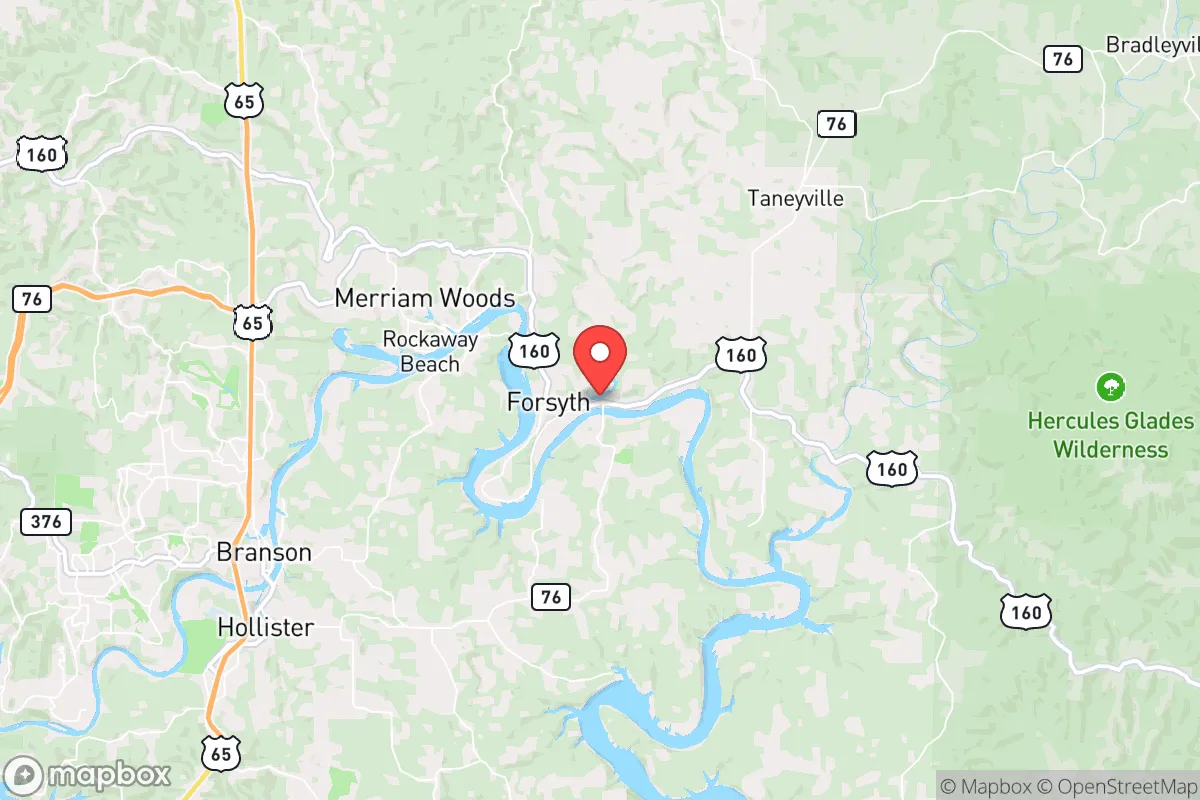
Forsyth, Missouri, offers a strategic blend of low-key resilience and practical self-sufficiency that appeals to relocators prioritizing disaster readiness without sacrificing access to essential services. Nestled in the Ozark Mountains along the White River, this Taney County community of roughly 2,500 residents sits about 30 miles south of Springfield and 15 miles north of the Arkansas border, placing it far enough from major metropolitan centers to avoid the worst of urban collapse scenarios while remaining within a comfortable drive of regional hospitals, supply chains, and transportation corridors. The area's topography, water resources, and relatively low population density create a foundation for long-term stability, though proximity to a major hydroelectric dam and a regional airport introduces specific risk factors that a serious relocator should weigh carefully.
Geographic position and natural advantages for long-term stability
Forsyth's location in the Ozarks provides several inherent resilience advantages that are hard to replicate in flatter, more exposed regions. The town sits on the banks of the White River, just downstream from the Bull Shoals Lake system, giving residents direct access to a massive, reliable freshwater source that is less susceptible to drought than many Midwestern aquifers. The surrounding terrain is characterized by steep hills, limestone bluffs, and dense hardwood forests, which naturally limit large-scale development and keep population density low—Taney County averages about 80 people per square mile, compared to Missouri's statewide average of 89. This topography also offers natural defensibility: the winding roads and narrow valleys create chokepoints that would slow any large-scale movement, whether from a natural disaster or a man-made crisis. The region sits outside the primary tornado alley that cuts through central Missouri and Kansas, though severe storms do occur. Winters are mild, with average January highs around 45°F, reducing the risk of catastrophic freeze events that can cripple infrastructure in northern states. The Ozarks are also geologically stable, with virtually no earthquake risk, and the area's elevation—around 900 feet above sea level—keeps it well above any plausible floodplain for the White River, even during extreme precipitation events.
Risks, exposures, and proximity to fallout-relevant landmarks
While Forsyth's natural setting offers clear advantages, a thorough resilience assessment must account for several man-made and infrastructure-related vulnerabilities. The most significant risk factor is the Bull Shoals Dam, located roughly 10 miles upstream on the White River. This is a major concrete gravity dam completed in 1951, standing 256 feet tall and stretching over a mile across. While the dam is well-maintained and has never experienced a catastrophic failure, its presence introduces a non-zero risk of downstream flooding in the event of a structural breach or a deliberate attack. A dam failure scenario would inundate large portions of the White River valley, including parts of Forsyth itself, though the town sits on higher ground than many downstream communities. More concerning for a preparedness-minded relocator is the dam's role as a critical infrastructure target—it generates significant hydroelectric power for the region and controls water flow for a multi-state area. The second major risk is proximity to the Springfield-Branson National Airport (SGF), located about 30 miles north. This is a medium-sized commercial airport serving over 1 million passengers annually, and in a national emergency or conflict scenario, it would be a logical target for disruption. The airport also hosts a Missouri Air National Guard unit, the 131st Bomb Wing, which operates B-2 Spirit stealth bombers out of nearby Whiteman Air Force Base—placing Forsyth within the broader operational footprint of strategic military assets. Additionally, the nearby city of Branson, just 10 miles south, draws 8 million tourists annually, creating a seasonal population surge that strains local resources and could complicate evacuation or supply scenarios during a crisis. For a relocator concerned about fallout from nuclear or industrial incidents, Forsyth's position in a river valley means prevailing winds from the west and southwest could carry airborne contaminants from the Springfield metropolitan area or from industrial facilities along the Mississippi River corridor, roughly 200 miles east. That said, the area's distance from any major nuclear power plant—the closest is Arkansas Nuclear One, about 120 miles south—reduces the most acute fallout risks.
Practical resilience for a relocator: food, water, energy, and defensibility
For a family or individual serious about self-sufficiency, Forsyth offers a realistic foundation for building a resilient homestead. The growing season runs from mid-April to mid-October, roughly 190 days, which is sufficient for most warm-season crops like tomatoes, peppers, corn, and beans. The local soil is predominantly rocky and alkaline, typical of Ozark limestone, so raised beds or imported topsoil are advisable for serious gardening. The White River and Bull Shoals Lake provide year-round fishing opportunities—smallmouth bass, crappie, and catfish are abundant—and the surrounding national forests (Mark Twain National Forest is within 20 miles) offer hunting for deer, turkey, and small game, though public land access requires a Missouri hunting license. Water is the area's strongest asset: the Ozark aquifer system is one of the most productive in the country, and many rural properties in Taney County have access to private wells with yields of 10-30 gallons per minute at depths of 200-400 feet. Municipal water in Forsyth itself comes from the White River and is treated at a local plant, but a well on your own land provides true independence. Energy resilience is more challenging. The local grid is served by White River Valley Electric Cooperative, which has a reasonable reliability record but is vulnerable to ice storms and summer thunderstorms that can knock out power for 24-72 hours. Solar potential is moderate—the area receives about 4.5 peak sun hours per day, comparable to much of the Midwest—so a properly sized off-grid solar array with battery storage is feasible, though winter cloud cover can reduce output significantly. Wood heating is a practical backup: hardwood is plentiful in the surrounding forests, and many homes in the area already have wood stoves or fireplaces. Defensibility is good but not exceptional. The town itself is compact and walkable, with a grid layout that offers multiple egress routes via US-160 and MO-76. Rural properties in the hills offer natural concealment and limited sightlines from main roads, but the dense tree cover also means that an intruder could approach relatively unseen. The local law enforcement presence is modest—the Taney County Sheriff's Office has about 40 sworn deputies for a county of 55,000 residents—so personal security and community networks are essential. The nearest hospital is Cox Medical Center in Branson, 12 miles south, which is a full-service facility with a Level III trauma center, but in a widespread crisis, that resource would be quickly overwhelmed.
The overall strategic picture for Forsyth is one of moderate-to-high resilience with specific, manageable vulnerabilities. The area's natural advantages—abundant water, defensible terrain, mild climate, and low population density—make it a strong candidate for a relocator who values self-sufficiency and is willing to invest in off-grid infrastructure. The primary risks are man-made: proximity to a major dam, a regional airport with military connections, and a tourist economy that creates seasonal volatility. For a family that can secure a property with a well, establish a garden, and build a community network among the area's existing homesteaders and outdoor enthusiasts, Forsyth offers a realistic path to long-term stability. The key is to treat the area not as a perfect bunker, but as a solid base camp that requires active preparation and awareness of the broader regional dynamics. If you're looking for a place that balances remoteness with access, natural resources with manageable risks, and quiet living with a serious preparedness culture, Forsyth deserves a close look.

* Values derived from national, state, county, city and local statistics and may differ in a specific area. Last updated: 2026-09-29T21:46:46.000Z
Narrative content on this page is AI-generated and may contain mistakes. Verify any details that matter before acting on them.
ReloMaps may earn a commission from affiliate links at no extra cost to you.

