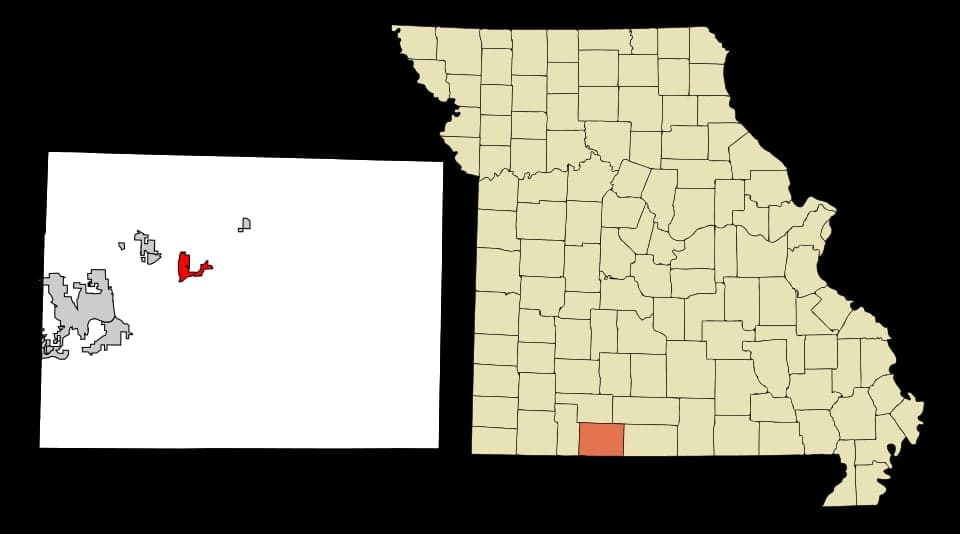
Photo: Wikipedia
Political ClimatePolitical Climate in Forsyth, MO
District shown is the primary district for this city’s centroid. Cities may span multiple districts.
Local Political AnalysisPolitical Analysis of Forsyth, MO
Forsyth, Missouri, sits in a deeply conservative pocket of the Ozarks, and it’s been that way for as long as anyone around here can remember. The Cook PVI for this area is R+21, which is a full 13 points more Republican than the state of Missouri as a whole, which sits at R+8. That’s not a small gap — it means Forsyth and the surrounding Taney County are among the most reliably red spots in an already red state. If you look at recent presidential elections, Taney County has routinely voted 70-75% Republican, while the statewide margin has been closer to 56-58%. The trajectory here isn’t really shifting; if anything, the area has become more uniformly conservative as retirees and families seeking a quieter, more traditional lifestyle have moved in from places like St. Louis, Kansas City, and even Chicago.
How it compares
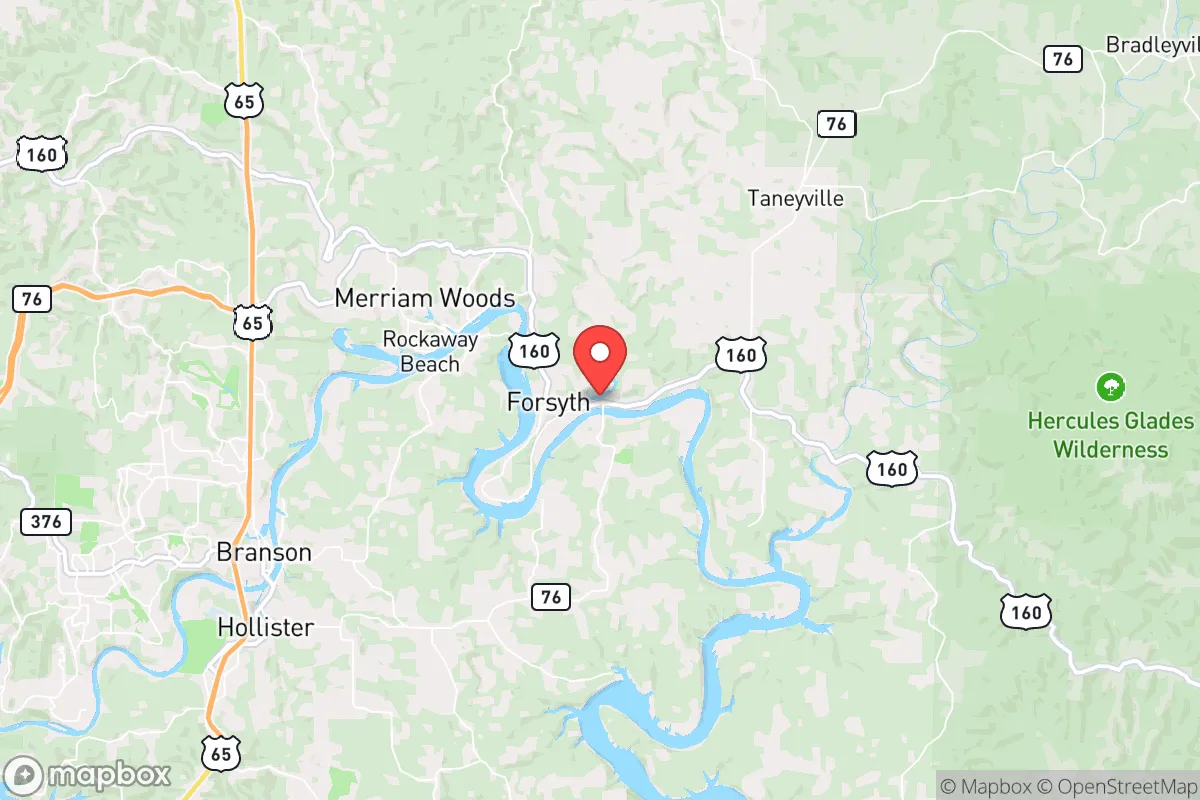
To understand Forsyth’s political climate, you have to look at the contrast with the rest of Missouri. The state’s R+8 rating already makes it a solidly Republican state, but it’s not a monolith — places like St. Louis County, Boone County (Columbia), and Jackson County (Kansas City) are reliably blue or purple, especially in local races. Forsyth, on the other hand, is surrounded by small towns like Branson, Hollister, and Kirbyville, all of which share the same deep-red lean. Drive an hour north to Springfield (Greene County), and you’ll find a more moderate conservative vibe — still red, but with a Cook PVI around R+15 and a noticeable libertarian streak. Head two hours east to West Plains (Howell County), and you’re back in R+25 territory. The real contrast, though, is with the state’s urban islands: a Forsyth voter’s political reality is almost the polar opposite of someone in St. Louis City (D+27). That urban-rural divide is the defining political fact of Missouri, and Forsyth sits firmly on the rural, deeply conservative side of that line.
What this means for residents
For conservative residents, Forsyth is about as comfortable as it gets. Local elections are rarely competitive, and the values reflected in county policy — low taxes, limited regulation, a strong emphasis on Second Amendment rights — align closely with the majority’s views. You’ll find that most churches, civic groups, and even the local school board lean conservative. For liberal residents, the reality is different. They are a distinct minority, and while there’s no open hostility, they often feel they have to be selective about where and how they express their views. There’s no real progressive infrastructure — no Democratic Party office in the county, no active liberal advocacy groups. That said, the area’s strong sense of neighborliness means most people are judged more by their character than their politics in day-to-day life. The key takeaway: if you’re conservative, you’ll feel at home; if you’re liberal, you’ll need to be comfortable being in the minority and finding your community through non-political channels.
One cultural distinction worth noting: Forsyth’s politics are deeply intertwined with its identity as a gateway to the Ozarks’ outdoor recreation and a retirement destination. The local economy leans heavily on tourism (Branson is just 10 minutes north) and service industries, which means there’s a practical, live-and-let-live attitude among many business owners. You won’t see a lot of overt political signage or activism compared to, say, a suburb of Kansas City. The politics here are quieter, more assumed than argued. Looking ahead, I don’t see the area’s lean changing much — the people moving here are doing so precisely because it’s a conservative, low-key place. If anything, the R+21 rating might even edge a point or two redder over the next decade as the state’s rural areas continue to diverge from its cities.

State Political ClimatePolitical Climate in Missouri
State Political AnalysisPolitical Environment in the State
Missouri has been a reliably red state for most of the 21st century, with a Cook PVI of R+8, but that number masks a deep and growing internal split. The state’s overall lean is driven by a massive, Trump-friendly rural and exurban vote that has only hardened since 2016, while the two major metro cores—St. Louis and Kansas City—have become increasingly blue and isolated. Over the last 20 years, the state has shifted roughly 10 points to the right in presidential races, a trajectory that shows no sign of reversing as rural counties depopulate and the suburbs of Springfield and Columbia remain reliably conservative.
Urban vs. rural divide
The political map of Missouri is a textbook case of the urban-rural chasm. St. Louis City and County, along with Kansas City (Jackson County), are the Democratic strongholds, delivering margins of 60-80% for the party. But these two metros are surrounded by a sea of red: St. Charles County, just west of St. Louis, has flipped from a swing county to a solidly Republican one (voting +18 for Trump in 2024), while Platte and Clay counties north of Kansas City are trending redder. The real engine of the state’s conservatism is the Ozarks—Springfield (Greene County) and the sprawling rural counties south of I-44 vote 70-80% Republican. Columbia (Boone County), home to the University of Missouri, is a blue island in a red sea, voting about 55% Democratic, but it’s too small to offset the rural vote. The Bootheel (Dunklin, Pemiscot counties) and the rural north (Adair, Sullivan counties) are deeply red, often voting 80%+ Republican. The divide isn’t just about population density—it’s cultural. Rural Missourians see the state’s identity as rooted in agriculture, gun rights, and local control, while urbanites prioritize transit, diversity, and public services. This split means statewide elections are effectively decided in the suburbs of St. Louis and Kansas City, where swing voters in St. Charles and Cass counties have moved right.
Policy environment
Missouri’s policy environment is aggressively conservative, shaped by a Republican supermajority in the legislature and a governor’s mansion held by the GOP since 2017. The state has a flat income tax rate of 4.8% (down from 5.4% in 2022, with a trigger to drop to 4.5% if revenue targets are met), no estate tax, and a sales tax cap of about 8.5% in most areas. Property taxes are low—among the 10 lowest in the nation—which is a major draw for families. Education policy is a flashpoint: Missouri has a robust school choice program (the MOScholars tax-credit scholarship) and a charter school law that applies only to St. Louis and Kansas City. The state also passed a law in 2022 banning the teaching of “critical race theory” in K-12 schools, though the language is broad enough to cover most discussions of systemic racism. Healthcare is mixed: Missouri expanded Medicaid in 2021 via a ballot initiative (despite legislative opposition), but the state has some of the most restrictive abortion laws in the country—a near-total ban with no exceptions for rape or incest, only for medical emergencies. Election laws are moderately restrictive: voter ID is required, and the state purged about 100,000 voters from rolls in 2023. There is no early voting by mail without an excuse, though no-excuse absentee voting was passed in 2022. The state also has a “right to work” law (repealed by voters in 2018, then reinstated by the legislature in 2023), which keeps union power weak outside of construction trades.
Recent policy direction
The last five years have seen Missouri push hard on a full spectrum of liberty-related issues. On gun rights, the state passed a “Second Amendment Preservation Act” (SAPA) in 2021, which declares federal gun laws unenforceable in Missouri and imposes fines on local police who help enforce them. This law has been partially struck down in federal court but remains a political statement. On parental rights, the legislature passed a 2023 law requiring schools to get parental consent before students can use a name or pronoun not matching their birth certificate, and it banned transgender girls from female sports. On speech and privacy, Missouri has no comprehensive data privacy law, but it passed a 2023 law restricting TikTok on government devices. On medical and bodily autonomy, the abortion ban is the headline, but the state also has a 2023 law banning gender-affirming care for minors (with a narrow exception for those already in treatment). On property rights, Missouri is a “right-to-farm” state with strong protections against nuisance lawsuits, and it has no statewide zoning code, leaving land use to counties. On taxation, the trend is toward cuts: the income tax rate has dropped from 5.4% to 4.8% since 2022, and the legislature is discussing a phase-out of the corporate income tax. On voting and ballot access, the state passed a 2022 law requiring a photo ID to vote and limiting the use of drop boxes, and it has a strict signature verification process for absentee ballots. The overall direction is toward a low-tax, low-regulation environment with strong cultural conservatism, but with a notable exception: the Medicaid expansion, which was voter-driven and has survived legislative attempts to undermine it.
Civil unrest & political movements
Missouri has a history of civil unrest, most notably the 2014 Ferguson protests after the shooting of Michael Brown, which sparked a national movement. That event still echoes in St. Louis, where the city has seen periodic protests over police shootings and racial justice. In 2020, the state saw significant Black Lives Matter protests in St. Louis, Kansas City, and Columbia, with some property damage in the Delmar Loop area of St. Louis. On the right, the state has a strong Second Amendment movement, with groups like the Missouri Firearms Coalition pushing SAPA. There have been no major secession or nullification movements, but the “Show-Me State” nickname is often invoked by those who want to resist federal mandates. Immigration politics are relatively quiet—Missouri has no sanctuary cities, and the state passed a 2023 law requiring local law enforcement to cooperate with ICE. The most visible political flashpoint in recent years has been the debate over abortion: after the Dobbs decision, the state’s trigger ban took effect immediately, and there have been ongoing protests outside Planned Parenthood clinics in St. Louis and Kansas City. Election integrity controversies have been muted compared to other states, but the 2020 election saw Trump’s campaign challenge results in St. Louis City (which Biden won by 80%), and the state’s GOP-led legislature has since tightened voting laws. A new resident would notice the political divide most in the suburbs: drive through St. Charles County and you’ll see Trump flags and “Let’s Go Brandon” signs; cross into St. Louis City and you’ll see Black Lives Matter banners and Pride flags. It’s a state that lives its politics out loud.
Projection
Over the next 5-10 years, Missouri is likely to become more Republican at the state level, even as its two big cities get bluer. The rural population is aging and shrinking, but the suburbs of St. Louis and Kansas City are growing and trending right, which will keep the state’s overall lean red. The biggest wildcard is in-migration: Missouri is seeing a net inflow from Illinois (especially the Metro East area) and California, but these newcomers tend to be more conservative (moving for lower taxes and gun laws) or more moderate (moving for housing affordability). The state’s demographic future is not as diverse as the Sun Belt—Missouri is about 80% white, and that share is stable—so the cultural politics are unlikely to shift dramatically. The biggest policy fights ahead will be over education funding (rural schools vs. charter expansion) and abortion (a ballot initiative to restore some access is likely in 2024 or 2026, but it faces an uphill battle in a state where the legislature can override voter initiatives). The tax-cutting trajectory will continue, with the income tax likely dropping to 4% or lower by 2030. A new resident moving in now should expect a state that is solidly conservative on cultural issues, low-tax, and pro-gun, but with pockets of deep blue in the cities. The practical reality is that your experience depends heavily on where you live: if you’re in St. Charles or Nixa, you’ll feel the conservative majority; if you’re in the Central West End or Brookside, you’ll feel like you’re in a blue state.
For a new resident, the bottom line is that Missouri offers a low-cost, low-regulation environment with a strong conservative tilt, but it’s not a monolith. If you’re a conservative family, you’ll find your values reflected in state law and local culture in most suburbs and rural areas. If you’re a liberal, you’ll find community in the cities and college towns, but you’ll be living under a state government that is actively hostile to many of your priorities. The state’s political climate is stable, predictable, and unlikely to surprise you—what you see is what you get, and what you get is a red state with two blue islands. The key is to choose your county carefully, because in Missouri, local politics matter as much as state policy.
* Values derived from national, state, county, city and local statistics and may differ in a specific area. Last updated: 2026-09-29T21:46:46.000Z
Narrative content on this page is AI-generated and may contain mistakes. Verify any details that matter before acting on them.
ReloMaps may earn a commission from affiliate links at no extra cost to you.

