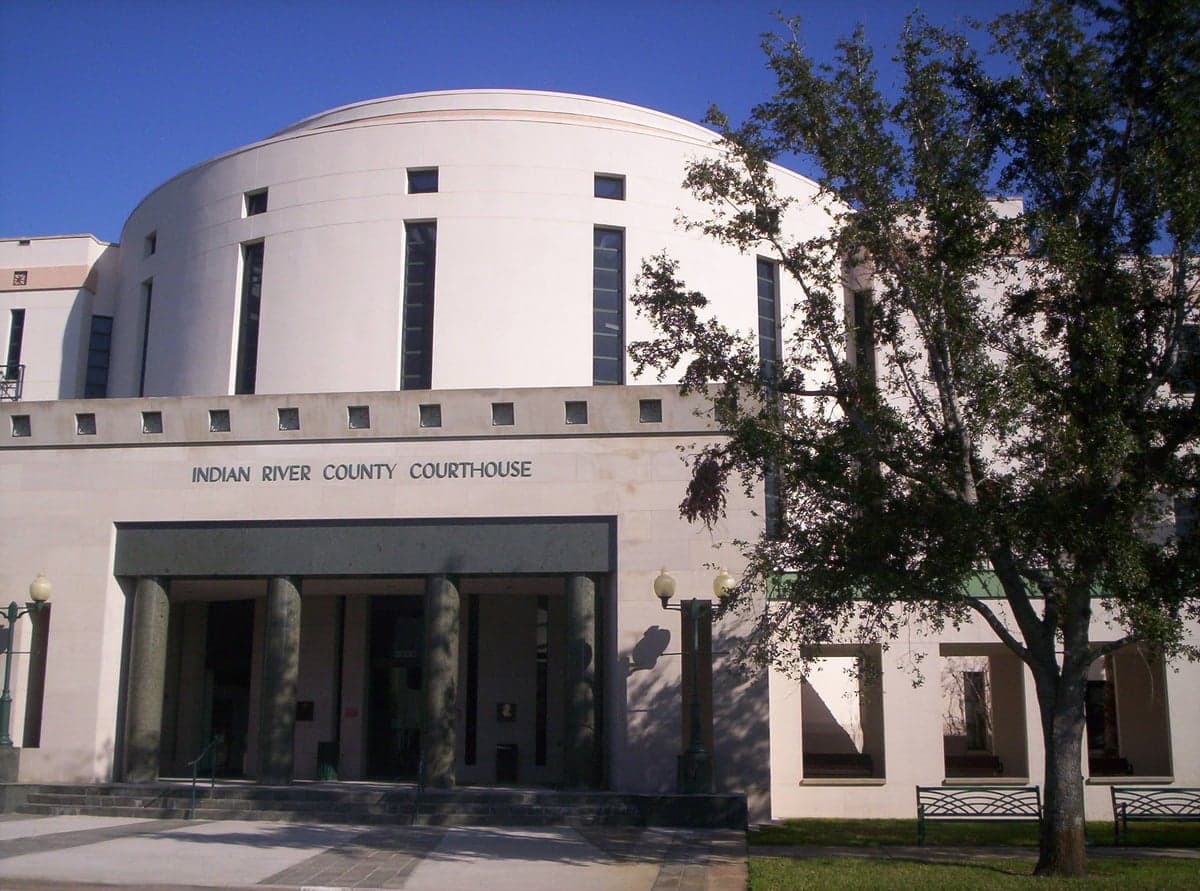
Photo: Wikipedia
Political ClimatePolitical Climate in Indian River County
Showing district-level results — no local-only data available.
Local Political AnalysisPolitical Analysis of Indian River County
Indian River County is a reliably Republican stronghold, with a Cook PVI of R+11 that makes it significantly more conservative than Florida as a whole (R+5). The county has voted for the GOP presidential candidate in every election since 2000, often by double-digit margins, and local races rarely see serious Democratic competition outside of a few specific precincts. That said, the political landscape isn't monolithic — there are real pockets of blue, particularly in the coastal communities and around the county seat, and the growing population is slowly shifting the county's center of gravity.
How it compares
The R+11 rating places Indian River County among the most conservative counties on Florida's Atlantic coast, roughly on par with neighboring St. Lucie County's R+10 but notably redder than Brevard County's R+8 to the north. The biggest difference from the state average shows up in presidential elections: in 2020, Donald Trump carried Indian River County by about 18 points, while he won Florida by just over 3 points. That gap has widened since 2016, when Trump's margin here was closer to 15 points. The county's Republican tilt is driven by its older, wealthier, and whiter demographic profile — about 85% of residents are white, and the median age is 52, well above the state's 43. Vero Beach, the county's largest city, leans Republican overall but has a noticeable Democratic minority, especially in the historic downtown and the barrier island neighborhoods like Riomar and Windsor. Fellsmere, a small agricultural town in the county's south, is a genuine swing precinct — its large Hispanic population (over 60%) has made it competitive, with Democrats winning it narrowly in 2020. Sebastian, to the north, is reliably red, while the unincorporated areas west of I-95 are among the most conservative in the county.
What this means for residents
For conservative residents, the county's lean means their values are reflected in local policy — the county commission is all-Republican, school board elections are nonpartisan but dominated by conservative candidates, and tax rates are among the lowest in the region. The county has resisted state-level pressure to expand Medicaid and has maintained a strong "right-to-work" environment. For liberal residents, the reality is more about finding community than winning elections. Democratic clubs in Vero Beach and Sebastian are active but small, and progressive candidates rarely break 40% in countywide races. The practical effect is that most political energy goes into school board and city council races, where margins are tighter and turnout is lower. The county's growth — about 10% since 2020 — is bringing in a mix of retirees from the Northeast and younger families from Orlando and Miami, which is slowly diversifying the electorate. The 2024 election saw a slight uptick in Democratic turnout in Vero Beach precincts, though the countywide margin held steady.
Culturally, Indian River County feels more like a traditional Southern community than the rest of Florida's coast. Church attendance is high, gun ownership is common, and the local newspaper's letters page is a reliable barometer of conservative sentiment. But there are also visible signs of change: the county's first LGBTQ+ pride event in Vero Beach drew over 2,000 attendees in 2023, and the school district has implemented a diversity, equity, and inclusion office despite pushback. The biggest policy distinction from the state is the county's aggressive approach to growth management — it has stricter wetland protections than state law requires, and the county commission has repeatedly voted down large-scale developments that would have been approved in neighboring counties. That land-use conservatism, ironically, is one issue where the county's Republicans and Democrats often find common ground.

State Political ClimatePolitical Climate in Florida
State Political AnalysisPolitical Environment in the State
Florida is a solidly Republican-leaning state with a Cook PVI of R+5, but calling it a simple red state misses the real story. Over the past 20 years, the state has shifted from a classic swing state—where George W. Bush won by just 537 votes in 2000—to a place where Republicans now hold a trifecta in state government and routinely win statewide races by 3-5 points. The dominant coalition is a mix of conservative retirees from the Midwest and Northeast, Cuban-American and Venezuelan exiles in South Florida, and fast-growing exurban and rural communities in the I-4 corridor and the Panhandle. Democrats still hold power in dense urban cores like Miami-Dade, Broward, and Orange counties, but their statewide influence has eroded as the state’s fastest-growing regions—places like The Villages, Lakeland, and Naples—have pulled the map decisively rightward.
Urban vs. rural divide
The political map of Florida is a study in stark contrasts. The Democratic strongholds are concentrated in the urban cores of Miami-Dade County (though it flipped from +29 D in 2016 to +11 D in 2024), Broward County (Fort Lauderdale), and Orange County (Orlando). These three counties alone account for roughly 40% of the state’s Democratic votes. Meanwhile, the Republican base is anchored in the sprawling exurbs and rural areas: Pasco County north of Tampa, Lake County (home to The Villages), Collier County (Naples), and the entire Panhandle from Pensacola to Tallahassee. The I-4 corridor—stretching from Tampa through Lakeland to Orlando—remains the state’s ultimate battleground, but even there, fast-growing suburbs like Lakeland and Winter Haven have shifted right. The biggest surprise in recent cycles has been Miami-Dade’s dramatic rightward swing, driven by Cuban-American and Venezuelan voters who have soured on the Democratic Party’s progressive turn on immigration and foreign policy. In 2024, Donald Trump won Miami-Dade by 11 points—a county that voted for Hillary Clinton by 29 points just eight years earlier.
Policy environment
Florida’s policy environment is defined by a low-tax, low-regulation posture that has made it a magnet for both businesses and retirees. There is no state income tax, and the state’s corporate tax rate is a flat 5.5%. Property taxes are moderate, though homeowners in high-demand areas like Naples or Miami Beach can face significant bills due to high property values. The state’s education policy has been a flashpoint: Governor Ron DeSantis pushed through the Parental Rights in Education Act (HB 1557, often called the “Don’t Say Gay” law) in 2022, which restricts classroom instruction on sexual orientation and gender identity in grades K-3. The state also expanded school choice dramatically, with nearly 1.3 million students now using vouchers or tax-credit scholarships. On healthcare, Florida did not expand Medicaid under the Affordable Care Act, leaving roughly 800,000 low-income residents in the coverage gap. Election laws have been tightened: the 2021 SB 90 law added stricter voter ID requirements, limited drop boxes, and restricted third-party ballot collection. The state also passed a 15-week abortion ban in 2022 (HB 5), later tightened to six weeks in 2023 (SB 300), with no exceptions for rape or incest.
Recent policy direction
The last five years have seen Florida move aggressively on a broad front of cultural and governance issues. On gun rights, the state passed permitless carry (HB 543) in 2023, allowing any adult who can legally own a firearm to carry it concealed without a permit. On parental rights, the aforementioned HB 1557 was followed by the Stop WOKE Act (HB 7) in 2022, which restricts workplace and classroom discussions of race and gender. On speech and privacy, the state passed a law (SB 258) in 2023 that bans social media platforms from deplatforming political candidates, and another (HB 3) that restricts minors’ access to social media and adult content. On medical and bodily autonomy, the six-week abortion ban is among the strictest in the nation, though a state constitutional amendment protecting abortion access (Amendment 4) failed to reach the 60% threshold in 2024, getting 57% of the vote. On property rights, the state has preempted local rent control ordinances and limited local governments’ ability to regulate short-term rentals like Airbnb. On voting, the state has purged voter rolls aggressively, removing over 300,000 inactive voters since 2021. The overall direction is toward a state that maximizes individual economic freedom while imposing conservative social and cultural norms.
Civil unrest & political movements
Florida has seen its share of political flashpoints, though large-scale civil unrest has been less common than in states like Oregon or Minnesota. The most visible protests in recent years were the 2020 Black Lives Matter demonstrations in Miami, Orlando, and Tampa, which were largely peaceful but saw some property damage. In response, the state passed the Combating Public Disorder Act (HB 1) in 2021, which enhanced penalties for rioting and created new crimes for blocking roads during protests. Immigration politics are a constant undercurrent, especially in South Florida, where the state has bused migrants to Democratic-led states like California and Massachusetts as a protest against federal border policy. There is no sanctuary city policy in Florida; in fact, the state passed SB 1718 in 2023, which requires hospitals to ask patients about immigration status and makes it a crime to transport undocumented immigrants into the state. Election integrity controversies have been a recurring theme: the 2020 election saw a massive recount in the presidential race, and the 2022 midterms were marred by allegations of voter suppression in heavily Democratic counties like Broward. A new resident would notice the political polarization in everyday life—yard signs, bumper stickers, and local news coverage are heavily partisan, especially in the I-4 corridor.
Projection
Over the next 5-10 years, Florida is likely to remain Republican-leaning, but the margin could narrow as the state’s demographics continue to shift. The biggest wildcard is the ongoing influx of new residents: roughly 1,000 people move to Florida every day, and they are coming from both blue states (New York, California, Illinois) and red states (Texas, Ohio). The newcomers from blue states tend to be more moderate or conservative than the states they left, but they are not uniformly Republican—many are fiscal conservatives who are socially liberal, which could create tension within the GOP coalition. The Cuban-American vote, which has been a reliable Republican bloc, is aging, and younger Cuban-Americans are more moderate on immigration and climate change. Meanwhile, the state’s growing Puerto Rican population in Central Florida (especially in Orlando and Kissimmee) leans Democratic, though turnout among that group has been inconsistent. The biggest threat to the Republican hold on the state is the housing crisis: as home prices and rents skyrocket in Miami, Tampa, and Jacksonville, younger voters and working-class families may blame the state’s pro-developer policies and lack of rent control. If Democrats can turn out their base in Broward and Orange counties while making inroads with moderate suburbanites in Pasco and Lake counties, the state could become competitive again by 2032. But for now, the trajectory is clear: Florida is a red state that is getting redder in its rural and exurban areas, even as its cities remain blue.
For a new resident, the bottom line is this: if you are a conservative, you will find a state government that largely shares your values on taxes, education, and cultural issues, and you will feel at home in most places outside of downtown Miami or Orlando. If you are a liberal, you will find strong communities in the urban cores and some suburbs, but you will be living under a state government that is actively hostile to many of your policy preferences—especially on abortion, LGBTQ+ rights, and voting access. The practical takeaway is that Florida is a state where your local experience will vary dramatically depending on whether you settle in Miami Beach or Pensacola, Orlando or Ocala. The political climate is not monolithic, but the state-level direction is unmistakably conservative, and that is unlikely to change in the near term.
* Values derived from national, state, county, city and local statistics and may differ in a specific area. Last updated: 2026-06-23T17:48:37.000Z
Narrative content on this page is AI-generated and may contain mistakes. Verify any details that matter before acting on them.
ReloMaps may earn a commission from affiliate links at no extra cost to you.

