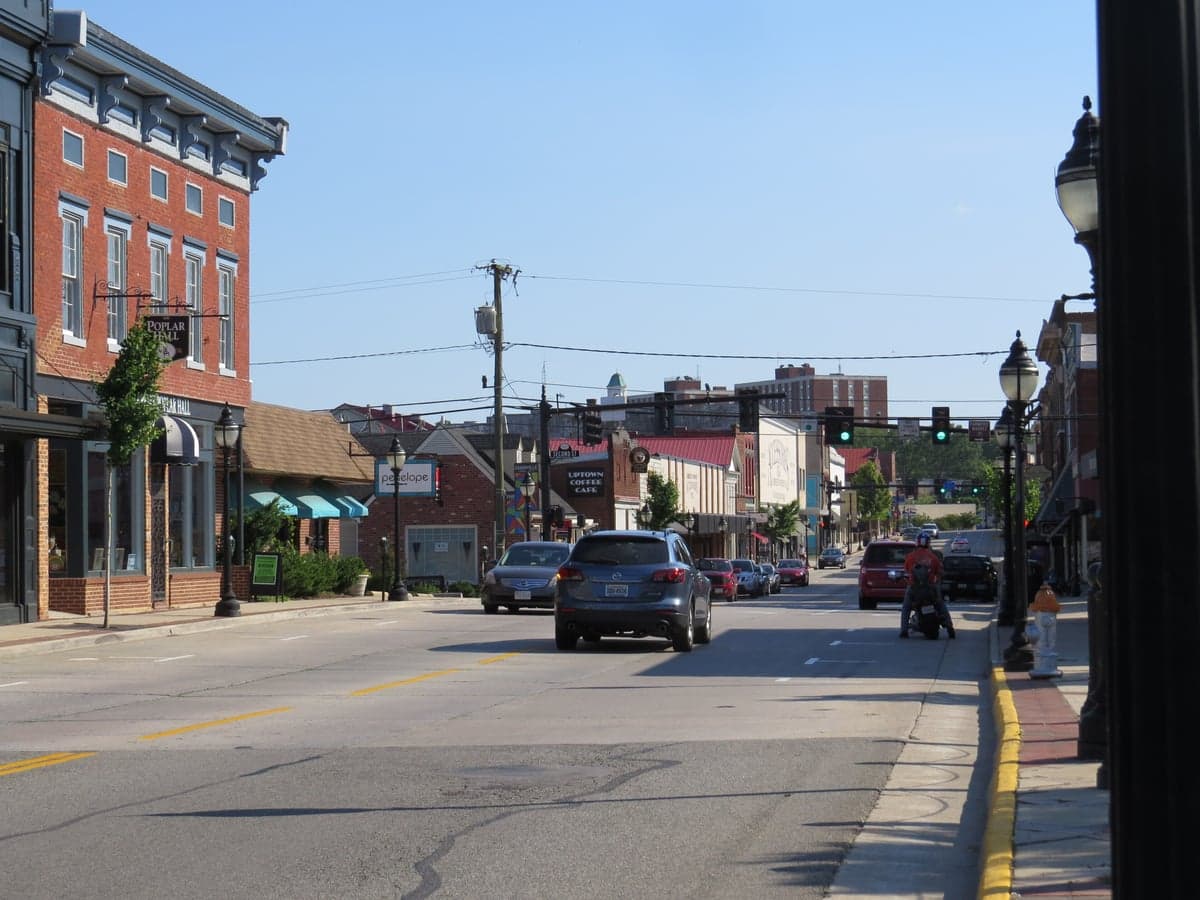
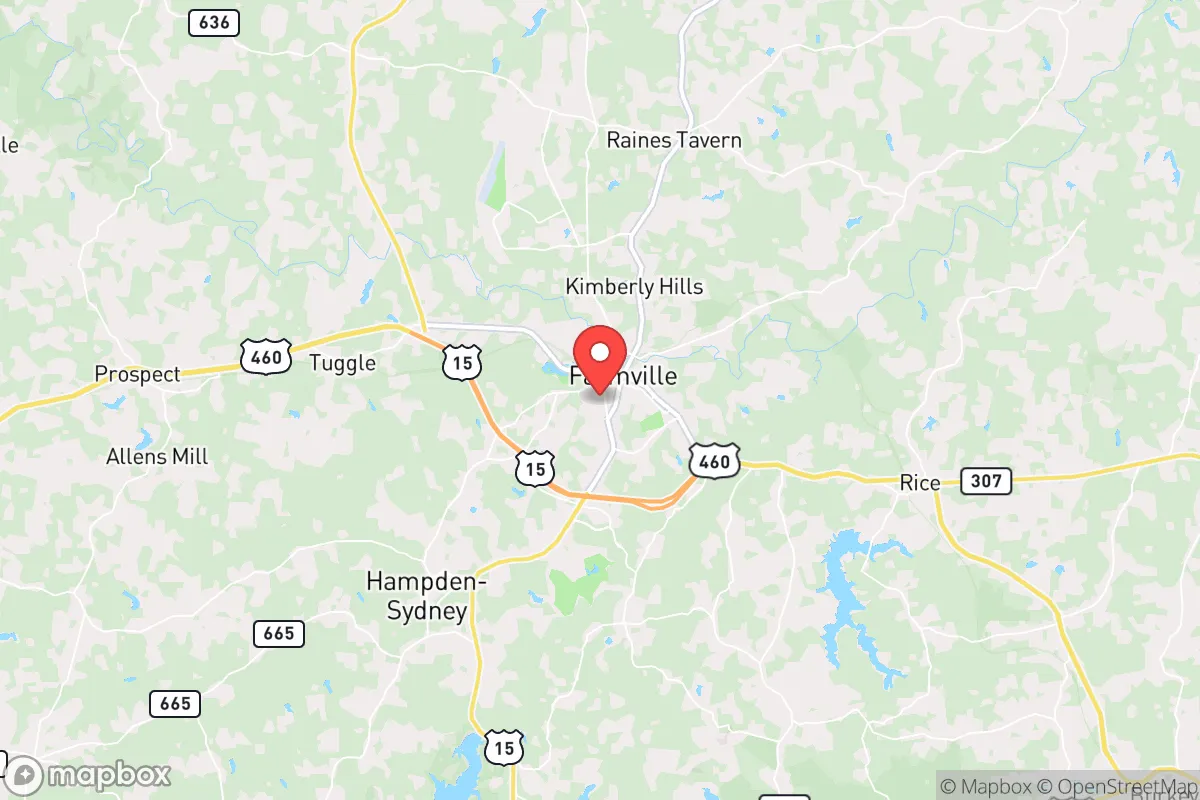
Photo: Wikipedia
Political ClimatePolitical Climate in Farmville, VA
District shown is the primary district for this city’s centroid. Cities may span multiple districts.
Local Political AnalysisPolitical Analysis of Farmville, VA
Farmville, Virginia, leans solidly Republican, with a Cook PVI of R+6 that places it well to the right of the state as a whole. This isn't a new development, but the gap has widened noticeably over the last decade. While the surrounding state of Virginia has shifted to a D+4 lean, driven by growth in Northern Virginia and the Richmond suburbs, Farmville and much of Southside Virginia have held steady or moved slightly right. You can feel it in the yard signs during election season and in the conversations at local diners like Uptown Coffee or Charley's Waterfront Café — the area's politics are rooted in rural values, gun rights, and a skepticism of Richmond's one-party control.
How it compares
Farmville's R+6 is a stark contrast to Virginia's D+4, a swing of 10 points that reflects the urban-rural divide shaping the state. Drive 45 minutes east to Petersburg or an hour north to Richmond, and you'll find Democratic strongholds where the political conversation is entirely different. Even closer, the college towns of Lynchburg (home to Liberty University) and Charlottesville (home to UVA) offer their own contrasts — Lynchburg is reliably conservative, while Charlottesville leans left. Farmville sits somewhere in the middle of that spectrum, but closer to Lynchburg's end. The presence of Longwood University and Hampden-Sydney College brings a small, transient liberal population, but it doesn't shift the county-level results much. In the 2024 presidential race, Prince Edward County voted roughly 58% Republican, while neighboring Cumberland and Buckingham counties were even more lopsided. The area's trajectory is stable: expect continued Republican dominance in local and federal races, with the only real competition happening in the Republican primary.
What this means for residents
For conservative residents, Farmville feels like home. Local government, the sheriff's office, and the school board are reliably conservative, and there's little friction in daily life over political issues. Gun laws are respected, taxes are low, and the pace of change is slow. For liberal residents, the reality is more nuanced. You'll find like-minded people, especially around the university, but you're in the minority. Political conversations at work or in social settings can be uncomfortable, and national Democratic candidates rarely campaign here. That said, Farmville is not a hostile place — people are generally polite, and the area's history of civil rights activism (the Moton Museum is a powerful reminder) means there's an undercurrent of progressive thought that surfaces in local issues like education funding and economic development. The key is that politics here is less about daily life than it is about elections. Most people just want good schools, safe streets, and a thriving downtown.
One cultural distinction worth noting: Farmville's identity is tied to both its agricultural roots and its role as a college town, which creates a unique blend of old and new. The local government has focused on downtown revitalization and attracting small businesses, a priority that crosses party lines. You won't see the kind of partisan gridlock that paralyzes state government in Richmond. Instead, decisions are made pragmatically, with an eye on what works for a town of about 8,200 people. The biggest political debates tend to be about land use, school funding, and how to balance growth with preserving the area's rural character. For anyone moving here, the political climate is straightforward: it's conservative, stable, and unlikely to change dramatically anytime soon, but it's also a place where neighbors help each other regardless of how they vote.

State Political ClimatePolitical Climate in Virginia
State Political AnalysisPolitical Environment in the State
Virginia has shifted from a reliably purple swing state to a solidly Democratic-leaning one over the past two decades, carrying a Cook PVI of D+4. The transformation has been driven primarily by explosive population growth in the Washington, D.C. suburbs, particularly in Northern Virginia, which now dominates statewide elections. While the state still elects Republican governors in off-years and maintains a competitive General Assembly, the underlying demographic and cultural trends point toward a continued leftward drift that makes it a challenging environment for conservatives seeking a reliably red state.
Urban vs. rural divide
The political map of Virginia is a study in stark geographic polarization. The urban crescent stretching from Northern Virginia through Richmond to Hampton Roads is overwhelmingly Democratic, while the vast rural expanse west of Interstate 95 and south of the James River is deeply Republican. Fairfax County alone, with 1.1 million residents, casts more votes than the entire southwestern Virginia region combined, and it votes Democratic by margins of 60-65%. The cities of Arlington, Alexandria, and Richmond are among the most liberal jurisdictions in the South, routinely delivering 75-85% of their votes to Democratic candidates. Meanwhile, counties like Lee, Wise, and Russell in the far southwest vote Republican by 70-80% margins, driven by coal country economics and cultural conservatism. The exurban counties of Loudoun and Prince William have been the key battlegrounds — both flipped from reliably red to reliably blue between 2008 and 2020 as D.C.-area commuters moved farther out. Loudoun County, once a Republican stronghold, now votes Democratic by roughly 20 points, a shift that has fundamentally altered statewide elections.
Policy environment
Virginia's policy landscape reflects its purple-to-blue trajectory. The state has a relatively moderate tax burden — income tax rates range from 2% to 5.75%, and sales tax is 5.3% (higher in some localities). Property taxes are set at the local level and vary widely, with Northern Virginia rates typically double those in rural areas. The regulatory environment is business-friendly compared to deep-blue states, but has tightened under Democratic control. Education policy has become a flashpoint: the state eliminated its Standards of Learning graduation requirements in 2021 and has moved toward equity-focused funding formulas. Healthcare is a mixed bag — Virginia expanded Medicaid under the Affordable Care Act in 2018, but private insurance markets remain relatively competitive. Election laws have shifted significantly: the state now has no-excuse absentee voting, 45 days of early voting, and same-day voter registration, making it one of the most accessible states for ballot access in the South.
Recent policy direction
The last five years have seen Virginia move decisively left on several fronts. In 2020, the Democratic-controlled General Assembly passed a sweeping gun control package that included universal background checks, a red flag law, and a one-handgun-per-month limit. Second Amendment sanctuary resolutions were passed by over 100 counties and cities in protest, but the laws remain in effect. On education, the state adopted the "Model Policies on the Treatment of Transgender Students" in 2021, which required schools to accommodate students based on gender identity — these were repealed by Governor Youngkin in 2023 but remain a contentious issue. Parental rights became a central battleground, with Youngkin's administration pushing for greater transparency in school curricula and library materials. On abortion, Virginia remains an outlier in the South — abortion is legal through the second trimester with no major restrictions, and the state has become a destination for women from neighboring states with bans. Property rights are generally strong, though localities in Northern Virginia have imposed rent control and tenant protection ordinances. Privacy and surveillance laws are moderate, with no statewide ban on facial recognition but growing local restrictions. The state has also legalized marijuana possession and home cultivation, though retail sales remain unregulated.
Civil unrest & political movements
Virginia has been a focal point for political activism on both sides. The 2017 Unite the Right rally in Charlottesville, which resulted in the death of a counter-protester, remains a defining scar on the state's political identity and led to the removal of Confederate monuments statewide. The 2020 protests following George Floyd's murder were particularly intense in Richmond, where protesters toppled statues on Monument Avenue. On the right, the Second Amendment sanctuary movement of 2019-2020 was one of the largest coordinated conservative protests in modern Virginia history, with over 100 counties passing resolutions. The 2021 gubernatorial election saw Glenn Youngkin win by tapping into suburban parental anger over COVID school closures and critical race theory, a template that national Republicans have since adopted. Immigration politics are relatively muted compared to border states, though Northern Virginia has sanctuary city policies in Arlington and Alexandria. Election integrity has been a persistent issue since 2020, with Republican activists raising concerns about the state's move to universal mail-in ballots and same-day registration, though no major fraud has been documented.
Projection
Over the next 5-10 years, Virginia's Democratic lean is likely to deepen, but not uniformly. The key variable is Northern Virginia's continued growth — the region is adding population faster than the rest of the state combined, and its voters are becoming more Democratic with each cycle as tech workers and federal employees dominate the electorate. Loudoun County, which was still voting Republican in 2004, is now reliably blue by 20 points, and similar shifts are underway in Stafford and Spotsylvania counties as D.C. exurbs expand southward. The rural Republican base is shrinking in absolute terms, with population loss in southwest Virginia and the Eastern Shore. However, the state's off-year election cycle (governor races in non-presidential years) will continue to produce competitive races, as the electorate is older and whiter in those years. A conservative moving to Virginia today should expect to live in a state where Democrats control the governorship more often than not, where the General Assembly will be closely divided but trending left, and where cultural issues like gun rights and parental control over education will be perpetual battlegrounds. The state is unlikely to flip back to reliably red unless there is a dramatic reversal of Northern Virginia's demographic trajectory.
For a new resident, the practical takeaway is that Virginia offers a moderate-to-liberal policy environment with pockets of deep conservatism in rural areas. If you're a conservative, you'll find your values reflected in the western and southern parts of the state, but you'll be fighting an uphill battle in statewide elections. If you're a liberal, you'll find a welcoming policy environment in the urban crescent, but you'll need to contend with a Republican governor every few years. The state's political identity is fundamentally split between the D.C.-centric, globally oriented Northern Virginia and the traditional, rural South — and that divide is only getting wider.
* Values derived from national, state, county, city and local statistics and may differ in a specific area. Last updated: 2026-10-12T12:58:41.000Z
Narrative content on this page is AI-generated and may contain mistakes. Verify any details that matter before acting on them.
ReloMaps may earn a commission from affiliate links at no extra cost to you.

