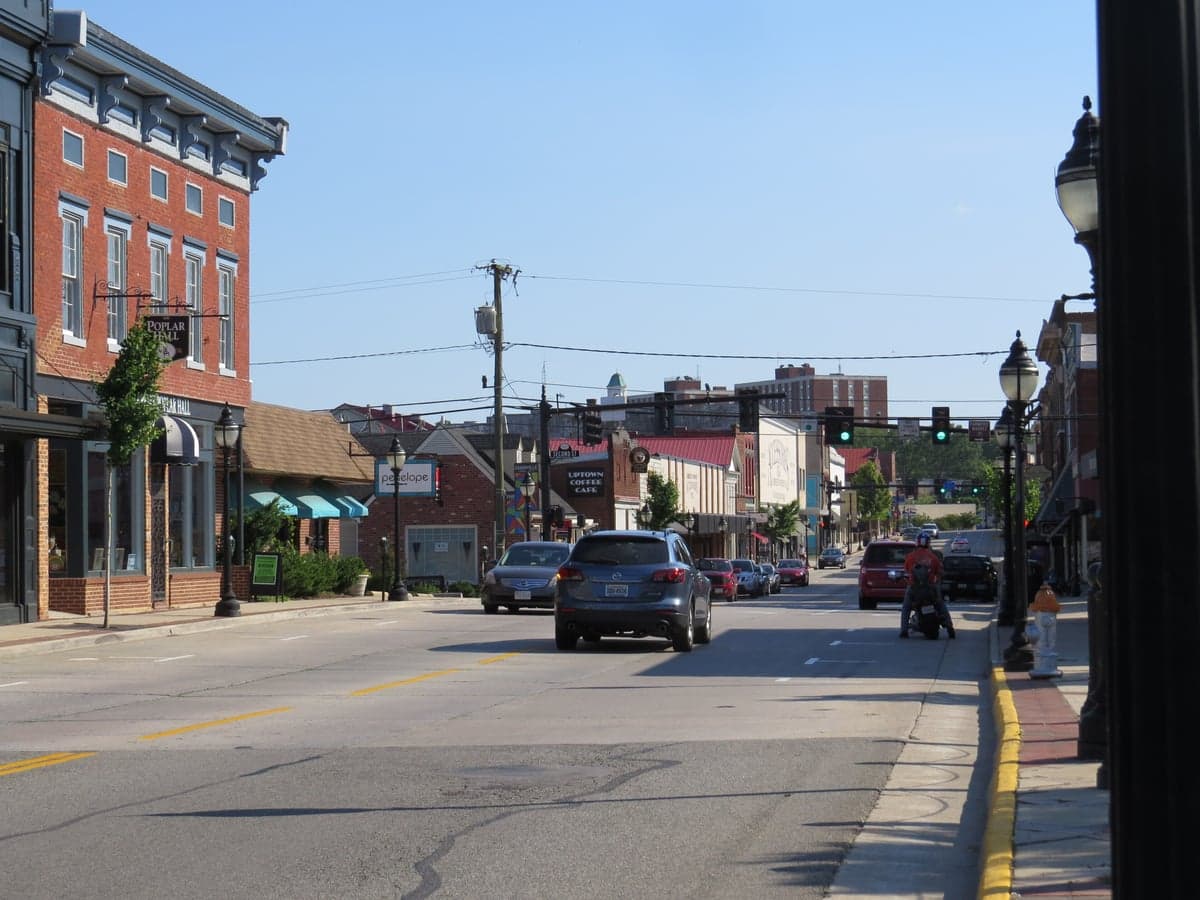
Photo: Wikipedia
Personal Sovereignty in Farmville, VA
Viable for self-reliance. Generally workable, though some barriers may limit total independence.
What does Personal Sovereignty tell us?
Personal Sovereignty measures your capacity for self-reliance and independence with minimal government friction. Higher scores mean fewer barriers between you and the way you want to live... but it assumes you have the space you need and good neighbors.
What does this tell us?
Personal Sovereignty measures your capacity for self-reliance and independence with minimal government friction. Higher scores mean fewer barriers between you and the way you want to live... but it assumes you have the space you need and good neighbors.
State Policy
Energy independence: Importer (20% of energy produced in-state)
Personal Liberty
Homesteading

Personal Liberty Analysis
Farmville, Virginia, offers a notably high degree of personal sovereignty, anchored by Virginia’s status as a Dillon Rule state that nonetheless grants significant local latitude in practice, particularly in rural counties like Prince Edward and Cumberland. The town’s regulatory environment is light-touch relative to Northern Virginia or the Tidewater region, with a tax burden that is moderate by state standards and a legal framework that strongly supports self-defense, property rights, and parental autonomy. For individuals and families prioritizing independence, Farmville presents a balanced environment where state-level constraints are present but local enforcement and cultural norms lean toward self-reliance.
Tax burden and regulatory posture in Prince Edward County
Farmville’s tax burden is competitive for Virginia, with the combined state and local sales tax rate at 5.3% (Virginia’s base 4.3% plus Prince Edward County’s 1.0%). Property taxes are assessed at a rate of $0.68 per $100 of assessed value in Prince Edward County, which is below the state median and significantly lower than in Richmond or Northern Virginia. There is no local income tax; Virginia’s state income tax is a graduated flat rate ranging from 2% to 5.75%, which applies uniformly. The regulatory posture in Prince Edward County is generally permissive: zoning is minimal in unincorporated areas, and the county does not impose the stringent land-use controls found in more urbanized jurisdictions. Business licensing is straightforward, and the county’s economic development office actively courts small-scale enterprises. However, Virginia’s Dillon Rule means that localities can only exercise powers expressly granted by the state, which limits the county’s ability to enact novel regulations but also prevents the kind of overreach seen in home-rule states. For a reader accustomed to heavy regulation, Farmville’s environment will feel notably light.
Self-defense and gun law specifics in central Virginia
Virginia is a shall-issue state for concealed handgun permits, meaning that if an applicant meets statutory requirements (background check, completed training course, and fee), the issuing authority—in this case, the Prince Edward County Circuit Court—must issue the permit. There is no discretionary denial. Open carry is legal without a permit for anyone at least 18 years old who can legally possess a firearm. Virginia does not have a red flag law that allows for the temporary seizure of firearms without a criminal conviction, though it does have a one-handgun-per-month purchase limit that was reinstated in 2020. The state also prohibits firearms in certain sensitive locations (e.g., K-12 schools, courthouses, and airports), but these restrictions are standard and do not significantly impede lawful carry. Stand-your-ground laws are not codified in Virginia statute, but the state’s self-defense jurisprudence is based on the common law “no duty to retreat” principle, which effectively provides stand-your-ground protections in most circumstances. For a reader concerned with self-defense rights, Farmville’s legal environment is solidly pro-rights, with the main limitation being the one-gun-a-month rule.
Self-reliance and homesteading viability: lot sizes, zoning, and off-grid feasibility
Farmville’s rural character makes it highly viable for homesteading and self-reliance. In Prince Edward County, minimum lot sizes in agricultural zoning districts are typically 3 to 5 acres, though smaller parcels are available in subdivisions. The county’s zoning ordinance permits accessory dwelling units, home occupations, and small-scale agricultural operations (e.g., keeping chickens, goats, and bees) without special permits in most residential zones. Off-grid living is feasible but subject to Virginia’s building code: the county requires a building permit for any new structure, and the Virginia Uniform Statewide Building Code mandates compliance with basic safety standards. However, there is no county-level prohibition on solar panels, rainwater collection, or composting toilets, provided they meet state health department standards for wastewater treatment. The county does not have a specific “off-grid” exemption, but enforcement is complaint-driven, and many rural properties operate with minimal oversight. The local extension office through Virginia Tech provides resources for small-scale farming, and the Farmville Farmers Market supports local food production. For a family seeking to reduce dependence on municipal utilities and grocery chains, the area offers practical pathways with moderate bureaucratic friction.
Personal liberties: parental rights, medical autonomy, speech, and property
Virginia’s legal framework provides strong protections for parental rights, including the right to direct the upbringing, education, and healthcare of one’s children. The state does not have a specific “parental rights” statute, but case law and the Virginia Code affirm that parents have a fundamental right to make decisions regarding their children’s education and medical care. Homeschooling is legal and regulated under the state’s homeschool statute, which requires submission of a notice of intent and annual evidence of progress (e.g., standardized test scores or a portfolio review). There is no requirement for parents to hold teaching credentials. Medical autonomy is more constrained: Virginia mandates certain vaccinations for school attendance, and the state’s vaccine exemption process requires a medical or religious exemption (philosophical exemptions were eliminated in 2021). However, the state does not have a general “medical freedom” law, and local healthcare providers in Farmville (Centra Southside Community Hospital) operate under standard Virginia medical regulations. Free speech protections are robust, as Virginia is a First Amendment jurisdiction with no state-level hate speech laws that would restrict political or religious expression. Property rights are strong: Virginia’s eminent domain laws were reformed after the Kelo decision, and the state prohibits the taking of private property for economic development purposes. The county’s zoning is minimal, and there is no county-level rent control or landlord licensing scheme. For a reader prioritizing personal liberties, Farmville’s environment is permissive in most areas, with the main friction points being vaccine mandates and the one-gun-a-month rule.
Overall, Farmville’s personal sovereignty profile is strong for a Virginia locality, particularly when compared to the heavily regulated environments of Northern Virginia or the urban corridor. The combination of low property taxes, permissive zoning, shall-issue concealed carry, and strong property rights creates a foundation for self-reliance that is rare in the state. The main trade-offs are Virginia’s Dillon Rule structure, which limits local innovation, and the state-level vaccine and firearm purchase restrictions. For a conservative-leaning individual or family seeking a balance of autonomy and access to services, Farmville ranks favorably among central Virginia towns, offering a lighter regulatory touch than Charlottesville or Richmond while maintaining proximity to those markets.

* Values derived from national, state, county, city and local statistics and may differ in a specific area. Last updated: 2026-10-12T12:58:41.000Z
Narrative content on this page is AI-generated and may contain mistakes. Verify any details that matter before acting on them.
ReloMaps may earn a commission from affiliate links at no extra cost to you.

