Photo: Wikipedia
Demographics of Farmville, VA
Affluence Level in Farmville, VA
A below-average socioeconomic profile. Incomes, home values, and educational attainment trail the U.S., with higher poverty and unemployment.
People of Farmville, VA
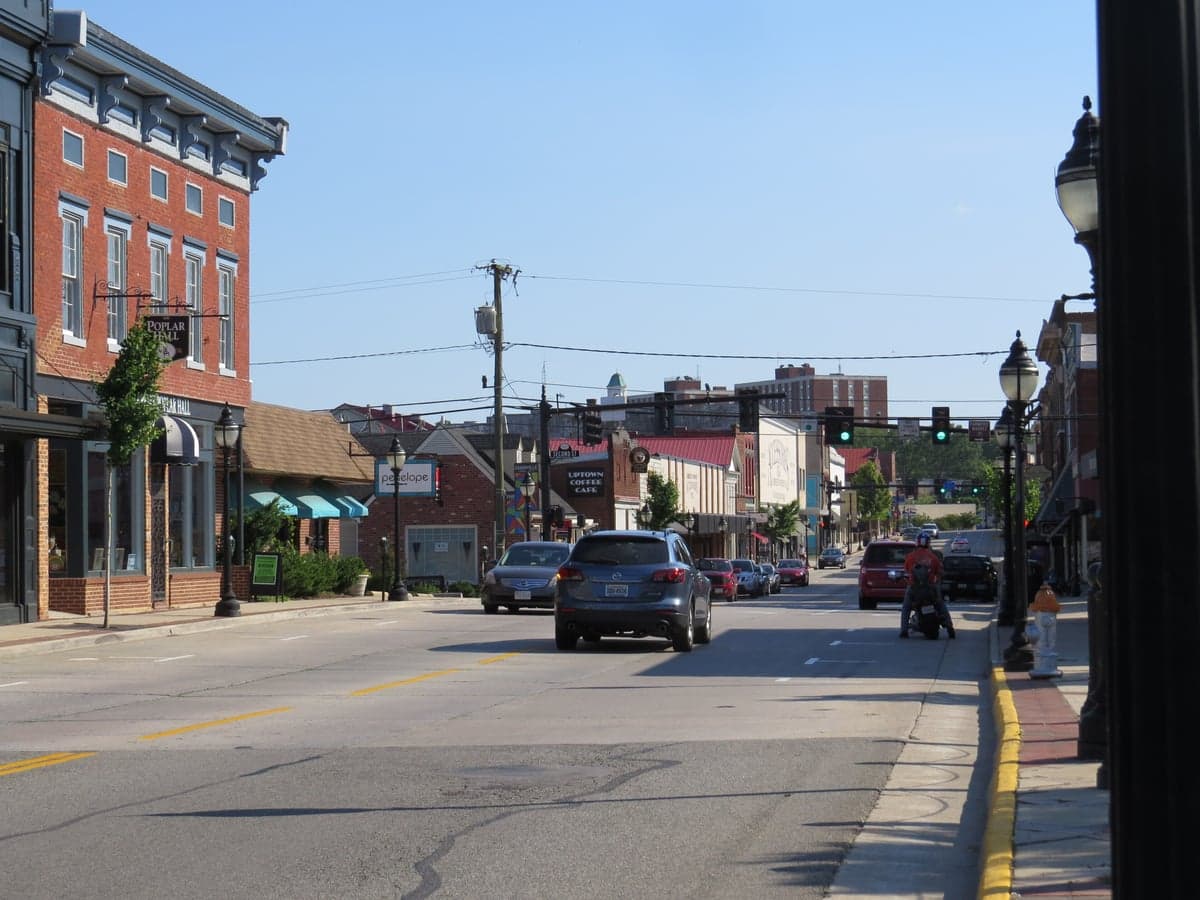
Farmville, Virginia, is a small college town of 7,613 residents where a distinctive blend of historic Black families, long-standing white working-class communities, and a growing student population from Longwood University and Hampden-Sydney College shapes daily life. The city’s character is defined by its dual identity as a former tobacco and railroad hub and as an educational anchor in Southside Virginia, with a population that is 65.2% white and 24.8% Black, alongside small but growing Hispanic (3.2%) and East/Southeast Asian (1.1%) communities. The foreign-born share sits at 4.6%, reflecting modest but steady international in-migration tied to the universities. Farmville remains more racially balanced than many surrounding rural counties, though its population has been nearly flat since 2010, with growth concentrated in student housing and new subdivisions on the outskirts.
How the city was settled and grew
Farmville’s original population was drawn by the confluence of the Appomattox River, the Southside Railroad (completed 1854), and fertile tobacco-growing land. The town was incorporated in 1879, but its growth accelerated after the Civil War when freedmen established independent communities. The Linden Street and Main Street corridors became the heart of the white merchant and professional class, while Black families built the North Street and High Street neighborhoods—areas that remain predominantly African American today. The arrival of Longwood University (then a women’s normal school) in 1884 and Hampden-Sydney College (founded 1775, just outside town) brought a steady stream of faculty and students, many from outside the region. The tobacco warehouses along the railroad tracks employed generations of Black and white workers, and by 1900, Farmville had a small but visible Jewish merchant community centered on Third Street. The Great Migration saw many Black families leave for northern cities, but those who stayed anchored the North Street and Beech Street neighborhoods, which became centers of Black-owned businesses and churches.
Modern era (post-1965)
After the 1965 Immigration and Nationality Act, Farmville saw only modest international immigration compared to Virginia’s urban centers. The largest post-1965 shift was domestic: the expansion of Longwood University (which became coeducational in 1976 and a university in 2002) drew faculty and students from across the state and country, diversifying the white population with newcomers from Northern Virginia and the Northeast. The Glenmore subdivision, developed in the 1970s and 1980s on the town’s western edge, became the primary destination for middle-class white families and university faculty. Meanwhile, the Black population remained concentrated in the historic North Street and South Main Street areas, though some upwardly mobile Black families moved into newer subdivisions like Woodland Hills. The Hispanic population, now 3.2%, began growing in the 1990s, driven by agricultural labor in surrounding tobacco and vegetable farms, with families settling in rental housing along South Main Street and near the industrial park. The East/Southeast Asian population (1.1%) is almost entirely tied to the universities—faculty and graduate students from China, South Korea, and Vietnam—and lives in apartments near Longwood’s campus. The Indian-subcontinent population (0.4%) is similarly university-linked, concentrated in the High Street student housing corridor.
The future
Farmville’s population is projected to remain stable or grow very slowly, with most new residents being university-affiliated. The Hispanic share is likely to rise gradually as agricultural and service-sector jobs attract families, while the Black share may decline slightly as younger Black residents move to Richmond or Northern Virginia for better job opportunities. The white population is aging, with many retirees staying in place, but the university ensures a steady influx of younger, college-educated whites from outside the region. New development is concentrated in the West Farmville area along Route 460, where a mix of townhomes and single-family houses is attracting both faculty and commuters who work in Lynchburg or Richmond. The historic Black neighborhoods face pressure from student housing conversions, which is slowly altering their character. The cultural identity is becoming more college-town oriented, with less emphasis on the tobacco-and-railroad past, though the legacy of the 1963 civil rights protests at the local Woolworth’s remains a point of pride for the Black community.
For someone moving in now, Farmville offers a small-town Virginia experience with a genuine biracial history and a growing college-town energy. The population is stable but slowly diversifying, with the universities providing the main engine of change. Newcomers will find a community where the old guard of Black and white families still holds significant influence, but where the future is increasingly shaped by students, faculty, and Hispanic workers—a place that is neither static nor rapidly transforming, but quietly evolving.

* Values derived from national, state, county, city and local statistics and may differ in a specific area. Last updated: 2026-10-12T12:58:41.000Z
Narrative content on this page is AI-generated and may contain mistakes. Verify any details that matter before acting on them.
ReloMaps may earn a commission from affiliate links at no extra cost to you.

