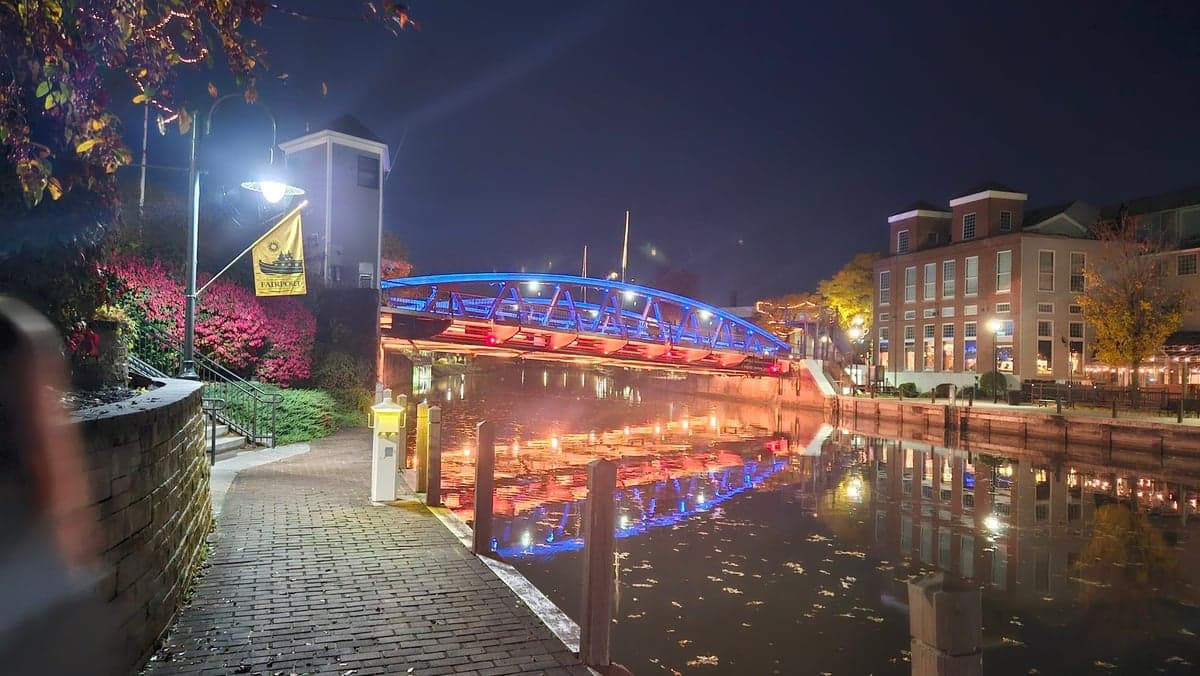
Photo: Wikipedia
Political ClimatePolitical Climate in Fairport, NY
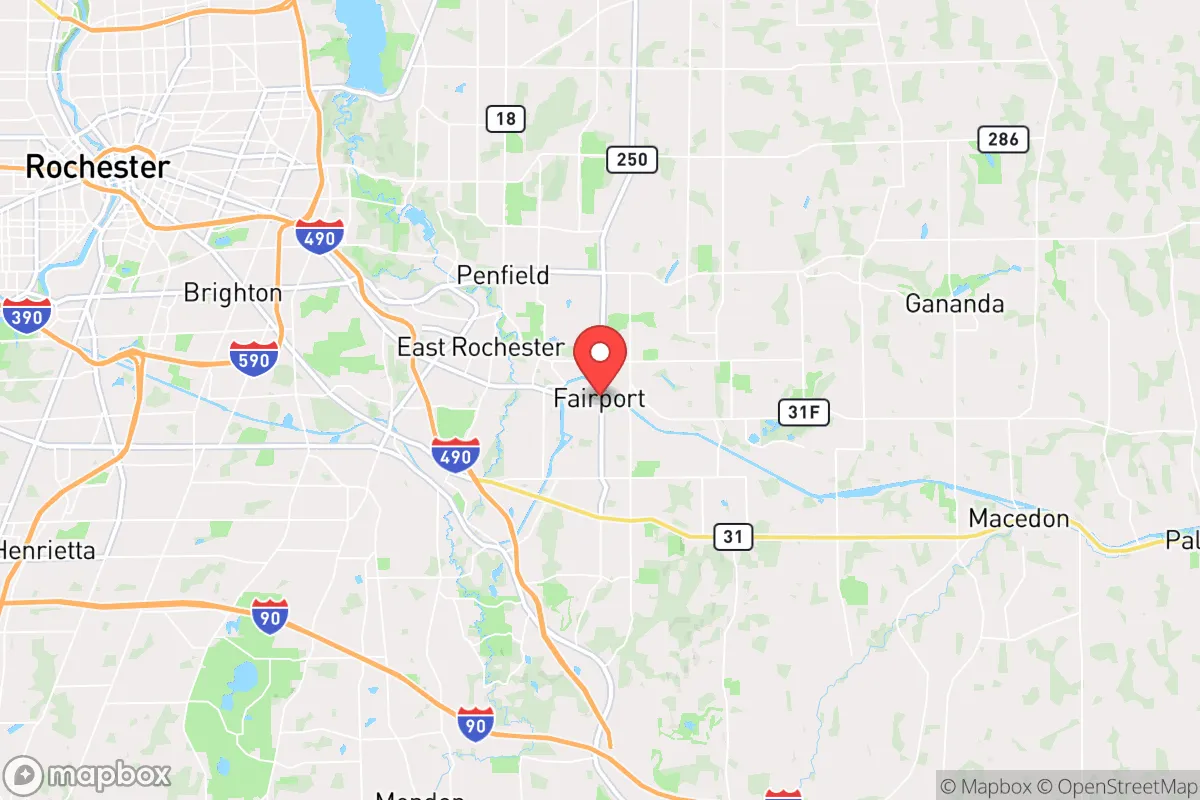
District shown is the primary district for this city’s centroid. Cities may span multiple districts.
Political rankings in New York
- Most Conservative Cities in New York
- Most Liberal Cities in New York
- Best Conservative-Leaning Towns in the Northeast
- Best Conservative-Leaning Towns in the Mid-Atlantic
- Safest Liberal-Leaning Towns on the East Coast
- Safest Conservative-Leaning Towns on the East Coast
- Most Affordable Liberal-Leaning Small Towns in the U.S.
- Safest Liberal-Leaning Cities in the U.S.
- Most Conservative Counties in New York
- Most Liberal Counties in New York
Local Political AnalysisPolitical Analysis of Fairport, NY
Fairport, NY, sits in a solidly blue pocket of the Finger Lakes region, with a Cook Partisan Voting Index of D+10 that puts it roughly 10 points more Democratic than the nation as a whole. That number tells you the village leans left, but it doesn't capture the nuance: Fairport is a classic suburban swing town that has shifted steadily toward the Democrats over the past decade, mirroring the broader trend in Monroe County's inner-ring suburbs. The local political reality is less about hardline ideology and more about a pragmatic, community-focused electorate that values schools, parks, and a walkable village core—issues that often transcend party labels.
How it compares
Compared to New York City, Fairport is noticeably more moderate. While Manhattan and Brooklyn are deep blue strongholds with Cook PVIs in the D+30 to D+40 range, Fairport's D+10 reflects a community where conservative and independent voters still have a real presence. The contrast is sharpest when you look at the surrounding towns: Perinton, which Fairport is part of, voted for Joe Biden by about 12 points in 2020, while neighboring Macedon and Walworth in Wayne County went for Trump by similar margins. Drive 15 minutes east and you're in a different political world. The village itself is more liberal than the town as a whole—Fairport's walkable core and younger professional population tilt left, while the outer subdivisions and farmlands lean right. New York City's political gravity is so strong that it shapes state policy, but Fairport's politics are more locally driven, focused on school budgets, development proposals, and the Erie Canal waterfront.
What this means for residents
For liberal residents, Fairport offers a comfortable environment where progressive values are the norm in local governance—the village board and school board are reliably Democratic, and you'll see Pride flags and Black Lives Matter signs in many front yards. Conservative residents aren't marginalized, but they are a clear minority in local elections. They tend to find their voice on specific issues like tax rates, development density, and school spending, where pragmatic concerns can unite voters across party lines. The practical effect is that Fairport's politics are less polarized than what you'd see in a deep-blue city or a deep-red rural county. Town hall meetings are civil, and candidates often run unopposed or with minimal opposition. The trajectory is toward a slightly bluer shade: as younger families move in from Rochester and the suburbs age, the Democratic margin has crept up by 2-3 points per presidential cycle since 2012.
The cultural and policy distinctions between Fairport and New York City are significant. Fairport's political debates revolve around school taxes, canal maintenance, and downtown parking—not the high-stakes battles over rent control, subway funding, or public housing that dominate NYC politics. The village's small size (about 5,500 people) means that personal relationships and local issues matter more than party affiliation. A conservative resident who serves on the planning board or coaches Little League will have more influence than their voting record might suggest. Looking ahead, Fairport will likely continue its gradual leftward drift, but it will remain a place where the political temperature stays moderate—a blue suburb that hasn't lost its purple roots.

State Political ClimatePolitical Climate in New York
State Political AnalysisPolitical Environment in the State
New York State is a solidly Democratic stronghold, but the reality on the ground is far more nuanced than the national headlines suggest. The state has voted for the Democratic presidential candidate by double-digit margins in every election since 2012, with Joe Biden winning by 23 points in 2020. However, this blue veneer masks a deep and widening urban-rural chasm, a powerful Republican resurgence in the suburbs and exurbs, and a policy environment that has shifted dramatically leftward over the past decade. For a conservative-leaning relocator, the key takeaway is that New York is not a monolith—your experience will vary wildly depending on whether you land in Manhattan, a Buffalo suburb, or a farm town in the Southern Tier.
Urban vs. rural divide
The political map of New York is a tale of two states. New York City, with its 8.5 million residents, is the engine of the state's Democratic dominance, delivering roughly 2 million more votes for Democrats than Republicans in statewide races. The city's five boroughs—Manhattan, Brooklyn, Queens, the Bronx, and Staten Island—are overwhelmingly blue, though Staten Island remains a notable Republican outlier, often voting for GOP candidates by 10-15 points. The immediate suburbs—Nassau and Suffolk Counties on Long Island, and Westchester, Rockland, and Putnam Counties north of the city—have been trending redder. In 2022, Republican Lee Zeldin flipped Nassau and Suffolk, winning them by 8 and 12 points respectively, a sign that suburban voters are increasingly alienated by progressive policies on crime and education. Upstate, the divide is stark: cities like Buffalo, Rochester, Syracuse, and Albany are Democratic islands in a sea of red. The rural counties of the North Country (St. Lawrence, Jefferson, Lewis) and the Southern Tier (Steuben, Chemung, Allegany) routinely vote 60-70% Republican. The "collar counties" around Albany—Rensselaer, Saratoga, and Columbia—are competitive, with Saratoga Springs itself leaning blue but its surrounding towns staying red. The 2022 gubernatorial race crystallized this: Zeldin won 57 of 62 counties, but lost the state by 6 points because New York City and its inner suburbs overwhelmed the rest.
Policy environment
New York's policy environment is among the most progressive in the nation, with a tax burden that consistently ranks in the top 5 highest. The state income tax tops out at 10.9% for earners over $25 million, but even middle-class families face rates of 5.5-6.5%. Property taxes are notoriously high, especially in the suburbs: Westchester County's average effective rate is 1.8%, while Erie County (Buffalo) sits around 2.5%. The regulatory posture is heavy—New York was the first state to enact a "Green New Deal" style climate law (the Climate Leadership and Community Protection Act of 2019), mandating 70% renewable electricity by 2030 and zero-emissions electricity by 2040. Education policy is centralized and progressive: the state's Board of Regents has pushed "culturally responsive-sustaining education" frameworks, and the state funds public schools at a per-pupil level ($26,000+) that is second only to Vermont. Healthcare is dominated by the state's Medicaid program, which covers one in three New Yorkers, and the state has its own health insurance exchange (NY State of Health). Election laws are among the most liberal: no-excuse absentee voting, early voting (10 days), automatic voter registration, and same-day registration. The state also passed the John R. Lewis Voting Rights Act in 2022, which requires pre-clearance for local voting changes in jurisdictions with a history of discrimination.
Recent policy direction
Over the last five years, New York has lurched left on nearly every front a conservative relocator might care about. On gun and self-defense law, the state passed the SAFE Act in 2013 (universal background checks, assault weapons ban, magazine capacity limit) and then the 2022 CCIA (Concealed Carry Improvement Act) after the Supreme Court's Bruen decision. The CCIA made New York a "sensitive places" state, banning firearms in Times Square, subways, and most private businesses unless the owner explicitly posts a sign allowing them. It also requires "good moral character" for permits, which has been challenged in court. On parental and education rights, the state has resisted the national trend: it does not have a parental rights in education law, and the NYC Department of Education has implemented "gender-inclusive" policies that allow students to change their names and pronouns without parental consent. On speech, New York passed a 2022 law (S. 5953) that allows defamation lawsuits against "hate speech" online, though it has not been fully tested in court. On privacy and surveillance, the state's "Green Light Law" (2019) prohibits the DMV from sharing driver data with federal immigration authorities, but also allows local police to use automated license plate readers (ALPRs) widely. On medical and bodily autonomy, New York has enshrined abortion rights up to viability (and beyond for health reasons) in state law via the 2019 Reproductive Health Act, and it passed a 2022 law protecting providers who prescribe abortion pills via telehealth to patients in other states. On property rights, the state's rent stabilization laws in NYC and some suburbs severely limit landlords' ability to raise rents or evict tenants, and the 2019 Housing Stability and Tenant Protection Act eliminated vacancy decontrol. On taxation, the state has not cut income tax rates since the 1990s, and the 2021 budget raised the top rate to 10.9%. On voting and ballot access, the state has expanded early voting and mail-in ballots, but it also passed a 2021 law (S. 1095) that requires all counties to offer "ballot curing" (allowing voters to fix signature mismatches).
Civil unrest & political movements
New York has been a flashpoint for both left-wing and right-wing activism. The 2020 George Floyd protests in NYC were among the largest in the nation, with an estimated 50,000 people marching in Brooklyn alone. The "defund the police" movement gained traction in the city, leading to a $1 billion cut to the NYPD budget in 2020 (later partially restored). On the right, the "Law and Order" backlash was palpable: the 2022 Zeldin campaign focused heavily on rising crime, bail reform, and the "broken windows" policing debate. The state's 2019 bail reform law, which eliminated cash bail for most misdemeanors and non-violent felonies, became a lightning rod. In 2022, the legislature amended it to add more crimes to the list of bail-eligible offenses, but the damage to public perception was done. Immigration politics are a major fault line: New York is a "sanctuary state" under the 2017 "New York is a Sanctuary State" executive order and subsequent legislation (the 2019 Green Light Law). NYC has a "right to shelter" law that has been strained by the arrival of over 100,000 asylum seekers since 2022, leading to tensions in neighborhoods where shelters have been placed. Election integrity controversies have been muted compared to other states, but the 2020 election saw Trump's campaign file lawsuits over absentee ballot procedures in NYC, which were dismissed. Secession rhetoric is alive in the "New York State of Mind" movement, which advocates for upstate counties to break away from the downstate region, though it has no serious legislative traction. A new resident would notice the visible presence of both "Black Lives Matter" murals in city squares and "Trump 2024" flags on pickup trucks in rural areas.
Projection
Over the next 5-10 years, New York's political trajectory points toward continued polarization, with the Democratic majority in the state legislature and governor's office likely to hold, but the margins narrowing. The key demographic shift is out-migration: New York lost over 300,000 residents between 2020 and 2023, mostly to Florida, Texas, and the Carolinas. Those leaving tend to be higher-income and more conservative, which could make the remaining electorate even bluer. However, the suburbs are growing more competitive: Long Island and the Hudson Valley are seeing an influx of former NYC residents who are fiscally conservative but socially moderate, creating a potential "swing" bloc. The state's high cost of living and tax burden will continue to push businesses and families out, but the state's economic anchors—finance, tech, healthcare, and education—are resilient. A conservative moving in now should expect that the state's policy direction will remain progressive on social issues (abortion, gun control, transgender rights) but may moderate on crime and fiscal policy if the Democratic majority feels electoral pressure. The 2026 gubernatorial race will be a bellwether: if a Republican can win back the suburbs, the state could become a "purple" battleground again. Realistically, though, the Democratic supermajority in the Assembly and the party's control of the Senate mean that major conservative policy reversals are unlikely for at least a decade.
For a conservative-leaning relocator, the bottom line is that New York offers a stark choice. If you move to a red county like Steuben or a purple suburb like Saratoga Springs, you can find a community that shares your values on taxes, crime, and education, but you will still be subject to state-level policies you may oppose. You will pay high property taxes, deal with a complex regulatory environment, and live under some of the strictest gun laws in the nation. On the other hand, you will have access to world-class healthcare, top-tier public schools (in many suburbs), and a state that protects your privacy from federal immigration enforcement. The key is to pick your county carefully—and to understand that in New York, your local government has far less power to shield you from state policy than in a place like Texas or Florida. If you want a state where your vote for president matters, New York is not it. But if you want a place where your vote for county executive or school board can actually change your daily life, New York's fractured political map gives you that chance.
* Values derived from national, state, county, city and local statistics and may differ in a specific area. Last updated: 2026-11-26T22:48:00.000Z
Narrative content on this page is AI-generated and may contain mistakes. Verify any details that matter before acting on them.
ReloMaps may earn a commission from affiliate links at no extra cost to you.

