Photo: Wikipedia
Demographics of Fairport, NY
Affluence Level in Fairport, NY
A middle-class area roughly in line with national averages across income, home values, education, and employment.
People of Fairport, NY
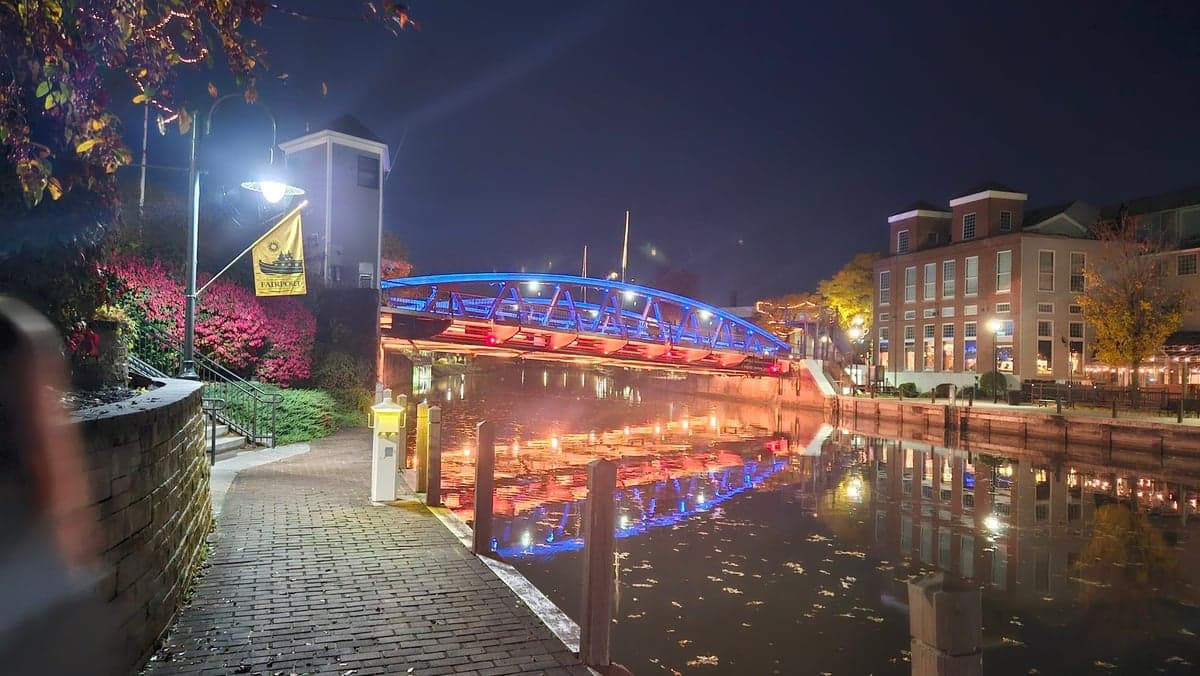
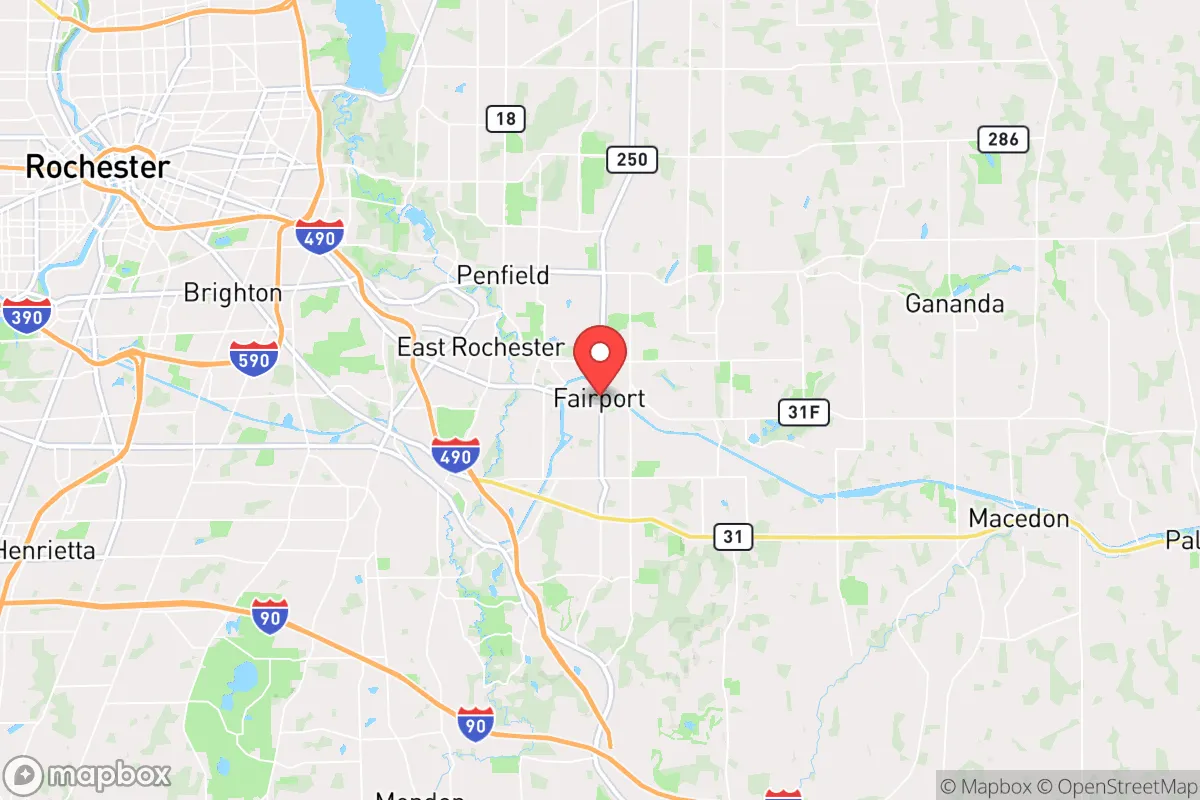
Fairport, New York, is a tight-knit village of 5,436 residents where nearly nine in ten residents identify as White (88.9%) and the foreign-born population is virtually nonexistent at 0.1%. With a college-educated rate of 53.7%—well above the national average—the community is defined by its historic canal-side charm, a strong sense of local identity, and a demographic profile that has remained remarkably stable over decades. The village’s population is older and more settled than the surrounding Monroe County suburbs, reflecting a place where families often stay for generations rather than a destination for new international arrivals.
How the city was settled and grew
Fairport’s human history begins with the Erie Canal, completed through the area in 1822. The canal transformed a sparsely settled farming hamlet into a busy port and milling center, drawing its first major wave of residents: Yankees from New England and upstate New York who arrived to operate grain mills, warehouses, and boatyards. These early settlers built their homes along what is now the Village Center Historic District, a compact grid of Federal and Greek Revival houses clustered near the canal lift bridge. By the mid-19th century, Irish laborers who dug and maintained the canal settled in modest cottages along Church Street and South Main Street, forming a working-class Irish Catholic enclave that persisted for generations. German immigrants followed in the 1850s and 1860s, drawn by jobs in the growing shoe and barrel factories; they concentrated in the East Avenue and West Avenue neighborhoods, where they built St. John’s Lutheran Church and the German-language parochial school. The village incorporated in 1867, and by 1900 its population had reached roughly 2,500, overwhelmingly native-born White with small pockets of Irish and German heritage. No significant wave of Southern or Eastern European immigration reached Fairport in the early 20th century; the village remained a homogeneous, Protestant- and Catholic-leaning community of canal and factory workers.
Modern era (post-1965)
After the 1965 Immigration and Nationality Act, Fairport saw virtually no influx of new foreign-born populations. The village’s 0.1% foreign-born share is among the lowest in Monroe County, and its racial composition has shifted only marginally. The Hispanic population grew from near zero in 1990 to 3.4% today, with most Hispanic residents living in the Parker Street and Boughton Avenue areas—older, more affordable housing stock near the village’s southern edge. The East/Southeast Asian population (0.8%) and Black population (0.8%) are tiny and dispersed, with no single neighborhood reaching even a 5% share of either group. The dominant demographic story of the modern era is not diversification but suburbanization and aging. From the 1970s through the 1990s, young families from Rochester’s inner-ring suburbs moved to Fairport for its highly rated Fairport Central School District and its walkable canal village atmosphere. They settled in the Perinton Hills subdivision (a late-1970s development of single-family homes on the village’s northwest side) and the Ayrault Road corridor, which filled with split-level and colonial-style houses. These newcomers were overwhelmingly White, college-educated professionals—engineers from Xerox and Kodak, healthcare workers from Strong Memorial Hospital, and small-business owners. The result is a village that is more educated (53.7% college degree) and more affluent than Monroe County as a whole, but also less diverse and older, with a median age of 44.
The future
Fairport’s population is projected to remain stable or decline slightly over the next decade, mirroring trends across upstate New York. The village’s low foreign-born share and minimal non-White population are unlikely to change dramatically: there is no major employer recruiting international talent, and the housing stock—dominated by older, expensive single-family homes—offers few entry points for new immigrant communities. The Hispanic population may grow slowly as second-generation families from nearby Rochester move outward, but the Parker Street area will likely remain the only neighborhood with a visible Hispanic presence. The bigger demographic shift is generational: as the large cohort of Baby Boomer homeowners ages out, younger families—still predominantly White and college-educated—are buying their homes, drawn by the school district and the canal lifestyle. The village’s cultural identity is evolving from a blue-collar canal town to a white-collar historic village, with more coffee shops, boutique retail, and canal-side events replacing the old factory-town character. For someone moving in now, Fairport offers a stable, low-diversity, highly educated community where the population is turning over slowly but the essential character—quiet, family-oriented, and rooted in local tradition—is likely to persist for another generation.

* Values derived from national, state, county, city and local statistics and may differ in a specific area. Last updated: 2026-11-26T22:48:00.000Z
Narrative content on this page is AI-generated and may contain mistakes. Verify any details that matter before acting on them.
ReloMaps may earn a commission from affiliate links at no extra cost to you.

