
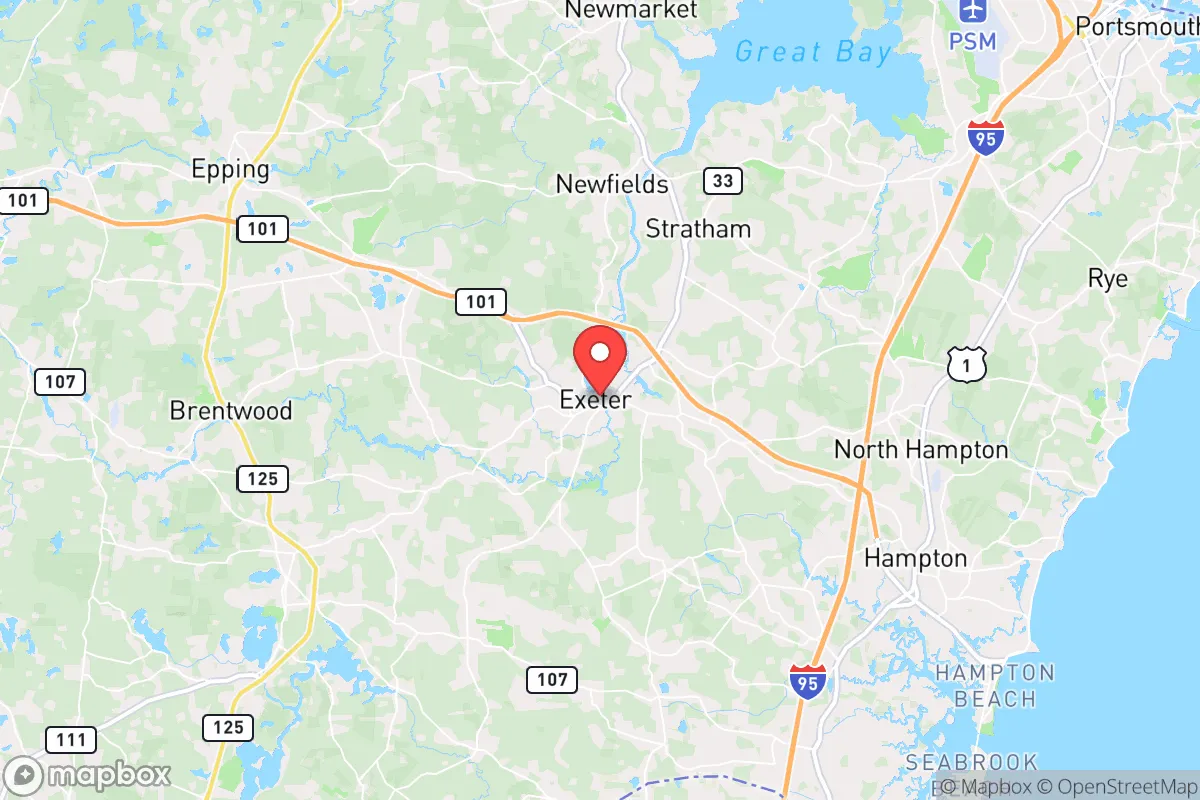
Photo: Wikipedia
Personal Sovereignty in Exeter, NH
Viable for self-reliance. Generally workable, though some barriers may limit total independence.
What does Personal Sovereignty tell us?
Personal Sovereignty measures your capacity for self-reliance and independence with minimal government friction. Higher scores mean fewer barriers between you and the way you want to live... but it assumes you have the space you need and good neighbors.
What does this tell us?
Personal Sovereignty measures your capacity for self-reliance and independence with minimal government friction. Higher scores mean fewer barriers between you and the way you want to live... but it assumes you have the space you need and good neighbors.
State Policy
Energy independence: Importer (10% of energy produced in-state)
Personal Liberty
Homesteading

Personal Liberty Analysis
Exeter, New Hampshire, offers a personal sovereignty environment that is among the strongest in New England, anchored by the state’s lack of a broad-based income or sales tax and a deep-rooted tradition of local self-governance. For a relocation audience prioritizing autonomy, the town’s regulatory posture is best described as moderately light-touch at the state level, with local ordinances that can vary but generally respect individual decision-making. The overarching ethos in the Seacoast region, and Exeter specifically, balances a live-and-let-live attitude with a pragmatic, community-oriented approach to land use and public safety. This creates a setting where personal freedom is the default, but not without some local guardrails that are worth understanding before moving.
Tax burden and regulatory posture: How New Hampshire’s model works for residents
New Hampshire’s tax structure is a major draw for those seeking financial autonomy. The state imposes no general sales tax and no personal income tax on wages or salaries, a combination found in only a handful of states. Exeter residents do pay a statewide property tax (roughly $2.50 per $1,000 of assessed value) plus local property taxes, which together create a total effective property tax rate that typically lands between 1.5% and 2.0% of a home’s assessed value annually. For a median-priced Exeter home (around $550,000 in 2025), that means annual property taxes of roughly $8,250 to $11,000. While not low by national standards, this is the primary revenue source for local services, and there is no state-level income tax to layer on top. The regulatory environment is similarly lean: New Hampshire has no statewide building code for single-family homes in most towns (Exeter adopts the International Residential Code locally), no mandatory vehicle emissions testing, and a famously minimal business regulatory footprint. The state’s “Right-to-Know” law and strong tradition of town meeting governance give residents direct influence over local ordinances, reinforcing a culture where government is seen as a service provider, not a manager of daily life.
Self-defense and gun law specifics: What the Second Amendment landscape looks like
New Hampshire is one of the most firearm-friendly states in the Northeast, and Exeter fully reflects that. The state operates under a permitless carry regime for both open and concealed carry for anyone legally allowed to possess a firearm—no license, permit, or training course required. There is no state-level firearm registry, no waiting period for purchases, and no magazine capacity restrictions. The state preempts local gun ordinances, meaning Exeter cannot enact its own bans or restrictions beyond state law. Stand-your-ground and castle doctrine principles are codified in statute (RSA 627:4), providing strong legal protection for self-defense in the home or in public. For those who want a concealed carry permit for reciprocity with other states, New Hampshire issues non-resident permits with a simple application and background check. The political climate in Exeter is more moderate than in rural parts of the state, but the legal framework is uniformly protective of individual gun rights. The local police department is professional and generally supportive of lawful firearm ownership; there is no local hostility to the Second Amendment that would affect daily life.
Self-reliance and homesteading viability: Lot sizes, zoning, and off-grid feasibility
Exeter offers moderate-to-good conditions for self-reliance, though it is not a rural homesteading paradise. The town’s zoning is primarily residential and agricultural, with minimum lot sizes ranging from one to three acres in most districts, though some areas allow half-acre lots. This means raising chickens, keeping bees, or maintaining a substantial vegetable garden is feasible on most properties, but keeping larger livestock (goats, pigs, cattle) typically requires a minimum of two to five acres and may require a special exception. Off-grid living is legally possible but practically constrained: New Hampshire law does not require connection to the electrical grid, but Exeter’s building code requires a septic system approved by the state Department of Environmental Services, and wells must be permitted. Solar panels are allowed without special permitting, and net metering is available through the local utility, Unitil. Wood stoves are common and legal, but must meet EPA emissions standards and local fire code. The town does not have a formal “right to farm” ordinance, but the state’s Right-to-Farm law (RSA 432:34) protects agricultural activities from nuisance lawsuits. For those seeking true off-grid independence, the more rural towns north of Exeter (like Brentwood or Epping) offer larger parcels and fewer restrictions, but Exeter itself is viable for a semi-self-sufficient lifestyle with a garden, small livestock, and solar backup.
Personal liberties: Parental rights, medical autonomy, speech, and property
New Hampshire has a strong track record on several key personal liberties. Parental rights in education are explicitly protected by state law (RSA 186-C:7-a), which gives parents the right to review all instructional materials and opt their children out of any curriculum they find objectionable. The state also has a robust school choice system, including open enrollment across districts, charter schools, and a thriving homeschooling community (with no state registration or testing requirements for homeschoolers). Medical autonomy is similarly respected: New Hampshire has no state-level vaccine mandate for adults, and while school vaccine requirements exist, they include broad religious and philosophical exemptions. The state’s “Right to Try” law allows terminally ill patients access to experimental treatments, and there is no state income tax on health savings account withdrawals. Free speech protections are strong, with no state-level hate speech laws that would criminalize protected expression. Property rights are reinforced by a relatively low rate of eminent domain use and a state law (RSA 498-A) that requires just compensation for any regulatory taking. The town of Exeter itself has a historic district commission that reviews exterior changes to buildings in the downtown historic district, which can be a constraint on property rights in that specific area, but this is limited to a small geographic zone and does not affect the vast majority of residential properties.
Overall, Exeter’s personal sovereignty profile places it among the top tier of New England towns for those who value autonomy. The combination of no income or sales tax, permitless carry, strong parental rights, and viable homesteading conditions creates a legal environment where individual decision-making is the norm. The trade-offs are the relatively high property taxes (funding excellent schools and infrastructure) and the historic district restrictions in a small downtown area. Compared to Massachusetts or Vermont, Exeter offers significantly more freedom in taxation, self-defense, and medical choice. Compared to more rural New Hampshire towns like Pittsburg or Colebrook, it offers less land and slightly more zoning oversight, but far better access to jobs, healthcare, and services. For a conservative-leaning individual or family who wants a balance of personal liberty and community infrastructure, Exeter represents a well-calibrated choice where the default answer from government is usually “yes, unless there’s a clear public safety reason not to.”

* Values derived from national, state, county, city and local statistics and may differ in a specific area. Last updated: 2026-09-22T00:53:16.000Z
Narrative content on this page is AI-generated and may contain mistakes. Verify any details that matter before acting on them.
ReloMaps may earn a commission from affiliate links at no extra cost to you.

