Photo: Wikipedia
Demographics of Exeter, NH
Affluence Level in Exeter, NH
An upper-middle-class area. Household wealth, education levels, and homeownership run ahead of national benchmarks.
People of Exeter, NH
The people of Exeter, New Hampshire, today form a predominantly white, highly educated community of roughly 10,100 residents, with a notably low foreign-born share of 1.4% and a college attainment rate of 52.1%. The population is overwhelmingly non-Hispanic white at 87.0%, with the largest minority groups being Hispanic (3.5%), East/Southeast Asian (3.3%), Indian subcontinent (1.2%), and Black (1.1%). Exeter retains a distinctly New England character—historic, family-oriented, and civically engaged—while its demographic profile reflects slow, steady change rather than rapid transformation.
How the city was settled and grew
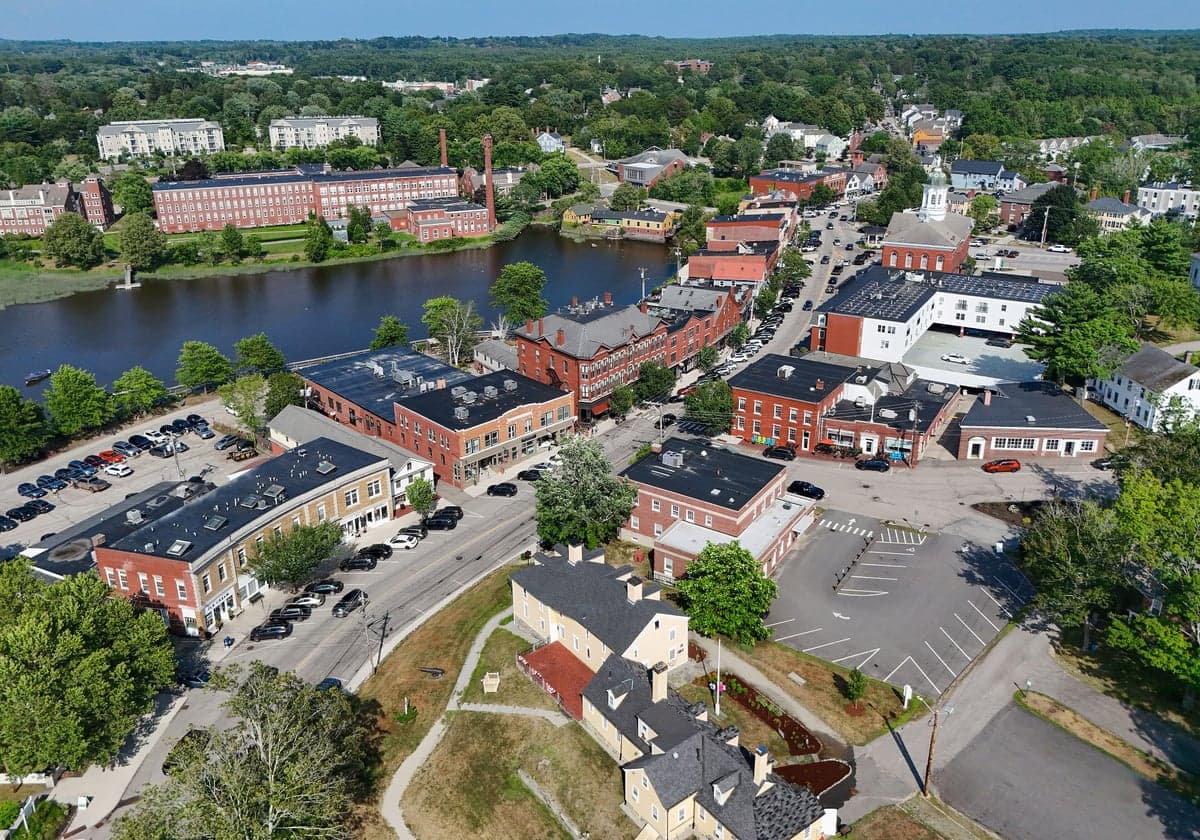
Exeter was founded in 1638 by a group of dissident settlers from Massachusetts, including the Reverend John Wheelwright, who sought religious and political freedom. The town’s location on the Exeter River made it an early center for shipbuilding, milling, and trade, drawing English and Scottish immigrants through the 18th century. The historic Water Street district along the river became the commercial and industrial heart, with mills and wharves operated by families like the Gilmans and Ladds. By the 19th century, Exeter’s population grew modestly as the town became a regional hub for manufacturing—especially textiles and shoes—and as the home of Phillips Exeter Academy, founded in 1781. The academy attracted faculty and students from across New England, but the broader workforce remained largely native-born Yankee stock, with small pockets of Irish and French-Canadian laborers settling in the String Bridge and Park Street neighborhoods near the mills. The 20th century brought little new immigration; Exeter’s population hovered around 5,000 through the 1950s, with the Exeter Highlands area developing as a middle-class residential district for commuters to Portsmouth and Boston.
Modern era (post-1965)
After the 1965 Hart-Cellar Act, Exeter saw only a trickle of new immigration, consistent with its low foreign-born share today. The most significant demographic shift came from domestic in-migration: professionals and families drawn by Exeter’s strong schools, historic charm, and proximity to the Seacoast’s growing tech and healthcare sectors. The Kensington Road corridor and Epping Road areas filled with single-family subdivisions during the 1980s and 1990s, attracting white-collar workers from Massachusetts and southern New Hampshire. The East/Southeast Asian community, now 3.3% of the population, began to appear in the 1990s and 2000s, largely tied to faculty and staff at Phillips Exeter Academy and nearby universities; these families tend to settle in the Academy Hill and High Street neighborhoods. The Indian subcontinent community (1.2%) arrived more recently, often in professional roles at Exeter Hospital and regional tech firms, with a visible presence in the Hampton Road area. The Hispanic population (3.5%) grew slowly, primarily through service-sector employment, and is dispersed rather than concentrated in any single neighborhood. Exeter’s Black population remains very small at 1.1%, with no historic enclave. Overall, the town’s racial and ethnic diversity has increased modestly since 2000 but remains far below state and national averages.
The future
Exeter’s population is projected to grow slowly, likely reaching 11,000–11,500 by 2040, driven by continued domestic in-migration of educated professionals and retirees. The foreign-born share may rise slightly but will remain low, as the town lacks the industrial or agricultural sectors that attract large immigrant flows. The East/Southeast Asian and Indian subcontinent communities are expected to grow gradually, primarily through professional recruitment and family reunification, but will remain small shares of the total. The Hispanic population may increase modestly, reflecting broader regional trends. The most notable demographic change will be aging: Exeter’s median age is already above the national average, and the 65+ cohort is growing as younger families are priced out of the housing market. New residential development is concentrated in the Epping Road and Portsmouth Avenue corridors, where townhouse and apartment complexes are being built to meet demand from downsizing seniors and young professionals. Exeter’s cultural identity will remain rooted in its historic, education-focused character, but the town will become slightly more diverse and more economically stratified as housing costs rise.
For someone moving in now, Exeter offers a stable, safe, and highly educated community with excellent schools and a strong sense of place. The population is becoming slightly more diverse and older, but the pace of change is slow, and the town’s Yankee-Protestant cultural foundations remain dominant. New residents—especially families and professionals—will find a welcoming but not rapidly transforming environment, where the biggest challenge is affordability rather than demographic upheaval.

* Values derived from national, state, county, city and local statistics and may differ in a specific area. Last updated: 2026-09-22T00:53:16.000Z
Narrative content on this page is AI-generated and may contain mistakes. Verify any details that matter before acting on them.
ReloMaps may earn a commission from affiliate links at no extra cost to you.

