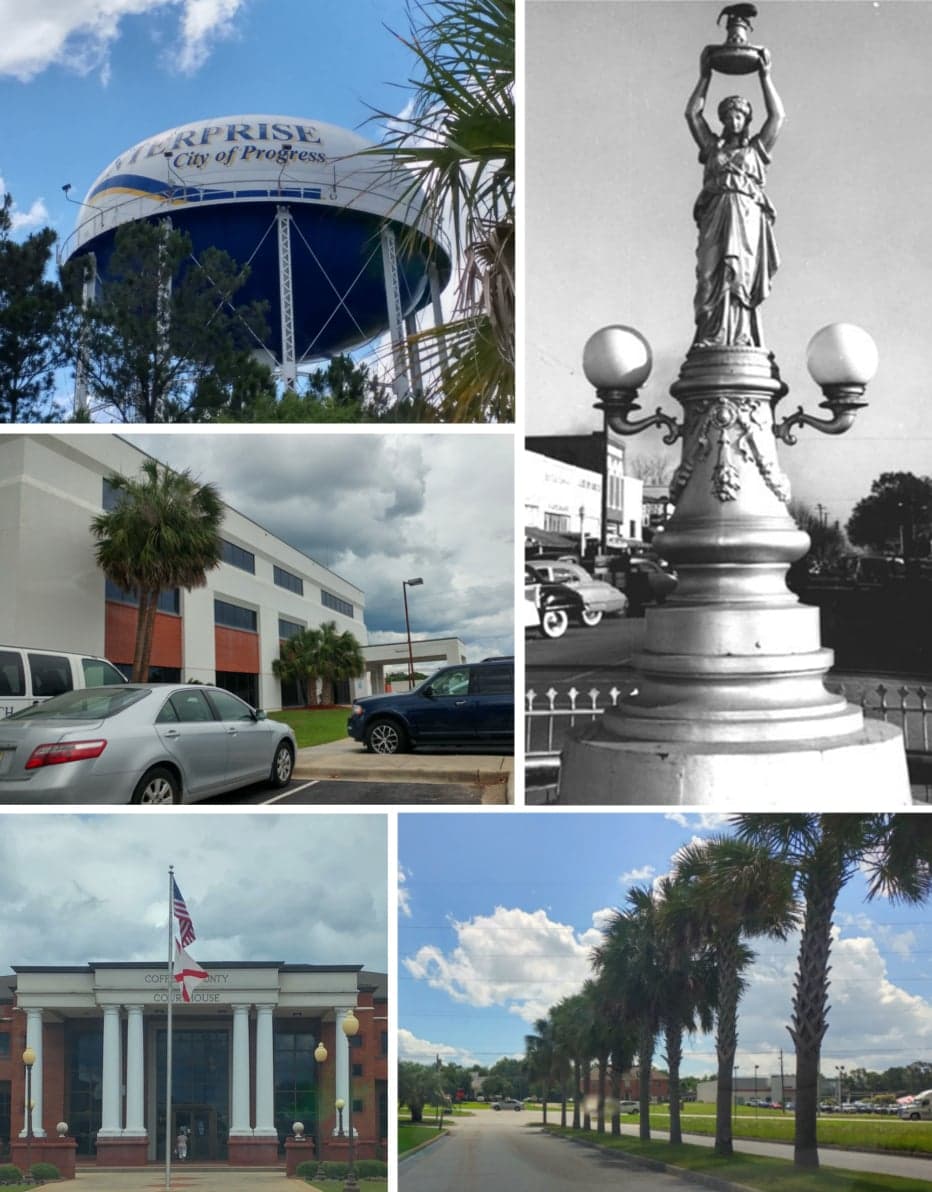
Photo: Wikipedia
Political ClimatePolitical Climate in Enterprise, AL
District shown is the primary district for this city’s centroid. Cities may span multiple districts.
Local Political AnalysisPolitical Analysis of Enterprise, AL
Enterprise, Alabama, is about as solidly conservative as it gets, with a Cook PVI of R+27 that puts it deep in the red. This isn't a purple area that flips back and forth—it's a place where Republican candidates routinely win by double digits, and the local culture reflects that. The political lean here is rooted in a strong military presence from Fort Novosel (formerly Fort Rucker), a deep agricultural tradition, and a general distrust of federal overreach. You don't see much hand-wringing over tax hikes or gun control; folks here value personal responsibility and local control, and they vote accordingly.
How it compares
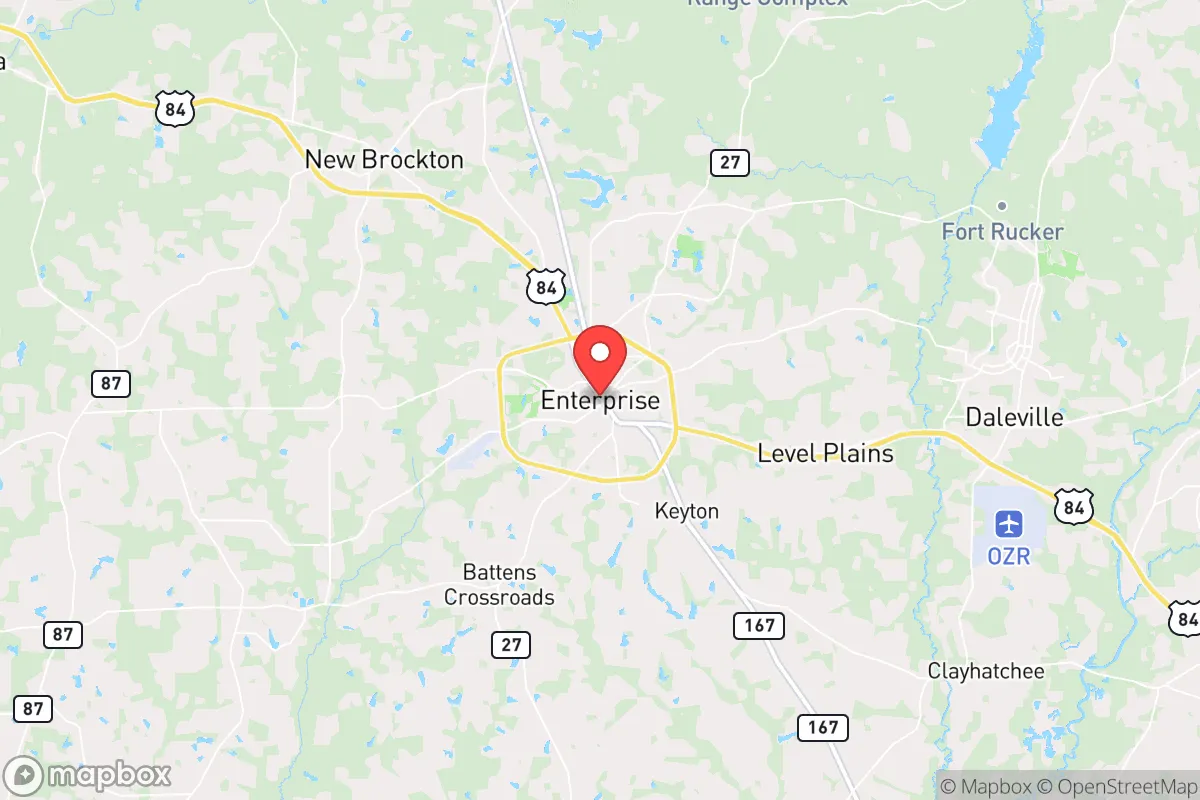
Compared to the rest of Alabama, Enterprise is right in line with the state's conservative heartland, but it stands out when you look at nearby cities like Dothan or Ozark. Dothan, about 20 miles east, is also conservative but has a slightly more moderate streak due to its larger retail and healthcare sectors—think more Chamber of Commerce Republicans. Ozark, just north of Fort Novosel, leans conservative too, but its politics are heavily influenced by the military base, which can bring a more transient, less locally rooted perspective. Head west to the Wiregrass region, and you'll find even more rural, deeply traditional communities like Geneva or Hartford, where the politics are even more libertarian-leaning on issues like property rights and land use. Enterprise, by contrast, feels like a stable, long-term conservative stronghold where the values haven't shifted much in decades.
What this means for residents
For residents, this political climate means a government that generally stays out of your business. You won't see the kind of progressive overreach that's creeping into bigger cities—no heavy-handed zoning rules, no aggressive tax schemes, and no push to restrict Second Amendment rights. The local school board and city council tend to focus on practical issues like infrastructure and public safety, not social experiments. That said, there's a quiet concern among long-time residents about the slow creep of federal mandates, especially around environmental regulations that could impact farming and the base. The biggest worry is that as the state grows and attracts new residents from blue states, some of those progressive ideas might follow. For now, though, Enterprise remains a place where you can live your life without the government breathing down your neck, and that's exactly how most folks want it.
Culturally, Enterprise is distinct for its fierce independence and its celebration of military service. The city's famous Boll Weevil Monument isn't just a quirky landmark—it's a symbol of overcoming adversity without waiting for Washington to step in. You'll find a strong sense of community here, with churches and civic groups playing a big role in daily life. Policy-wise, the city keeps taxes low, supports school choice, and generally resists any move toward progressive ideology. If you're looking for a place where your rights are respected and the government knows its place, Enterprise is a solid bet. Just keep an eye on the state legislature—some of those bills coming out of Montgomery could test how long this place stays true to its roots.

State Political ClimatePolitical Climate in Alabama
State Political AnalysisPolitical Environment in the State
Alabama is a deeply conservative state, with Republicans holding every statewide elected office and supermajorities in both legislative chambers, a position they've solidified over the past 20 years. The state voted for Donald Trump by +25 points in 2024, a margin that has actually grown from the +14 point win in 2012, driven by a steady realignment of rural and suburban voters away from the Democratic Party. While the state's overall partisan lean is rock-solid red, the real story is the internal migration of political power from the old Black Belt Democratic strongholds to the fast-growing, conservative suburbs of Birmingham, Huntsville, and the Gulf Coast.
Urban vs. rural divide
The political map of Alabama is a study in stark contrasts. The major metros—Birmingham, Huntsville, and Montgomery—are the only areas where Democrats remain competitive, but even there the picture is nuanced. Birmingham's Jefferson County is the state's largest Democratic stronghold, delivering about 60% of its vote to Biden in 2020, but the city's affluent suburbs like Vestavia Hills and Hoover are reliably Republican. Huntsville, the state's fastest-growing city, is a fascinating case: it's a high-tech, educated hub that still leans Republican, though the margin has narrowed as transplants from blue states arrive. The rural areas tell a different story. The Black Belt counties stretching from Selma to Union Springs are overwhelmingly Democratic due to high African American populations, but they are depopulating. Meanwhile, the rural white counties in north Alabama and the Wiregrass—places like Cullman, DeKalb, and Geneva—vote 80%+ Republican. The most politically distinct suburb is Auburn, where the university moderates the lean but the surrounding Lee County is still solidly red. The key takeaway: Alabama's rural areas are getting redder and emptier, while the metros are diversifying but not flipping blue.
Policy environment
Alabama's policy environment is among the most conservative in the nation, with a strong emphasis on limited government and traditional values. The state has no state income tax on retirement income and a flat 5% income tax on wages, with a 4% state sales tax that local governments can stack to 10% or more. Property taxes are among the lowest in the country, averaging about 0.4% of assessed value, which is a major draw for families. The regulatory posture is business-friendly, with a right-to-work law and minimal zoning restrictions outside major cities. Education policy is a flashpoint: the state passed the Alabama Literacy Act in 2019, requiring third graders to read at grade level before advancing, and in 2022 enacted the CHOOSE Act, a school choice program that provides tax credits for private school tuition and homeschooling expenses. Healthcare is a mixed bag—the state refused Medicaid expansion under the ACA, keeping the system lean, but rural hospital closures are a persistent concern. Election laws are strict: voter ID is required, early voting is limited to absentee ballots with an excuse, and the state banned curbside voting and ballot drop boxes in 2021. For a conservative family, the policy environment is largely aligned with their values, though the high sales tax and limited healthcare access in rural areas are real trade-offs.
Trajectory & freedom
Alabama has been on a clear trajectory of expanding personal freedom in several key areas, particularly since 2020. The state passed constitutional carry in 2022, allowing law-abiding citizens to carry a concealed firearm without a permit, and in 2023 enacted the "Second Amendment Preservation Act," which prohibits state enforcement of any future federal gun bans. Parental rights were strengthened with the 2022 "Parental Rights in Education" law, which requires schools to notify parents of any changes in a child's mental or physical health and bans classroom instruction on sexual orientation and gender identity in K-5. Medical freedom saw a major win with the 2024 "Medical Freedom Act," which prohibits employers and schools from requiring COVID-19 vaccines. On the flip side, the state has expanded government power in ways that concern some conservatives: the 2023 "Transgender Medical Procedures Ban" for minors, while popular with the base, represents a significant state intervention into private medical decisions. Property rights remain strong, with no statewide rent control and limited eminent domain abuse, though the 2023 "Alabama Landowner Protection Act" tightened rules on solar farm leases. Overall, the state is becoming more free in the areas of gun rights, parental control, and medical choice, but the trend toward using state power to enforce social policy is a double-edged sword that bears watching.
Civil unrest & political movements
Alabama has not seen the large-scale civil unrest of other states, but there are active political movements on both sides. The most visible flashpoint in recent years was the 2023 "Don't Say Gay" protests in Montgomery and Birmingham, where progressive activists rallied against the parental rights law, but these were small and quickly faded. The state's immigration politics are relatively quiet—Alabama passed a strict immigration law in 2011 (HB 56) that was largely gutted by courts, and since then the issue has simmered without major action. There is no sanctuary city movement; in fact, the 2024 "Alabama Immigration Enforcement Act" requires local law enforcement to cooperate with ICE. Election integrity controversies have been minimal, though the 2020 election saw a brief controversy in Mobile County over a voting machine error that was quickly resolved. The most organized political movement on the right is the "Alabama Freedom Caucus," a group of state legislators pushing for further tax cuts, school choice expansion, and anti-ESG legislation. On the left, the "Alabama Poor People's Campaign" has organized around Medicaid expansion and voting rights, but it remains a fringe force. A new resident would notice the absence of visible political conflict—no street protests, no graffiti, no partisan tension in daily life—which is a feature, not a bug, for many conservatives.
Projection
Over the next 5-10 years, Alabama is likely to become even more conservative, but with a shifting flavor. The in-migration of retirees from the Midwest and Northeast, particularly to the Gulf Coast around Gulf Shores and Orange Beach, will reinforce the Republican lean, as these newcomers are typically fiscally conservative. The growth of Huntsville's aerospace and defense sector will bring in younger, more educated workers who may be less culturally conservative, but the city's Republican lean is likely to hold as long as the economy stays strong. The Black Belt will continue to depopulate, reducing the Democratic base, while the suburbs of Birmingham and Montgomery will grow and stay red. The biggest wildcard is the potential for a school choice expansion—if the CHOOSE Act is expanded to universal vouchers, it could accelerate the decline of rural public schools and shift more families into private and homeschool networks, further entrenching conservative values. Expect more legislation on parental rights, gun rights, and medical freedom, but also a growing tension between the "liberty" wing of the party and the "moral order" wing over issues like gambling legalization and alcohol sales. A new resident moving in now should expect to find a state that is stable, predictable, and increasingly aligned with traditional conservative values, but with a growing libertarian streak that values personal autonomy over government enforcement of social norms.
For a conservative family or individual considering relocation, Alabama offers a policy environment that is largely aligned with their values: low taxes, strong gun rights, school choice, and a culture that respects personal freedom. The trade-offs are real—high sales taxes, limited healthcare access in rural areas, and a state government that is increasingly willing to use its power to enforce social policy, which may or may not be a concern depending on your views. The bottom line is that Alabama is a safe bet for someone looking to escape the progressive policies of blue states, but it's not a libertarian paradise—it's a place where community norms and traditional values still carry weight, and the government is seen as a tool to protect them, not to expand individual choice in every direction. If that sounds like your kind of place, you'll fit right in.
* Values derived from national, state, county, city and local statistics and may differ in a specific area. Last updated: 2026-04-19T18:49:16.000Z
Narrative content on this page is AI-generated and may contain mistakes. Verify any details that matter before acting on them.
ReloMaps may earn a commission from affiliate links at no extra cost to you.

