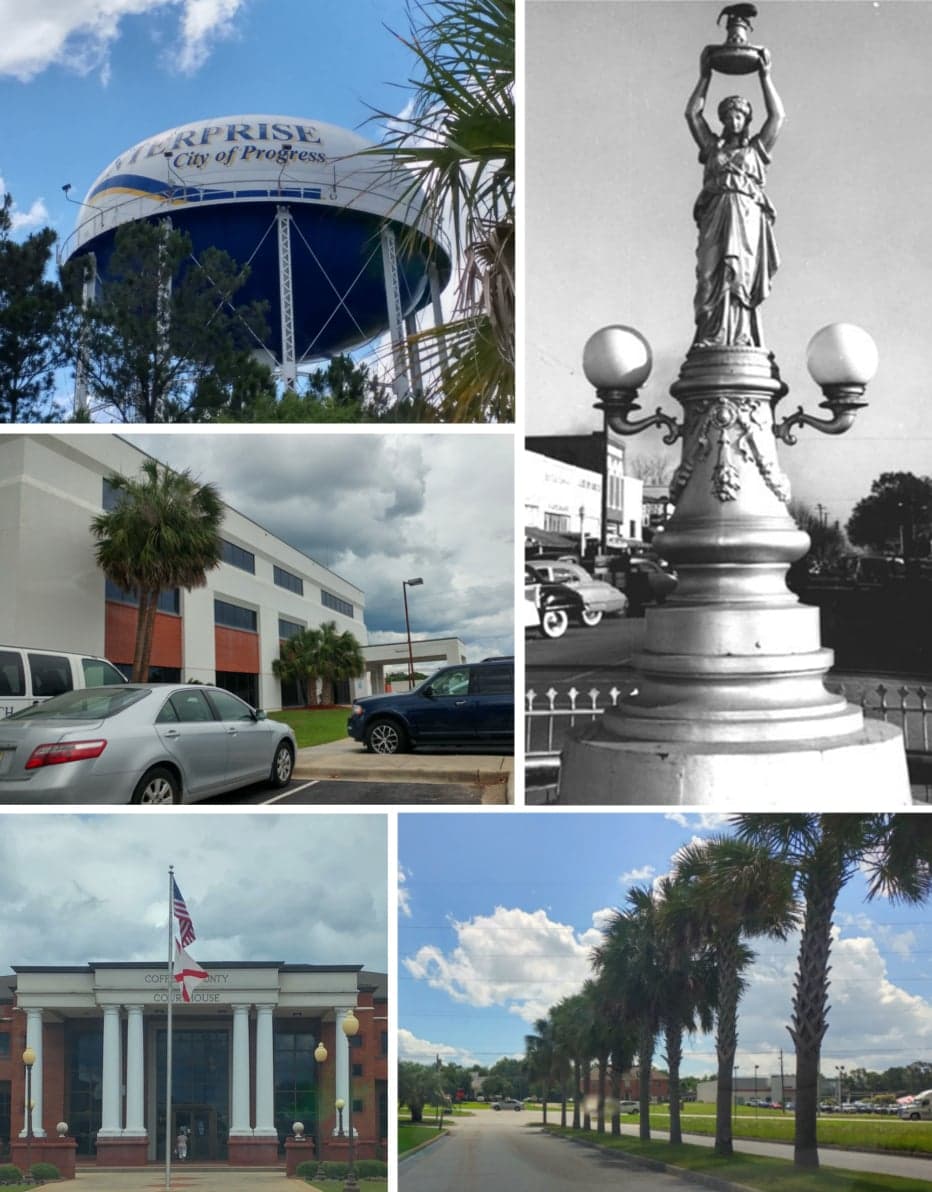
Photo: Wikipedia
Personal Sovereignty in Enterprise, AL
Viable for self-reliance. Generally workable, though some barriers may limit total independence.
What does Personal Sovereignty tell us?
Personal Sovereignty measures your capacity for self-reliance and independence with minimal government friction. Higher scores mean fewer barriers between you and the way you want to live... but it assumes you have the space you need and good neighbors.
What does this tell us?
Personal Sovereignty measures your capacity for self-reliance and independence with minimal government friction. Higher scores mean fewer barriers between you and the way you want to live... but it assumes you have the space you need and good neighbors.
State Policy
Energy independence: Importer (45% of energy produced in-state)
Personal Liberty
Homesteading

Personal Liberty Analysis
Enterprise, Alabama offers a notably high degree of personal sovereignty relative to most of the United States, functioning as a pocket where state-level preemption laws and a deeply ingrained local culture of self-reliance push back against the federal overreach that increasingly chokes freedom in blue-state metros. For the strategic relocator—whether a single prepper or a parent seeking to insulate a family from government intrusion—this Wiregrass city provides a legal and social environment where the default posture is "leave me alone," not "comply or else." The key is understanding how Alabama’s constitutional framework and Enterprise’s specific local dynamics translate into real autonomy on the ground, from tax burden to the right to defend one’s home without bureaucratic second-guessing.
Tax burden and regulatory posture: How Alabama’s low-tax framework protects your income and property
Alabama’s tax and regulatory climate is among the most favorable in the nation for those seeking to minimize government extraction from their labor and assets. The state’s combined state and local sales tax rate averages around 9.22% in Enterprise (Coffee County), which is high for everyday purchases, but this is offset by the absence of a state-level property tax on vehicles and a median property tax rate of just 0.33% of assessed home value—one of the lowest in the country. For a $250,000 home, that’s roughly $825 annually, compared to $3,000+ in many Northern states. Income tax is a flat 5% on taxable income over $3,000, but the state offers a standard deduction and allows a full federal income tax deduction on state returns, effectively lowering the bite for most earners. More critically for the sovereignty-minded, Alabama operates under a Dillon’s Rule framework for local governments, meaning cities and counties only have powers explicitly granted by the state legislature. This limits Enterprise’s ability to impose local ordinances that restrict property use, business operations, or personal conduct beyond state law. You won’t see the kind of municipal overreach common in California or New York—no local bans on gas stoves, no city-level red flag laws, no aggressive zoning that prohibits home-based businesses or small-scale agriculture. The regulatory posture is essentially: if the state hasn’t banned it, you’re free to do it, and local officials generally lack the appetite or authority to invent new restrictions.
Self-defense and gun law specifics: Stand Your Ground, permitless carry, and what it means for daily life
Alabama is a constitutional carry state as of 2022, meaning no permit is required to carry a concealed firearm for anyone legally allowed to possess one. This is not a theoretical right—it’s exercised openly and without social stigma in Enterprise, where gun ownership is the norm rather than the exception. The state’s Stand Your Ground law (Ala. Code § 13A-3-23) removes any duty to retreat before using deadly force if you are in a place you have a legal right to be and reasonably believe force is necessary to prevent death, great bodily harm, or a forcible felony. This applies in your home, your vehicle, your place of business, or on public streets. For the prepper mindset, this means your defensive plan isn’t hamstrung by legal ambiguity: if a threat materializes in your driveway or at a gas station, the law is on your side, not the aggressor’s. Enterprise also benefits from preemption of local gun ordinances—Alabama law explicitly prohibits cities from enacting their own gun control measures, so you won’t face the patchwork of local bans that plague states like Colorado or Washington. Magazine capacity limits, assault weapon bans, and waiting periods simply do not exist at the local level. The practical effect is that daily life involves less friction: you can carry into most businesses (private property rights still apply, but “no guns” signs carry no force of law unless you refuse to leave when asked), and the sheriff’s office in Coffee County is known for issuing permits quickly for those who still want reciprocity with other states. For parents, this also means teaching firearm safety and marksmanship to children is a culturally accepted activity, with multiple local ranges and hunting clubs providing venues for training without government interference.
Self-reliance and homesteading viability: Lot sizes, zoning, and off-grid feasibility in Enterprise
Enterprise’s zoning code and land availability make genuine homesteading—not just suburban gardening—a realistic option within a short drive of town amenities. Inside the city limits, minimum lot sizes in residential zones are typically 7,500 to 10,000 square feet, but many neighborhoods on the outskirts (like those off Highway 84 or near the Fort Novosel gate) feature lots of 0.5 to 2 acres. Outside city limits in unincorporated Coffee County, zoning is minimal to nonexistent, and parcels of 5 to 20 acres are common and affordable, often priced between $3,000 and $6,000 per acre as of 2025. Off-grid feasibility is high: Alabama has no state-level ban on rainwater collection, and while the Alabama Department of Public Health regulates well drilling, permits are issued routinely for private wells on parcels over one acre. Solar panels face no HOA restrictions in unincorporated areas, and net metering is available through the local electric cooperative (Wiregrass Electric Cooperative) at a 1:1 rate for systems under 100 kW. The climate supports year-round growing (Zone 8b/9a), with a growing season of roughly 240 days. For those concerned about grid dependency, burning wood for heat is common and legal, with no local bans on outdoor wood boilers in rural zones. The main limitation is water: the region is prone to periodic drought, so a reliable well depth of 200-400 feet is typical, and storage capacity of 1,000+ gallons is advisable. Sewage is handled via septic systems in unincorporated areas, with no requirement to connect to municipal lines. In short, a determined individual can achieve near-total food, water, and energy independence within 15 minutes of Enterprise’s grocery stores and hospitals—a balance that is increasingly rare in the continental US.
Personal liberties: Parental rights, medical autonomy, speech, and property protections
Alabama has become a national leader in codifying parental rights and medical autonomy, particularly since the 2022 Dobbs decision. The state’s Parental Rights in Education law (Ala. Code § 16-1-50) requires schools to notify parents of any medical or mental health services offered to their child and prohibits classroom instruction on sexual orientation or gender identity in grades K-5. For parents, this means you retain the authority to direct your child’s upbringing without school administrators acting in loco parentis on sensitive issues. Medical autonomy is robust: Alabama has no vaccine mandate for adults or children (schools require standard childhood vaccines for attendance, but medical and religious exemptions are available and honored), and the state explicitly prohibits discrimination against unvaccinated individuals in employment or public accommodations. The Alabama Medical Cannabis Act allows limited medical use, but recreational use remains illegal, and law enforcement in Coffee County is known for enforcing drug laws consistently—a factor that appeals to those who view drug legalization as a vector for social decay. Speech protections are strong: the state has no hate speech laws that criminalize political or religious expression, and Enterprise’s local government has not attempted to create “safe zones” or restrict public assembly. Property rights are reinforced by the Alabama Property Rights Protection Act, which limits eminent domain to traditional public uses (roads, schools, utilities) and prohibits its use for private economic development. For the sovereignty-minded, the cumulative effect is a legal environment where the government is a backstop, not a manager—you are free to raise your children, practice your religion, speak your mind, and use your property as you see fit, provided you do not initiate force against others.
Compared to the rest of the United States, Enterprise offers a level of personal sovereignty that is increasingly concentrated in the Deep South and a few Mountain West states. The combination of constitutional carry, Stand Your Ground, low property taxes, minimal zoning outside city limits, strong parental rights, and a culture that values self-reliance over government dependency places this city in the top tier for those seeking to opt out of the managed decline visible in blue states. It is not a libertarian utopia—sales tax is high, the state income tax exists, and the local economy is tied to the military base (Fort Novosel), which brings federal presence—but for the strategic relocator who wants to maximize personal freedom while maintaining access to jobs, healthcare, and infrastructure, Enterprise represents a rational, defensible choice in an era of expanding state control.

* Values derived from national, state, county, city and local statistics and may differ in a specific area. Last updated: 2026-04-19T18:49:16.000Z
Narrative content on this page is AI-generated and may contain mistakes. Verify any details that matter before acting on them.
ReloMaps may earn a commission from affiliate links at no extra cost to you.

