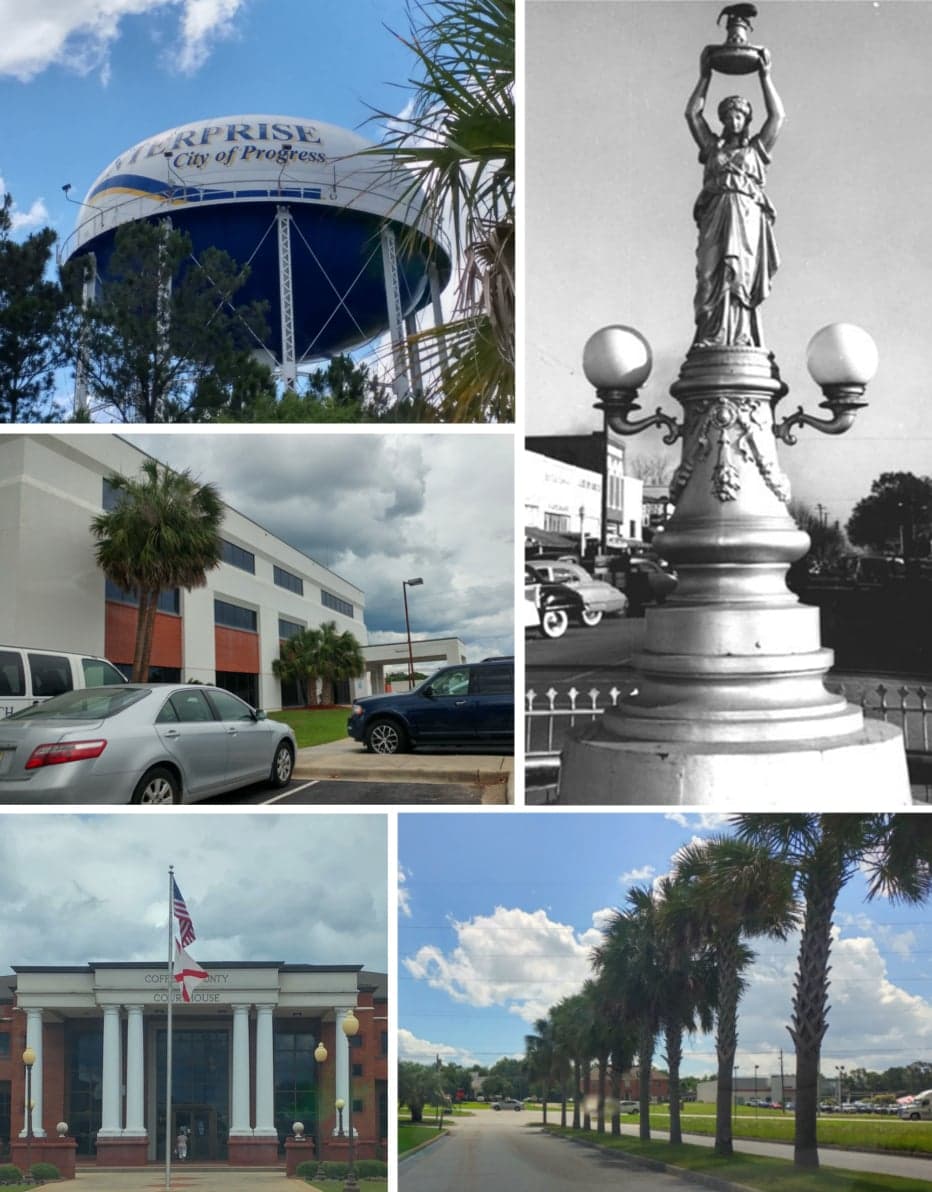
Photo: Wikipedia
Strategic Assessment of Enterprise, AL
Meaningful friction. Expect exposure to either population pressure, blast zones, or natural disaster risk. Consider buying a retreat property.
What does the Strategic Assessment tell us?
Our Strategic Assessment grades tactical survivability of an area. Major population centers, military targets, fallout zones, natural disasters, and border exposure all drive risk — lower exposure means a more defensible position in a crisis.
This is heavily inspired by Joel Skousen's Strategic Relocation book. Highly recommended you checkout the book ($)What does this tell us?
Our Strategic Assessment grades tactical survivability of an area. Major population centers, military targets, fallout zones, natural disasters, and border exposure all drive risk — lower exposure means a more defensible position in a crisis.
This is heavily inspired by Joel Skousen's Strategic Relocation book. Highly recommended you checkout the book ($)Strategic Pillars

Key Distances
Regional Safe Places
Below is our recommended "safe zones" in Alabama and the surrounding area based on our strategic heuristics. For most people, it's unrealistic to live in a “safe zone” full-time due to work, family or other personal reasons. They tend to be more rural. However, many of these areas are perfect for second homes and retreat properties that double as a vacation home or even a short-term rental.
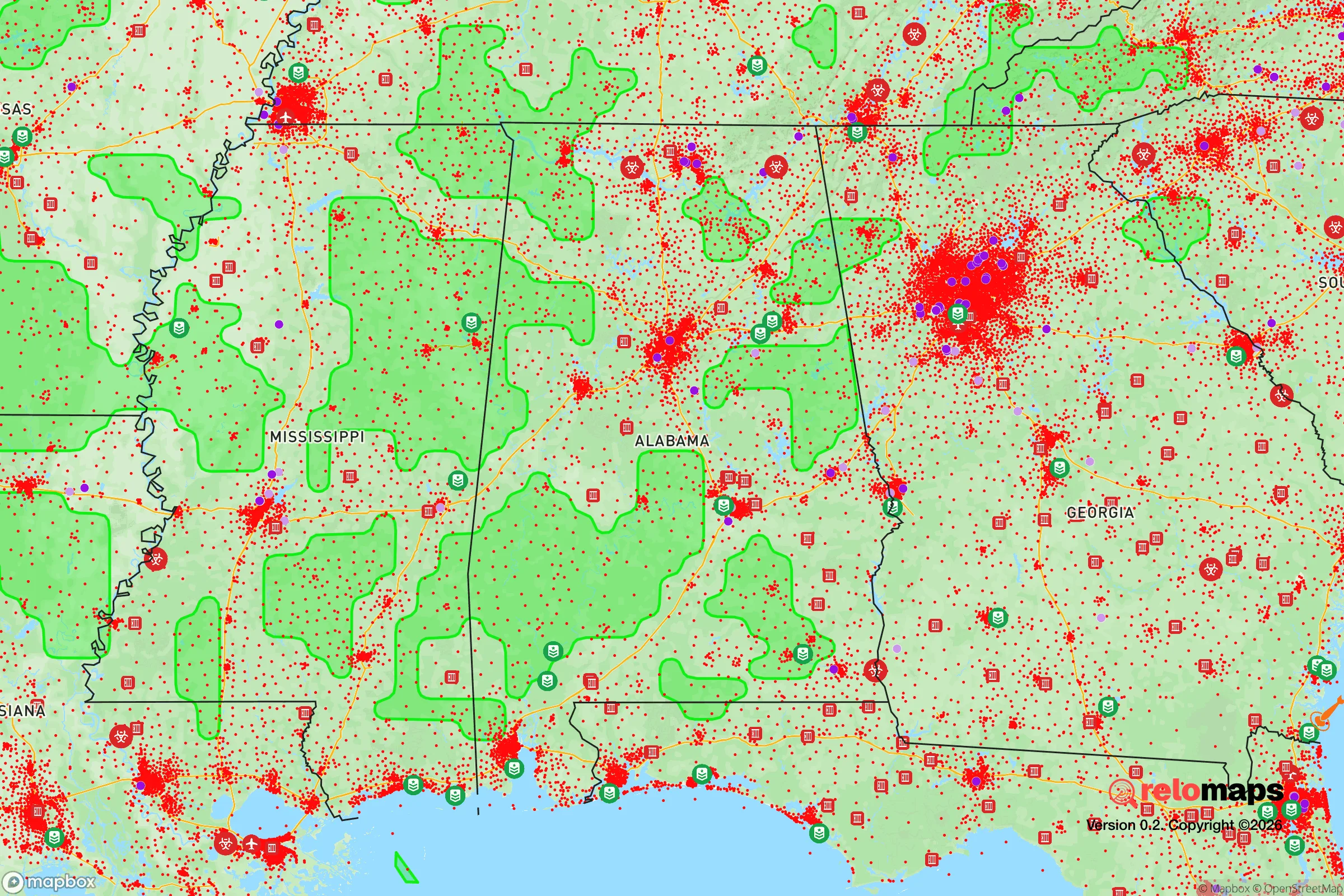
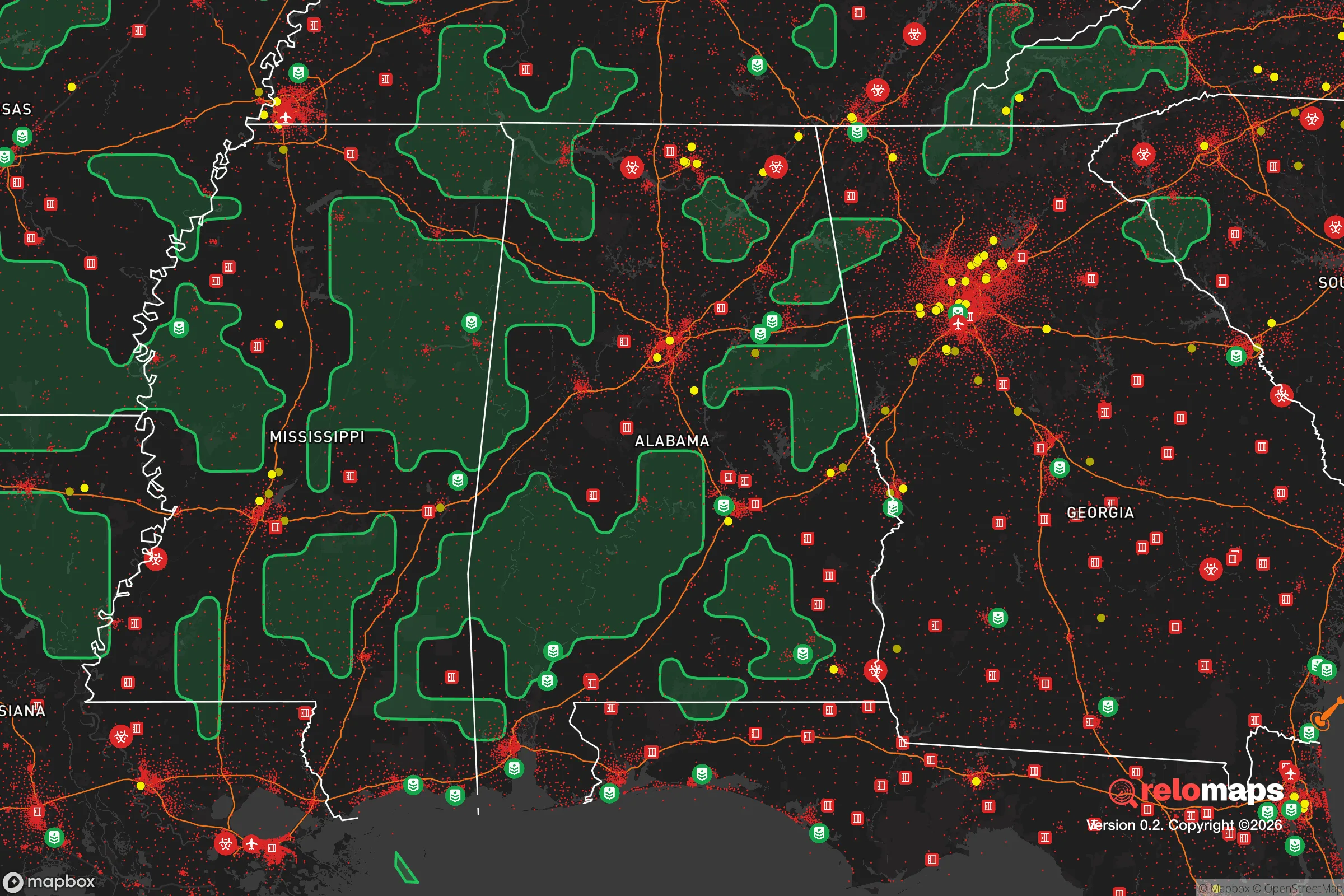


Important Note: For informational purposes only. This does not mean nothing bad ever happens in the green zones. Please use common sense. This is based on public data and modeled with AI. We tried to take a conservative approach but mistakes happen. We update this regularly as new information becomes available.
Solar Generator Recommendations
Backup power matters more here than in safer locations. We've picked three solar generators across budgets and capacity tiers — start with the budget unit if you only need a few essentials, or step up if you want to run a fridge and HVAC for days at a time.

Jackery Portable Power Station Explorer 300
Budget OptionPower on the Go: Weighing only 11 lbs, it's convenient to set up and store with book-sized foldable solar panels

BLUETTI Portable Power Station AC180
Designed for both indoor and outdoor scenarios, AC180 is highly capable as it has a robost capacity and continuous output power.

EF ECOFLOW DELTA Pro Ultra Power Station
Upgraded PickEcoFlow DELTA Pro Ultra is a whole-home energy system designed to grow with your family. Integrated with the Smart Home Panel 2, it scales to meet your evolving energy needs — keeping your home powered, intelligent, and secure through every stage of life.
We earn a commission, at no additional cost to you.
Strategic Assessment Analysis
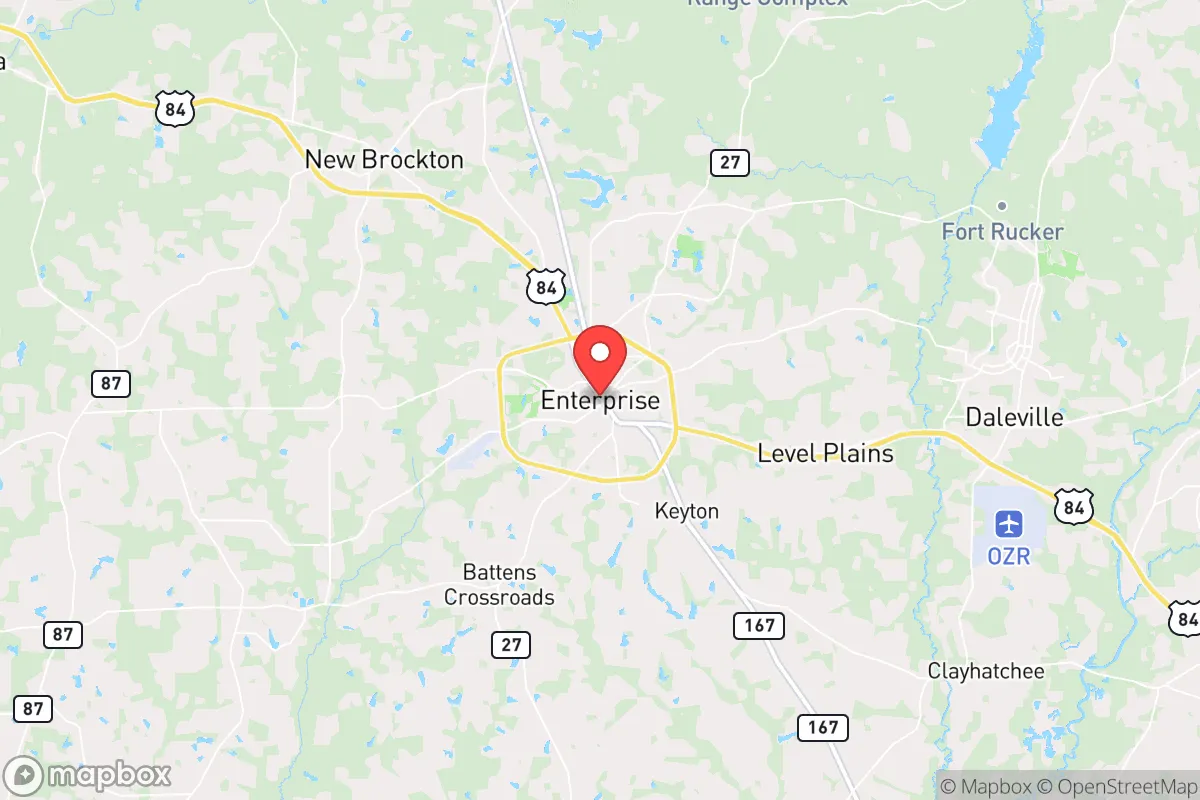
Enterprise, Alabama, offers a strategic relocation option for those prioritizing resilience, sitting far enough from major metropolitan targets to avoid the immediate fallout of a collapse event while retaining access to critical infrastructure. The city’s location in the southeastern corner of the state, roughly 80 miles from the Gulf Coast and 90 miles from the Florida line, places it outside the blast radius of any single major city, yet within a day’s drive of multiple supply corridors. For a conservative-leaning individual or family focused on self-sufficiency and long-term preparedness, Enterprise’s combination of agricultural self-reliance, a strong military presence, and a relatively insular community makes it a viable base of operations for weathering civic unrest or large-scale disruptions.
Geographic position and natural advantages for long-term survival
Enterprise sits in the Wiregrass region of Alabama, a zone defined by sandy loam soils, abundant rainfall, and a temperate climate that supports year-round food production. The area receives roughly 55 inches of rain annually, ensuring a reliable water supply for gardening, livestock, and basic household needs without heavy reliance on municipal systems. The terrain is gently rolling, with no major floodplains or earthquake risks, and the local water table is high enough that shallow wells are feasible for most properties outside the city limits. The city’s proximity to Fort Novosel (formerly Fort Rucker) — the Army’s primary aviation training base — means the region has a built-in population of military families and veterans, many of whom already maintain a mindset of readiness and community self-defense. This military presence also ensures that local infrastructure, including roads and emergency services, receives above-average funding and maintenance compared to similarly sized rural towns. For a relocator, the key natural advantage is the ability to produce food and secure water without complex technology: the growing season stretches from March to November, and native hardwoods provide ample firewood for heating and cooking in a grid-down scenario.
Risks, exposures, and proximity to fallout-relevant landmarks
Enterprise’s primary risk exposure comes from its location within 100 miles of two major potential targets: the Port of Mobile and the Eglin Air Force Base complex in Florida. Mobile, with its chemical plants, refineries, and shipping infrastructure, is a plausible target for a kinetic or EMP attack, though Enterprise sits far enough inland (about 85 miles) to avoid direct blast effects or significant fallout from a ground burst. Eglin, a major Air Force installation with test ranges and munitions storage, is roughly 90 miles south; a strike there could generate fallout patterns that drift northeast, potentially brushing the Enterprise area depending on wind direction. More concerning is the proximity to the Alabama Power Farley Nuclear Plant, located about 35 miles northwest near Dothan. A catastrophic failure or sabotage at that facility could render the region uninhabitable for decades, though the plant’s containment design and the prevailing winds (typically from the south and west) make this a low-probability, high-consequence risk. The city itself has no major industrial targets — no refineries, no rail hubs, no military bases within its limits — which is a net positive for a survivalist assessment. The biggest practical risk is the area’s vulnerability to hurricanes: while Enterprise is far enough inland to avoid storm surge, it sits in the path of tropical systems that can dump 10–15 inches of rain in 24 hours, causing flash flooding in low-lying areas and knocking out power for days. For a relocator, the takeaway is that Enterprise avoids the worst of the coastal fallout risks while still being close enough to the Gulf to monitor maritime threats and adjust plans accordingly.
Practical resilience for a relocator: food, water, energy, and defensibility
For a family or individual looking to establish a self-sufficient homestead, Enterprise offers several concrete advantages. The local soil, while sandy, is well-suited for raised-bed gardening and supports crops like sweet potatoes, okra, collards, and peanuts — all high-calorie, low-maintenance staples. The city’s agricultural heritage means that feed stores, seed suppliers, and livestock auctions are common within a 30-minute drive, and the local extension office at Auburn University’s Wiregrass Research and Extension Center provides free guidance on soil testing, pest control, and food preservation. Water is the strongest asset: the Choctawhatchee River runs just east of town, and the area’s numerous creeks and ponds offer surface water for filtration, while the shallow aquifer means a hand-pump well can be installed for under $2,000 on most rural lots. Energy resilience is moderate — the local power grid is served by Alabama Power, which has a reputation for slow restoration after storms, but the abundance of southern pine and hardwood makes wood heating a practical backup. Solar potential is good, with roughly 220 sunny days per year, though the region’s humidity and frequent cloud cover during summer reduce panel efficiency. Defensibility is where Enterprise shines: the city is laid out in a compact grid with clear sightlines, and the surrounding countryside is a patchwork of small farms and pine plantations with limited road access, making it easy to monitor approaches. The local sheriff’s office and Enterprise Police Department maintain a visible presence, and the community’s gun culture is strong — there are multiple gun shops and ranges within city limits, and the state’s constitutional carry law (passed in 2022) means no permit is needed for concealed carry. For a relocator, the practical checklist is straightforward: buy a property with a well and a wood stove, stock up on heirloom seeds and ammunition, and get to know your neighbors at the local VFW or church — because in a crisis, the military and veteran community here will likely organize faster than most.
The overall strategic picture for Enterprise is one of moderate risk and high reward for a conservative-minded relocator. It avoids the worst of the coastal and urban target zones while retaining access to military-grade logistics and a community that already values preparedness. The biggest downsides are the hurricane threat and the proximity to the Farley nuclear plant, but these are manageable with proper planning — a good well, a root cellar, and a bug-out route east toward the Florida panhandle’s less populated areas. For a single individual or a family looking to ride out the coming instability without going completely off-grid, Enterprise offers a realistic middle ground: enough isolation to avoid the chaos of the cities, but enough infrastructure to maintain a decent quality of life while you build your own resilience. It’s not a fortress, but it’s a solid base camp.

* Values derived from national, state, county, city and local statistics and may differ in a specific area. Last updated: 2026-04-19T18:49:16.000Z
Narrative content on this page is AI-generated and may contain mistakes. Verify any details that matter before acting on them.
ReloMaps may earn a commission from affiliate links at no extra cost to you.

