Photo: Wikipedia
Political ClimatePolitical Climate in East St. Louis, IL
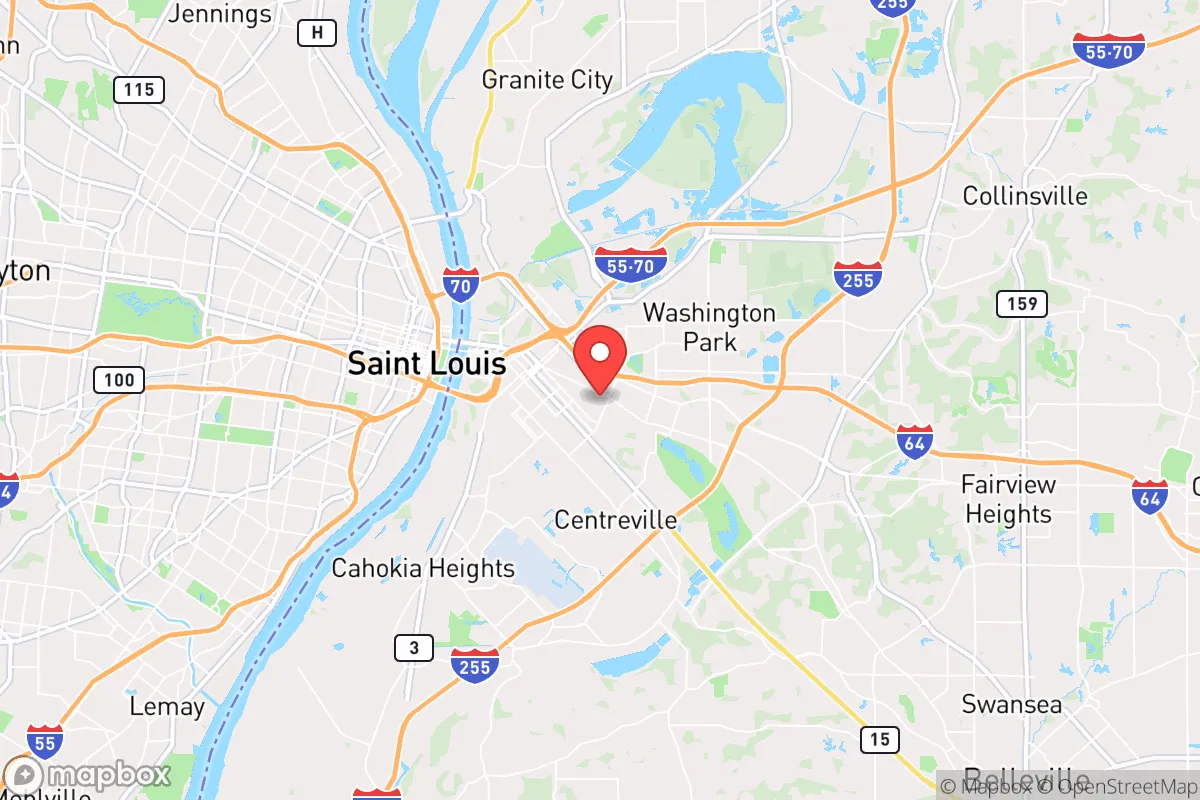
District shown is the primary district for this city’s centroid. Cities may span multiple districts.
Local Political AnalysisPolitical Analysis of East St. Louis, IL
East St. Louis sits in a political landscape that is deeply Democratic, but with a distinct local flavor that sets it apart from the rest of Illinois. The city itself has a Cook PVI of D+5, meaning it leans Democratic by five points relative to the national average, but this is actually a couple of points less blue than the state of Illinois as a whole, which sits at D+7. That gap might seem small, but it reflects a real tension: East St. Louis is a heavily African American, working-class city with a long history of industrial decline and systemic disinvestment, and its politics are shaped by survival and local patronage networks rather than the broader suburban or progressive currents that drive Illinois’s overall Democratic tilt. You won’t find the same kind of affluent, college-educated liberal activism here that you see in places like Evanston or Oak Park. Instead, the political conversation is about jobs, public safety, and the constant struggle to keep city services running on a shoestring budget.
How it compares to the rest of Illinois
When you compare East St. Louis to the state average, the key difference is intensity and isolation. Illinois as a whole is D+7, boosted by Chicago’s massive Democratic machine and the collar counties’ moderate-to-liberal lean. But East St. Louis is a Democratic stronghold in a region that is otherwise deeply conservative. Drive 15 minutes east into Belleville or O’Fallon, and you’re in St. Clair County’s more suburban, Republican-leaning areas. Head west across the Mississippi into Missouri, and you hit St. Louis city (D+27) and St. Louis County (D+14), but the rural counties around them are solidly red. So East St. Louis is a blue island in a sea of red, and its D+5 rating actually understates how isolated it feels politically. The city’s Democratic votes are overwhelming—often 90% or more for Democratic presidential candidates—but that doesn’t translate into state-level influence because the surrounding suburbs and exurbs cancel it out. In Springfield, East St. Louis is often seen as a problem to be managed rather than a partner in governance.
What this means for residents
For liberal residents, the political climate means that local elections are the real battleground. The Democratic primary is the only election that matters, and it’s often a fight between factions tied to the city’s old political machine, the county board, and state-level players. You’ll hear a lot of talk about “the old guard” versus reformers, but the reality is that whoever wins has to deal with the same brutal fiscal constraints. For conservative residents—and there are a few, mostly in the city’s dwindling white enclaves or among small business owners—the political reality is that you’re a permanent minority. Your vote for a Republican candidate in a general election is essentially symbolic. But the upside is that the city’s Democratic leadership is often pragmatic, not ideological. They’ll work with anyone who can bring in state or federal dollars, and they’re not pushing progressive social policies that would alienate the more moderate, churchgoing base. The real divide isn’t left versus right; it’s between those who have access to the patronage network and those who don’t.
One cultural distinction that sets East St. Louis apart is its deep-rooted sense of local identity and pride, despite the national headlines about crime and poverty. The city’s political discourse is less about national issues and more about who’s going to fix the potholes, keep the water running, or bring a new grocery store to the north side. You’ll hear people talk about “the East Side” as a place that’s been forgotten by everyone except its own residents. That insularity means that national political trends—like the rise of the progressive left or the Trump-era realignment of working-class voters—don’t hit here the same way they do in Chicago or the suburbs. The city’s politics are stubbornly local, and that’s not likely to change anytime soon. If you’re moving here, expect to engage with a system that’s personal, sometimes frustrating, but always deeply connected to the community’s survival.

State Political ClimatePolitical Climate in Illinois
State Political AnalysisPolitical Environment in the State
Illinois is a solidly Democratic state at the statewide level, with a Cook PVI of D+7, but that number hides a brutal urban-rural civil war that has only intensified over the past 20 years. The Democratic coalition is overwhelmingly powered by Chicago and its inner suburbs, while the rest of the state—from the Mississippi River towns to the southern tip—has shifted hard red. The net result is a state that votes reliably blue for president and governor, but where the legislature and governor have pushed a consistently progressive agenda that leaves conservative residents feeling increasingly alienated and outvoted.
Urban vs. rural divide
The political map of Illinois is essentially a tale of two states. Cook County, home to Chicago, casts about 40% of the state's total vote and delivers margins of 70-80% for Democrats. The collar counties—DuPage, Lake, Kane, Will, and McHenry—were once Republican strongholds but have been trending purple-to-blue, especially in presidential years. DuPage County, which voted for George W. Bush by 18 points in 2004, voted for Joe Biden by 9 points in 2020. Meanwhile, downstate Illinois has become as Republican as any part of the Deep South. Counties like Williamson, Franklin, and Jefferson in the Little Egypt region routinely vote 75-80% Republican. The shift is starkest in the western Illinois river towns: Quincy, once a swing area, now votes +30 Republican, and Peoria, the home of Caterpillar, has flipped from a Democratic-leaning union town to a reliably Republican one over the past decade. The only real blue islands downstate are college towns like Champaign-Urbana (home to the University of Illinois) and Carbondale (SIU), plus the majority-Black city of East St. Louis.
Policy environment
Illinois has one of the highest combined state and local tax burdens in the nation, driven by a flat income tax rate of 4.95% and property taxes that average over 2% of home value—among the highest in the country. The state's regulatory posture is heavily pro-labor and pro-union, with no right-to-work laws and a $15 minimum wage that was phased in by 2025. Education policy is dominated by the Chicago Teachers Union, which has enormous influence in Springfield. The state has a universal school voucher program? No—Illinois has no school choice to speak of, and the Chicago Public Schools system remains one of the most dysfunctional in the nation. On healthcare, Illinois expanded Medicaid under the ACA and has some of the strongest insurance mandates in the country. Election laws are among the most liberal: automatic voter registration, no-excuse mail-in voting, and same-day registration are all in place. The state also has a "sanctuary state" law (the TRUST Act) that limits local law enforcement cooperation with federal immigration authorities.
Recent policy direction
The last five years have seen a dramatic acceleration of progressive legislation. In 2021, Illinois became the first state to eliminate cash bail entirely through the Pretrial Fairness Act, though implementation was delayed by court challenges until 2023. Gun laws have been tightened significantly: in 2023, the state passed a ban on assault weapons and high-capacity magazines, following a mass shooting at the Highland Park Fourth of July parade in 2022. The law is currently being challenged in federal court, but remains in effect. On education, the state eliminated the requirement for standardized tests like the SAT for high school graduation and passed a law requiring all public schools to teach LGBTQ+ history. Parental rights have been a flashpoint: Illinois does not require schools to notify parents if a child changes their gender identity or pronouns, a policy that has driven some conservative families to move to neighboring Indiana or Missouri. On abortion, Illinois has become a regional haven, with no waiting periods, no parental consent requirements for minors (though parental notification is required), and state funding for abortion services. The state also expanded Medicaid coverage for gender-affirming care. Property rights have been constrained by the 2021 eviction moratorium extension and by rent control laws that allow local governments to impose caps. On voting, the state expanded mail-in ballot access permanently after the 2020 election and now allows 16- and 17-year-olds to pre-register to vote.
Civil unrest & political movements
Illinois has seen significant political turbulence. The 2020 George Floyd protests in Chicago were among the largest and most destructive in the country, with looting and property damage that led to a lasting political backlash in the city's more moderate wards. The "defund the police" movement gained traction in the Chicago City Council, but was largely rejected by voters in subsequent elections. On the right, the "Illinois Separation" movement—advocating for downstate counties to secede and form a new state—has gained real traction, with over 30 counties passing symbolic resolutions in favor of exploring secession since 2020. While legally impossible without congressional approval, the movement reflects deep alienation. Immigration politics are a constant flashpoint: the state's sanctuary policies have led to tension with the Trump administration, and Chicago has seen an influx of migrants bused from Texas since 2022, straining city resources and creating political divisions within the Democratic coalition. Election integrity controversies have been relatively muted compared to other states, though the 2020 election saw some Republican complaints about Chicago's vote-counting process, which were not substantiated by any court findings.
Projection
Over the next 5-10 years, Illinois is likely to become even more polarized. The Chicago metro area will continue to grow and diversify, while downstate will continue to lose population and age. The 2020 Census showed Illinois losing a congressional seat for the seventh consecutive decade, and that trend is expected to continue. The Democratic majority in the state legislature is likely to hold or even expand, meaning the policy direction will remain progressive. However, there are limits: the state's fiscal crisis—with a $140 billion unfunded pension liability—will constrain spending. The exodus of conservative-leaning residents to Indiana, Wisconsin, and Tennessee will accelerate, making the state's electorate even more Democratic. For a conservative relocating to Illinois, the realistic expectation is that you will be living in a state where your vote for president and Senate is essentially meaningless, but where local elections in your county or town may still be competitive. The best bet for a conservative is to target the few remaining red-leaning suburbs like Orland Park or New Lenox in Will County, or the exurban areas of McHenry County near the Wisconsin border, where local government is still conservative even if the state is not.
For a conservative considering a move to Illinois, the bottom line is this: you will be paying high taxes for services you may not agree with, living under gun laws you likely oppose, and sending your kids to schools that teach a worldview you may find alien. The trade-off is access to Chicago's economy, world-class universities, and cultural amenities—if those are worth the price. For a liberal, Illinois offers a policy environment that is among the most aligned with progressive values in the Midwest, with strong labor protections, abortion access, and a safety net. Either way, the state's trajectory is clear: it will remain a blue state in a red region, and the cultural and political divide between Chicago and the rest of the state will only grow wider.
* Values derived from national, state, county, city and local statistics and may differ in a specific area. Last updated: 2026-10-10T16:27:22.000Z
Narrative content on this page is AI-generated and may contain mistakes. Verify any details that matter before acting on them.
ReloMaps may earn a commission from affiliate links at no extra cost to you.

