
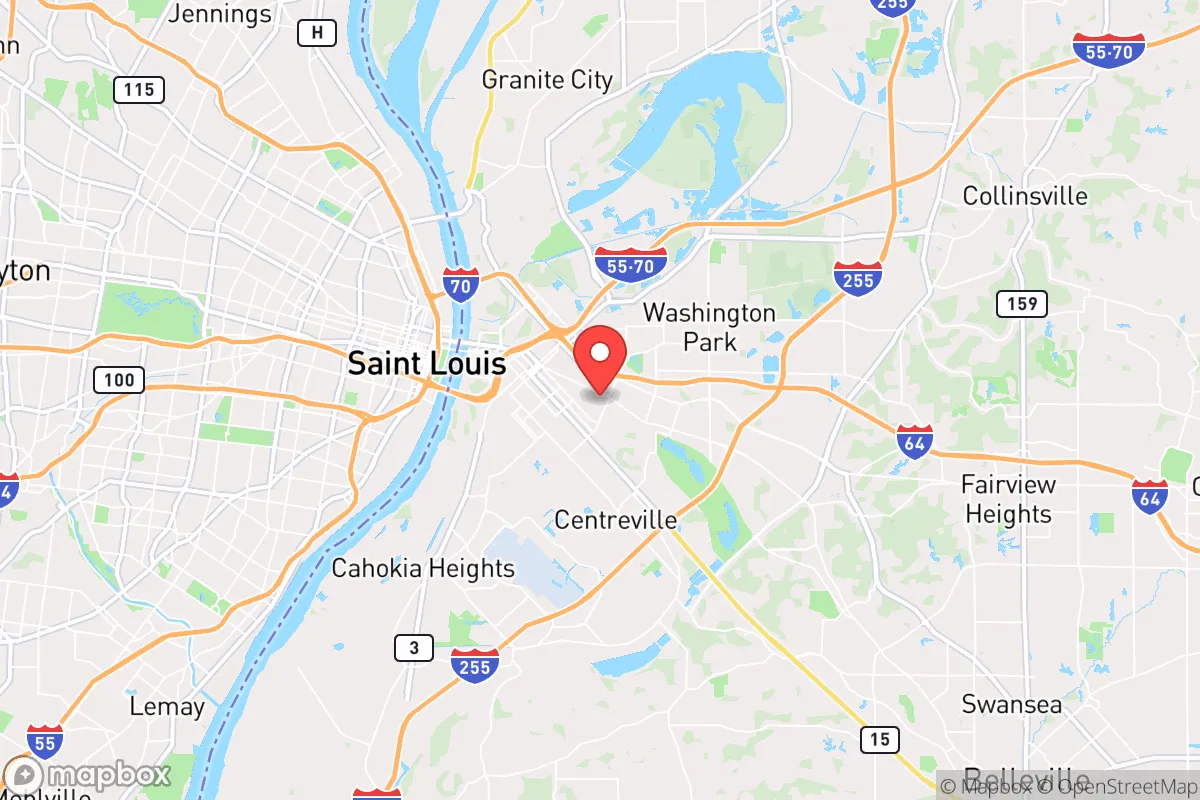
Photo: Wikipedia
Personal Sovereignty in East St. Louis, IL
Viable for self-reliance. Generally workable, though some barriers may limit total independence.
What does Personal Sovereignty tell us?
Personal Sovereignty measures your capacity for self-reliance and independence with minimal government friction. Higher scores mean fewer barriers between you and the way you want to live... but it assumes you have the space you need and good neighbors.
What does this tell us?
Personal Sovereignty measures your capacity for self-reliance and independence with minimal government friction. Higher scores mean fewer barriers between you and the way you want to live... but it assumes you have the space you need and good neighbors.
State Policy
Energy independence: Importer (45% of energy produced in-state)
Personal Liberty
Homesteading

Personal Liberty Analysis
East St. Louis, Illinois presents a deeply contradictory environment for personal sovereignty, where the state’s relatively permissive legal framework on self-defense and firearm ownership clashes with one of the highest municipal tax burdens and most constrained property-rights climates in the Midwest. For a relocation researcher focused on autonomy, the city itself offers little in the way of light-touch governance, but the surrounding St. Clair County and broader Illinois context provide specific tools—particularly in gun law and homeschooling—that a determined individual can leverage. The net assessment is that East St. Louis is a high-friction, low-autonomy location for most measures of personal freedom, with the notable exception of self-defense law, where Illinois’s preemption statutes and shall-issue carry regime create a baseline of protection that the city cannot override.
Tax burden and regulatory posture in East St. Louis
East St. Louis carries one of the highest combined property tax rates in Illinois, with the city’s total levy often exceeding 3.5% of assessed value when including school district and county portions. This places it among the top 5% of municipalities nationally for property tax burden. The state’s flat income tax rate of 4.95% is moderate, but when combined with a 6.25% sales tax rate (including county and transit levies), the overall tax load is heavy for a city with a median household income around $30,000. Regulatory posture at the city level is interventionist: zoning is strict, building permits require multiple layers of approval, and the city has a reputation for slow processing times. The state of Illinois adds layers of occupational licensing and environmental regulation that affect small businesses and tradespeople. For a reader prioritizing low-tax, low-regulation living, East St. Louis is a poor fit; the tax burden consumes a large share of income, and the regulatory environment is not business-friendly by any standard.
Self-defense and gun law specifics in Illinois
Illinois is a shall-issue state for concealed carry, meaning that after completing a 16-hour training course and passing a background check, a resident can obtain a license with no discretionary denial by local authorities. This is a critical sovereignty point: East St. Louis cannot impose its own gun restrictions beyond state law, thanks to Illinois’s firearm preemption statute (430 ILCS 65/13.1). The city has no local assault weapons ban or magazine capacity limit that differs from state law. However, Illinois does require a Firearm Owner’s Identification (FOID) card to possess any firearm or ammunition, a process that involves a state police background check and can take 30–90 days. The state also bans the sale of “assault weapons” under the Protect Illinois Communities Act (effective 2023), which prohibits new purchases of many semi-automatic rifles and standard-capacity magazines. Existing owners are grandfathered but must register them with the state police by 2024. For self-defense in the home, handguns and shotguns remain fully legal. Stand-your-ground law does not exist in Illinois; a person has a duty to retreat before using deadly force outside the home, unless they are in their own dwelling or vehicle. Castle doctrine applies inside the home. For a conservative-leaning reader, the gun laws are a mixed bag: the carry permit is accessible, but the FOID requirement and assault weapon ban represent significant state-level restrictions that cannot be avoided by moving to East St. Louis.
Self-reliance and homesteading viability in East St. Louis
East St. Louis is a dense urban environment with a median lot size of approximately 5,000 square feet, typical of older industrial cities. Vacant lots are common—the city has an estimated 3,000+ vacant parcels—but purchasing them for homesteading is complicated by delinquent property taxes, unclear titles, and a city land bank that requires a lengthy application process. Zoning is primarily residential R-1 and R-2, which permits single-family homes and gardens but restricts livestock, poultry, and commercial-scale agriculture. Chickens are allowed with a permit, but goats, pigs, or horses are not permitted within city limits. Off-grid feasibility is extremely low: the city mandates connection to municipal water and sewer, and building codes require electrical service. Solar panels are allowed but must comply with utility interconnection rules. Rainwater collection is legal but limited to 50 gallons per property under Illinois law. For a reader seeking self-reliance through homesteading, East St. Louis is not viable. The surrounding St. Clair County, however, offers rural parcels with acreage (1–5 acres common) within a 20-minute drive, where zoning is more permissive, property taxes are lower (around 1.8% of assessed value), and off-grid options become feasible with a private well and septic system. The city itself is a dead end for homesteading; the county is a moderate option.
Personal liberties in East St. Louis: parental rights, medical autonomy, speech, and property
Illinois is a state with strong preemption on many personal liberty issues, meaning local ordinances in East St. Louis cannot override state law. Parental rights are relatively robust: Illinois has no mandatory vaccination law for school attendance (medical and religious exemptions are allowed), and homeschooling is legal with minimal regulation—parents must provide instruction in required subjects but do not need to register with the state or submit to testing. This is a significant sovereignty advantage for families. Medical autonomy is more constrained: Illinois has a broad vaccine mandate for healthcare workers and long-term care facilities, and the state’s medical cannabis program is well-established but does not allow home cultivation. Recreational cannabis is legal for adults 21+, with a possession limit of 30 grams. Speech is protected under the First Amendment, and East St. Louis has no local ordinances restricting political speech or assembly. Property rights are the weakest point: the city has an aggressive code enforcement program, with fines for unkempt lots, unregistered vehicles, and building code violations. Eminent domain has been used historically for redevelopment projects, and property tax liens are common. For a reader prioritizing parental control and educational freedom, Illinois offers a decent baseline; for property rights and medical autonomy, the environment is restrictive.
Overall, East St. Louis ranks low on personal sovereignty compared to other Midwestern cities of similar size. The tax burden is crushing, the regulatory environment is heavy-handed, and homesteading is effectively impossible within city limits. The bright spots are the state’s shall-issue concealed carry law and the flexibility in homeschooling and vaccination choices. For a conservative-leaning individual or family, the city itself is a poor choice for autonomy, but the surrounding St. Clair County offers a more balanced environment—lower taxes, larger lots, and the same state-level protections. If personal freedom is the primary relocation criterion, East St. Louis should be approached with caution, and the county should be the focus of any serious search.

* Values derived from national, state, county, city and local statistics and may differ in a specific area. Last updated: 2026-10-10T16:27:22.000Z
Narrative content on this page is AI-generated and may contain mistakes. Verify any details that matter before acting on them.
ReloMaps may earn a commission from affiliate links at no extra cost to you.

