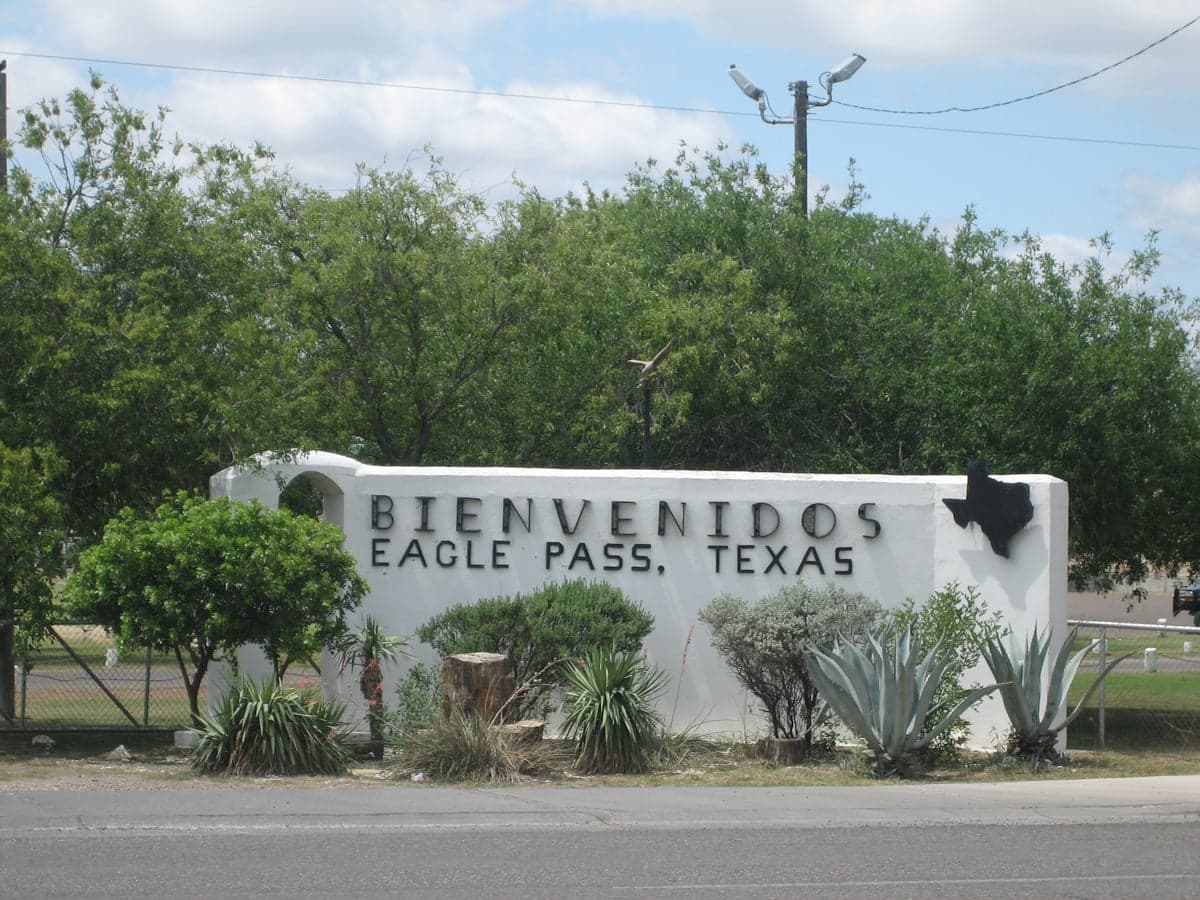

Photo: Wikipedia
Political ClimatePolitical Climate in Eagle Pass, TX
District shown is the primary district for this city’s centroid. Cities may span multiple districts.
Inherited from parent county — no local data available.
* Lean and PVI are calculated from Eagle Pass, TX’s own 2020 presidential results (precinct returns summed to the city), with 2024 estimated from the surrounding county’s 2020–2024 shift, Cook-style. Sources: state election offices; VEST 2020 precinct results (CC BY 4.0).
Political rankings in Texas
- Most Conservative Cities in Texas
- Most Liberal Cities in Texas
- Best Liberal-Leaning Towns in the South
- Safest Liberal-Leaning Towns in the South
- Safest Conservative-Leaning Towns in the South
- Affordable Small Towns for Conservatives
- Most Affordable Liberal-Leaning Small Towns in the U.S.
- Safest Conservative-Leaning Cities in the U.S.
- Most Conservative Counties in Texas
- Most Liberal Counties in Texas
Local Political AnalysisPolitical Analysis of Eagle Pass, TX
Eagle Pass leans Republican but is far from a deep-red stronghold, with a Cook PVI of R+3 that makes it one of the more politically competitive areas in Texas. That R+3 rating means the district votes about three points more Republican than the national average, but in a state where many rural counties go R+20 or higher, Eagle Pass stands out as a genuine swing zone. The city itself has a long history of Democratic-leaning Hispanic voters, but that’s been shifting steadily toward the GOP over the past decade, especially among working-class families who prioritize border security and economic opportunity. If you’ve been around here since the 90s, you’ve watched the local Democratic machine lose its grip, while Republican registration has climbed every cycle.
How it compares
Compared to Texas as a whole, Eagle Pass is actually more moderate than the state’s average voter. The state’s Cook PVI is unknown, but statewide elections typically break R+8 to R+10, meaning Eagle Pass’s R+3 is noticeably less conservative. Drive 45 minutes north to Uvalde, and you’ll find a similar R+10 lean. Head an hour east to Carrizo Springs, and it’s R+15. The real contrast is just across the border in Piedras Negras, Mexico, where politics are entirely different, but within Texas, the closest politically similar town might be Del Rio, which also sits around R+5. What makes Eagle Pass unique is its high percentage of naturalized citizens and first-generation voters, who often split tickets more than native-born Texans. You’ll see precincts here vote for a Democratic county judge and a Republican state representative in the same election.
What this means for residents
For conservative residents, the R+3 lean means their votes usually carry the day in local races, but they can’t take anything for granted. You’ll see more competitive primaries here than in deep-red counties, and Republican candidates actually have to campaign on local issues like water rights and trade with Mexico, not just national talking points. For liberal residents, it’s not a hopeless environment—Democratic candidates regularly pull 45-48% in countywide races, and the city council often has a progressive voice. The practical effect is that policy tends to be pragmatic rather than ideological. The school board, for instance, focuses on bilingual education and workforce training for the maquiladora economy, not culture war issues. Property taxes are a universal gripe, and both parties’ candidates promise relief, though results vary.
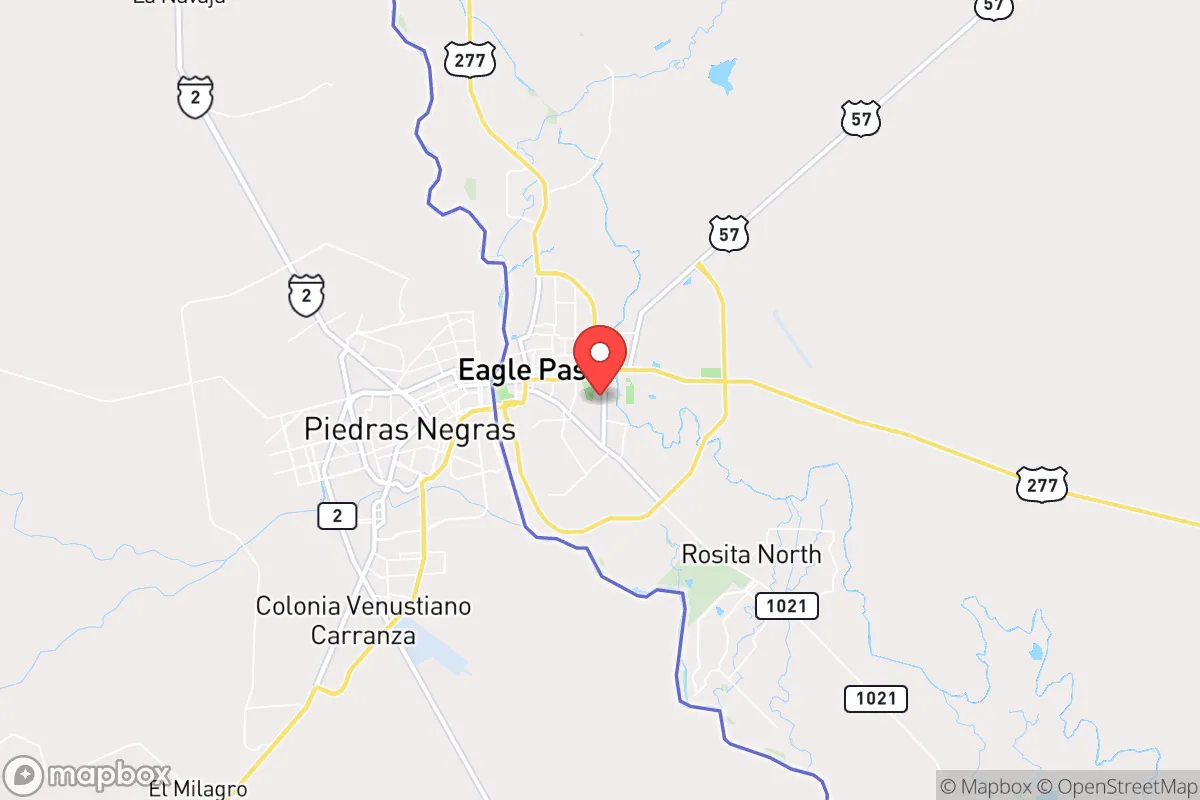
Culturally, Eagle Pass is distinct from most of Texas because of its deep binational identity. Spanish is heard as often as English in grocery stores, and the city’s economy is tied to the international bridge and border patrol presence. That creates a political reality where debates over immigration aren’t abstract—they’re about your neighbor’s commute or your cousin’s visa. The local Democratic Party tends to be more conservative on social issues than national Democrats, while the local GOP is more libertarian on trade and less focused on religious conservatism. Looking ahead, the trajectory is toward a continued slow shift rightward, but the R+3 rating could hold steady if new housing developments bring in younger, more diverse families from San Antonio. For now, it’s one of the few places in Texas where a door-knocking campaign can genuinely swing an election either way.

State Political ClimatePolitical Climate in Texas
State Political AnalysisPolitical Environment in the State
Texas has been a reliably Republican state for the past three decades, but the margin has been shrinking. In 2024, Donald Trump won Texas by about 9 points, down from 11 points in 2020 and 16 points in 2016. The state’s political center of gravity is shifting as explosive growth in the suburbs of Dallas-Fort Worth, Houston, and Austin brings in a wave of moderate and left-leaning voters, while rural and exurban areas remain deeply conservative. The result is a state that still leans right but is increasingly competitive, with a Republican-controlled legislature that has moved aggressively to the right on cultural and election issues in response to the demographic pressure.
Urban vs. rural divide
The political map of Texas is a study in contrasts. The state’s five largest metros—Houston, Dallas-Fort Worth, San Antonio, Austin, and El Paso—are all Democratic-leaning, but the degree varies. Austin and El Paso are deep blue, with Harris County (Houston) and Dallas County trending that way. The real battleground is the suburban ring around these cities. Collin County (north of Dallas) and Denton County (northwest of Dallas) were reliably red for decades, but both flipped to Trump by only single digits in 2024. Tarrant County (Fort Worth) is now a true swing county. Meanwhile, the vast rural expanse—from the Panhandle down through West Texas and into East Texas—votes Republican by 70-80% margins. The Rio Grande Valley, once a Democratic stronghold, has shifted right, with counties like Starr and Hidalgo moving 20+ points toward Trump since 2016. The divide isn’t just urban vs. rural; it’s also suburban vs. exurban. Places like Frisco and McKinney are purple, while nearby Celina and Prosper are still deep red.
Policy environment
Texas has no state income tax, which is the single biggest policy draw for relocators. Property taxes are high to compensate—averaging about 1.6% of assessed value—but there is no tax on retirement income. The regulatory posture is famously business-friendly: no state-level minimum wage above the federal $7.25, weak unions, and a right-to-work law. On education, the state funds public schools through a complex Robin Hood system that redistributes property tax revenue from wealthy districts to poor ones. School choice has been a major fight; in 2023, Governor Greg Abbott pushed a universal school voucher bill that failed in the House due to rural Republican opposition, but it’s expected to return. Healthcare policy is largely hands-off: Texas did not expand Medicaid under the ACA, leaving about 1.5 million uninsured. Abortion is effectively banned after six weeks, with no exceptions for rape or incest, under the 2021 Heartbeat Act and a 2023 trigger law. Election laws were tightened in 2021 with SB 1, which banned 24-hour and drive-through voting, added ID requirements for mail ballots, and gave partisan poll watchers more access.
Recent policy direction
The last three legislative sessions have pushed Texas sharply right on a broad front. On guns, Texas became a permitless carry state in 2021 (HB 1927), allowing anyone 21 or older who can legally own a firearm to carry it without a license or training. On parental rights, the 2023 session passed a ban on gender-affirming care for minors (SB 14) and a law requiring school libraries to remove books deemed “sexually explicit” (HB 900), though the latter is tied up in court. On speech, the state passed a law in 2021 (HB 20) that bars social media platforms from moderating content based on viewpoint, though it’s been partially blocked by courts. On privacy and surveillance, Texas has no comprehensive data privacy law, but it did pass a biometric privacy law in 2023. On property rights, the state has strong eminent domain protections for landowners, and a 2023 law (SB 2038) restricts local governments from banning natural gas hookups in new construction. On voting, the 2021 SB 1 tightened rules, but turnout has remained high—over 60% in 2024. The overall direction is toward maximizing individual liberty on guns and property, while restricting it on abortion, transgender care, and certain speech protections.
Civil unrest & political movements
Texas has seen its share of political flashpoints. The 2020 protests after George Floyd’s murder in Minneapolis sparked large demonstrations in Austin, Houston, and Dallas, with some property damage and a heavy police response. The “Defund the Police” movement gained little traction in Texas; most cities actually increased police budgets. On the right, the “constitutional sheriff” movement is strong in rural counties, with sheriffs in places like Montgomery and Smith counties publicly refusing to enforce certain state or federal gun laws. Immigration politics are a constant: the 2023 Operation Lone Star, a state-level border security initiative, has deployed thousands of National Guard troops and state troopers to the border, and the state bused over 100,000 migrants to Democratic-led cities. Sanctuary city policies are banned statewide (SB 4, 2017), but some cities like Austin and San Antonio have “welcoming” ordinances that limit local police cooperation with federal immigration enforcement. Secession rhetoric flares up periodically—the Texas Nationalist Movement has some grassroots support—but it’s a fringe position. Election integrity remains a live issue; the 2020 and 2024 elections saw no evidence of widespread fraud, but Republican officials continue to push for tighter rules, and some counties have seen partisan fights over voting machine contracts.
Projection
Over the next 5-10 years, Texas is likely to become more competitive at the statewide level, but the legislature will remain Republican-controlled due to gerrymandering. The state is adding about 400,000 new residents per year, mostly from California and other blue states, and these newcomers tend to be moderate or left-leaning. The suburbs of Dallas, Houston, and Austin will continue to purple, while rural areas will stay deep red. The Rio Grande Valley’s shift right may accelerate if Democrats fail to reconnect with working-class Hispanic voters. By 2032, Texas could be a true swing state in presidential elections, though the state-level offices (governor, legislature) will lag behind that shift. The policy direction will likely remain conservative on taxes, guns, and regulation, but may moderate on cultural issues as the electorate changes. The voucher fight will probably be resolved in favor of school choice within the next few sessions. Climate and water issues will become more prominent as the state’s population grows and droughts intensify, potentially creating new political cleavages between urban and rural areas over water rights and development.
For a new resident, the bottom line is this: Texas offers a low-tax, low-regulation environment with a strong economy and a growing population. If you lean conservative, you’ll find a state government that largely shares your values on guns, taxes, and parental rights. If you lean liberal, you’ll find vibrant blue cities with strong cultural scenes, but you’ll be living under a state government that is actively hostile to many of your policy preferences. The political climate is polarized but not violent—most Texans get along fine day-to-day regardless of party. The key is choosing the right city or suburb that matches your political comfort zone. The state is big enough that you can find a community that fits, whether that’s deep-red Lubbock, purple Fort Worth, or blue Austin. Just know that the state-level politics will lean right for the foreseeable future, and that’s unlikely to change dramatically even as the demographics shift.
* Values derived from national, state, county, city and local statistics and may differ in a specific area. Last updated: 2026-11-11T04:03:54.000Z
Narrative content on this page is AI-generated and may contain mistakes. Verify any details that matter before acting on them.
ReloMaps may earn a commission from affiliate links at no extra cost to you.

