Photo: Wikipedia
Demographics of Eagle Pass, TX
Affluence Level in Eagle Pass, TX
A below-average socioeconomic profile. Incomes, home values, and educational attainment trail the U.S., with higher poverty and unemployment.
People of Eagle Pass, TX
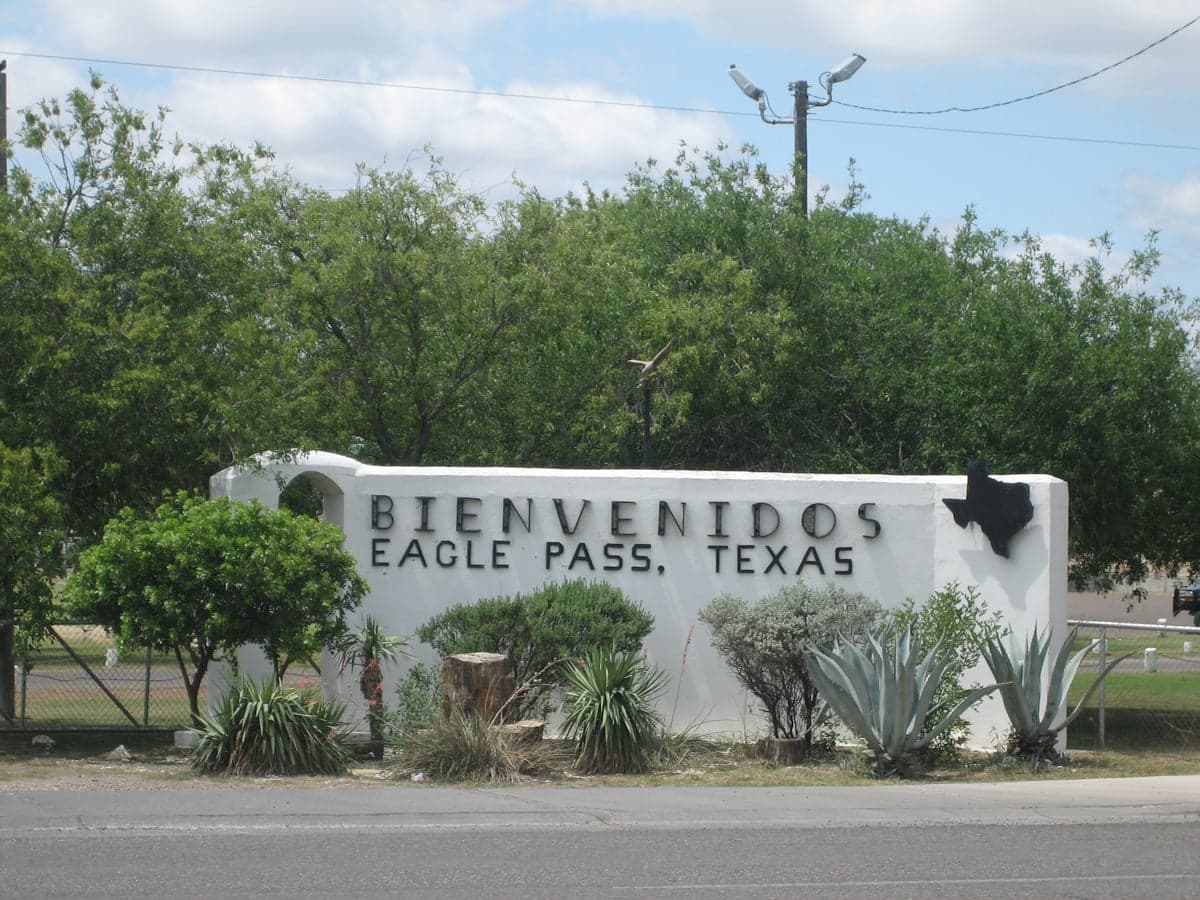
The people of Eagle Pass, Texas, today form a densely Hispanic community of 28,186 residents, with 95.5% identifying as Hispanic or Latino, a 15.0% foreign-born population, and a notably low 3.5% non-Hispanic white share. The city’s identity is deeply shaped by its position as a major border crossing and a historic ranching and trade hub, giving it a bicultural character distinct from inland Texas towns. With a college attainment rate of 23.2%, the workforce leans toward trade, logistics, and public service, and the population is younger than the national median. This is a place where family networks, cross-border ties, and a strong sense of local heritage define daily life.
How the city was settled and grew
Eagle Pass was founded in 1849 as a U.S. Army post, Camp Eagle Pass, established to protect the international boundary after the Mexican-American War. The first permanent settlers were Anglo-American traders and soldiers, but the population quickly shifted as Mexican families crossed the Rio Grande to work on sprawling ranches and in the emerging coal mining industry in the late 1800s. The arrival of the railroad in the 1880s cemented Eagle Pass as a commercial gateway, drawing a wave of Mexican laborers and merchants who built the city’s earliest Hispanic neighborhoods. Historic downtown, centered around Main Street and the international bridge, became the commercial and social heart for these early Mexican-American families, while the Rosita Valley area to the south developed as a working-class enclave of ranch hands and miners. By the early 20th century, the city’s population was overwhelmingly Mexican-American, with a small Anglo elite living in the Pueblo Nuevo district, a neighborhood of larger homes near the old fort grounds. The mid-20th century saw steady growth as agricultural and border trade expanded, but the population remained ethnically stable through the 1960s.
Modern era (post-1965)
After the 1965 Hart-Cellar Act ended national-origin quotas, Eagle Pass experienced a surge in immigration from northern Mexico, particularly from Coahuila and Nuevo León, as family reunification policies took effect. This wave settled heavily in the Las Quintas neighborhood, a newer residential area on the city’s west side that grew rapidly in the 1970s and 1980s with modest single-family homes. The 1990s and 2000s brought a second domestic in-migration wave: Anglo retirees and second-home buyers from the Midwest and Texas Hill Country, drawn by the low cost of living and the Rio Grande’s recreational appeal. These newcomers concentrated in the Eagle Pass Country Club area and the El Indio Highway corridor, where gated subdivisions and golf-course lots appeared. However, the overall racial composition remained overwhelmingly Hispanic—95.5% today—as the Anglo share dropped from roughly 10% in 1990 to 3.5% by 2020. The Black population (0.3%) and East/Southeast Asian population (0.5%) remain negligible, and the Indian-subcontinent share is effectively zero. The foreign-born share of 15.0% is lower than many border cities, reflecting a population that is largely multigenerational Mexican-American rather than recent immigrant.
The future
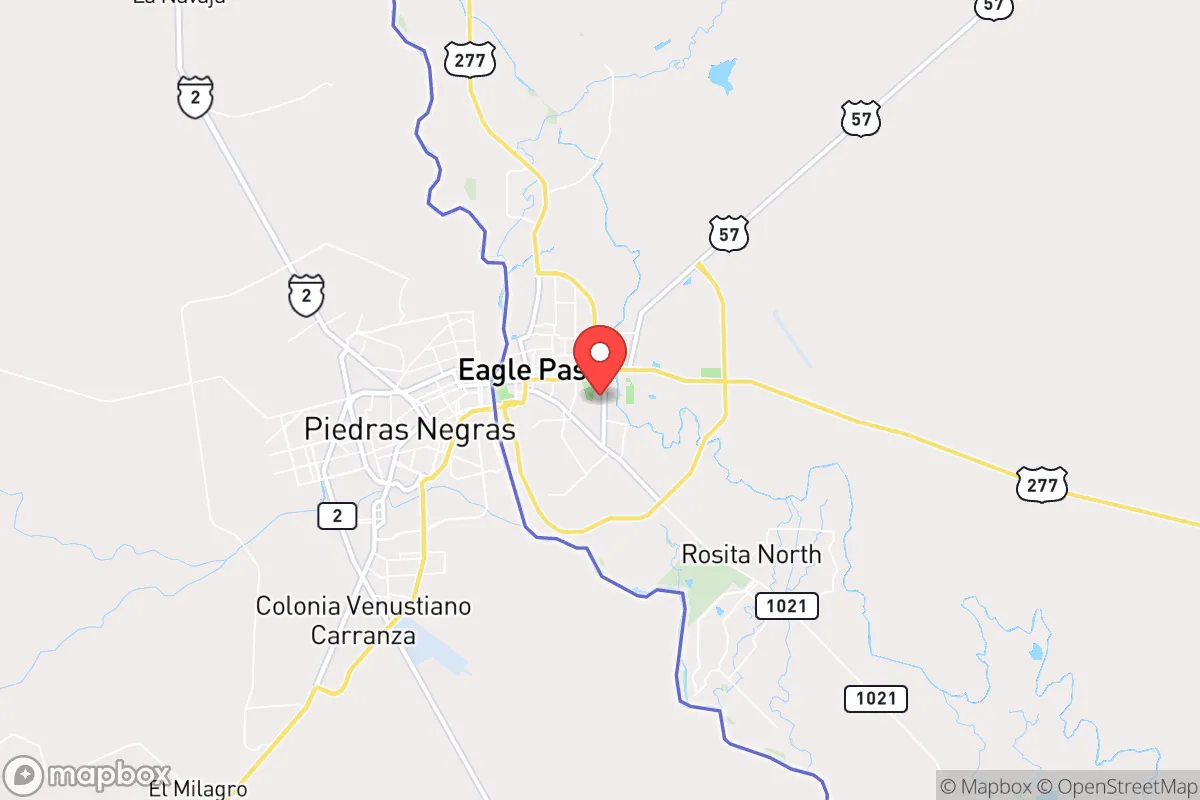
Eagle Pass’s population is projected to grow modestly, driven by continued cross-border trade and the expansion of the Port of Entry, which employs thousands. The city is becoming slightly more diverse at the margins: the small East/Southeast Asian population, mostly Vietnamese and Filipino families working in healthcare and logistics, is slowly growing in the North Eagle Pass area near the new hospital. The Anglo share is likely to remain low, as retirees are increasingly priced out by rising home values along the river. The Hispanic majority is expected to persist above 90%, but the cultural identity is evolving: younger residents are more bilingual and more connected to both U.S. and Mexican media, creating a hybrid border identity that is less tied to either country’s national politics. The next 10-20 years will likely see continued suburban-style development on the city’s northern and western edges, with new subdivisions like Los Sauces attracting young families from both Eagle Pass and Piedras Negras, Mexico, further blurring the line between the two cities.
For someone moving in now, Eagle Pass offers a stable, family-oriented community where Spanish is heard as often as English, and where the economy is anchored by the border crossing rather than by tech or oil. The population is not becoming more diverse in the national sense, but it is becoming more economically stratified, with new gated communities sitting alongside older colonias. Newcomers should expect a tight-knit, culturally conservative environment where local politics and daily life are inseparable from the international boundary.

* Values derived from national, state, county, city and local statistics and may differ in a specific area. Last updated: 2026-11-11T04:03:54.000Z
Narrative content on this page is AI-generated and may contain mistakes. Verify any details that matter before acting on them.
ReloMaps may earn a commission from affiliate links at no extra cost to you.

