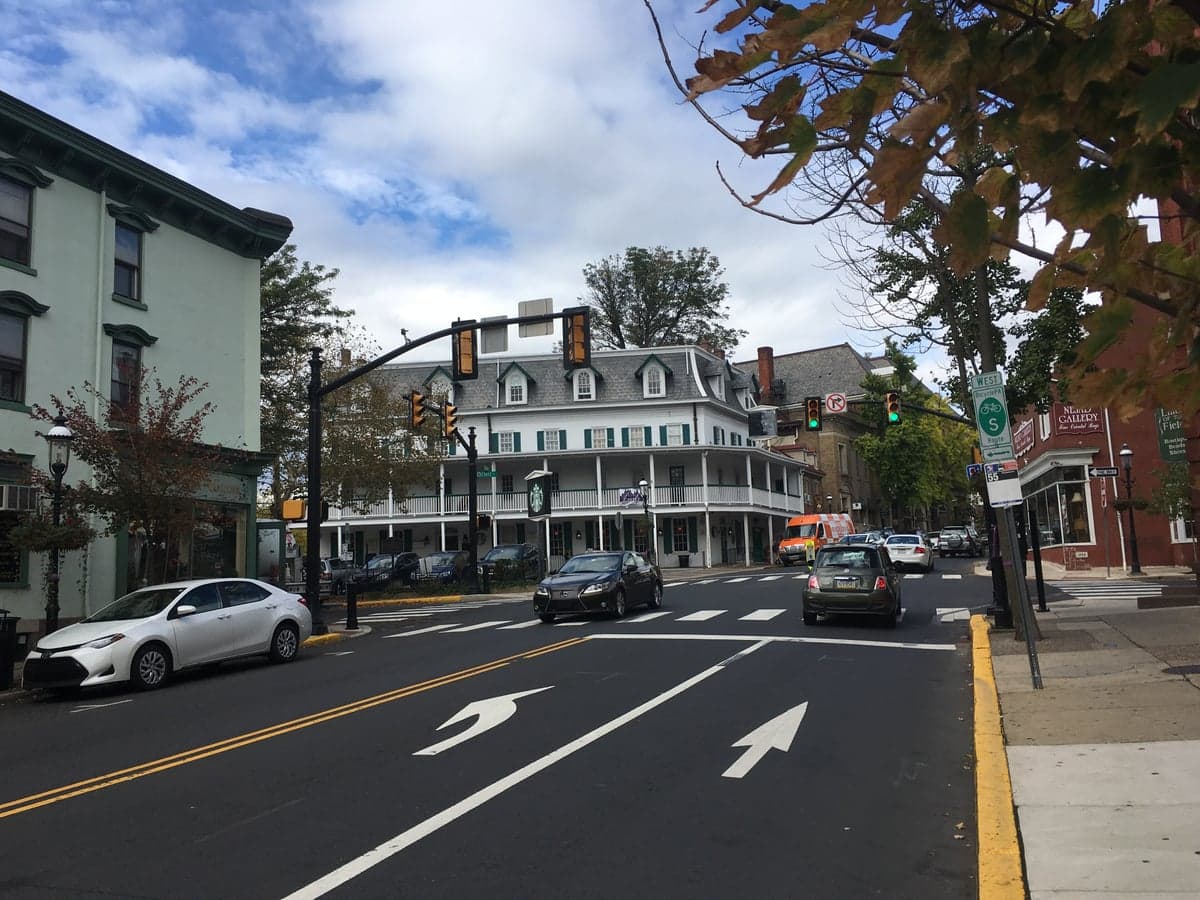
Photo: Wikipedia
Political ClimatePolitical Climate in Doylestown, PA
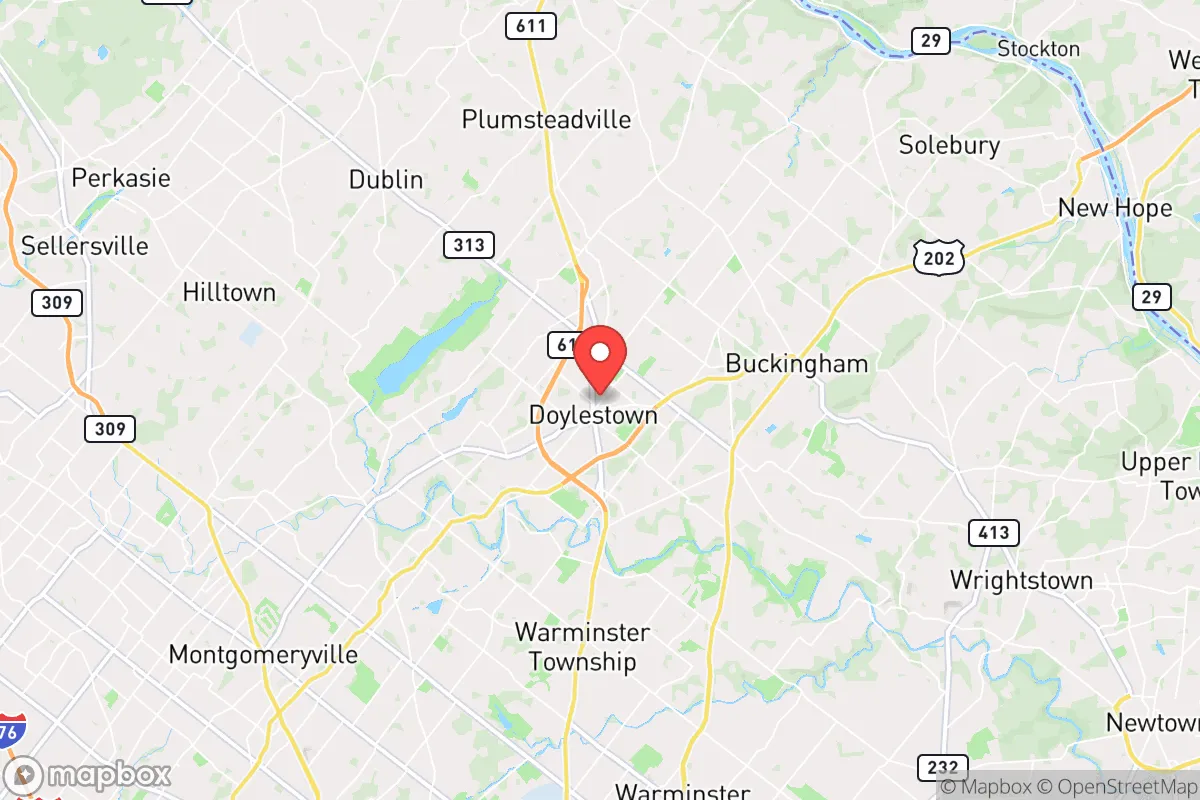
District shown is the primary district for this city’s centroid. Cities may span multiple districts.
Local Political AnalysisPolitical Analysis of Doylestown, PA
Doylestown has shifted from a reliably conservative stronghold to a politically competitive battleground, now carrying a Cook Partisan Voting Index (PVI) of D+1. That means the borough leans just slightly more Democratic than the nation as a whole, a notable change from even a decade ago when local elections were often decided in Republican primaries. The surrounding state of Pennsylvania holds a PVI of EVEN, making Doylestown a touch more Democratic than the state average, though the real story is in the margins—this is a place where a few hundred votes can flip a precinct from red to blue.
How it compares
Drive ten minutes west to Chalfont or New Britain Township, and you'll find reliably Republican turf where Trump won by double digits in 2020. Head east into Buckingham Township, and the vote splits nearly evenly, mirroring Doylestown's own internal divide. The borough itself is a classic example of the suburban shift seen across the Philadelphia collar counties: college-educated professionals and younger families moving in from the city have pulled the electorate left, while longtime residents and the surrounding farm country remain conservative. In the 2022 gubernatorial race, Democrat Josh Shapiro carried Doylestown by a comfortable margin, while Republican Mehmet Oz narrowly won the borough in the Senate race—a split that captures the area's ticket-splitting tendencies. Compared to Pennsylvania as a whole, Doylestown is less influenced by the rural-urban divide that defines much of the state; it's more like the inner-ring suburbs of Philadelphia than the coal country of Luzerne County or the farmlands of Lancaster.
What this means for residents
For conservative residents, the political shift means they can no longer take local elections for granted. School board and borough council races are now genuinely contested, with both parties fielding candidates and spending money. For liberal residents, it means their vote finally carries weight, but they still face a community where many neighbors hold traditional values. The practical effect is a politics of moderation: candidates who want to win in Doylestown have to appeal to the center, avoiding the extremes of either party. You'll see Republicans emphasizing fiscal responsibility and public safety rather than culture war issues, and Democrats focusing on downtown revitalization and infrastructure rather than progressive social policies. The borough's small size—roughly 8,000 residents—means that local politics remains personal; you might disagree with your council member on national issues but still work with them on the new park project.
Culturally, Doylestown's political evolution has made it a place where both sides can find community. The annual Pride festival draws large crowds and has become a fixture, while the Central Bucks School District still holds moments of silence before meetings and has a strong FFA program. The borough's historic downtown, with its independent bookstores and farm-to-table restaurants, attracts a more liberal crowd, but the county courthouse and the nearby VFW hall remain gathering spots for conservatives. What sets Doylestown apart from many similarly sized towns is that the political divide hasn't turned hostile—yet. People still shop at the same grocery stores and cheer for the same high school teams. The trajectory suggests the borough will continue to inch leftward as more Philadelphia commuters arrive, but the surrounding townships will keep it from becoming a liberal island. For now, Doylestown offers a rare thing in 2026: a place where your vote actually matters and your neighbor's vote still feels like a conversation, not a declaration of war.

State Political ClimatePolitical Climate in Pennsylvania
State Political AnalysisPolitical Environment in the State
Pennsylvania is the ultimate swing state, holding a Cook PVI of EVEN, meaning it votes almost exactly in line with the national average. Over the last 20 years, it has shifted from a reliably blue firewall in presidential elections to a true battleground, flipping from Obama in 2008 and 2012 to Trump in 2016, then back to Biden in 2020, and remaining a razor-thin toss-up in 2024. The state’s political soul is split between the heavily populated, union-heavy, and increasingly diverse southeast (Philadelphia and its collar counties) and the vast, more culturally conservative expanse of central and western Pennsylvania, anchored by the former industrial powerhouse of Pittsburgh.
Urban vs. rural divide
The political map of Pennsylvania is a textbook study in the urban-rural chasm. Philadelphia County consistently delivers margins of 75-80% for Democrats, making it the single biggest driver of the state’s blue vote. Its affluent, educated suburbs—places like Montgomery County and Bucks County—have shifted sharply left over the past decade, turning from classic swing suburbs into solid Democratic strongholds. On the other side, the vast rural and exurban regions, including the northern tier along the New York border and the south-central counties like York and Franklin, vote Republican by 60-70% margins. The real battleground is the "T" in the middle: the old industrial and coal country stretching from Scranton and Wilkes-Barre in the northeast, down through the Lehigh Valley (Allentown, Bethlehem), and west across the rust-belt towns like Erie and Beaver County. These areas, once reliably blue due to labor unions, have been trending red for a decade, driven by cultural and economic populism. Pittsburgh itself is a blue island in a red sea, but its suburbs are more mixed than Philly’s, with some like Washington County staying reliably red.
Policy environment
Pennsylvania’s policy environment is a direct reflection of its divided government. The state has a flat income tax rate of 3.07%, which is relatively low and popular with conservatives, and a sales tax of 6% (higher in Philadelphia at 8%). Property taxes are a major pain point, among the highest in the nation, and a perennial source of debate. The regulatory posture is moderate; it’s not Texas, but it’s not California either. On education, the state has a patchwork of strong public schools in wealthy suburbs and struggling districts in rural and urban areas, with a growing charter school movement that has bipartisan support but fierce opposition from teachers' unions. Healthcare is a mixed bag: the state expanded Medicaid under the ACA, but private insurance markets are competitive. Election laws are a flashpoint: Pennsylvania has no-excuse mail-in voting (passed with bipartisan support in 2019), but it also has strict voter ID requirements for first-time voters and a contentious debate over drop boxes and ballot curing. The state is a perennial battleground for election integrity lawsuits.
Recent policy direction
The last few years have seen Pennsylvania lurch in both directions, depending on which party holds the governor's mansion. Under Democratic Governor Josh Shapiro, the state has moved left on some fronts while remaining gridlocked on others. On gun and self-defense law, Pennsylvania is a "shall-issue" state for concealed carry, with no permit required for open carry (except in Philadelphia). However, there is no preemption law, meaning Philadelphia and Pittsburgh have passed their own restrictions, including bans on assault weapons and large-capacity magazines, which are currently being litigated. On parental and education rights, the state has seen fierce battles over school library books and curriculum transparency, with several conservative-leaning school boards in places like Central Bucks and York County passing parental notification policies. On speech and privacy, Pennsylvania has no broad privacy law like the GDPR, but it does have a strong wiretapping law requiring two-party consent. On medical and bodily autonomy, abortion remains legal up to 24 weeks, and Governor Shapiro has pledged to veto any further restrictions, making it a relative safe haven in the region compared to Ohio or West Virginia. On property rights, the state has no statewide rent control, but Philadelphia has its own ordinance. On taxation, there is a growing push for property tax relief, but no major overhaul has passed. On voting and ballot access, the state has expanded mail-in voting but also seen controversies over the "undated ballot" issue, with courts split on whether ballots with missing or incorrect dates should be counted.
Civil unrest & political movements
Pennsylvania has been a hotbed of political activism on both sides. The 2020 election aftermath saw massive "Stop the Steal" rallies in Harrisburg and outside the state capitol, as well as dueling protests in Philadelphia. The state has a strong and visible Second Amendment movement, with regular gun rights rallies at the capitol. On the left, the Black Lives Matter protests in Philadelphia in 2020 were large and occasionally violent, leading to a lasting debate over policing and public safety. Immigration politics are less heated than in border states, but Philadelphia is a self-declared "sanctuary city," which has become a flashpoint in state-level politics, with Republican legislators pushing for a ban on such policies. There is no serious secession movement, but there is a persistent rural-urban cultural divide that manifests in talk of splitting the state into two, though it remains fringe. Election integrity remains a live issue, with ongoing litigation over voting machines, drop boxes, and the role of the state Supreme Court, which has a 5-2 Democratic majority.
Projection
Over the next 5-10 years, Pennsylvania is likely to remain a toss-up, but the demographic trends favor a slow shift to the left. The Philadelphia suburbs are getting bluer and more diverse, while the rural areas are getting older, whiter, and redder. The wild card is the in-migration pattern: the state is not seeing the explosive growth of Texas or Florida, but it is attracting some remote workers from New York and New Jersey, who tend to be more liberal. The old industrial towns in the "T" are still losing population, which hurts the Democratic coalition. If current trends hold, the state could become a lean-Democratic state by the early 2030s, but it will never be safe for either party. A new resident moving in now should expect a state that is perpetually contested, with divided government as the norm, meaning policy will continue to be a patchwork of compromises and gridlock.
For a new resident, the bottom line is that Pennsylvania offers a genuine swing-state experience. If you are conservative, you will find strong communities in the rural areas and exurbs, but you will be living under a state government that is often controlled by Democrats, especially on social issues like abortion and gun control. If you are liberal, you will find a welcoming environment in Philadelphia and Pittsburgh, but you will have to contend with a state legislature that is often Republican-controlled and hostile to your priorities. The practical takeaway is that your daily life will be shaped more by your local county and municipality than by the state as a whole. Choose your town carefully, because in Pennsylvania, the political climate varies more by zip code than almost anywhere else in the country.
* Values derived from national, state, county, city and local statistics and may differ in a specific area. Last updated: 2026-09-27T19:28:49.000Z
Narrative content on this page is AI-generated and may contain mistakes. Verify any details that matter before acting on them.
ReloMaps may earn a commission from affiliate links at no extra cost to you.

