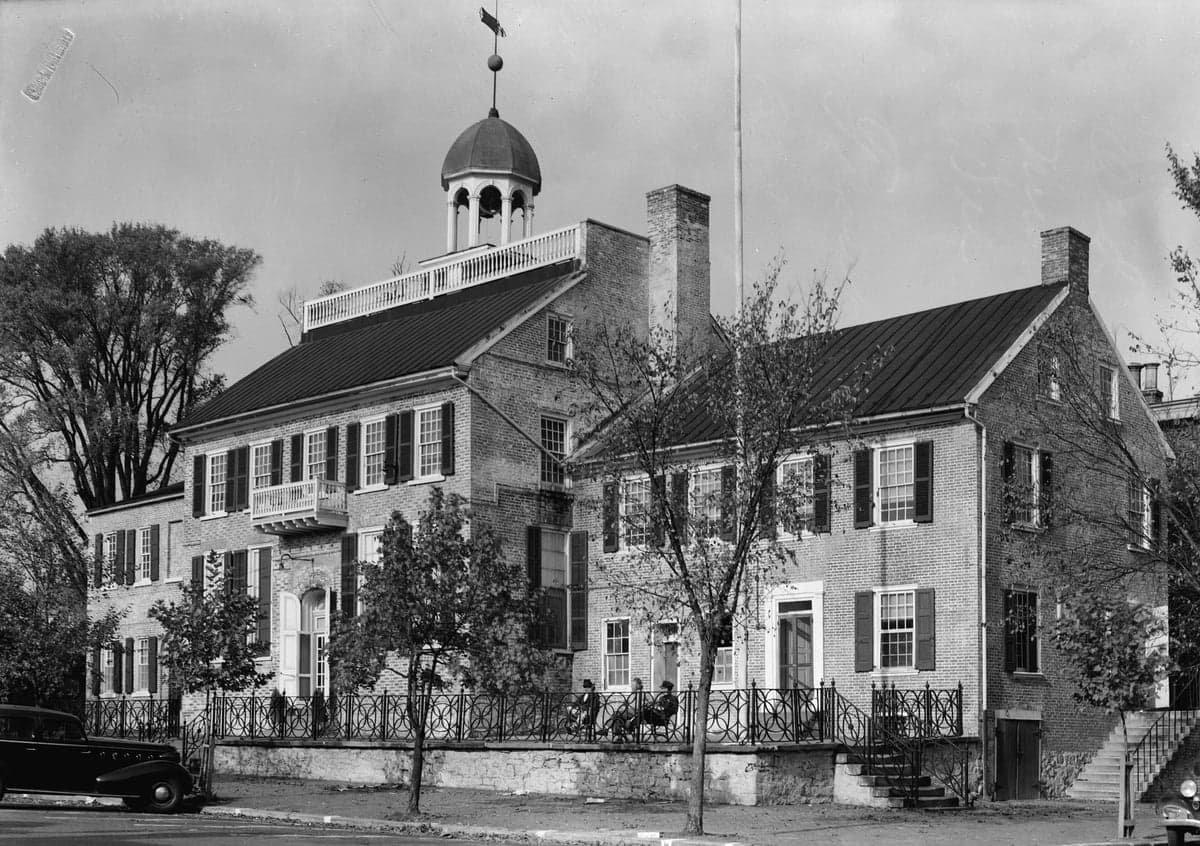
Photo: Wikipedia
Demographics of New Castle County
Affluence Level in New Castle County
A middle-class area roughly in line with national averages across income, home values, education, and employment.
People of New Castle County
The people of New Castle County, Delaware, today form a densely populated, racially and economically diverse community of 573,030 residents, anchored by the city of Wilmington and stretching south through a corridor of suburbs and exurbs toward the Maryland line. The county is the state's urban and commercial core, home to nearly 60 percent of Delaware's total population, yet it retains a distinctive identity shaped by centuries of layered migration — from colonial Dutch and Swedish settlers to 20th-century industrial workers and post-1965 immigrants from Latin America, East Asia, and the Indian subcontinent. With a foreign-born share of just 5.6 percent — lower than the national average — New Castle County is less a gateway for new arrivals than a mature, settled region where demographic change has come gradually through both domestic migration and family-based immigration. The county's character today is defined by its mix of historic river towns, sprawling postwar suburbs, and a growing professional class tied to Wilmington's finance and legal sectors, alongside persistent economic divides between the city and its surrounding communities.
Settlement & growth (pre-1960)
Long before European arrival, the area now known as New Castle County was home to the Lenape people, who lived in seasonal villages along the Delaware River and its tributaries, including the Christina River and Brandywine Creek. The Lenape called the region Poutaxat, and their trails and trading paths later became the routes of colonial roads. The first European settlement came in 1638, when Swedish colonists established Fort Christina at the site of present-day Wilmington, making it the first permanent European settlement in the Delaware Valley. The Dutch seized control in 1655, and the English took over in 1664, renaming the settlement New Castle and making it the colonial capital of the Delaware territories. The county's name itself derives from the English Duke of York's reorganization of the region in the 1660s.
Through the 18th and early 19th centuries, the population grew slowly, dominated by English, Scots-Irish, and German farmers who spread across the fertile Piedmont plain. The towns of Newark and Middletown emerged as agricultural market centers, while New Castle remained a small port and administrative hub. The real transformation began in the early 19th century with the rise of the du Pont family's gunpowder mills along Brandywine Creek, which drew skilled laborers — many of them Irish and German immigrants — to the area around present-day Greenville and Wilmington. By 1850, Wilmington had become a manufacturing city, with shipbuilding, ironworks, and textile mills attracting waves of Irish immigrants fleeing the Great Famine, followed by German and later Italian immigrants in the late 19th and early 20th centuries.
The Great Migration of African Americans from the rural South reshaped Wilmington's population between 1910 and 1960. Black families moved north for industrial jobs in the city's shipyards, chemical plants, and railroad yards, settling primarily in Wilmington's East Side and Southbridge neighborhoods. By 1960, Wilmington's population was roughly 40 percent Black, while the surrounding suburbs remained overwhelmingly white. The county's industrial base also drew Polish, Ukrainian, and Jewish immigrants to Wilmington and the mill towns of Claymont and Edgemoor in the early 20th century, creating dense ethnic neighborhoods that persisted through the mid-century. The post-World War II boom brought a new wave of domestic migrants — white families from Philadelphia and the urban Northeast — who moved into the newly built suburbs of Pike Creek, Bear, and Glasgow, accelerating the suburbanization that would define the county's modern geography.
Modern era (post-1965)
The 1965 Hart-Cellar Act opened the door to new immigration streams that gradually reshaped New Castle County's ethnic composition, though the county's foreign-born share remains modest compared to major gateway cities. The most significant post-1965 change has been the growth of the Hispanic population, which now stands at 11.4 percent of the county's residents. This community is predominantly of Mexican, Puerto Rican, and Central American origin, with the largest concentrations in Wilmington's West Side and the suburban corridor along U.S. Route 40 in Bear and Glasgow. Many arrived initially for work in construction, landscaping, and the poultry processing plants of southern New Castle and neighboring Kent County, and the community has since diversified into small business ownership and service-sector employment.
The Black population, at 24.6 percent, remains the county's largest non-white group, but its geographic distribution has shifted significantly since 1960. Middle-class Black families have moved from Wilmington's historic East Side into suburbs such as Middletown, Newark, and Bear, creating a more suburbanized Black population. Middletown, in particular, has seen substantial growth among Black professionals drawn to newer housing and strong schools, making it one of the most racially integrated communities in the county. Wilmington itself has become poorer and more racially isolated, with a poverty rate roughly double the county average, while the surrounding suburbs have absorbed much of the region's population growth.
East and Southeast Asian communities, comprising 2.5 percent of the population, are a smaller but visible presence, concentrated in Newark near the University of Delaware and in the corporate corridor along Delaware Route 7. Chinese, Korean, and Vietnamese families have settled here, many drawn by professional opportunities in Wilmington's finance and chemical sectors or by academic ties to the university. The Indian-subcontinent population, at 3.4 percent, is slightly larger and has grown rapidly since the 1990s, with families clustering in Newark, Pike Creek, and the Hockessin area. Many Indian residents work in information technology, engineering, and health care, and the community has established cultural institutions including Hindu temples and Indian grocery stores in the Newark-Pike Creek corridor. Domestic migration from the Rust Belt and the Northeast has continued, with families from Pennsylvania, New Jersey, and New York moving into the southern part of the county — particularly Middletown and Odessa — drawn by lower housing costs and Delaware's favorable tax climate.
The future
New Castle County is projected to become more diverse over the next two decades, though the pace of change will likely remain moderate compared to fast-growing Sun Belt regions. The Hispanic and Indian-subcontinent populations are expected to grow the fastest, driven by both immigration and higher birth rates among younger families. The white population, already a bare majority at 53.5 percent, will continue to decline as a share of the total, while the Black population is likely to remain stable or grow slightly through natural increase and continued suburban migration. The county's overall population is projected to grow slowly — perhaps 5 to 10 percent by 2040 — as development pushes southward into the farmland around Middletown and Townsend, where new subdivisions are already reshaping the landscape.
The cultural identity of the county is evolving from a historically biracial Wilmington-versus-suburbs dynamic into a more complex, multiethnic mosaic. The growing Hispanic and Indian communities are dispersing across the suburban landscape rather than forming dense urban enclaves, which may accelerate integration but also dilute the formation of distinct ethnic neighborhoods. Wilmington's economic struggles and population loss — the city has shrunk from a peak of 112,000 in 1960 to roughly 71,000 today — will continue to shape the county's character, as the suburban majority increasingly sets the political and cultural tone. The county is likely to become more politically moderate over time, as growing diversity and in-migration from the Northeast shift the electorate leftward, though the southern exurbs may remain more conservative.
For someone moving to New Castle County now, the region offers a settled, mature suburban environment with good schools, a strong job market anchored by finance and health care, and a gradually diversifying population that is still predominantly native-born. The county is not a high-growth frontier or a rapidly changing gateway; it is a place where demographic change comes incrementally, where newcomers are absorbed into established communities, and where the biggest question is not who is arriving but how the county's historic divides — between city and suburb, between old industry and new economy, between the Delaware River towns and the Piedmont interior — will be resolved in the decades ahead.

* Values derived from national, state, county, city and local statistics and may differ in a specific area. Last updated: 2026-06-17T15:01:38.000Z
Narrative content on this page is AI-generated and may contain mistakes. Verify any details that matter before acting on them.
ReloMaps may earn a commission from affiliate links at no extra cost to you.

