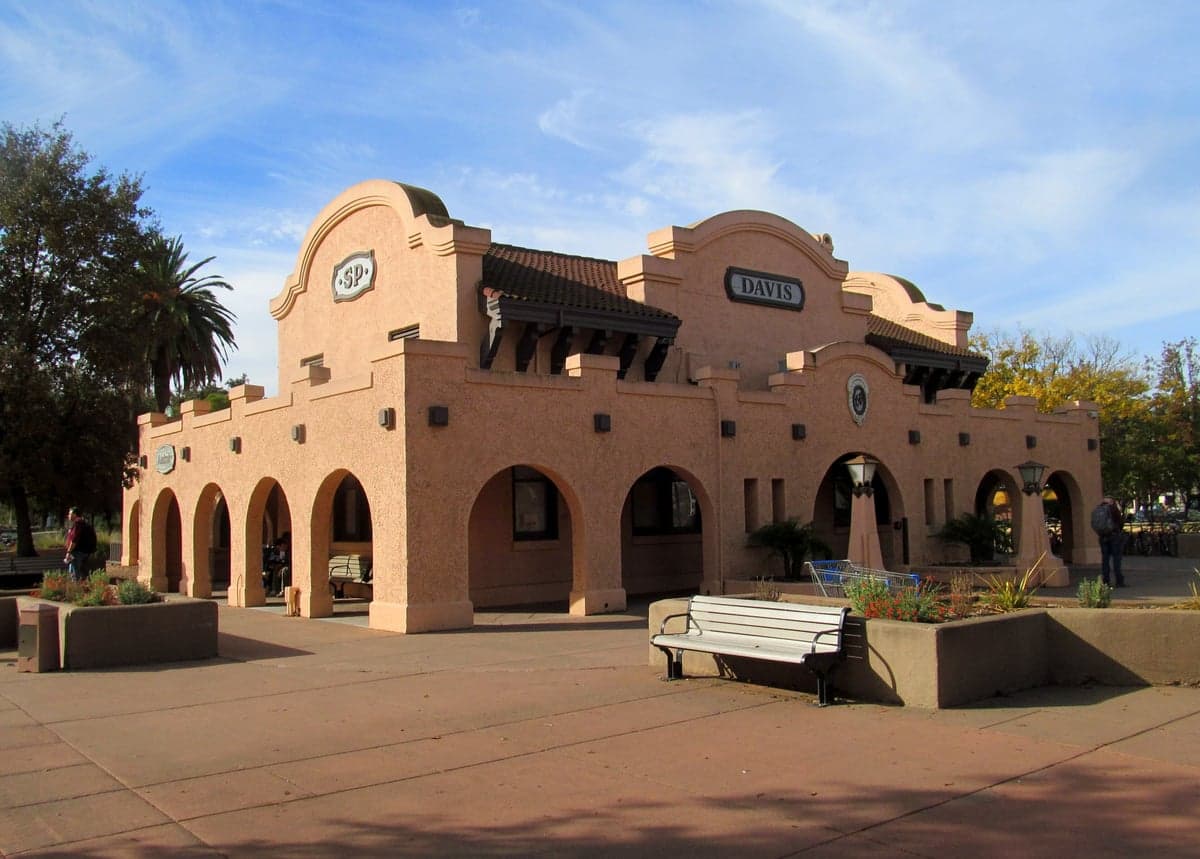
Photo: Wikipedia
Political ClimatePolitical Climate in Davis, CA
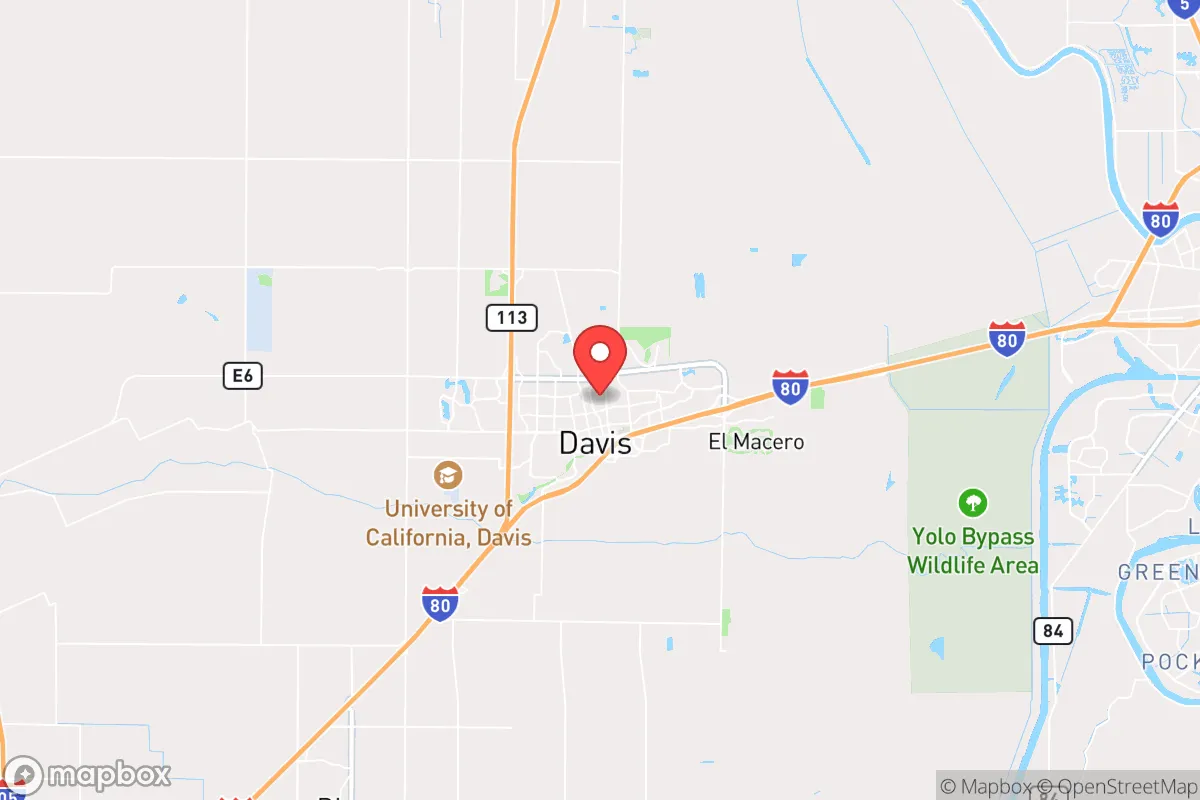
District shown is the primary district for this city’s centroid. Cities may span multiple districts.
Lean and PVI are calculated from Davis, CA’s own 2020 and 2024 presidential results, Cook-style. Sources: state election offices; VEST 2020 precinct results (CC BY 4.0).
Political rankings in California
- Most Conservative Cities in California
- Most Liberal Cities in California
- Best Conservative-Leaning Towns on the West Coast
- Affordable Small Towns for Conservatives
- Most Affordable Liberal-Leaning Small Towns in the U.S.
- Safest Liberal-Leaning Cities in the U.S.
- Most Conservative Counties in California
- Most Liberal Counties in California
Local Political AnalysisPolitical Analysis of Davis, CA
Davis is one of the most reliably liberal cities in California, with a Cook Partisan Voting Index (PVI) of D+19, meaning it votes about 19 points more Democratic than the national average. In practice, this makes Davis a deep-blue island in Yolo County, surrounded by more moderate or conservative areas like Woodland and Dixon to the north and east, and the more evenly split Sacramento suburbs to the south. The city’s trajectory has been steadily leftward since the 1990s, driven by the University of California, Davis, which anchors the local economy and culture. While the surrounding state of California as a whole leans Democratic (roughly D+13 in recent presidential elections), Davis is significantly more progressive, often outpacing even San Francisco in per-capita Democratic vote share.
How it compares
Compared to California at large, Davis is a political outlier even within a blue state. The state’s Cook PVI is not officially calculated, but based on 2020 and 2024 results, it sits around D+13 to D+15. Davis’s D+19 puts it in the same league as Berkeley or Santa Monica, not just Sacramento. The contrast with nearby cities is stark: Woodland, just 10 miles north, leans D+5, while Dixon and Vacaville to the east are closer to R+5 or R+8. This means a Davis resident driving 15 minutes east can go from a city where Bernie Sanders won 60% of the primary vote to one where Trump got 55% of the general vote. The university is the main driver—faculty, staff, and students consistently push local elections left, while the agricultural communities around Davis vote more conservatively.
What this means for residents
For liberal residents, Davis offers a comfortable political environment where progressive policies on housing, climate, and social justice are the norm. The city council has passed rent control measures, a “Green New Deal” resolution, and strong tenant protections, often without serious opposition. Conservative residents, however, are a clear minority—typically around 15-20% of the vote in local elections. They report feeling politically isolated, especially in city council races where candidates often run unopposed or face only token challengers. That said, the county government in Yolo is more mixed, and conservative voices have more sway on issues like agricultural land use and water rights. The practical effect is that Davis feels like a bubble: intensely progressive on campus and in downtown, but surrounded by a region that is more politically diverse.
One cultural distinction is the city’s strong bicycle and environmental ethos, which is tied to its political identity. Davis has some of the highest bike-commute rates in the nation, and local policies prioritize bike lanes and transit over car infrastructure—a reflection of its progressive governance. Another is the influence of the university on local discourse: debates over free speech, diversity initiatives, and housing affordability are constant, often more intense than in other California cities of similar size. For newcomers, the key takeaway is that Davis is not a purple city—it’s a deep-blue one where political homogeneity is the norm, and where the main political friction is between different shades of progressivism rather than between left and right. If you’re looking for a place where your vote truly counts in a competitive sense, this isn’t it; but if you want a community where progressive values are baked into daily life, Davis delivers.

State Political ClimatePolitical Climate in California
State Political AnalysisPolitical Environment in the State
California is a deeply blue state where Democrats hold every statewide office and supermajorities in both legislative chambers, but that monolithic label hides a far more complicated reality. The state hasn’t voted Republican in a presidential race since 1988, and its partisan lean has only grown more lopsided over the past two decades—from a roughly 10-point Democratic margin in 2000 to a 30-point margin in 2024. Yet this dominance is driven almost entirely by a handful of coastal megacities, while vast inland regions have swung hard in the opposite direction, creating one of the most politically polarized landscapes in the country.
Urban vs. rural divide
The political map of California is essentially a battle between the coast and the interior. The San Francisco Bay Area and Los Angeles County alone account for roughly half the state’s Democratic votes, with San Francisco itself delivering 85% of its vote to Joe Biden in 2020. The Central Valley, by contrast, has been trending red for a decade: Kern County (Bakersfield) voted +16 for Trump in 2024, up from +11 in 2016. The Inland Empire—Riverside and San Bernardino counties—is the state’s true battleground, flipping from blue to purple as working-class Latino and white voters shift right. Orange County, once a Republican stronghold, flipped blue in 2018 and has stayed there, but its northern suburbs like Yorba Linda and Huntington Beach remain conservative holdouts. The real story is the rural exodus from the Democratic coalition: counties like Shasta (Redding), Sutter, and Tehama now vote 2-to-1 Republican, and the gap is widening with every cycle.
Policy environment
California’s policy environment is defined by high taxes, heavy regulation, and expansive state government. The state has a progressive income tax with a top marginal rate of 13.3% (the highest in the nation), a 7.25% sales tax floor that local governments can add to, and property taxes capped at 1% of assessed value under Proposition 13. The regulatory posture is among the most aggressive in the country: California sets its own vehicle emissions standards (waived by the EPA), mandates renewable energy targets of 100% clean electricity by 2045, and enforces strict labor laws including a $16.50 minimum wage that rises with inflation. Education policy is centralized in Sacramento, with a per-pupil spending of roughly $23,000—above the national average—but outcomes vary wildly by district. Healthcare is heavily regulated through the state’s individual mandate and Medi-Cal expansion, covering roughly one-third of residents. Election laws are among the most accessible in the nation: universal mail-in ballots, same-day registration, and no-excuse absentee voting are all standard.
Recent policy direction
The last five years have seen California accelerate its progressive agenda across nearly every dimension a relocator might care about. On gun rights, the state passed a 2023 law banning most concealed carry in sensitive places (SB 2) and a 2024 measure requiring microstamping on all new handguns, effectively blocking many models from sale. Parental and education rights saw a major flashpoint in 2023 with AB 1078, which prohibits school boards from banning books or curricula that discuss race, gender, or sexuality—a direct response to conservative school board takeovers in places like Temecula and Chino Valley. On speech, the state’s 2022 anti-SLAPP law was strengthened, but a 2024 bill (AB 2655) targeting election-related deepfakes has raised free speech concerns. Privacy and surveillance saw the California Privacy Rights Act (CPRA) take full effect in 2023, giving residents broad control over data collection. Medical and bodily autonomy is protected by a 2022 constitutional amendment enshrining abortion and contraception rights, while a 2024 law (SB 525) raised healthcare worker minimum wages to $25/hour. Property rights remain constrained by the California Environmental Quality Act (CEQA), which opponents use to block housing and infrastructure projects. On taxation, a 2024 ballot measure (Proposition 5) to lower the supermajority requirement for local housing bonds failed, keeping the status quo. Voting access expanded further with 2023’s AB 1220, which requires counties to offer ballot drop boxes in every municipality.
Civil unrest & political movements
California has been a national epicenter for political movements on both sides. The 2020 George Floyd protests in Los Angeles and Oakland were among the largest and most destructive in the country, leading to billions in property damage and a lasting shift in public safety politics. The 2021 recall election against Governor Gavin Newsom, fueled by pandemic lockdown fatigue and small-business closures, saw 48% of voters support removal—a surprisingly close call in a deep-blue state. Immigration politics remain a constant flashpoint: California’s 2017 sanctuary state law (SB 54) limits local law enforcement cooperation with ICE, and the state has sued the Trump administration multiple times over border policies. Secession rhetoric has cooled since the 2016-2020 “Calexit” movement, but a 2024 poll found 32% of Republicans still support some form of state breakup. Election integrity controversies flared in 2020 when the state’s universal mail-in system was implemented overnight, but subsequent audits found no evidence of widespread fraud. Visible flashpoints for a new resident include regular protests at the state capitol in Sacramento, competing rallies at Los Angeles City Hall, and the annual “Freedom Week” gatherings in rural counties like Modoc and Siskiyou.
Projection
Over the next 5-10 years, California’s political trajectory points toward continued Democratic dominance at the state level, but with growing internal fractures. Demographic shifts are working against the progressive coalition: the state’s population has declined for four consecutive years (2020-2024), driven largely by out-migration of working-age families to Texas and Arizona, while international immigration keeps the overall numbers stable. The Latino electorate, which made up 30% of voters in 2024, is trending right—especially among men and in the Central Valley—which could flip a handful of congressional seats in places like Bakersfield and the Inland Empire. The housing crisis is the wild card: if the state fails to build enough units, the exodus of moderate and conservative-leaning residents will accelerate, making the remaining electorate even more liberal. A new resident moving in now should expect a state where the political center of gravity continues to shift left on social and environmental issues, but where economic pressures—taxes, housing costs, and regulatory burdens—will remain the dominant concerns for most people.
For a conservative-leaning relocator, the bottom line is that California offers a high-cost, high-regulation environment where your political views will be in the minority at the state level, but where you can find like-minded communities in places like Huntington Beach, Temecula, or Bakersfield. For a liberal relocator, the state delivers on policy promises—strong labor protections, environmental leadership, and social safety nets—but at a price that is increasingly unaffordable for all but the wealthy. The practical takeaway is that California is not a single political entity; it’s a collection of regions that are growing more distinct with every election, and your experience will depend almost entirely on which one you choose to call home.
* Values derived from national, state, county, city and local statistics and may differ in a specific area. Last updated: 2026-11-23T15:21:31.000Z
Narrative content on this page is AI-generated and may contain mistakes. Verify any details that matter before acting on them.
ReloMaps may earn a commission from affiliate links at no extra cost to you.

