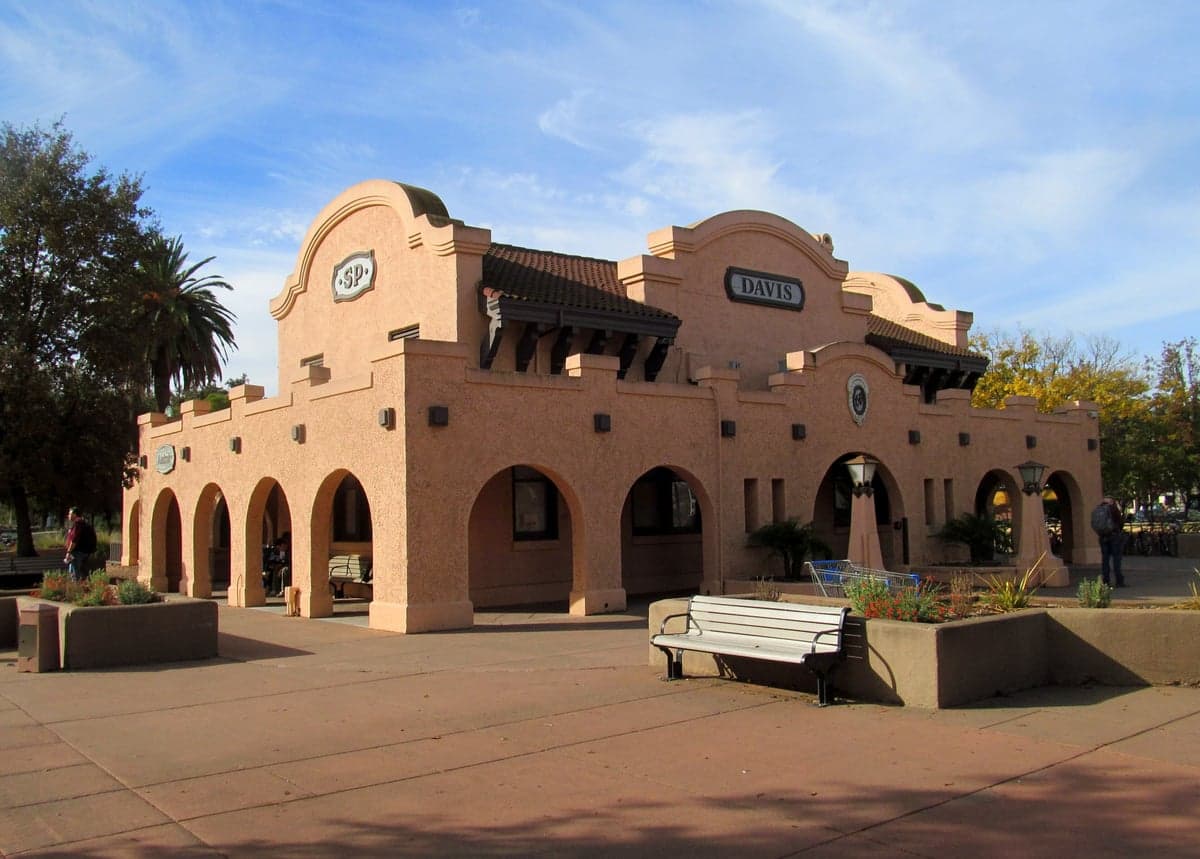
Photo: Wikipedia
Personal Sovereignty in Davis, CA
Viable for self-reliance. Generally workable, though some barriers may limit total independence.
What does Personal Sovereignty tell us?
Personal Sovereignty measures your capacity for self-reliance and independence with minimal government friction. Higher scores mean fewer barriers between you and the way you want to live... but it assumes you have the space you need and good neighbors.
What does this tell us?
Personal Sovereignty measures your capacity for self-reliance and independence with minimal government friction. Higher scores mean fewer barriers between you and the way you want to live... but it assumes you have the space you need and good neighbors.
State Policy
Energy independence: Importer (25% of energy produced in-state)
Personal Liberty
Homesteading

Personal Liberty Analysis
Davis, California, presents a complex environment for personal sovereignty, where a strong local culture of progressive governance and dense university-town living creates a regulatory atmosphere that is notably heavier than in many other parts of the state, let alone the country. While the city offers certain lifestyle amenities, individuals and families who prioritize autonomy, self-reliance, and minimal government intrusion will find significant friction points, particularly around housing, land use, and personal liberties. The overall sovereignty picture in Davis is constrained by both state-level mandates and a local political climate that actively shapes daily life through ordinances and zoning, making it a place where personal freedom often requires navigating a thicket of rules.
Tax burden and regulatory posture in Davis and Yolo County
California’s high tax burden is a given, and Davis sits squarely within that framework. The state’s top marginal income tax rate of 13.3% applies to high earners, and the sales tax rate in Davis is 8.25% (as of 2026), which includes a local add-on. Property taxes are capped by Proposition 13 at roughly 1% of assessed value, but because Davis real estate is expensive—median home prices often exceed $800,000—the actual dollar amount is substantial. The regulatory posture in Davis is distinctly heavy-touch. The city’s General Plan and zoning code are among the most restrictive in the region, with stringent environmental review processes (CEQA) that can delay or kill development projects, including small-scale home additions or ADUs. The city also enforces a robust rental inspection program and has a rent stabilization ordinance for certain properties, adding layers of compliance for landlords. For a homeowner or small business owner, the permitting process for even minor renovations can be slow and costly, reflecting a local government that prioritizes process and community input over individual property rights.
Self-defense and gun law specifics in Davis
California’s gun laws are among the strictest in the nation, and Davis residents must comply fully. The state requires a 10-day waiting period, a Firearm Safety Certificate, and a background check for all firearm purchases. Concealed carry permits (CCWs) are issued by the Yolo County Sheriff’s Office, and while the process is shall-issue after the Bruen decision, the training requirements and fees are higher than in many other states. The city of Davis itself has no additional gun ordinances beyond state law, but the local political climate is strongly anti-gun; the city council has passed symbolic resolutions supporting state-level gun control measures. Open carry of handguns is prohibited, and carrying a loaded firearm in public without a CCW is a felony. For self-defense in the home, state law imposes a duty to retreat if safe to do so, and the "castle doctrine" is limited—you cannot use deadly force unless you reasonably believe it is necessary to prevent imminent death or great bodily injury. Magazine capacity is capped at 10 rounds. For a self-reliant individual, the legal landscape for self-defense in Davis is restrictive, requiring significant compliance effort and limiting the tools available for personal protection.
Self-reliance and homesteading viability: lot sizes, zoning, and off-grid feasibility
Homesteading and off-grid living are essentially non-viable within Davis city limits. The city is built on a grid of small lots—typically 5,000 to 7,000 square feet in older neighborhoods—with strict zoning that prohibits agricultural uses on residential parcels. Keeping chickens is allowed with a permit, but goats, pigs, or larger livestock are prohibited. Backyard vegetable gardens are common, but the city’s water use restrictions and composting rules add layers of regulation. Off-grid systems are effectively illegal: all homes must be connected to the municipal water and sewer system, and solar panels require city permits and must be grid-tied. Rainwater harvesting is allowed but limited to 500 gallons per property without a more complex permit. The city’s Climate Action Plan includes mandates for electric vehicle charging infrastructure and energy efficiency upgrades, which can add costs for homeowners. For those seeking true self-reliance—growing food, generating power, or living with minimal municipal services—Davis is a poor fit. The surrounding unincorporated areas of Yolo County offer slightly more flexibility, but even there, well and septic permits are expensive, and agricultural zoning restricts residential density.
Personal liberties: parental rights, medical autonomy, speech, and property
Personal liberties in Davis are shaped by a progressive consensus that prioritizes community standards over individual autonomy. Parental rights are constrained by state law: California mandates comprehensive sexual health education in public schools, and parents cannot opt their children out of lessons on gender identity or sexual orientation. The Davis Joint Unified School District has implemented policies supporting transgender students, including allowing them to use preferred names and pronouns without parental notification. Medical autonomy is similarly limited: California has strict vaccine mandates for school attendance, and Davis has a strong public health culture that supports these measures. During the COVID-19 pandemic, the city and county imposed some of the longest-lasting mask and business restrictions in the state. Free speech is protected under the First Amendment, but the city’s noise ordinances and permitting requirements for public gatherings can be used to limit spontaneous expression. Property rights are heavily circumscribed by zoning, historic preservation rules, and environmental regulations. For a family that values the ability to make independent decisions about their children’s education, healthcare, or property use, Davis presents a challenging environment where local and state authorities assert significant control.
In the broader context of personal sovereignty, Davis ranks among the more restrictive areas in California, which itself is one of the least sovereignty-friendly states in the nation. Compared to cities in the Central Valley or inland regions of the state, Davis imposes a heavier regulatory burden on housing, land use, and daily life. For a reader who prioritizes autonomy—whether in self-defense, homesteading, or parental decision-making—Davis is likely to feel constraining. The trade-off is a highly educated, walkable community with strong public services, but the price is a significant surrender of personal freedom to collective governance. Those seeking a lighter-touch environment would be better served by looking at unincorporated areas of Yolo County, or at cities in neighboring states like Nevada or Arizona, where tax burdens are lower, gun laws are more permissive, and zoning is less restrictive.

* Values derived from national, state, county, city and local statistics and may differ in a specific area. Last updated: 2026-11-23T15:21:31.000Z
Narrative content on this page is AI-generated and may contain mistakes. Verify any details that matter before acting on them.
ReloMaps may earn a commission from affiliate links at no extra cost to you.

