Photo: Wikipedia
Demographics of Davis, CA
Affluence Level in Davis, CA
An upper-middle-class area. Household wealth, education levels, and homeownership run ahead of national benchmarks.
People of Davis, CA
The people of Davis, California, in 2026 form a highly educated, racially diverse, and politically progressive community of roughly 66,800 residents. The city’s identity is defined by its role as a university town—home to UC Davis—which drives a population that is 75.1% college-educated, a figure among the highest in the state. The population is notably Asian (20.6% East/Southeast Asian), with a separate Indian-subcontinent community (3.3%), alongside a Hispanic population of 15.2% and a White population of 50.9%, creating a demographic mosaic that is both stable and slowly diversifying.
How the city was settled and grew
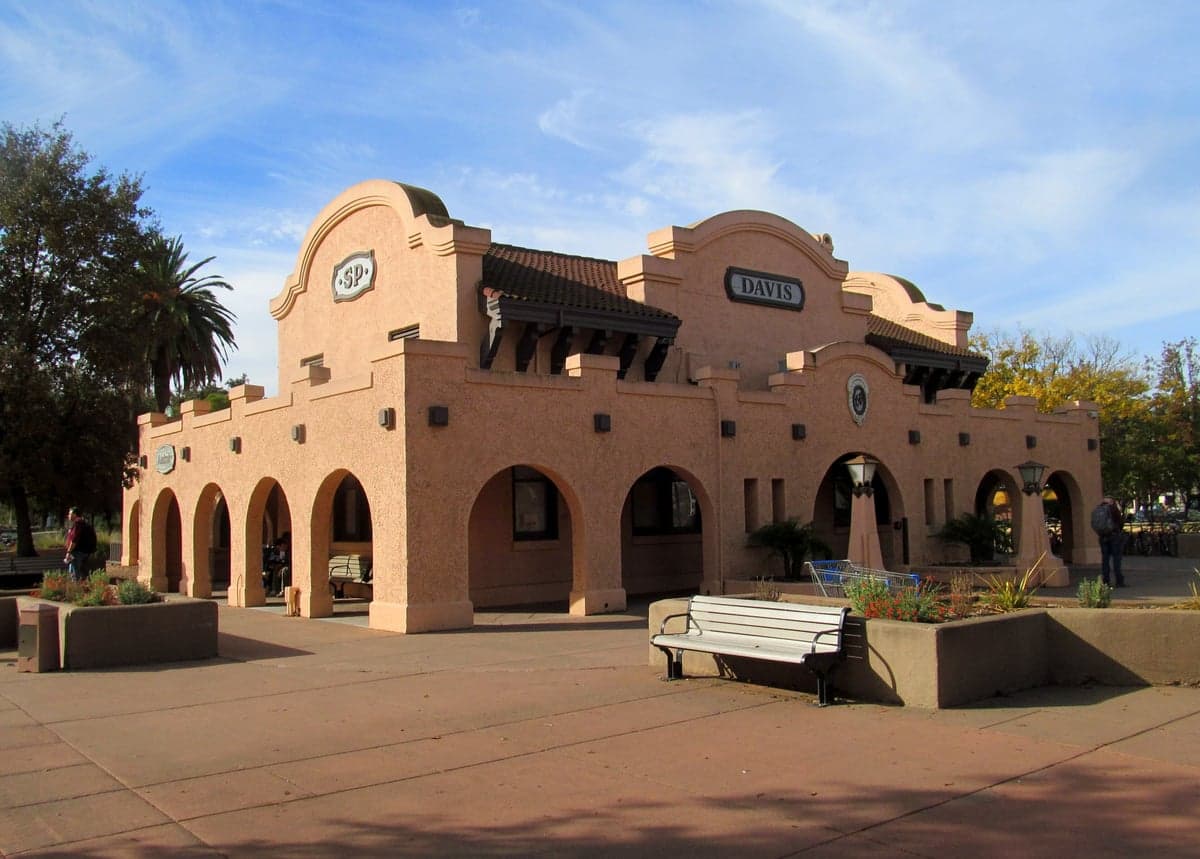
Davis began as a railroad stop in the 1860s, named after the Davis family who donated land for the station. The original population was a mix of Anglo-American farmers and a small number of Chinese laborers who worked on the railroad and in agriculture. The founding of the University Farm (now UC Davis) in 1908 was the pivotal event, drawing faculty, staff, and students. The historic Downtown Davis area, centered around G and E Streets, was built by these early university families and local merchants. A second wave came with the post-World War II GI Bill, which brought veterans to the university and spurred the construction of the West Davis neighborhood, a grid of modest single-family homes built in the 1950s and 1960s. The city’s growth remained tightly linked to the university, with the population rising from about 3,500 in 1950 to 23,000 by 1970.
Modern era (post-1965)
The 1965 Hart-Cellar Act and the end of restrictive national-origin quotas reshaped Davis’s population. The university’s growing international reputation attracted a wave of East/Southeast Asian graduate students and faculty, particularly from China, Taiwan, and South Korea. These families initially settled in the University Park neighborhood, a planned community built in the 1970s near the campus’s eastern edge, known for its bike paths and family-friendly layout. A second significant group—Indian-subcontinent professionals and academics—began arriving in the 1980s and 1990s, drawn by UC Davis’s strong engineering and agricultural programs. They concentrated in North Davis, a newer area with larger homes built in the 1990s and 2000s, and in the Mace Ranch development, a master-planned community that opened in the 2000s. The Hispanic population, historically tied to agricultural labor in Yolo County, grew more slowly within city limits, with many families living in the South Davis area, a working-class neighborhood near the railroad tracks. By 2020, the White share had fallen from over 80% in 1980 to 50.9%, while the Asian share rose to 20.6% and the Hispanic share to 15.2%. The Black population remains small at 2.4%, reflecting the city’s limited historical draw for African American families.
The future
Davis’s population is projected to grow slowly, constrained by strict urban growth boundaries and high housing costs. The city is becoming slightly more diverse: the White share is expected to continue declining, while the East/Southeast Asian and Indian-subcontinent populations will likely grow, driven by continued university hiring and the tech sector in nearby Sacramento. New development is concentrated in the Wildhorse area, a large planned community on the city’s eastern edge, which is attracting a mix of young families and professionals. The Hispanic population is also growing, though at a slower pace, with new arrivals often settling in South Davis or in unincorporated areas just outside city limits. The city’s cultural identity remains dominated by the university—progressive, bike-centric, and environmentally conscious—but the increasing diversity is adding new religious institutions, ethnic grocery stores, and community organizations. Over the next 10-20 years, Davis will likely become more Asian and Indian, more expensive, and slightly less White, while retaining its core character as a college town.
For someone moving in now, Davis offers a stable, highly educated community with a strong sense of place, but it is not a place of rapid demographic change or economic boom. The population is becoming more diverse in a measured, organic way, driven by the university and the broader Sacramento region’s growth. New residents will find a city that values education, environmentalism, and civic engagement, but they should also expect high housing costs and a relatively insular social scene centered on the university and its calendar.

* Values derived from national, state, county, city and local statistics and may differ in a specific area. Last updated: 2026-11-23T15:21:31.000Z
Narrative content on this page is AI-generated and may contain mistakes. Verify any details that matter before acting on them.
ReloMaps may earn a commission from affiliate links at no extra cost to you.

